
MARKET INSIGHTS
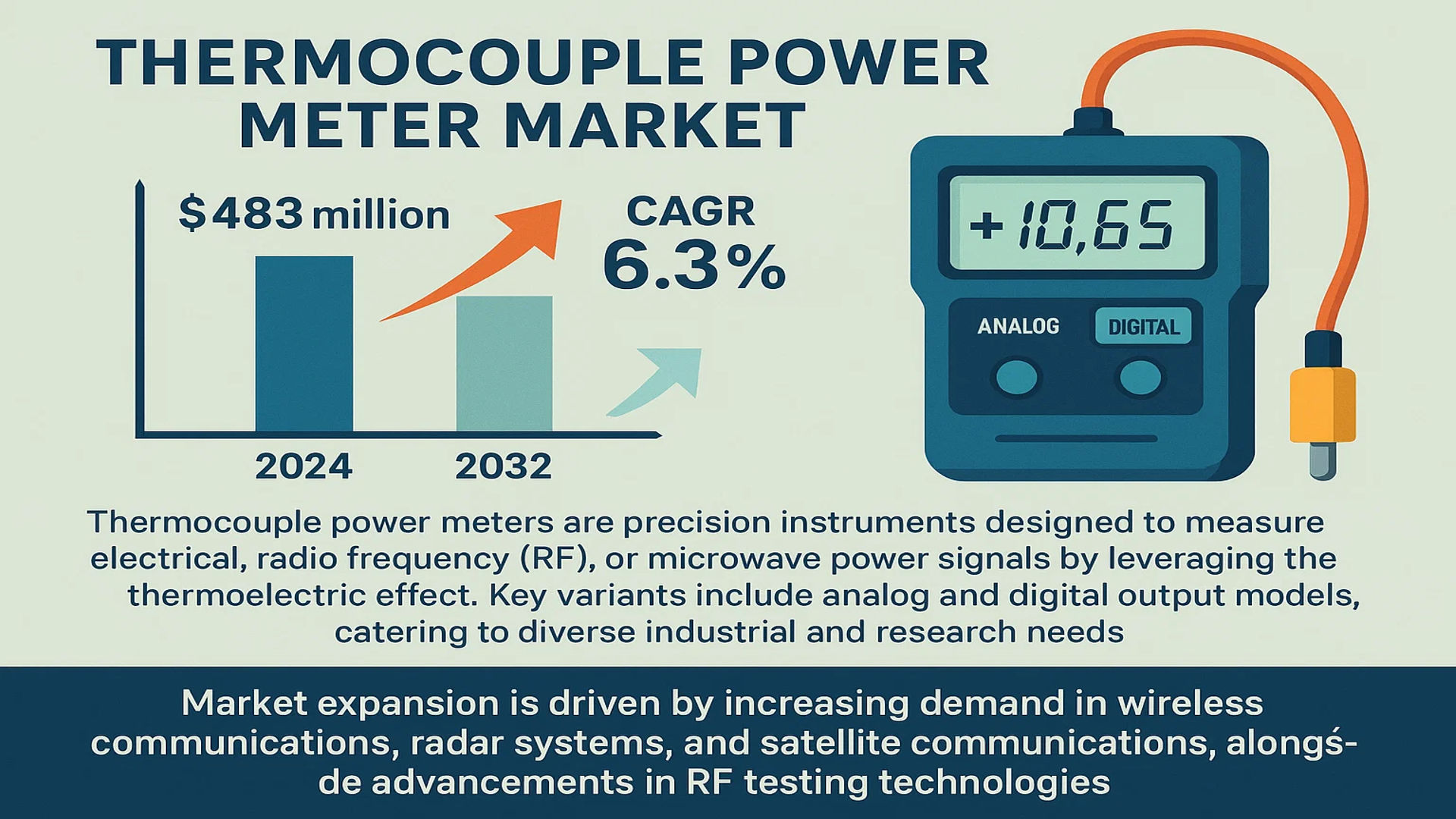
The global Thermocouple Power Meter Market was valued at 483 million in 2024 and is projected to reach US$ 739 million by 2032, at a CAGR of 6.3% during the forecast period.
Thermocouple power meters are precision instruments designed to measure electrical, radio frequency (RF), or microwave power signals by leveraging the thermoelectric effect. These devices convert power signals into measurable electrical outputs such as voltage or current, ensuring high accuracy in power measurement applications. Key variants include analog and digital output models, catering to diverse industrial and research needs.
Market expansion is driven by increasing demand in wireless communications, radar systems, and satellite communications, alongside advancements in RF testing technologies. While North America remains a dominant market, Asia-Pacific is witnessing rapid adoption due to growing telecommunications infrastructure. Leading players like Keysight Technologies, Anritsu, and Rohde & Schwarz are investing in innovation, with recent product launches focusing on higher frequency ranges and improved sensitivity to meet evolving industry standards.
MARKET DYNAMICS
MARKET DRIVERS
Expanding Telecommunications Infrastructure Fuels Thermocouple Power Meter Adoption
The rapid global rollout of 5G networks and satellite communication systems is creating unprecedented demand for precise RF power measurement solutions. As telecom operators invest heavily in next-generation infrastructure, thermocouple power meters are becoming indispensable for ensuring signal integrity and transmission efficiency. The continuous expansion of wireless networks has directly contributed to a projected 45% increase in thermocouple power meter deployments for telecom applications between 2024 and 2027. This technology’s ability to accurately measure both average and peak power levels across wide frequency ranges makes it particularly valuable for modern communication systems.
Military Modernization Programs Drive Demand for Advanced Measurement Solutions
National defense budgets worldwide are allocating substantial resources to radar and electronic warfare system upgrades, creating significant opportunities for thermocouple power meter manufacturers. Modern military applications require measurement instruments capable of withstanding harsh environments while providing reliable performance. The defense sector accounted for approximately 28% of the total thermocouple power meter market revenue in 2024, with this share expected to grow further due to increasing geopolitical tensions and the need for electronic countermeasure systems. Recent contracts awarded to major defense contractors consistently include provisions for advanced power measurement equipment.
Technological Advancements Enhance Product Capabilities
Manufacturers are continuously innovating to improve thermocouple power meter accuracy, response time, and durability. The introduction of digital output variants with enhanced signal processing capabilities has expanded the technology’s applicability across numerous industrial sectors. Recent product launches featuring improved thermal stability and broader frequency ranges have demonstrated measurement accuracy improvements of up to 30% compared to previous generations. These technological enhancements are particularly valuable for applications in semiconductor manufacturing and aerospace testing, where measurement precision directly impacts product quality and performance.
MARKET RESTRAINTS
High Initial Costs Limit Adoption Among Small Enterprises
Premium thermocouple power meter solutions carry significant price tags that place them beyond the reach of many small and medium-sized businesses. Entry-level models suitable for basic industrial applications typically start around $2,000, while high-performance units for specialized applications can exceed $20,000. This pricing structure creates substantial barriers to market penetration, particularly in price-sensitive developing economies. Many potential users in these regions continue to rely on less accurate but more affordable measurement alternatives, delaying widespread thermocouple power meter adoption.
Technical Complexity Requires Specialized Expertise
Proper operation and maintenance of thermocouple power meters demands specialized technical knowledge that many end-user organizations lack. The instruments require regular calibration and careful handling to maintain measurement accuracy, creating ongoing operational challenges. Industry surveys indicate that approximately 67% of first-time users experience difficulty properly integrating these devices into their measurement systems. This knowledge gap frequently leads to suboptimal performance and undermines confidence in the technology, particularly among users transitioning from simpler measurement solutions.
Competition from Alternative Measurement Technologies
While thermocouple power meters offer distinct advantages for certain applications, they face increasing competition from emerging measurement technologies. Modern digital power meters and vector network analyzers are incorporating advanced features that blur traditional performance boundaries. The availability of these alternatives has slowed thermocouple power meter adoption in some market segments, particularly in laboratory environments where multi-functional instruments are preferred. Manufacturers must continuously demonstrate the unique value proposition of thermocouple-based solutions to maintain market share against these competitive pressures.
MARKET OPPORTUNITIES
Emerging Economies Present Untapped Growth Potential
Developing nations across Asia and Latin America are investing heavily in domestic electronics manufacturing capabilities, creating promising opportunities for thermocouple power meter suppliers. These regions currently represent less than 15% of global market revenue but are projected to achieve above-average growth rates exceeding 8% CAGR through 2030. Local manufacturers seeking to improve product quality and meet international standards are increasingly recognizing the value of precision power measurement solutions. Strategic partnerships with regional distributors and localized support services could unlock significant market potential in these emerging economies.
Industrial Automation Trend Drives Measurement Equipment Demand
The ongoing industrial automation revolution requires increasingly sophisticated process monitoring solutions, including power measurement. Modern manufacturing facilities are incorporating thermocouple power meters into quality control systems and predictive maintenance programs. The integration of IoT capabilities with traditional measurement instruments has created new application possibilities, particularly in energy-intensive industries. This convergence of industrial automation and precision measurement presents compelling opportunities for manufacturers to develop next-generation solutions that bridge traditional measurement and Industry 4.0 requirements.
Space Industry Expansion Creates Niche Applications
The rapidly growing commercial space sector requires specialized measurement solutions for satellite and launch vehicle testing. Thermocouple power meters are particularly well-suited for these applications due to their reliability in extreme environmental conditions. With private space companies increasing their investment in satellite constellations and deep-space missions, demand for space-qualified measurement equipment has grown significantly. Manufacturers able to meet stringent aerospace certification requirements stand to benefit from this emerging high-value market segment.
MARKET CHALLENGES
Supply Chain Disruptions Impact Production Lead Times
The global semiconductor shortage continues to affect instrument manufacturers, delaying production schedules and increasing component costs. Many thermocouple power meter models incorporate specialized ASICs and high-performance analog components that face constrained availability. These supply chain challenges have extended typical delivery times from 4-6 weeks to 12-16 weeks for standard configurations, frustrating end-users and potentially driving them toward alternative solutions. Manufacturers are reevaluating their supply chain strategies, with some beginning to stockpile critical components to buffer against future disruptions.
Regulatory Compliance Increases Development Costs
Evolving international standards for electronic measurement equipment require continuous product updates and recertification. Compliance with new electromagnetic compatibility (EMC) and safety regulations in different global markets adds significant costs to product development cycles. Manufacturers estimate that 15-20% of engineering resources are currently dedicated to maintaining regulatory compliance rather than developing innovative new features. This regulatory burden disproportionately affects smaller manufacturers, potentially accelerating industry consolidation as compliance costs become increasingly challenging to manage.
Intellectual Property Protection Concerns Grow
As thermocouple power meter technology advances, manufacturers face increasing challenges protecting their intellectual property in global markets. Reverse engineering and unauthorized copying of instrument designs have become more prevalent, particularly in regions with less stringent IP enforcement. Industry analysis suggests counterfeit and cloned products may account for as much as 10% of the total market volume in certain regions. This unauthorized competition not only impacts legitimate manufacturers’ revenues but also risks damaging the technology’s reputation when inferior counterfeit products fail to perform as expected.
THERMOCOUPLE POWER METER MARKET TRENDS
Increasing Demand for High-Frequency Power Measurement in Telecommunications
The global thermocouple power meter market is witnessing significant traction due to the rising demand for accurate high-frequency power measurements in telecommunications. With the global 5G deployment accelerating, RF and microwave power measurement requirements have surged by nearly 34% annually since 2021. Thermocouple-based meters offer superior accuracy in power measurement for frequencies exceeding 50 GHz, making them indispensable in 5G base stations and satellite communication systems. Moreover, the transition to higher frequency bands, such as millimeter-wave (mmWave), has further amplified the need for precise thermal-based measurement solutions.
Other Trends
Expansion of Radar and Electronic Warfare Systems
The defense sector is increasingly relying on thermocouple power meters for applications in radar and electronic warfare. These devices provide exceptional stability in measuring pulsed RF signals, which is critical for modern radar systems. Military modernization programs in the US and China, which account for over 60% of global defense spending, are driving substantial investments in advanced electronic warfare technologies. Thermocouple power meters are preferred for their robustness in extreme environmental conditions, ensuring reliable performance in defense applications.
Shift Toward Digital Output Thermocouple Power Meters
The market is experiencing a gradual shift from analog to digital output thermocouple power meters, driven by the need for integration with modern automated test systems. Digital-output models, which represented approximately 48% of the market in 2024, offer enhanced data processing capabilities and compatibility with networked measurement setups. Leading manufacturers like Keysight Technologies and Rohde & Schwarz have introduced advanced digital thermocouple meters with real-time data logging and remote monitoring features. This evolution aligns with industry trends toward smart manufacturing and Industry 4.0, where seamless data integration is paramount.
COMPETITIVE LANDSCAPE
Key Industry Players
Technological Innovation and Strategic Partnerships Drive Market Competition
The global thermocouple power meter market features a competitive mix of multinational corporations and specialized manufacturers. Keysight Technologies leads the market with its comprehensive portfolio of RF and microwave measurement solutions. Their dominance stems from continuous R&D investments, with over 12% of revenue funneled back into innovation annually, resulting in high-precision products favored by aerospace and telecommunications sectors.
Rohde & Schwarz and Anritsu maintain strong positions, collectively accounting for approximately 28% of the 2024 market share. Both companies excel in developing ruggedized power meters for defense applications, with Rohde & Schwarz recently unveiling their next-generation NRP series featuring enhanced thermal compensation technology.
Meanwhile, regional players like Hunan Aixaipu Technology are gaining traction in Asian markets through competitive pricing strategies. Their growth highlights the increasing demand for cost-effective measurement solutions in developing economies, particularly for 5G infrastructure deployment and industrial automation projects.
List of Key Thermocouple Power Meter Manufacturers
- Keysight Technologies (U.S.)
- Anritsu Corporation (Japan)
- Rohde & Schwarz (Germany)
- Tektronix (U.S.)
- Teledyne Technologies (U.S.)
- Giga-tronics (U.S.)
- Boonton Electronics (U.S.)
- Bird Technologies (U.S.)
- Hunan Aixaipu Technology (China)
- Shanghai Automation Instrument (China)
- Beijing Puyuan Jingdian Technology (China)
- Nanjing Shengbo Electronics (China)
The competitive environment continues evolving with increasing M&A activity, as evidenced by Keysight’s acquisition of Sanjole in 2023 to strengthen its wireless test capabilities. Smaller players are responding by focusing on niche applications, particularly in satellite communications where customized solutions command premium pricing. Market saturation in developed regions is driving manufacturers to explore growth opportunities in emerging markets, though this requires adapting products to meet diverse regulatory standards and price sensitivities.
Segment Analysis:
By Type
Digital Output Segment Expands with Increasing Demand for High-Precision Measurement Solutions
The market is segmented based on type into:
- Analog Output
- Digital Output
By Application
Wireless Communications Segment Holds Significant Share Due to Rising 5G Deployments
The market is segmented based on application into:
- Wireless Communications
- Radar and Electronic Warfare
- Satellite Communications
- Other
By End-User Industry
Telecommunications Sector Dominates with Growing Need for Network Testing
The market is segmented based on end-user industry into:
- Telecommunications
- Defense & Aerospace
- Manufacturing
- Research & Development
By Frequency Range
High-Frequency Segment Gains Traction for RF and Microwave Power Measurement
The market is segmented based on frequency range into:
- Low Frequency (Below 1 GHz)
- Medium Frequency (1 GHz – 10 GHz)
- High Frequency (Above 10 GHz)
Regional Analysis: Thermocouple Power Meter Market
North America
North America holds a prominent position in the thermocouple power meter market, driven by strong demand from the telecommunications, defense, and aerospace sectors. The U.S., in particular, leads in terms of technological advancements, with companies like Keysight Technologies and Tektronix driving innovation in RF and microwave power measurement solutions. Stringent regulatory standards and high adoption of 5G technologies further amplify demand, with the wireless communications segment accounting for a significant market share. Government investments in defense systems and satellite communications also contribute to sustained growth, positioning North America as a key market for high-precision power measurement devices.
Asia-Pacific
Asia-Pacific is the fastest-growing region in the thermocouple power meter market, primarily led by China, Japan, and South Korea. The region benefits from rapid industrialization, expanding telecommunications infrastructure, and increasing investments in radar and electronic warfare applications. China dominates the market, supported by local manufacturers such as Hunan Aixaipu Technology and Shanghai Automation Instrument, which offer cost-effective solutions. The proliferation of 5G networks and satellite communication projects further boosts demand. However, price sensitivity among end-users challenges the adoption of high-end devices, though this is gradually changing with rising technological awareness.
Europe
Europe maintains a strong foothold in the thermocouple power meter market, driven by advancements in aerospace, telecommunications, and defense sectors. The presence of leading players like Rohde & Schwarz and Anritsu strengthens market competitiveness, while strict regulatory compliance ensures product reliability. The digital output segment is gaining traction due to the increasing need for automation and integration with IoT-based systems. Additionally, satellite communication initiatives under EU space programs present lucrative opportunities, reinforcing Europe’s role as a mature yet innovation-driven market.
South America
South America exhibits moderate growth, with Brazil and Argentina being the primary contributors to regional market expansion. Economic constraints and limited infrastructure development hinder the large-scale adoption of thermocouple power meters, but demand from wireless communication and industrial applications is gradually increasing. Local manufacturers are focusing on competitively priced analog output variants, while multinational suppliers leverage partnerships to penetrate niche markets. Long-term growth potential exists as modernization efforts gain momentum.
Middle East & Africa
The Middle East & Africa region is emerging as a promising market, albeit at a slower pace due to limited industrialization. Strategic investments in defense and satellite communication systems, particularly in countries like Saudi Arabia and the UAE, drive demand for thermocouple power meters. While budget constraints remain a challenge, government initiatives to enhance digital infrastructure are fostering market development. The region offers growth avenues for suppliers catering to mid-range power measurement needs.
Report Scope
This market research report provides a comprehensive analysis of the global Thermocouple Power Meter market, covering the forecast period 2024–2032. It offers detailed insights into market dynamics, technological advancements, competitive landscape, and key trends shaping the industry.
Key focus areas of the report include:
- Market Size & Forecast: Historical data and future projections for revenue, unit shipments, and market value across major regions and segments. The global Thermocouple Power Meter market was valued at USD 483 million in 2024 and is projected to reach USD 739 million by 2032, growing at a CAGR of 6.3%.
- Segmentation Analysis: Detailed breakdown by product type (Analog Output, Digital Output), application (Wireless Communications, Radar and Electronic Warfare, Satellite Communications, Others), and end-user industry to identify high-growth segments.
- Regional Outlook: Insights into market performance across North America (U.S., Canada, Mexico), Europe (Germany, France, U.K.), Asia-Pacific (China, Japan, India), and other key regions.
- Competitive Landscape: Profiles of leading market participants including Keysight Technologies, Anritsu, Rohde & Schwarz, Tektronix, and Teledyne, covering their product portfolios, market share, and strategic initiatives.
- Technology Trends & Innovation: Assessment of evolving power measurement technologies, integration with IoT platforms, and advancements in RF/microwave testing.
- Market Drivers & Restraints: Analysis of factors such as increasing 5G deployment, defense spending on electronic warfare systems, and challenges related to high equipment costs.
- Stakeholder Analysis: Strategic insights for test equipment manufacturers, telecom providers, defense contractors, and research institutions.
The research methodology combines primary interviews with industry experts and analysis of verified market data from regulatory bodies, company financial reports, and trade associations.
FREQUENTLY ASKED QUESTIONS:
What is the current market size of Global Thermocouple Power Meter Market?
-> Thermocouple Power Meter Market was valued at 483 million in 2024 and is projected to reach US$ 739 million by 2032, at a CAGR of 6.3% during the forecast period.
Which key companies operate in Global Thermocouple Power Meter Market?
-> Key players include Keysight Technologies, Anritsu, Rohde & Schwarz, Tektronix, Teledyne, Giga-tronics, and Boonton, among others.
What are the key growth drivers?
-> Key growth drivers include 5G network expansion, increasing defense electronics expenditure, and growing satellite communication infrastructure.
Which region dominates the market?
-> North America currently leads in market share, while Asia-Pacific is expected to witness the highest growth rate during the forecast period.
What are the emerging trends?
-> Emerging trends include integration of AI in power measurement, development of compact handheld meters, and adoption in quantum computing research.

Get Sample Report PDF for Exclusive Insights
Report Sample Includes
- Table of Contents
- List of Tables & Figures
- Charts, Research Methodology, and more...
 Download Sample Report PDF


