MARKET INSIGHTS
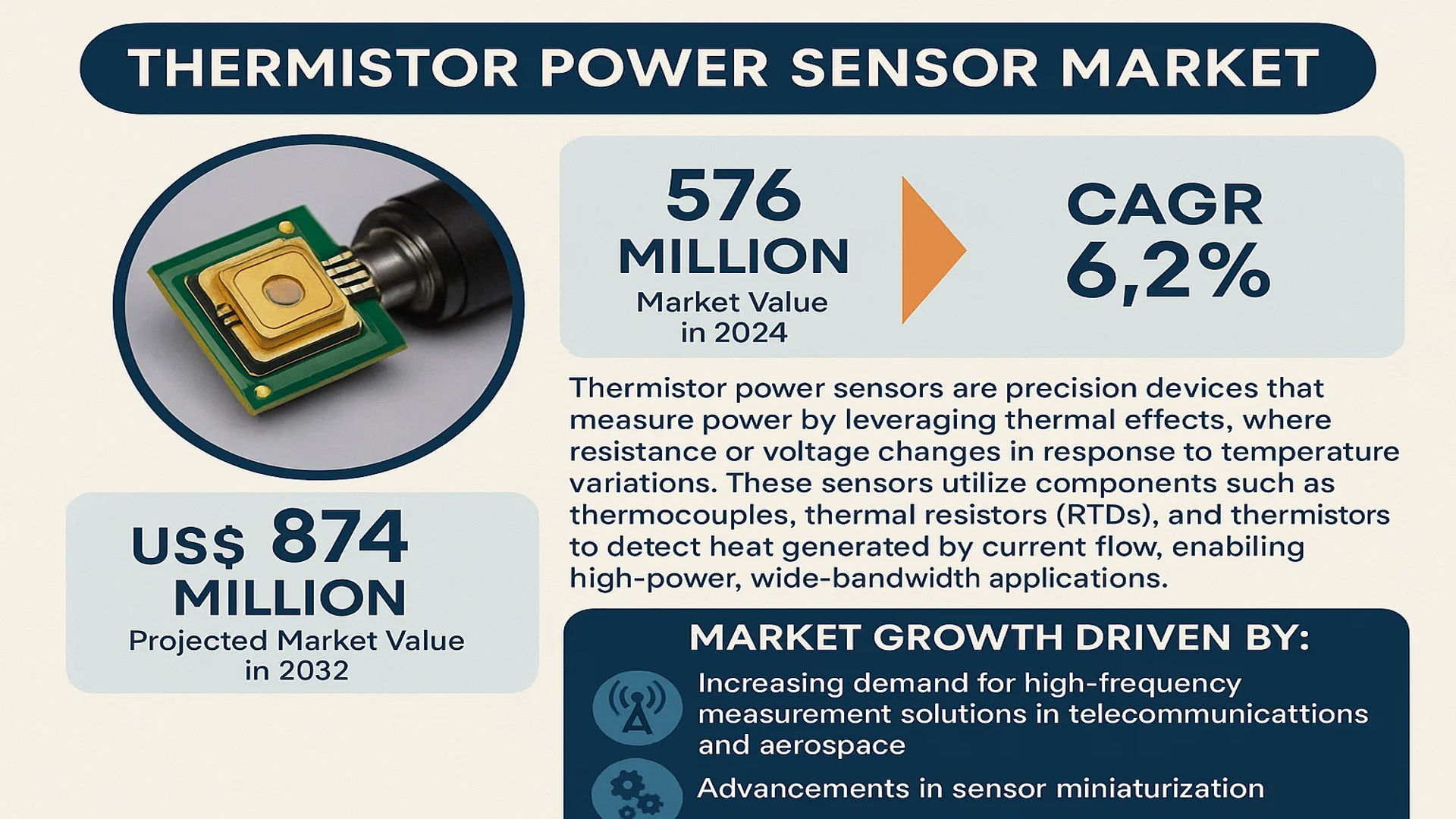
The global Thermistor Power Sensor Market was valued at 576 million in 2024 and is projected to reach US$ 874 million by 2032, at a CAGR of 6.2% during the forecast period.
Thermistor power sensors are precision devices that measure power by leveraging thermal effects, where resistance or voltage changes in response to temperature variations. These sensors utilize components such as thermocouples, thermal resistors (RTDs), and thermistors to detect heat generated by current flow, enabling high-power, wide-bandwidth applications. They are widely used in RF/microwave power measurement, laser power monitoring, and industrial power systems due to their accuracy and reliability.
The market growth is driven by increasing demand for high-frequency measurement solutions in telecommunications and aerospace, alongside advancements in sensor miniaturization. However, competition from alternative technologies like diode-based sensors poses a challenge. Key players such as Keysight Technologies, Rohde & Schwarz, and Anritsu dominate the market, collectively holding a significant revenue share in 2024. For instance, Keysight’s recent launch of enhanced thermistor sensors for 5G testing underscores innovation in this space.
MARKET DYNAMICS
MARKET DRIVERS
Growing Adoption of RF and Microwave Technologies to Accelerate Market Demand
The thermistor power sensor market is experiencing robust growth driven by the expanding applications of RF and microwave technologies across telecommunications, aerospace, and defense sectors. With the global rollout of 5G networks requiring precise power measurement solutions, demand for high-accuracy thermistor sensors has surged significantly. These sensors play a critical role in base station testing, satellite communications, and radar systems where power measurement accuracy directly impacts system performance.
Increased Industrial Automation to Fuel Market Expansion
Industrial power systems increasingly incorporate thermistor power sensors for energy monitoring and process control solutions. The global industrial automation market, projected to grow substantially through 2030, is creating new opportunities for power measurement technologies. These sensors enable precise energy consumption monitoring in smart factories, helping optimize operational efficiency and reduce power wastage across manufacturing processes.
Advancements in Medical Laser Technologies to Drive Innovation
The medical sector presents significant growth potential for thermistor power sensors, particularly in laser power monitoring applications. With laser-based medical procedures becoming more sophisticated, the need for precise power measurement during surgical and therapeutic applications has intensified. Recent developments in ophthalmic lasers, dermatological treatments, and minimally invasive surgeries are creating demand for high-precision sensors that ensure patient safety and treatment efficacy.
MARKET RESTRAINTS
High Initial Costs and Maintenance Requirements Pose Adoption Challenges
While thermistor power sensors offer precise measurement capabilities, their sophisticated design and calibration requirements result in significantly higher costs compared to alternative power measurement technologies. This price premium creates barriers to adoption, particularly for small and medium enterprises with limited capital expenditure budgets. Additionally, the need for periodic recalibration and specialized maintenance further increases the total cost of ownership.
Other Restraints
Temperature Sensitivity Limitations
Thermistor-based sensors exhibit inherent temperature dependence that can affect measurement accuracy in extreme operating conditions. This characteristic requires additional compensation circuitry in certain applications, increasing system complexity and cost. In environments with wide temperature fluctuations, these limitations may prompt users to consider alternative sensing technologies.
Competition from Alternative Technologies
The emergence of advanced semiconductor-based power sensors poses competitive pressure on traditional thermistor solutions. These alternatives often offer faster response times, wider bandwidth, and digital interfaces that appeal to modern automation systems, challenging the market position of thermistor power sensors in certain applications.
MARKET CHALLENGES
Stringent Calibration Requirements Create Deployment Complexities
The accurate operation of thermistor power sensors depends on meticulous calibration processes that require specialized equipment and technical expertise. This creates significant challenges for end-users in remote locations or resource-constrained environments. Proper calibration maintenance becomes particularly critical in mission-critical applications like aerospace and defense, where measurement inaccuracies could have severe consequences.
Other Challenges
Limited Bandwidth Capabilities
While thermistor sensors excel in certain frequency ranges, they face limitations in ultra-wideband applications becoming common in modern RF systems. This bandwidth constraint requires careful consideration during system design and may necessitate the use of complementary sensing technologies in some applications.
Supply Chain Disruptions
The market continues to experience intermittent shortages of critical components, particularly high-performance thermal materials and precision electronic components. These supply chain issues can lead to extended lead times and affect the ability of manufacturers to meet growing market demand consistently.
MARKET OPPORTUNITIES
Emerging 6G Development to Open New Growth Avenues
As research and development of 6G communication technologies accelerates globally, new opportunities are emerging for advanced power measurement solutions. The anticipated higher frequency bands and more complex signal modulation schemes in 6G systems will require innovative power sensing solutions with enhanced performance characteristics. Market leaders are already investing in next-generation sensor designs to address these future requirements.
Expansion of Renewable Energy Systems Creates New Applications
The rapid growth of renewable energy infrastructure presents significant opportunities for power monitoring solutions. Thermistor-based sensors are finding new applications in solar power inverters, wind turbine systems, and smart grid technologies where precise power measurement contributes to system efficiency optimization and predictive maintenance capabilities.
Miniaturization Trends to Drive Product Innovation
The increasing demand for compact power measurement solutions in portable electronics and space-constrained applications is driving innovation in sensor miniaturization. Manufacturers developing smaller form-factor thermistor sensors with maintained or improved performance characteristics stand to gain significant market share as these trends accelerate across multiple industries.
THERMISTOR POWER SENSOR MARKET TRENDS
Increasing Demand for High-Precision Power Measurement to Drive Market Growth
The global thermistor power sensor market is witnessing strong growth due to rising demand for high-precision power measurement in RF, microwave, and laser applications. With industries increasingly adopting 5G technology, the need for accurate power sensors capable of handling high-frequency signals has surged. The market value is projected to reach $874 million by 2032, reflecting a steady CAGR of 6.2% from 2024. North America and Asia-Pacific, particularly China and the U.S., remain key revenue contributors, together accounting for over 50% of the global market share. While thermistor sensors dominate RF power measurement, their adoption in industrial power systems is also accelerating with the expansion of automation solutions.
Other Trends
Advancements in Miniaturization and IoT Integration
The development of compact, high-performance thermistor power sensors has become a focal point for manufacturers. Modern sensors now incorporate advanced materials and microelectronic fabrication techniques to enhance sensitivity while reducing size and power consumption. The growing penetration of IoT and Industry 4.0 has further fueled the demand for these miniaturized sensors in smart grid applications and real-time power monitoring systems. Additionally, AI-based calibration and machine learning algorithms are improving measurement accuracy, making thermistor sensors indispensable in mission-critical applications.
Expansion of Wireless Communication and Semiconductor Industries
The rapid growth of wireless communication infrastructure, particularly in 5G and 6G networks, presents significant opportunities for thermistor power sensor manufacturers. With over 1.5 million 5G base stations deployed globally in 2024, the need for reliable power monitoring in telecom equipment is higher than ever. Similarly, the semiconductor industry continues to drive demand as chip manufacturers rely on thermistor sensors for precise thermal management in fabrication processes. Companies such as Keysight Technologies and Rohde & Schwarz are leading innovation with next-generation sensors designed for ultra-wideband frequency ranges, ensuring compatibility with emerging wireless standards.
COMPETITIVE LANDSCAPE
Key Industry Players
Leading Manufacturers Focus on Innovation to Drive Market Differentiation
The global thermistor power sensor market features a diversified competitive environment with established electronics giants and specialized sensor manufacturers vying for market share. Keysight Technologies and Rohde & Schwarz currently dominate the high-frequency measurement segment, collectively holding significant market share in RF and microwave applications.
Meanwhile, Emerson and Teledyne Technologies maintain strong positions in industrial power systems, leveraging their legacy expertise in thermal measurement technologies. Emerson’s recent product innovations in high-temperature tolerant sensors has further strengthened its market position.
As the market experiences steady growth at 6.2% CAGR through 2032, companies are increasingly investing in portfolio diversification and precision improvements. Anritsu Corporation, for instance, recently launched their MA2440A series with broader frequency ranges (10MHz-40GHz) to address emerging 5G testing requirements.
While North American and European players lead in technological innovation, Asian manufacturers including Murata Manufacturing and Beijing Zhongwei Technology are gaining traction through cost-competitive solutions for mid-range applications. This geographical diversification creates dynamic pricing pressures while expanding overall market accessibility.
List of Key Thermistor Power Sensor Companies
- Emerson Electric Co. (U.S.)
- Keysight Technologies (U.S.)
- Rohde & Schwarz (Germany)
- Anritsu Corporation (Japan)
- Teledyne Technologies Inc. (U.S.)
- Bird Technologies (U.S.)
- Tektronix, Inc. (U.S.)
- Mini-Circuits (U.S.)
- Rohm Semiconductor (Japan)
- Chipsea Technologies (China)
- Hanwei Electronics (China)
- Dali Technology (China)
- Sensirion AG (Switzerland)
- PICO Technology (UK)
- Texas Instruments (U.S.)
- Honeywell International (U.S.)
- Murata Manufacturing (Japan)
- Beijing Zhongwei Technology (China)
Thermistor Power Sensor Market: Segment Analysis
By Type
Thermocouple Segment Leads Due to High Accuracy and Wide Application in Power Measurement
The market is segmented based on type into:
- Thermocouple
- Resistance Thermocouple (RTD)
- Other
By Application
RF and Microwave Power Measurement Segment Dominates Driven by Telecommunications and Defense Sector Demand
The market is segmented based on application into:
- RF and Microwave Power Measurement
- Laser Power Monitoring
- Industrial Power Systems
- Other
By End User
Telecommunications Sector Shows Strong Demand for Network Infrastructure Applications
The market is segmented based on end user into:
- Telecommunications
- Aerospace & Defense
- Medical Equipment
- Energy & Utilities
- Industrial Manufacturing
Regional Analysis: Thermistor Power Sensor Market
Asia-Pacific
The Asia-Pacific region dominates the global thermistor power sensor market, driven by rapid industrialization and expansion in the telecommunications and electronics sectors. Countries like China, Japan, and South Korea are leading the demand, particularly for applications in RF/microwave power measurement and laser power monitoring. China’s 5G infrastructure rollout and semiconductor manufacturing growth contribute significantly to sensor adoption. While cost-effective solutions remain preferred, high-precision sensors are gaining traction due to increasing quality standards. Regional manufacturers, such as Rohm Semiconductor and Murata Manufacturing, play a pivotal role in supplying sensors for both domestic and international markets.
North America
North America holds a substantial market share, supported by advancements in aerospace, defense, and telecommunications. The U.S. accounts for the majority of regional demand, with companies like Keysight Technologies and Emerson providing high-performance sensors for military-grade and industrial applications. Strict calibration standards and the need for reliable power measurement in critical infrastructure drive innovation. Additionally, investments in renewable energy systems and electric vehicle manufacturing are creating new opportunities for thermistor power sensors in power monitoring applications.
Europe
Europe’s market thrives on stringent regulatory compliance and a strong industrial automation sector. Germany and the U.K. are key adopters, utilizing these sensors in industrial power systems and laser-based applications. The region emphasizes energy efficiency and precision measurement, fostering demand for advanced thermistor-based solutions. Companies like Rohde & Schwarz and Sensirion lead innovation, particularly in developing low-drift, high-stability sensors. The growing adoption of Industry 4.0 technologies further accelerates integration across manufacturing and process control sectors.
South America
South America shows moderate growth, with Brazil and Argentina as primary markets. The region’s focus on expanding industrial capabilities and upgrading power infrastructure presents opportunities for thermistor power sensor adoption. However, economic instability and reliance on imports limit market expansion. Key applications include electrical grid monitoring and basic RF measurement tools, where cost sensitivity remains a deciding factor for procurement. Suppliers are gradually establishing localized partnerships to enhance accessibility.
Middle East & Africa
The Middle East & Africa region is nascent but exhibits potential, particularly in GCC countries like Saudi Arabia and the UAE. Telecom infrastructure projects and energy sector investments are driving demand for power measurement solutions. However, limited local manufacturing and dependency on international suppliers hinder rapid market penetration. In Africa, sporadic industrialization and underdeveloped regulatory frameworks slow adoption, though long-term opportunities exist in power distribution and renewable energy projects.
Report Scope
This market research report provides a comprehensive analysis of the global Thermistor Power Sensor market, covering the forecast period 2024–2032. It offers detailed insights into market dynamics, technological advancements, competitive landscape, and key trends shaping the industry.
Key focus areas of the report include:
- Market Size & Forecast: Historical data and future projections for revenue, unit shipments, and market value across major regions and segments. The global Thermistor Power Sensor market was valued at USD 576 million in 2024 and is projected to reach USD 874 million by 2032, growing at a CAGR of 6.2%.
- Segmentation Analysis: Detailed breakdown by product type (Thermocouple, Resistance Thermocouple (RTD), Others), application (RF and Microwave Power Measurement, Laser Power Monitoring, Industrial Power Systems, Others), and end-user industries.
- Regional Outlook: Insights into market performance across North America, Europe, Asia-Pacific, Latin America, and the Middle East & Africa. The U.S. and China represent key growth markets.
- Competitive Landscape: Profiles of leading market participants including Emerson, Keysight Technologies, Rohde & Schwarz, Anritsu, and Teledyne Technologies, covering their product portfolios, market share, and strategic developments.
- Technology Trends & Innovation: Assessment of emerging sensor technologies, integration with IoT systems, and advancements in high-precision power measurement solutions.
- Market Drivers & Restraints: Evaluation of factors such as growing demand for RF/microwave applications, expansion of 5G networks, industrial automation trends, along with challenges like pricing pressures and technical complexities.
- Stakeholder Analysis: Strategic insights for sensor manufacturers, system integrators, research institutions, and investors regarding market opportunities and competitive positioning.
The report employs both primary and secondary research methodologies, including interviews with industry experts, analysis of company financials, and validation of market data through multiple authoritative sources to ensure accuracy and reliability.
FREQUENTLY ASKED QUESTIONS:
What is the current market size of Global Thermistor Power Sensor Market?
-> Thermistor Power Sensor market was valued at 576 million in 2024 and is projected to reach US$ 874 million by 2032, at a CAGR of 6.2% during the forecast period.
Which key companies operate in Global Thermistor Power Sensor Market?
-> Key players include Emerson, Keysight Technologies, Rohde & Schwarz, Anritsu, Teledyne Technologies, Bird Technologies, and Tektronix, among others.
What are the key growth drivers?
-> Key growth drivers include increasing demand for RF/microwave applications, expansion of 5G infrastructure, and growing adoption in industrial power systems.
Which region dominates the market?
-> North America currently leads in market share, while Asia-Pacific is expected to witness the highest growth rate during the forecast period.
What are the emerging trends?
-> Emerging trends include development of miniaturized sensors, integration with IoT platforms, and advancements in high-frequency measurement capabilities.

Get Sample Report PDF for Exclusive Insights
Report Sample Includes
- Table of Contents
- List of Tables & Figures
- Charts, Research Methodology, and more...
 Download Sample Report PDF