
Thermal Cutoff Device Market Insights
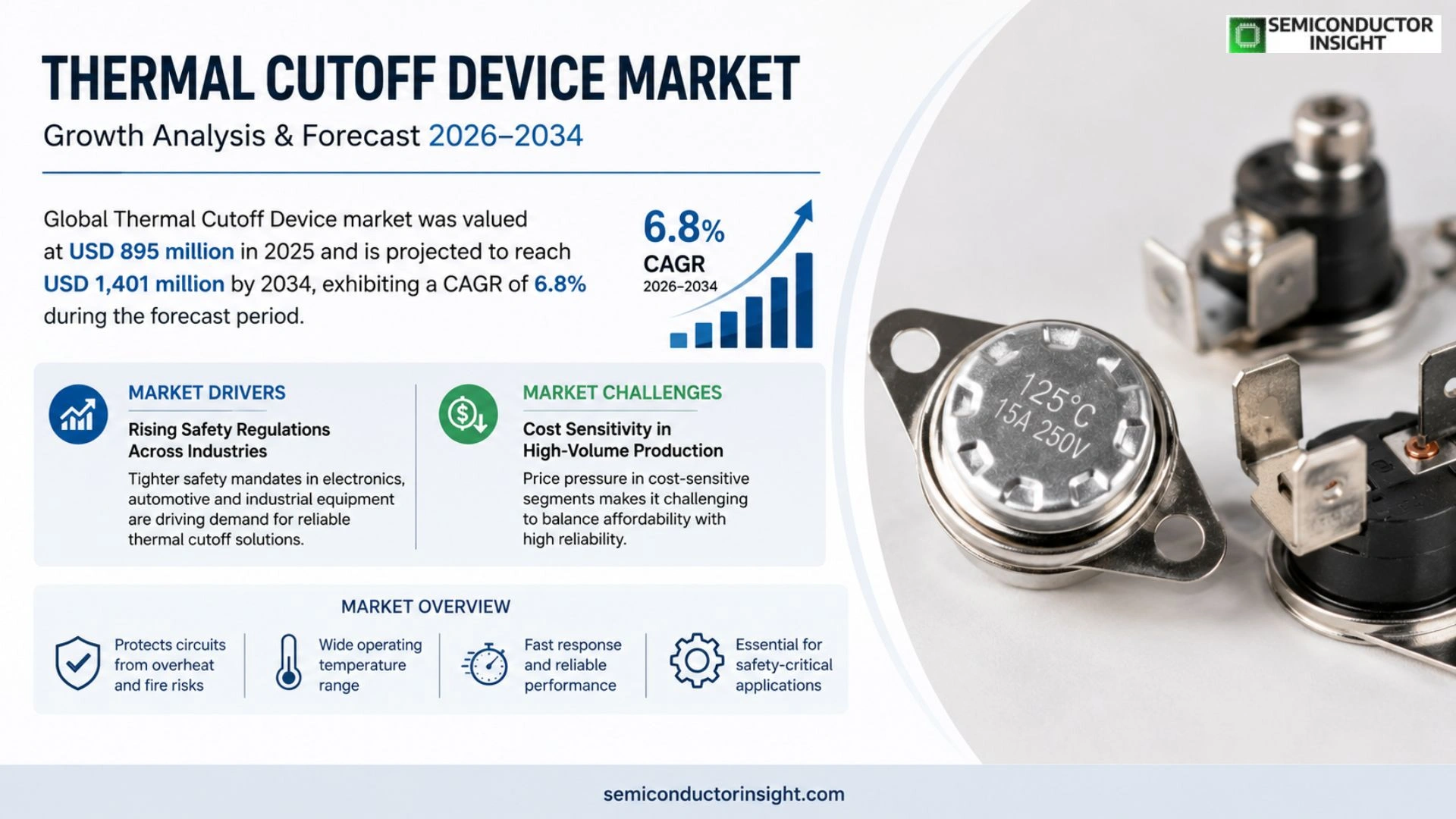
Global Thermal Cutoff Device market was valued at USD 895 million in 2025 and is projected to reach USD 1,401 million by 2034, exhibiting a CAGR of 6.8% during the forecast period.
A thermal fuse is a one‑time temperature‑sensitive safety component that interrupts circuit flow when ambient or device temperature exceeds a preset threshold. The internal fusible alloy or organic particles melt, creating a permanent open circuit that prevents overheating, fire, or equipment damage. These devices are integral to home appliances, power modules, battery packs, heating equipment and consumer electronics.
The market benefits from steady demand across home appliances, consumer electronics and battery‑powered products where safety regulations are tightening. Rising adoption of compact high‑power‑density designs generates more heat, prompting manufacturers to seek reliable thermal protection. Miniaturization, higher temperature accuracy and consistent performance are emerging technical trends, while growth in electric vehicles and smart appliances expands application scenarios.
MARKET DRIVERS
Rising Safety Regulations Across Industries
Thermal Cutoff Device Market is gaining momentum as manufacturers confront tighter safety mandates in consumer electronics, automotive systems, and industrial equipment. Regulators are demanding devices that can instantly interrupt current flow once temperature thresholds are breached, compelling OEMs to embed more reliable cutoff solutions. This regulatory push translates into immediate procurement cycles and heightened design scrutiny.
Advances in Smart and Miniaturized Electronics
Contemporary product portfolios increasingly feature compact, low‑power modules that operate at elevated temperatures. Engineers are turning to sophisticated thermal cutoff components that combine rapid response with minimal footprint, enabling designers to push device density without sacrificing protection. The convergence of miniaturization and safety creates a fertile environment for innovative cutoff technologies.
➤ “Over‑temperature protection is now a non‑negotiable criterion in product certification, reshaping supplier relationships and accelerating market adoption.”
These forces together elevate the strategic importance of Thermal Cutoff Device Market, prompting vendors to expand capacity, diversify material mixes, and strengthen after‑sales support. Companies that align product development with evolving standards stand to capture a larger share of upcoming contracts.
MARKET CHALLENGES
Cost Sensitivity in High‑Volume Production
While safety imperatives are clear, manufacturers remain wary of added bill of materials. In sectors such as consumer appliances, even a modest price increase can erode competitive advantage, prompting buyers to scrutinize cutoff device costs against performance gains. Balancing affordability with reliability is a delicate act for suppliers.
Other Challenges
Supply Chain Constraints
Global shortages of high‑grade ceramics and specialized alloys have introduced lead‑time volatility. Vendors that cannot secure consistent material flows risk delayed shipments, which may force OEMs to seek alternative protection schemes or defer product launches.
MARKET RESTRAINTS
Material Cost Volatility
Fluctuations in raw‑material prices, particularly for nickel‑based alloys and high‑purity polymers, place upward pressure on unit costs for thermal cutoff devices. When material expenses rise sharply, end‑users may postpone upgrades or opt for legacy protection components, tempering overall market momentum.
MARKET OPPORTUNITIES
Integration with IoT‑Enabled Monitoring
The emergence of connected sensors offers a pathway for thermal cutoff devices to transmit real‑time status alerts to cloud platforms. By embedding telemetry, manufacturers can provide predictive maintenance services, opening new revenue streams and differentiating their product lines within Thermal Cutoff Device Market. Early adopters that fuse protection hardware with data analytics are positioned to lead the next wave of value‑added solutions.
Thermal Cutoff Device Market Trends
Safety Regulation Tightening Fuels Demand
The tightening of safety standards across home appliance, consumer‑electronics, and battery‑powered product categories is reshaping Thermal Cutoff Device Market. Regulators in Europe, North America, and emerging Asian economies have introduced lower maximum temperature limits for circuits that handle high power densities. As a result, manufacturers are compelled to integrate temperature‑sensitive protection components that activate well before a hazardous threshold is reached. This shift elevates the value of a reliable over‑temperature fuse, prompting original equipment manufacturers to qualify multiple suppliers and to prioritize devices with tighter tolerance bands. The ripple effect is a modest uplift in unit prices, which in turn sustains healthy gross margins for tier‑one producers.
Other Trends
Shift Toward Miniaturized Designs
Product miniaturization is driving a redesign of the thermal cutoff element itself. Customers now expect compact modules that occupy less board real‑estate while delivering the same safety performance. Advances in fusible alloy chemistry and ceramic housing precision have enabled fuse diameters to shrink by roughly 20 % over the past three years without compromising melting point accuracy. This trend expands the addressable market in smart‑appliance segments, where space constraints are a key differentiator. Suppliers that can offer both low‑profile and high‑temperature‑accuracy options are better positioned to capture design‑win opportunities.
Automation and Cost Discipline in Manufacturing
Manufacturers are responding to the high‑volume, low‑price nature of the sector by investing in automated assembly lines and inline calibration stations. The move reduces labor intensity and tightens process control, which translates into more consistent break‑away temperatures and fewer warranty claims downstream. At the same time, companies are renegotiating raw‑material contracts for fusible alloys and ceramic powders to lock in lower costs as production scales toward the 9‑billion‑unit capacity level observed in recent years. The combined effect of automation and disciplined sourcing equips firms to protect their profitability while meeting the expanding demand driven by stricter safety rules and the proliferation of electric‑vehicle battery packs.
COMPETITIVE LANDSCAPE
Key Industry Players
Thermal Cutoff Device Market – Competitive Overview
Littelfuse commands the bulk of the global thermal cutoff segment, thanks to an integrated supply chain that spans raw‑material sourcing, high‑precision assembly, and automated testing. Its capacity to produce over 3 billion units annually aligns with the industry’s 7 billion‑unit demand, granting the firm pricing leverage while preserving profit margins in the mid‑30 % range. The company’s R&D focus on miniaturized, resettable designs has opened doors in electric‑vehicle battery packs and high‑density smart appliances, sectors where temperature‑sensitive protection is mandatory. Moreover, Littelfuse’s worldwide sales network, reinforced by regional compliance labs, accelerates time‑to‑market for OEMs seeking certification‑ready components, reinforcing its position as a preferred supplier for large‑scale manufacturers.
Beyond the market leader, a cluster of specialists sustains competitive pressure. Schott and Panasonic leverage their heritage in high‑temperature ceramics and polymer films to deliver ultra‑reliable single‑use fuses for industrial power modules. Emerson’s industrial‑automation portfolio incorporates temperature‑controlled cutoffs that meet stringent IEC standards, appealing to automakers expanding electrified drivetrain lines. Bourns and Bel Fuse focus on niche automotive and consumer‑electronics segments, differentiating through compact SMT packages. UCHIHASHI and Sungwoo Industrial dominate the Asian low‑temperature market, where cost‑sensitive volume production is paramount. Microtherm, SETsafe, Zhangzhou Aupo Electronics, and A.R.Electric contribute regional diversification, often partnering with local battery‑pack assemblers to tailor temperature thresholds. Collectively, these firms inject innovation, regional responsiveness, and price competition, preventing market concentration and encouraging continuous improvement across the value chain.
List of Key Thermal Cutoff Device Companies Profiled
- Littelfuse
- Littelfuse
- Schott
- Schott
- Panasonic
- Panasonic
- Emerson
- Emerson
- Bourns
- UCHIHASHI
- Sungwoo Industrial
- Microtherm
- SETsafe
- Zhangzhou Aupo Electronics
- Bel Fuse
- A.R.Electric
Segment Analysis:
| Segment Category | Sub-Segments | Key Insights |
| By Type |
|
Single-use dominates early‑stage adoption because:
|
| By Application |
|
Household Appliance remains the principal driver because:
|
| By End User |
|
Appliance Manufacturers lead due to:
|
| By [Segment Category 3]] |
|
Leading Segment description with qualitative insights only [Pointers preferred in bullets atleast 2-3]. |
| By [Segment Category 4]] |
|
Leading Segment description with qualitative insights only [Pointers preferred in bullets atleast 2-3]. |
Regional Analysis: Thermal Cutoff Device Market
North America
The United States and Canada have recently tightened fire‑safety directives for portable electronics, requiring thermal cutoff devices that can trigger within milliseconds of overheating. Compliance teams are therefore aligning product roadmaps with these timelines, accelerating certification cycles and prompting early‑stage testing protocols.
Residential appliance manufacturers are responding to heightened consumer awareness of fire risks by embedding cutoff modules directly into control boards, a move that shortens installation time and reduces assembly complexity.
Proximity to core raw‑material suppliers,particularly high‑purity ceramic manufacturers in the Midwest,allows North American firms to shorten lead times, offering a tactical advantage over distant competitors.
Collaborative labs in Silicon Valley are experimenting with nanostructured trigger elements that promise lower activation temperatures, positioning the region at the front of next‑generation safety technology.
Europe
European manufacturers benefit from a harmonized set of safety directives that streamline cross‑border product launches. The region’s emphasis on energy efficiency drives designers to select compact thermal cutoff devices that fit within increasingly miniaturized power modules. Automotive suppliers, especially in Germany and France, are integrating these devices into battery‑management systems, a response to both regulatory pressure and consumer demand for longer vehicle ranges. Strategic partnerships between component firms and academic institutions in the Netherlands are fostering novel polymer‑based cutoff solutions, widening the material palette beyond traditional metal alloys.
Asia‑Pacific
Rapid growth of consumer electronics manufacturing hubs in China, South Korea, and Vietnam fuels a surge in demand for reliable thermal protection. Local OEMs are attracted to devices that balance cost efficiency with performance, prompting a wave of incremental design improvements. The region’s fragmented regulatory environment creates opportunities for niche players to tailor solutions for specific national standards, especially in emerging markets such as Indonesia and the Philippines. Additionally, a shift toward electric‑vehicle production in India is prompting early adoption of advanced cutoff technologies to meet stringent safety expectations.
South America
In Brazil and Argentina, the expansion of residential construction projects and a growing middle‑class consumer base are driving interest in safer home appliances. Manufacturers are increasingly sourcing thermal cutoff devices from regional distributors who prioritize quick turnaround and after‑sales support. Local regulations, while less prescriptive than those in North America, are beginning to incorporate international safety benchmarks, nudging firms toward higher‑grade components. The market is also seeing modest investment in R&D centers focused on adapting cutoff designs to humid tropical climates prevalent across the continent.
Middle East & Africa
The Middle East’s focus on high‑end hospitality and luxury real‑estate projects creates a niche demand for premium thermal cutoff devices that can withstand extreme temperature variations. In the United Arab Emirates, developers are specifying safety components that integrate seamlessly with Building Information Modeling (BIM) tools, facilitating faster approvals. African markets, particularly South Africa and Kenya, are experiencing incremental growth as electricity access expands, prompting utility providers to require embedded thermal safety in new infrastructure. Regional distributors are building expertise around certification processes to bridge the gap between global manufacturers and local installers.
Report Scope
This market research report provides a comprehensive analysis of the Thermal Cutoff Device Market , covering the forecast period 2026–2034. It offers detailed insights into market dynamics, technological advancements, competitive landscape, and key trends shaping the industry.
Key focus areas of the report include:
- Market Overview: The report begins with an overview outlining its current market scenario, key growth indicators, and industry transformation drivers. It discusses macroeconomic factors, demand–supply balance, regulatory landscape, and the strategic role of semiconductors in powering advancements across industries such as automotive, telecommunications, consumer electronics, and industrial automation.
- Market Size & Forecast: Historical data and future projections for revenue, unit shipments, and market value across major regions and segments.
- Segmentation Analysis: Detailed breakdown by product type, technology, application, and end-user industry to identify high-growth segments and investment opportunities.
- Regional Insights: Insights into market performance across North America, Europe, Asia-Pacific, Latin America, and the Middle East & Africa, including country-level analysis where relevant.
- Competitive Landscape: Profiles of leading market participants, including their product offerings, R&D focus, manufacturing capacity, pricing strategies, and recent developments such as mergers, acquisitions, and partnerships.
- Technology Trends & Innovation: Assessment of emerging technologies, integration of AI/IoT, semiconductor design trends, fabrication techniques, and evolving industry standards.
- Market Drivers & Restraints: Evaluation of factors driving market growth along with challenges, supply chain constraints, regulatory issues, and market-entry barriers.
- Stakeholder Insights: Insights for component suppliers, OEMs, system integrators, investors, and policymakers regarding the evolving ecosystem and strategic opportunities.
Primary and secondary research methods are employed, including interviews with industry experts, data from verified sources, and real-time market intelligence to ensure the accuracy and reliability of the insights presented.
FREQUENTLY ASKED QUESTIONS:
What is the current market size of Thermal Cutoff Device Market?
-> Thermal Cutoff Device market is projected to reach USD 1,401 million by 2034, exhibiting a CAGR of 6.8% during the forecast period.
Which key companies operate in Thermal Cutoff Device Market?
-> Key players include Schott, Panasonic, Emerson, Bourns, UCHIHASHI, Sungwoo Industrial, Microtherm, SETsafe, Zhangzhou Aupo Electronics, Bel Fuse, A.R.Electric, Littelfuse, among others.
What are the key growth drivers?
-> Key growth drivers include steady demand from home appliances, consumer electronics and battery‑powered products, stricter safety regulations, increasing heat generation from compact high‑power devices, growth of electric vehicles, lithium‑ion battery packs, smart appliances, miniaturization, higher temperature accuracy and improved consistency.
Which region dominates the market?
-> Asia shows strong market activity driven by extensive home‑appliance manufacturing, electric‑vehicle production and battery pack assembly, making it a leading region in terms of demand.
What are the emerging trends?
-> Emerging trends include miniaturization of thermal fuses, higher temperature‑accuracy designs, improved consistency through automated mass production, integration with smart and IoT‑enabled appliances, and expanding applications in electric‑vehicle and lithium‑battery safety systems.

Get Sample Report PDF for Exclusive Insights
Report Sample Includes
- Table of Contents
- List of Tables & Figures
- Charts, Research Methodology, and more...
