Key Statistics
Key Takeaways
- Asia Pacific is the largest market and the source page attributes more than 48% of 2024 demand to the region, reflecting concentration of specialty-glass suppliers, advanced packaging, display-scale processing knowledge and semiconductor manufacturing in Japan, Taiwan, South Korea and China.
- CTE below 5 ppm/°C is the leading source-defined type because low thermal expansion can reduce mismatch against silicon and help control warpage in large, high-density packages. Higher-CTE glass remains useful when package designers need thermomechanical tuning against other stack materials.
- Wafer-level packaging is the established application base, while panel-level packaging represents a major scale opportunity. Moving to 510×515 mm-class glass can increase package output per panel, but it also raises stringent requirements for flatness, via uniformity, handling and metallization yield.
- TGV formation is the central manufacturing gate. Laser drilling, wet etching, laser-modification-plus-etch and photo-structuring approaches compete on via diameter, aspect ratio, sidewall quality, throughput and damage control; the lowest-cost glass is irrelevant if via yield limits downstream packaging.
- AI accelerators, HBM and co-packaged optics strengthen the technical case for glass. Large packages need dimensional stability and dense routing, while high-speed optical/electrical interfaces benefit from glass’s dielectric and low-loss properties.
- The market is moving from laboratory capability toward pilot-line qualification. DNP’s pilot line, NEG’s large TGV panels, AGC’s semiconductor exhibitions and SCHOTT’s packaging-focused initiatives show suppliers building manufacturable ecosystems rather than offering isolated material samples.
TGV Glass Core Substrate Market Overview
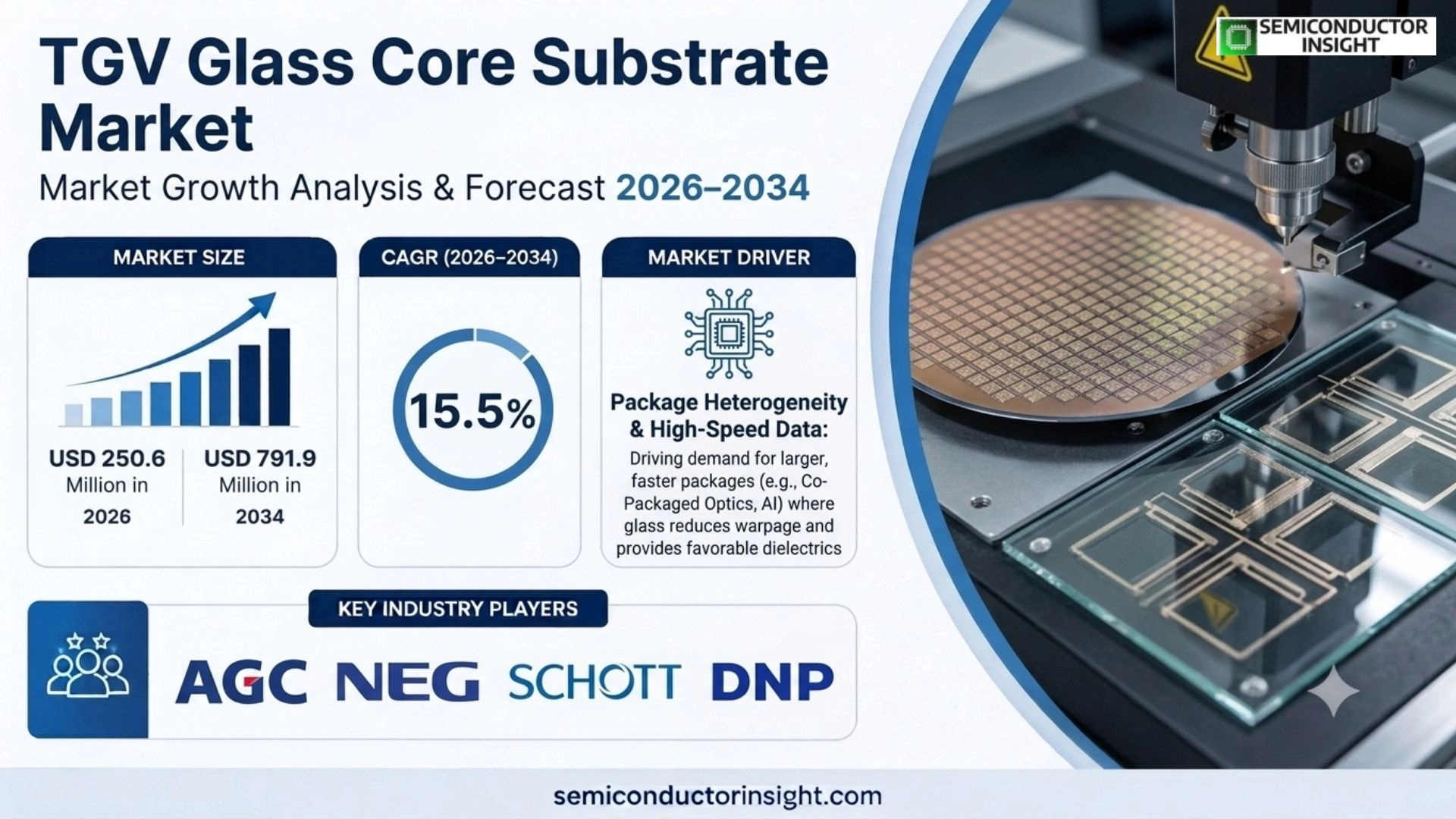
TGV glass core substrate market was valued at USD 217.1 million in 2025, is estimated at USD 250.6 million in 2026, and is projected to reach USD 791.9 million by 2034, representing an anchor-derived CAGR of 15.5% during 2026–2034. Asia Pacific is the largest regional market in 2025 on the controlling report scope, while the commercial growth mechanism is increasingly shaped by panel-scale glass processing, fine-pitch through-glass via formation, AI/HPC packaging and co-packaged optics that require low-loss, dimensionally stable interconnect platforms.
A TGV glass core substrate is an engineered glass platform containing through-glass vias that provide vertical electrical connections through the substrate. The glass core can support redistribution layers, copper metallization and high-density package routing while offering low dielectric loss, high dimensional stability, controllable coefficient of thermal expansion and very smooth surfaces. These properties are particularly valuable as AI, high-performance computing and optical interconnect packages become physically larger and carry more chiplets, HBM stacks and high-speed interfaces.
The controlling source page defines type by coefficient of thermal expansion, applications by wafer-level and panel-level packaging, end-use across consumer electronics, telecommunications, automotive, aerospace and defense, and manufacturing processes including laser drilling, wet etching, photo structuring and other methods. This scope distinguishes TGV glass core substrates from generic glass carriers because the commercially relevant product must combine material properties with repeatable via formation and metallization.
Scale is the central economic question. Wafer-sized glass can use semiconductor-style lithography and handling, but panel formats offer the possibility of processing many more package sites per cycle. AGC lists both 150/200/300 mm wafer formats and 510×515 mm panels, while Nippon Electric Glass and SCHOTT have publicized similarly large glass formats. The opportunity is substantial, but yield loss on a large panel can erase the area advantage, making process uniformity more important than nominal panel size.
Supplier competition therefore spans more than glass composition. Customers need controlled thickness, CTE, flatness, dielectric characteristics, via geometry, clean sidewalls, copper adhesion and compatibility with redistribution-layer processes. Material companies are increasingly partnering with drilling, etch, plating, substrate and packaging ecosystems because no single property determines qualification. A successful platform must survive repeated thermal cycles and downstream assembly while delivering measurable package-level yield and electrical performance.
Segment Analysis: By Type
By coefficient of thermal expansion, the source scope divides the market into CTE above 5 ppm/°C and CTE below 5 ppm/°C. The below-5 class leads because silicon-adjacent packaging values low expansion and dimensional stability, while the above-5 class gives designers additional flexibility to match organic build-up, copper and board-level stack behavior.
| Type | Technical role | Market position |
|---|---|---|
| CTE above 5 ppm/°C | Engineered glass compositions with thermal expansion intentionally above very-low-CTE silicon-like levels. They allow package designers to tune thermomechanical behavior against copper, organic build-up layers and board attachment rather than optimizing only for die matching. | A meaningful application-specific segment. Selection depends on the total stack and reliability model; suppliers compete on consistency, flatness, dielectric performance and how the chosen CTE affects package warpage over temperature. |
| CTE below 5 ppm/°C | Low-expansion glass engineered to remain dimensionally stable near silicon and other low-CTE structures. This can improve alignment and reduce thermomechanical strain as package dimensions and interconnect density increase. | Leading source-defined type. It is particularly relevant to large AI/HPC and fine-pitch package architectures where dimensional movement can reduce lithography, bonding or assembly yield. |
Why is CTE a commercial packaging parameter rather than a standalone material specification?
A package contains silicon dies, copper, dielectric layers, solder joints, organic materials and sometimes optical components, each expanding differently with temperature. Glass CTE therefore affects package bow, redistribution-layer alignment, joint stress and reliability across manufacturing and field cycles. The commercially optimal value depends on the entire stack. Suppliers that offer multiple controlled compositions can work with customers to tune performance instead of forcing one glass chemistry into every package architecture.
Segment Analysis: By Application
By application, the source page segments the market into Wafer Level Packaging and Panel Level Packaging. Wafer-level processing is the more established qualification route because existing semiconductor equipment is optimized for circular substrates, while panel-level processing is strategically attractive because larger rectangular glass can increase package sites per process cycle.
| Application | Demand characteristics |
|---|---|
| Wafer Level Packaging | Established application base. Circular 150 mm, 200 mm and 300 mm glass formats can fit more readily into semiconductor lithography, metrology, handling and deposition flows. Customers value process familiarity and precise alignment, making wafer-level qualification a lower-risk route for high-value interposers and advanced packages even when area economics are less aggressive than panels. |
| Panel Level Packaging | Major scale opportunity. 510×515 mm-class glass can carry many package sites and potentially improve throughput for large-body AI or heterogeneous packages. The purchasing trigger is not panel size alone: via uniformity, flatness, contamination control, lithography field stitching and metallization yield must remain stable across the full panel for the area advantage to translate into lower cost. |
What must happen for panel-level TGV substrates to scale?
Panel economics improve only when the complete process chain-glass handling, TGV formation, cleaning, seed layers, copper fill, redistribution, inspection and singulation-delivers high yield across a much larger area. Equipment originally designed for displays or printed-circuit panels may provide scale, but semiconductor packaging demands tighter defect control. Pilot lines are therefore commercially important because they allow suppliers and customers to quantify whether larger panels reduce cost per package without introducing unacceptable yield loss.
Regional Analysis
Asia Pacific leads the TGV glass core substrate market, with the source page indicating more than 48% of 2024 demand. Japan anchors specialty-glass material and process development, while Taiwan, South Korea and China provide advanced packaging, electronics and panel-processing ecosystems. North America is a critical architecture and AI-packaging demand center, and Europe contributes specialty glass and photonics expertise.
Why is TGV glass commercialization geographically concentrated?
The market requires a rare overlap of specialty glass, semiconductor packaging, high-precision via processing, metallization and large-format manufacturing. Asia Pacific has the densest overlap because Japanese glass companies sit near major foundry, OSAT and electronics ecosystems. North America creates specifications through AI and advanced-compute platform development. Europe contributes specialty-glass and photonics expertise. Other regions participate mainly through downstream data-center, communications, automotive and defense demand.
| Region | Position | Growth outlook | Demand profile | What decides supplier selection |
|---|---|---|---|---|
| Asia Pacific | Largest (>48% of 2024 source-page demand) | Highest commercialization pace | Glass + advanced packaging + panel processing | TGV yield, CTE consistency, panel flatness, local qualification and cost |
| North America | Technology-demand center | High | AI/HPC + advanced packaging | Electrical performance, package reliability, supplier qualification and scale roadmap |
| Europe | Specialty materials and photonics center | Moderate-High | Glass science + telecom + industrial | Material consistency, low loss, traceability and process ecosystem |
| South America | Small downstream market | Moderate from small base | Telecom + cloud + electronics | Imported package availability, system cost and channel support |
| Middle East & Africa | Emerging downstream market | Moderate from small base | Data centers + telecom + defense | High-reliability qualification and supply continuity |
Competitive Landscape
Competition spans glass formulation, panel flatness, TGV processability, via yield, metallization and customer qualification. Established specialty-glass groups bring materials science and large-format production, while printing, precision-processing and semiconductor companies add the process capabilities required to turn glass into a package core.
AGC, SCHOTT, Corning, HOYA, Ohara and Nippon Electric Glass compete from a materials position. Their advantage is control over glass chemistry, CTE, dielectric properties, thickness and surface quality. Those capabilities are necessary but not sufficient; semiconductor customers also need evidence that the material survives via formation, copper processing and package reliability without introducing unacceptable defects.
DNP and other precision-processing participants add a manufacturing dimension by developing pilot lines and process integration. TGV formation can use laser drilling, laser modification followed by etching, wet etching or photo-structured methods, each with different throughput and geometry. A supplier able to pair material and process windows can reduce customer development time and increase the chance of qualification.
Large-panel capability is emerging as a strategic differentiator. AGC, NEG and SCHOTT publicly discuss formats around 510×515 mm, which aligns the market around equipment-compatible panel dimensions. The competitive question is shifting from whether large glass can be made to whether millions of vias and redistribution features can be produced uniformly across a panel at acceptable yield.
Customers are likely to qualify multiple material/process combinations because glass-core packaging remains early in industrialization. This creates an opening for newer Asian companies and process specialists, but established suppliers retain an advantage through semiconductor-grade quality systems, global application engineering and the financial ability to support multi-year qualification before volume revenue arrives.
| Competitive tier | Representative companies | Commercial basis |
|---|---|---|
| Global specialty-glass leaders | AGC Inc.; SCHOTT AG; Corning Incorporated; HOYA Corporation; Ohara Corporation; Nippon Electric Glass | Deep material science, controlled CTE/dielectric properties, semiconductor-grade surfaces and ability to supply wafer and large-panel formats. |
| Process and substrate industrializers | Dai Nippon Printing (DNP); Guangdong 3D Chips; WGTech | Compete through TGV formation, pilot-line integration, panel processing, metallization compatibility and customer-specific manufacturing development. |
| Specialty and emerging suppliers | CrysTop Glass and other regional precision-glass participants | Target application-specific glass, via-processing support and cost-effective qualification where customers want additional sources beyond global material leaders. |
Companies profiled in the source scope
AGC Inc., SCHOTT AG, Corning Incorporated, HOYA Corporation, Ohara Corporation, Dai Nippon Printing (DNP), Nippon Electric Glass (NEG), CrysTop Glass, Guangdong 3D Chips, WGTech.
Production Capacity Analysis
Production capacity is best understood as the ability to deliver semiconductor-grade glass plus high-yield TGV processing at wafer or panel scale. The bottleneck is not melting glass; it is maintaining flatness, via geometry, clean sidewalls and metallization reliability across large areas while controlling contamination and damage.
Glass formulation sets CTE, dielectric loss, stiffness, chemical durability and processing response. Semiconductor substrates require tighter lot consistency and surface specifications than many traditional glass markets, so capacity qualified for display or architectural glass cannot be counted automatically as TGV substrate capacity. Material suppliers must demonstrate that properties remain stable through downstream thermal and chemical processing.
TGV formation is the main throughput and yield gate. Laser drilling can be fast and programmable but must control heat-affected damage; laser modification followed by etching can create fine features with different sidewall characteristics; wet and photo processes trade tooling, selectivity and patterning complexity. The best route depends on via diameter, aspect ratio, panel size and the customer’s metallization process.
Metallization and redistribution add another capacity layer because every through-hole must become an electrically reliable conductor. Seed deposition, copper fill or lining, adhesion and planarity must work consistently over thousands or millions of vias. Panel-level economics are especially sensitive because one localized process excursion can affect many package sites at once.
| Capacity layer | Where it concentrates | Commercial constraint |
|---|---|---|
| Semiconductor-grade glass production | Japan, Germany, U.S. and selected Asian suppliers | CTE, dielectric behavior, thickness, surface quality and large-format flatness must be controlled lot-to-lot. |
| TGV formation | Japan, Taiwan, China and global precision-processing ecosystems | Via diameter, aspect ratio, sidewall damage, throughput and uniformity across wafer/panel are key yield constraints. |
| Metallization & RDL | Advanced packaging and substrate lines in Asia, North America and Europe | Seed-layer coverage, copper adhesion/fill, planarity and fine-line redistribution determine electrical yield. |
| Panel-level qualification | Pilot and early production lines using ~510×515 mm formats | Handling, contamination, lithography, inspection and defect density must scale without losing the theoretical area advantage. |
Market Dynamics
Growth is driven by packages becoming larger, faster and more heterogeneous, while restraint comes from the difficulty of manufacturing fine, reliable vias and redistribution layers at high yield. Commercial adoption will accelerate where glass solves a measurable package problem-warpage, routing density, electrical loss or optical integration-and where pilot lines can prove that benefit at production cost.
Market Drivers
| Factor | Directional impact | Why it matters |
|---|---|---|
| AI/HPC package scaling | High | Chiplets, HBM and wider interfaces enlarge packages and make dimensional stability and fine-pitch routing more valuable. |
| Panel-level packaging economics | High | Large rectangular glass can increase package sites per process cycle if via and redistribution yield remain uniform across the panel. |
| Co-packaged optics and high-speed I/O | Medium-High | Glass’s dielectric and optical compatibility can support low-loss interconnect and photonic integration near switches and accelerators. |
| Specialty-glass supplier industrialization | Medium-High | Pilot lines, public panel formats and semiconductor-focused product programs reduce qualification uncertainty and expand available supply. |
AI packages are straining conventional organic-core mechanics
Large accelerators combine multiple logic dies, HBM stacks and extensive power and I/O routing. As package area grows, substrate warpage and dimensional movement become harder to control. Glass offers high stiffness, smooth surfaces and tunable CTE, so its economic value rises when a package would otherwise lose yield during lithography, bonding or assembly. The driver is therefore package complexity, not a generic material substitution trend.
Panel processing can create a new cost curve
A 510×515 mm glass panel can contain far more package sites than a 300 mm wafer, potentially spreading process time and capital over more units. The opportunity is conditional on yield. If via, plating or lithography defects rise with area, the cost advantage disappears. This makes large-panel pilot lines essential for converting geometric potential into validated manufacturing economics.
High-speed electrical and optical integration favors low-loss substrates
Networking and AI systems need faster SerDes, shorter electrical paths and more optical bandwidth. Glass can provide favorable dielectric behavior and precision features while also supporting optical functions. Co-packaged optics therefore expands the set of performance problems glass can solve, increasing the strategic value of substrate platforms designed for both electrical and photonic integration.
Public supplier roadmaps reduce adoption risk
AGC, NEG, SCHOTT, DNP and other suppliers are publishing panel dimensions, TGV capabilities and pilot-line plans. This gives packaging customers more concrete process windows and second-source options. As multiple suppliers converge on manufacturable formats, equipment makers can design around common dimensions and customers can run parallel qualifications, accelerating ecosystem maturity.
Market Restraints
| Factor | Directional impact | Why it matters |
|---|---|---|
| TGV yield and throughput | High | Fine vias must be formed quickly and uniformly without cracking or sidewall damage; poor yield can overwhelm the material’s performance advantage. |
| Metallization reliability | High | Every via requires reliable conductive coverage and adhesion, creating a large defect opportunity as via counts rise. |
| Panel handling and flatness | Medium-High | Large thin glass is stiff yet brittle; automation, edge handling, bow control and inspection must be adapted to semiconductor defect standards. |
| Competing substrate ecosystems | Medium | Organic substrates and silicon interposers have mature manufacturing, established suppliers and known qualification behavior, so glass must solve a clear performance or cost constraint. |
Through-glass vias remain the primary manufacturing bottleneck
Material properties do not create a market unless vias can be formed at acceptable cost and yield. Laser and etch processes must produce consistent geometry and clean surfaces without microcracks that later propagate during thermal cycling. As via counts increase, even a very low defect probability per via can become commercially significant. Process capability therefore determines effective substrate capacity.
Copper integration can turn a good glass panel into a bad electrical substrate
TGVs need conductive seed layers and copper structures that adhere through subsequent thermal and mechanical stress. Poor coverage, voids or delamination can reduce electrical yield after substantial value has already been added. Suppliers increasingly need to demonstrate a qualified glass-plus-metallization process window rather than asking customers to solve every interface independently.
Large panels magnify handling and defect-control challenges
Panel-level packaging promises better area utilization, but large thin glass requires careful automation to avoid edge damage, breakage and contamination. Flatness and lithography alignment must remain controlled over hundreds of millimeters. A defect that would affect one wafer region can affect multiple package sites on a panel, so inspection and process uniformity become more stringent as scale rises.
Mature alternatives create a high proof threshold
Organic substrates already have global supply chains and high-volume assembly processes, while silicon interposers offer excellent fine-feature capability. Glass must therefore demonstrate a compelling combination of warpage, electrical performance, package density or cost. Customers are unlikely to switch for modest improvements because requalification of materials and package flows is expensive and time-consuming.
Market Opportunities
Panel-level AI accelerator cores
Very large AI packages are the strongest opportunity because mechanical stability and routing density have high economic value and package prices can absorb new-material cost. Suppliers that prove high-yield 510×515 mm TGV panels can offer a pathway to process many large package sites per panel, potentially creating a meaningful cost advantage over wafer-based approaches.
Co-packaged optics substrates
Moving optical engines closer to switches and accelerators creates a need for precise, low-loss substrates capable of integrating electrical and optical structures. Glass is naturally relevant to photonics and can support fine vias and waveguide-compatible concepts, giving specialty suppliers an opportunity to participate in next-generation networking rather than only conventional electronic packaging.
Pilot-line process services
Many semiconductor customers lack internal expertise in glass drilling, etching and metallization. Suppliers that provide pilot-line services, design rules and reference process flows can reduce customer qualification time and capture value beyond raw material. This service model also generates learning data that improves the supplier’s own process windows and strengthens future design wins.
Multiple-CTE material platforms
Package stacks vary widely in silicon area, copper content, organic build-up and board connection. Offering a family of controlled CTE materials allows suppliers to optimize thermomechanical behavior for different architectures. This creates a higher-value consultative relationship with packaging engineers and makes the glass supplier part of package co-design rather than a commodity material vendor.
Supply Chain Analysis
Glass formulation. Upstream value comes from reproducible material properties rather than glass tonnage. CTE, dielectric response and chemical durability must be controlled for semiconductor processing, and large panels must remain flat enough for lithography and bonding. Material suppliers capture more value when they provide application-specific compositions and detailed process compatibility data.
TGV formation. Via processing converts a sheet of glass into a functional semiconductor substrate and is therefore a major value-creation step. Process owners compete on feature size, aspect ratio, sidewall quality and holes per unit time. The best-performing method can vary by design, so equipment, material and substrate suppliers frequently need joint development rather than a universal recipe.
Metallization and redistribution. Seed layers, copper, dielectric films and redistributiontransform the vias into an electrical interconnect network. Yield at this stage depends on adhesion, cleanliness and planarity inherited from earlier processing. Suppliers that co-optimize TGV and metallization can reduce interface failures and make qualification easier for package customers.
Package integration. The substrate ultimately competes on package-level results: flatness, signal integrity, thermal-cycle reliability, assembly yield and cost per good package. AI and photonics customers will pay for glass only when these metrics improve enough to justify new equipment and qualification, so downstream package data determines how much value flows back to the glass ecosystem.
Recent Developments in the TGV Glass Core Substrate Market
Developments tracked to September 2026. Entries are dated to the official publication date where available.
- 2 September 2026 Industry showcase
AGC announced participation at SEMICON Taiwan 2026 with its TGV glass substrate technology, positioning the material directly within the world’s leading advanced-packaging ecosystem. The event supports customer evaluation of wafer and panel formats and increases visibility of glass as an industrial semiconductor substrate. Source - 21 May 2026 Ecosystem development
SCHOTT launched its SEMICON next knowledge hub to support next-generation semiconductor technologies enabled by glass. The initiative is commercially relevant because packaging adoption requires design rules and process collaboration across materials, equipment and device customers rather than isolated glass specifications. Source - 1 February 2026 Large-panel processing
Nippon Electric Glass published detailed technical work on large TGV glass substrates, extending public evidence around panel-scale glass and via formation. Such disclosures help packaging engineers assess manufacturability, process sequence and the trade-off between larger-area throughput and defect control. Source - 16 December 2025 Pilot line
Dai Nippon Printing announced a pilot line for glass-core substrates using through-glass vias at its Kuki plant, with operations beginning around late 2025 and sample supply activity in 2026. Pilot capacity is a key bridge between laboratory results and customer qualification for panel-level packaging. Source - 22 May 2025 Panel-scale milestone
Nippon Electric Glass announced development of a 515×510 mm large glass substrate with TGV processing, using laser-modification/etching and CO₂-laser approaches. The panel size is important because it aligns glass with emerging panel-level packaging economics rather than limiting the technology to wafer-scale demonstrations. Source
Report Scope & Segmentation
| Attribute | Coverage |
|---|---|
| Report title | TGV Glass Core Substrate Market Size, Trends, Business Strategies 2026-2034 |
| Base / estimate / forecast | 2025 base year; 2026 estimated year; 2034 forecast end year; CAGR measured for 2026–2034. |
| By Type | Coefficient of Thermal Expansion (CTE) above 5 ppm/°C; CTE below 5 ppm/°C. |
| By Application | Wafer Level Packaging; Panel Level Packaging. |
| By End-Use Industry | Consumer Electronics; Telecommunications; Automotive; Aerospace & Defense; Others. |
| By Manufacturing Process | Laser Drilling; Wet Etching; Photo Structuring; Others. |
| Regions | North America, Europe, Asia-Pacific, South America, and Middle East & Africa, with country-level analysis where relevant to the source scope. |
| Companies | AGC Inc., SCHOTT AG, Corning Incorporated, HOYA Corporation, Ohara Corporation, Dai Nippon Printing (DNP), Nippon Electric Glass (NEG), CrysTop Glass, Guangdong 3D Chips, WGTech |
| Customization Scope | Free report customization (equivalent to up to 4 analyst working days) with purchase. Addition or alteration to country, regional and segment scope. |
Frequently Asked Questions
What is the size of the TGV glass core substrate market?
The controlling source page publishes USD 188 million for 2024 and USD 594 million for 2032. Those anchors imply a consistent 15.5% CAGR, producing a rebased USD 217.1 million market in 2025, an estimated USD 250.6 million in 2026 and approximately USD 791.9 million by 2034. These anchor-derived figures are used consistently throughout the overview.
What is a TGV glass core substrate?
A TGV glass core substrate is an engineered glass wafer or panel containing through-glass vias that create vertical electrical paths through the core. Metallization and redistribution layers convert those vias into high-density interconnect. Glass is attractive because it can combine dimensional stability, smooth surfaces, controlled thermal expansion and favorable dielectric behavior for advanced semiconductor packaging.
Which region leads the TGV glass core substrate market?
Asia Pacific is the largest regional market, and the source page attributes more than 48% of 2024 demand to the region. Japan anchors specialty-glass and via-processing development, while Taiwan, South Korea and China provide advanced packaging, semiconductor and panel-manufacturing ecosystems that can move new glass platforms through qualification and production.
What are the main TGV glass substrate applications?
The source page segments applications into Wafer Level Packaging and Panel Level Packaging. Wafer-level processing is more established because semiconductor equipment already handles circular formats, while panel-level packaging is a major scale opportunity because 510×515 mm-class glass can contain many large package sites if TGV, metallization and lithography yield remain uniform.
Why is glass attractive for AI semiconductor packaging?
AI accelerators combine large silicon area, multiple chiplets, HBM stacks and wide high-speed interfaces, which makes package warpage and dimensional movement increasingly difficult to manage. Glass offers stiffness, smooth surfaces and tunable CTE, while TGVs enable dense vertical routing. The material becomes commercially attractive when those properties improve package yield, interconnect density or electrical performance enough to offset process complexity.
What is the main manufacturing challenge for TGV substrates?
Through-glass via yield and throughput are the primary challenge. Thousands or millions of holes must be formed with controlled diameter, sidewall quality and minimal microcracking, then metallized reliably. Laser, etch and hybrid processes make different trade-offs. A low-cost glass panel does not create economic value if via or copper defects reduce the number of good packages produced from it.
Which companies are active in TGV glass core substrates?
The source scope profiles AGC, SCHOTT, Corning, HOYA, Ohara, Dai Nippon Printing, Nippon Electric Glass, CrysTop Glass, Guangdong 3D Chips and WGTech. Competition spans both material and process capability: customers assess CTE, dielectric properties and flatness alongside via formation, panel handling, metallization compatibility and the supplier’s ability to support multi-year semiconductor qualification.
What is the role of panel-level packaging in market growth?
Panel-level packaging offers the possibility of processing many more package sites in a single cycle than wafer-level flows. Public supplier formats around 510×515 mm make that opportunity more concrete. However, the cost advantage appears only if flatness, contamination, via formation, lithography and metallization remain uniform across the full panel, making pilot-line yield the key commercial proof point.
How does co-packaged optics affect TGV glass demand?
Co-packaged optics places optical engines close to high-bandwidth switches and processors, increasing the need for precise, low-loss interconnect substrates that can support both electrical and optical integration. Glass’s dielectric and optical properties make it a candidate platform. If major networking architectures adopt glass, TGV suppliers gain a second high-value growth path beyond purely electrical AI package cores.
What is the forecast CAGR for the TGV glass core substrate market?
The source page’s USD 188 million 2024 and USD 594 million 2032 anchors imply approximately 15.5% compound annual growth, lower than the printed 17.4% label. The production workflow uses the anchor-implied rate because the size values are the controlling data, yielding the 2025, 2026 and 2034 figures presented consistently across all sections.
Research Sources & Evidence Base

Get Sample Report PDF for Exclusive Insights
Report Sample Includes
- Table of Contents
- List of Tables & Figures
- Charts, Research Methodology, and more...
 Download Sample Report PDF