Temperature And Vibration Integrated Industrial Sensor Market Insights
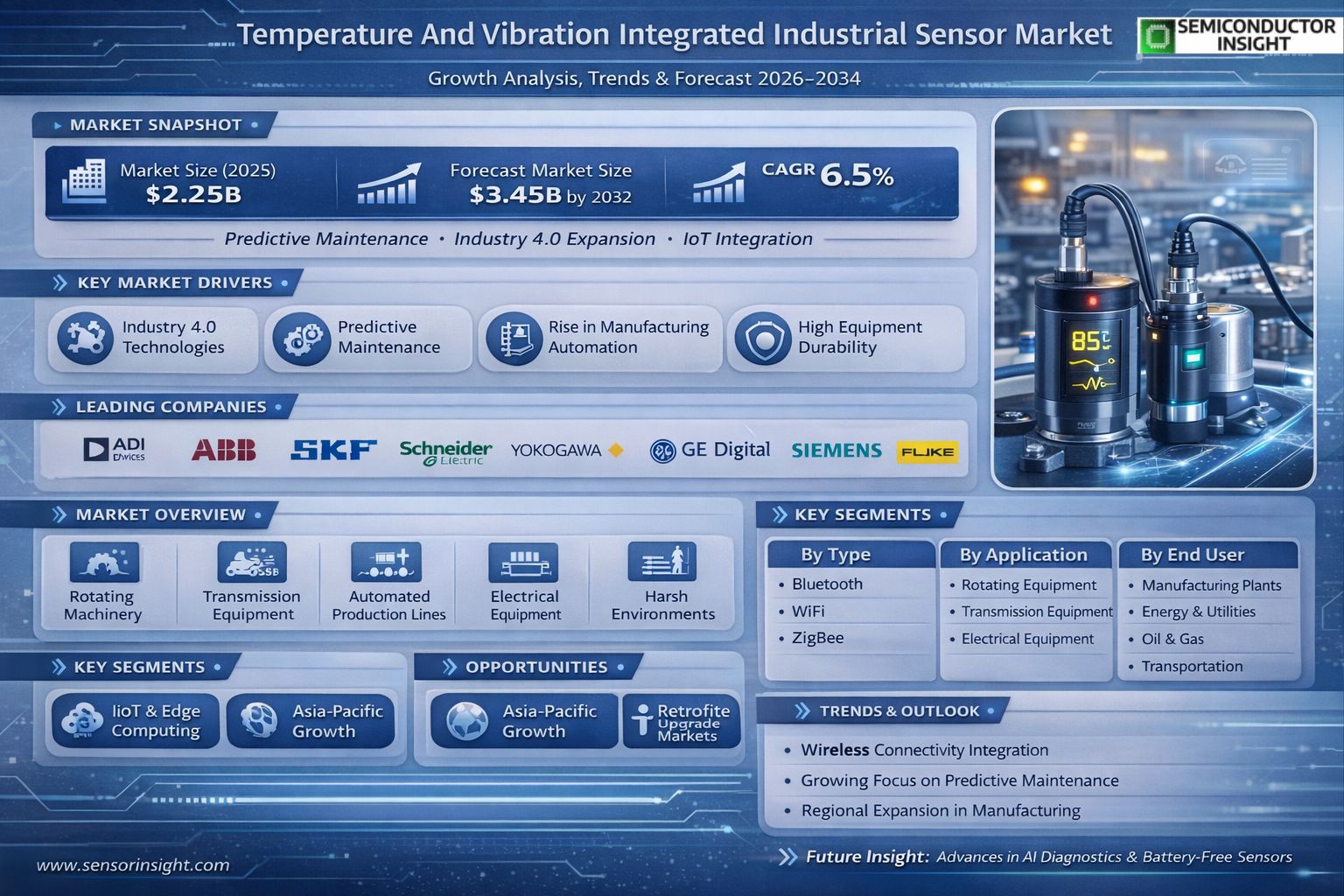
Global Temperature And Vibration Integrated Industrial Sensor market size was valued at USD 2,246 million in 2025. The market is projected to reach USD 3,453 million by 2032, exhibiting a CAGR of 6.5% during the forecast period.
The temperature and vibration integrated industrial sensor is a sensor that integrates temperature and vibration monitoring functions and is widely used in the health monitoring of industrial equipment. It can collect temperature and vibration data of the equipment in real time to help detect potential fault problems such as overheating and abnormal vibration, thereby improving the reliability and maintenance efficiency of the equipment, preventing equipment failures and optimizing production processes. Such sensors usually have high durability and anti-interference capabilities, and are suitable for harsh industrial environments.
The market is experiencing rapid growth due to several factors, including the surging demand for predictive maintenance solutions, widespread adoption of Industry 4.0 technologies, and expansion in manufacturing sectors worldwide. Furthermore, advancements in IoT integration and wireless communication protocols like Bluetooth and WiFi are propelling market expansion. Initiatives by key players are expected to further fuel this growth. ADI, ABB, SKF, Schneider, Yokogawa Electric, GE Digital, Siemens, and Fluke are some of the key players operating in the market with diverse product portfolios.
MARKET DRIVERS
Adoption of Industry 4.0 Technologies
Temperature And Vibration Integrated Industrial Sensor Market is propelled by the widespread integration of Industry 4.0 principles in manufacturing sectors. These sensors enable real-time monitoring of equipment health, reducing unplanned downtime by up to 30% in key industries like oil and gas and automotive production. Advanced IoT connectivity allows seamless data transmission, fostering predictive maintenance strategies that optimize operational efficiency.
Growth in Predictive Maintenance Demand
Rising demand for predictive maintenance solutions drives market expansion, as integrated sensors provide comprehensive diagnostics by combining temperature and vibration data. This synergy helps detect anomalies early, potentially saving industries billions in maintenance costs annually. The market’s growth is further supported by a projected CAGR of 9.2% through 2030, fueled by automation trends.
➤ Integrated sensors reduce failure rates by 25-40% in heavy machinery applications.
Regulatory pushes for enhanced safety standards in industrial environments also bolster adoption, positioning Temperature And Vibration Integrated Industrial Sensor Market as a cornerstone for reliable asset management.
MARKET CHALLENGES
High Initial Deployment Costs
One primary challenge in Temperature And Vibration Integrated Industrial Sensor Market is the substantial upfront investment required for sensor installation and system integration. Small to medium enterprises often face barriers due to costs averaging 20-30% higher than traditional single-parameter sensors, limiting widespread adoption in cost-sensitive regions.
Other Challenges
Compatibility and Interoperability Issues
Existing legacy systems pose significant hurdles, as retrofitting integrated sensors demands custom engineering solutions. This can extend project timelines by 40% and increase complexity in multi-vendor environments, hindering seamless scalability across diverse industrial setups.
Data overload from continuous monitoring strains current analytics infrastructure, requiring advanced AI processing that not all facilities possess, further complicating market penetration efforts.
MARKET RESTRAINTS
Stringent Regulatory Compliance
Temperature And Vibration Integrated Industrial Sensor Market faces restraints from rigorous regulatory frameworks governing sensor accuracy and calibration in hazardous environments. Compliance with standards like IEC 61508 can delay product launches by up to 18 months, impacting market entry for new innovations.
Supply chain disruptions, particularly for rare-earth materials used in high-precision components, constrain production scalability. Global events have led to 15-20% price volatility in sensor modules, affecting affordability.
Limited skilled workforce for installation and maintenance in emerging markets acts as another restraint, with training gaps slowing deployment rates by approximately 25% in regions like Southeast Asia.
MARKET OPPORTUNITIES
Expansion in IIoT and Edge Computing
Temperature And Vibration Integrated Industrial Sensor Market holds significant opportunities through the proliferation of Industrial Internet of Things (IIoT) platforms. Edge computing integration enables on-site data processing, reducing latency and enhancing decision-making in real-time applications across renewables and pharmaceuticals.
Emerging markets in Asia-Pacific present untapped potential, with industrial automation investments projected to grow at 12% annually, driving demand for rugged, integrated sensors in manufacturing hubs.
Advancements in wireless and battery-free sensor technologies open doors for retrofitting legacy equipment, potentially capturing a 35% share of the retrofit market by 2028.
Temperature And Vibration Integrated Industrial Sensor Market Trends
Advancements in Wireless Connectivity Integration
Temperature And Vibration Integrated Industrial Sensor Market is experiencing a notable shift towards wireless connectivity options such as Bluetooth, WiFi, and ZigBee. These technologies enable real-time data collection from industrial equipment, facilitating early detection of overheating and abnormal vibrations. Manufacturers like ADI, ABB, and SKF are prioritizing these features to enhance sensor durability in harsh environments, supporting seamless integration into existing industrial setups for improved equipment reliability and maintenance efficiency.
Other Trends
Growing Adoption in Predictive Maintenance
Integrated sensors are increasingly vital for predictive maintenance strategies across rotating equipment, transmission equipment, electrical equipment, and automated production lines. By combining temperature and vibration data, these sensors help prevent failures and optimize production processes, as highlighted by industry surveys involving key suppliers and experts who note rising demand driven by the need for higher operational uptime.
Expansion in Key Regional Markets
North America, Europe, and Asia-Pacific regions, particularly China and Japan, are seeing heightened deployment of these sensors. The focus on regional infrastructure development and manufacturing advancements is propelling market growth, with applications tailored to local industrial needs like heavy machinery monitoring.
Competitive Innovations by Leading Players
Major companies including Siemens, Schneider, Yokogawa Electric, GE Digital, and Fluke are driving innovations in sensor anti-interference capabilities and data accuracy. Recent developments emphasize compact designs and robust performance, enabling broader adoption in diverse applications and contributing to a competitive landscape focused on product enhancements and strategic partnerships to address industry challenges like equipment downtime.
COMPETITIVE LANDSCAPE
Key Industry Players
Global Leaders in Temperature And Vibration Integrated Industrial Sensor Market
Temperature And Vibration Integrated Industrial Sensor Market exhibits a moderately concentrated structure, led by established multinational corporations with strong expertise in industrial automation and predictive maintenance. Top players such as Analog Devices Inc. (ADI), ABB, SKF, Schneider Electric, and Siemens command significant market shares, collectively accounting for a substantial portion of global revenues estimated at over 2246 million USD in 2025. These leaders dominate through advanced sensor technologies that integrate temperature and vibration monitoring for real-time equipment health assessment, particularly in rotating equipment and electrical systems. Their competitive edge stems from robust R&D investments, scalable manufacturing, and integration with IoT platforms, enabling applications in harsh industrial environments while driving the projected growth to 3453 million USD by 2032 at a 6.5% CAGR.
Beyond the market frontrunners, a diverse group of niche and emerging players contributes to innovation, especially in wireless connectivity segments like Bluetooth, WiFi, and ZigBee. Companies including Fluke, GE Digital, Yokogawa Electric, Broadsens, and Petasense offer specialized solutions tailored for transmission equipment and automated production lines, focusing on high durability and anti-interference features. Regional specialists from China, such as Beijing Bohua Xinzhi Technology, Beijing Beetech, Suzhou Geniitek Sensor Tech., and Xindun, are rapidly expanding through cost-effective, high-performance sensors amid rising demand in Asia-Pacific. These players intensify competition by addressing specific pain points like fault detection and maintenance efficiency, fostering a dynamic landscape where mergers, acquisitions, and technological advancements shape future market positioning.
List of Key Temperature And Vibration Integrated Industrial Sensor Companies Profiled
- ADI
- ABB
- SKF
- Schneider Electric
- Yokogawa Electric
- GE Digital
- Siemens
- Fluke
- Broadsens
- Petasense
- ZifiSense
- Ronds
- iLine
- Beijing Bohua Xinzhi Technology
- Beijing Beetech
Segment Analysis:
| Segment Category | Sub-Segments | Key Insights |
| By Type |
|
Bluetooth
|
| By Application |
|
Rotating Equipment
|
| By End User |
|
Manufacturing Plants
|
| By Power Source |
|
Battery Powered
|
| By Mounting Type |
|
Bolt-On / Screw Mounted
|
Regional Analysis: Temperature And Vibration Integrated Industrial Sensor Market
North America
In North America’s oil and gas sector, Temperature And Vibration Integrated Industrial Sensor Market thrives due to the need for precise monitoring in remote drilling operations. Sensors provide early fault detection, optimizing asset performance and safety. Key players prioritize durable designs resistant to corrosive environments, aligning with business strategies for predictive analytics integration.
Automotive manufacturers in North America leverage these sensors for vibration and thermal management in electric vehicle production lines. Enhanced quality control and reduced failures drive adoption, with trends toward wireless connectivity supporting smart factory transitions and efficient supply chains.
Aerospace applications benefit from high-precision sensors ensuring engine integrity under extreme conditions. North American firms focus on lightweight, integrated solutions, fostering innovation in maintenance protocols and aligning with long-term strategies for aviation sustainability.
The pharmaceutical sector adopts these sensors for cleanroom vibration control and temperature stability, ensuring compliance and product integrity. Strategic investments in digital twins enhance process optimization, positioning the region for continued growth in regulated industries.
Europe
Europe’s Temperature And Vibration Integrated Industrial Sensor Market exhibits steady growth, driven by stringent environmental regulations and a strong emphasis on energy-efficient manufacturing. Countries like Germany and the UK lead with robust adoption in renewable energy and heavy machinery sectors, where sensors enable proactive maintenance to minimize emissions. Business strategies revolve around collaborations between sensor developers and automation giants, integrating these devices into smart grids and Industry 4.0 frameworks. Trends toward edge computing allow real-time data processing, enhancing operational resilience. The region’s focus on circular economy principles encourages recyclable sensor materials, while EU-funded R&D initiatives spur innovations in multi-parameter sensing. Challenges like supply chain disruptions are met with localized production strategies, ensuring market stability through 2034. Overall, Europe’s mature infrastructure and regulatory landscape position it as a key player in sustainable industrial sensor deployments.
Asia-Pacific
Asia-Pacific emerges as a dynamic force in Temperature And Vibration Integrated Industrial Sensor Market, fueled by rapid industrialization in China, Japan, and India. Manufacturing powerhouses integrate these sensors into electronics and semiconductor production for vibration-sensitive processes. Business leaders pursue aggressive expansion through cost-effective, scalable solutions, blending local manufacturing with global technology transfers. Trends highlight wireless and battery-free sensors suiting high-volume factory floors, supporting smart city initiatives. Government incentives for digital transformation accelerate IoT adoption, enhancing predictive capabilities across textiles and chemicals. Despite infrastructure variances, strategic investments in workforce upskilling drive widespread implementation. The region’s burgeoning middle class and urban growth amplify demand in logistics, ensuring robust trajectories toward 2034 with emphasis on resilient, high-performance sensing ecosystems.
South America
In South America, Temperature And Vibration Integrated Industrial Sensor Market gains momentum amid mining and agriculture expansions in Brazil and Chile. Sensors monitor heavy equipment in rugged terrains, improving uptime and safety in resource extraction. Business strategies focus on affordable, robust designs tailored to tropical climates, with partnerships bridging technology gaps. Trends include mobile sensor networks for remote operations, aligning with digital agriculture pushes. Regional players emphasize localization to counter import dependencies, fostering innovation in agro-industrial applications. Economic diversification efforts propel adoption in food processing, where precise environmental control boosts yields. Through 2034, infrastructure investments will enhance connectivity, solidifying South America’s role in emerging market dynamics for integrated industrial sensing.
Middle East & Africa
The Middle East & Africa region shows promising developments in Temperature And Vibration Integrated Industrial Sensor Market, particularly in oil-rich Gulf states and South African manufacturing. Sensors are vital for pipeline integrity and desalination plants, enduring desert extremes. Strategic visions like Saudi Vision 2030 drive diversification into non-oil sectors, integrating sensors for smart infrastructure. Trends favor harsh-environment certified devices with long-range telemetry. Business approaches involve joint ventures with international firms, transferring expertise for localized production. Africa’s mining boom accelerates demand for equipment health monitoring, mitigating operational risks. Renewable energy projects further embed these technologies, promoting sustainability. By 2034, enhanced digital policies and regional collaborations will elevate the market’s maturity and global integration.
Report Scope
This market research report provides a comprehensive analysis of Temperature And Vibration Integrated Industrial Sensor Market, covering the forecast period 2026–2034. It offers detailed insights into market dynamics, technological advancements, competitive landscape, and key trends shaping the industry.
Key focus areas of the report include:
- Market Overview: The report begins with an overview outlining its current market scenario, key growth indicators, and industry transformation drivers. It discusses macroeconomic factors, demand–supply balance, regulatory landscape, and the strategic role of temperature and vibration integrated sensors in powering advancements across industries such as manufacturing, energy, power generation, and industrial automation.
- Market Size & Forecast: Historical data and future projections for revenue, unit shipments, and market value across major regions and segments.
- Segmentation Analysis: Detailed breakdown by product type, technology, application, and end-user industry to identify high-growth segments and investment opportunities.
- Regional Insights: Insights into market performance across North America, Europe, Asia-Pacific, Latin America, and the Middle East & Africa, including country-level analysis where relevant.
- Competitive Landscape: Profiles of leading market participants, including their product offerings, R&D focus, manufacturing capacity, pricing strategies, and recent developments such as mergers, acquisitions, and partnerships.
- Technology Trends & Innovation: Assessment of emerging technologies, integration of AI/IoT, semiconductor design trends, fabrication techniques, and evolving industry standards.
- Market Drivers & Restraints: Evaluation of factors driving market growth along with challenges, supply chain constraints, regulatory issues, and market-entry barriers.
- Stakeholder Insights: Insights for component suppliers, OEMs, system integrators, investors, and policymakers regarding the evolving ecosystem and strategic opportunities.
Primary and secondary research methods are employed, including interviews with industry experts, data from verified sources, and real-time market intelligence to ensure the accuracy and reliability of the insights presented.
FREQUENTLY ASKED QUESTIONS:
What is the current market size of Temperature And Vibration Integrated Industrial Sensor Market?
-> Global Temperature And Vibration Integrated Industrial Sensor market was valued at USD 2,246 million in 2025 and is projected to reach USD 3,453 million by 2032, at a CAGR of 6.5% during the forecast period.
Which key companies operate in Temperature And Vibration Integrated Industrial Sensor Market?
-> Key players include ADI, ABB, SKF, Schneider, Yokogawa Electric, GE Digital, Siemens, Fluke, Broadsens, Petasense, among others.
What are the key growth drivers?
-> Key growth drivers include demand for real-time temperature and vibration monitoring, predictive maintenance for industrial equipment, and high durability in harsh environments.
Which region dominates the market?
-> Asia is the fastest-growing region, while North America remains a dominant market.
What are the emerging trends?
-> Emerging trends include wireless technologies such as Bluetooth, WiFi, ZigBee, and applications in rotating equipment, transmission equipment, and automated production lines.

Get Sample Report PDF for Exclusive Insights
Report Sample Includes
- Table of Contents
- List of Tables & Figures
- Charts, Research Methodology, and more...