Tandem OLED Display Market Insights
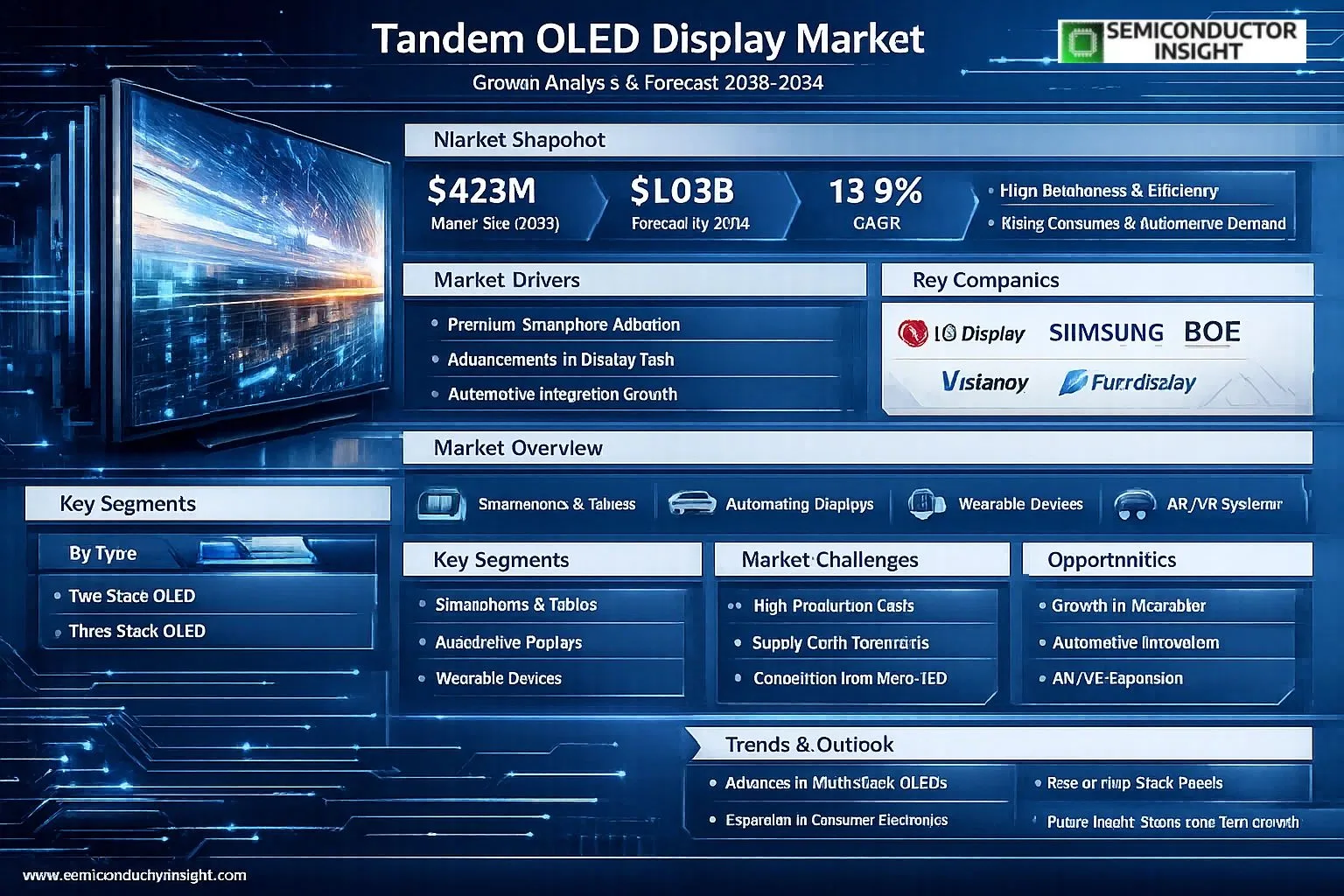
Global Tandem OLED Display market size was valued at USD 423 million in 2025. The market is projected to grow from USD 481 million in 2026 to USD 1,029 million by 2034, exhibiting a CAGR of 13.9% during the forecast period.
Tandem OLED displays are an advanced type of OLED technology in which multiple layers of organic light-emitting material are vertically stacked to significantly enhance overall display performance. This architectural approach directly improves key display attributes, including brightness, power efficiency, and operational lifespan. The stacking of multiple OLED layers — most commonly in two-stack or three-stack configurations — allows for more precise control over light emission, resulting in superior luminance output and reduced energy consumption compared to conventional single-stack OLED panels. These displays are increasingly adopted across consumer electronics and automotive applications, where high-brightness and long-lasting display performance are critical requirements.
The market is gaining strong momentum driven by rising consumer demand for premium display technologies, rapid adoption of OLED panels in smartphones and automotive infotainment systems, and ongoing advancements in display manufacturing processes. The growing penetration of tandem OLED technology in high-end mobile devices — most notably following Apple’s adoption of tandem OLED panels in its iPad Pro lineup — has served as a significant commercial catalyst. Furthermore, leading manufacturers such as LG, Samsung, BOE, Everdisplay, and Visionox continue to invest in scaling tandem OLED production capacity and enhancing panel efficiency, further reinforcing the competitive landscape and supporting sustained market expansion through the forecast period.
MARKET DRIVERS
Premium Smartphone Demand Fuels Growth
Tandem OLED Display Market is propelled by escalating consumer demand for superior display technologies in high-end smartphones. Tandem OLED panels, featuring stacked emissive layers, deliver exceptional brightness levels exceeding 2,000 nits, enabling vivid visuals even under direct sunlight. This capability addresses key limitations of traditional OLED, positioning tandem structures as the preferred choice for flagship devices from leading manufacturers.
Energy Efficiency and Longevity Advantages
Enhanced power efficiency in tandem OLED technology significantly extends battery life in portable devices, a critical factor in the competitive Tandem OLED Display Market. With up to 30% improved luminous efficacy compared to single-stack OLED, these displays reduce energy consumption while maintaining peak performance. Manufacturers report doubled operational lifespan, minimizing burn-in risks and appealing to quality-conscious consumers.
➤ Leading brands like Apple and Samsung have integrated tandem OLED in recent premium models, driving a 40% year-over-year shipment increase in 2024.
Regulatory pushes for sustainable electronics further accelerate adoption, as tandem OLED’s superior recyclability and lower power draw align with global eco-standards. This convergence of performance and environmental benefits solidifies the market’s upward trajectory.
MARKET CHALLENGES
Manufacturing Complexity Hinders Scalability
Tandem OLED Display Market faces significant hurdles due to the intricate fabrication process of multi-layer tandem structures. Aligning precise deposition of organic materials across stacked emitters demands advanced vacuum evaporation techniques, leading to lower yields initially hovering around 70%. This complexity escalates production timelines and requires substantial investment in specialized equipment.
Supply chain disruptions, particularly for rare earth dopants essential for tandem efficiency, exacerbate delays. Market players report a 15-20% cost overrun in pilot runs, straining profitability amid volatile raw material prices.
Other Challenges
Competition from Alternative Technologies
Mini-LED and micro-LED displays challenge tandem OLED dominance with potentially lower costs at scale. While tandem excels in flexibility and contrast, rivals offer brighter peaks without organic degradation, pressuring market share in mid-range segments.
Intellectual property disputes among key patent holders slow innovation diffusion, as licensing fees add 10% to component pricing in Tandem OLED Display Market.
MARKET RESTRAINTS
High Production Costs Limit Accessibility
Persistent elevated manufacturing expenses remain a primary restraint on Tandem OLED Display Market. The need for multiple emissive layers inflates material and process costs by approximately 50% over conventional OLED, confining adoption to premium tiers. Economies of scale are slow to materialize, with current panel prices at $150-200 per unit for 6-inch sizes.
Dependency on a concentrated supplier base for encapsulation films and driver ICs poses risks, as geopolitical tensions disrupt flows from Asia-Pacific hubs. This vulnerability caps aggressive expansion despite growing demand.
Limited color gamut optimization in early tandem designs further restrains penetration into professional displays, where quantum dot enhancements are still under refinement. Analysts project cost parity with single-stack OLED only by 2028.
MARKET OPPORTUNITIES
Expansion into Wearables and Automotive
Tandem OLED Display Market holds immense potential in wearables and automotive applications, where compact, high-brightness panels are essential. Smartwatch shipments incorporating tandem tech are forecasted to surge 60% by 2027, leveraging their thin profiles and durability for always-on displays.
Automotive HUD and IVI systems benefit from tandem OLED’s wide viewing angles and HDR performance, with EV makers prioritizing them for premium interiors. Market volume here could add $2.5 billion annually by decade’s end.
Innovations in printable tandem OLED lower entry barriers, opening doors to AR/VR headsets requiring over 3,000 nits for immersive experiences. Partnerships between display giants and content providers will catalyze this Tandem OLED Display Market segment’s rapid growth.
Tandem OLED Display Market Trends
Advancements in Multi-Stack OLED Configurations
Tandem OLED Display Market witnesses significant progress through multi-stack architectures, where multiple organic layers are precisely stacked to enhance light emission control. This technology boosts brightness levels, operational efficiency, and overall display longevity, making it ideal for demanding applications. Manufacturers are focusing on refining these stacked structures to achieve superior performance metrics compared to traditional single-stack OLEDs, driving broader adoption across premium devices.
Other Trends
Dominance of Two-Stack Tandem OLED Segment
The Two-Stack Tandem OLED variant leads within Tandem OLED Display Market, offering an optimal balance of performance improvements without excessive complexity. This configuration effectively doubles light output while maintaining color accuracy and power efficiency, appealing to high-end smartphone and wearable producers. Industry surveys indicate strong sales momentum for this segment, as it addresses key limitations in peak brightness for outdoor visibility and extended usage scenarios.
Growth in Automotive and Consumer Electronics Applications
Expansion into automotive displays represents a pivotal trend in Tandem OLED Display Market, where enhanced brightness and durability support advanced driver-assistance systems and infotainment screens. Similarly, consumer electronics continue to drive demand, with flexible and high-resolution tandem panels integrated into foldable smartphones and smartwatches. Key players like LG, Samsung, BOE, Everdisplay, and Visionox are investing in production scalability to meet rising volumes. Regional dynamics show Asia, particularly China, Japan, and South Korea, spearheading manufacturing innovations, while North America and Europe emphasize premium integration. Challenges such as material costs and yield optimization persist, yet ongoing R&D in stack optimization promises sustained market evolution. These developments position Tandem OLED Display Market for strategic growth through targeted segment penetration and technological refinements.
COMPETITIVE LANDSCAPE
Key Industry Players
Leading Manufacturers Shaping Tandem OLED Display Market
Tandem OLED Display Market exhibits an oligopolistic structure dominated by established South Korean and Chinese giants, with LG Display and Samsung Display as the frontrunners. These leaders collectively hold a substantial revenue share, estimated at over 50% among the top five players in 2025, leveraging their scale in production facilities and proprietary stacking technologies for two-stack and three-stack configurations. Their focus on enhancing brightness, efficiency, and lifespan positions them strongly in high-demand segments like consumer electronics and automotive displays, fueling the market’s projected growth from $423 million in 2025 to $1,029 million by 2034 at a 13.9% CAGR.
Beyond the top tier, niche players such as BOE Technology, Visionox, and Everdisplay are gaining traction through innovative tandem OLED solutions tailored for specific applications, including flexible displays and high-resolution panels. These companies emphasize cost optimization, strategic partnerships, and rapid scaling in Asia-Pacific regions, challenging incumbents with competitive pricing and advancements in multi-layer emissive structures. The competitive landscape is further intensified by mid-tier manufacturers investing in R&D to capture emerging opportunities in automotive and other specialized markets.
List of Key Tandem OLED Display Companies Profiled
- LG Display
- Samsung Display
- BOE Technology
- Visionox
- Everdisplay Optronics
- AU Optronics (AUO)
- Japan Display Inc. (JDI)
- JOLED
- Tianma Microelectronics
- TCL China Star Optoelectronics (CSOT)
- Kyocera Corporation
- Sharp Corporation
- Innolux Corporation
- Sumitomo Chemical
Segment Analysis:
| Segment Category | Sub-Segments | Key Insights |
| By Type |
|
Two-Stack Tandem OLED leads the segment by offering an optimal balance of enhanced brightness, power efficiency, and production scalability.
|
| By Application |
|
Consumer Electronics dominates as it leverages tandem OLED’s advantages in vibrant visuals and slim profiles for everyday devices.
|
| By End User |
|
Smartphone Manufacturers are at the forefront, capitalizing on tandem OLED for next-generation mobile displays.
|
| By Panel Size |
|
Small (<7 inches) leads due to its prevalence in portable and high-volume consumer products.
|
| By Resolution |
|
QHD emerges as the leading choice for balancing sharpness and performance in modern displays.
|
Regional Analysis: Tandem OLED Display Market
Asia-Pacific
Asia-Pacific’s manufacturing hubs excel in high-volume production of Tandem OLED Display Market components. Advanced fabs leverage economies of scale, producing multilayer stacks with precision. Local sourcing of rare materials reduces costs and lead times, enabling quick iterations.
Intense R&D in Tandem OLED Display Market drives breakthroughs in efficiency and durability. Universities and corporate labs collaborate on quantum dot integration and blue light enhancement, propelling next-gen panels for foldable devices.
Resilient supply chains in Asia-Pacific support Tandem OLED Display Market amid volatility. Diversified suppliers and stockpiling strategies mitigate risks, ensuring steady panel output for global OEMs.
Surging demand from smartphones and TVs bolsters Tandem OLED Display Market. Premium brands prioritize tandem tech for superior visuals, with regional giants capturing major shares through tailored solutions.
North America
North America plays a pivotal role in Tandem OLED Display Market through innovation and design leadership. Tech giants like Apple and Google specify advanced tandem panels for flagship devices, driving performance benchmarks. Strong IP portfolios and venture funding fuel startups exploring tandem variants for AR/VR headsets and medical displays. However, reliance on Asian manufacturing poses supply vulnerabilities. Focus on software-hardware integration enhances user experiences with adaptive brightness. Regulatory emphasis on energy efficiency aligns with tandem’s low-power traits, spurring adoption in data centers and signage. Collaborative ventures with Asian suppliers bridge gaps, while domestic pilot lines test emerging processes. Growth hinges on reshoring initiatives and talent pools in Silicon Valley, positioning North America as a key influencer despite production lags.
Europe
Europe advances steadily in Tandem OLED Display Market, emphasizing automotive and industrial applications. Firms like Continental and Infineon integrate tandem panels into dashboards and HUDs for enhanced visibility. Research hubs in Germany and the Netherlands pioneer phosphorescent materials for tandem efficiency. EU sustainability mandates favor eco-friendly displays, boosting tandem’s recyclability edge. Premium TV makers experiment with large-scale tandem for cinema-grade quality. Challenges include fragmented supply chains, but Horizon Europe funding accelerates prototypes. Strategic alliances with Asian tech transfer knowledge, fostering localized assembly. Consumer shift toward electric vehicles amplifies demand, with Europe carving a niche in specialized, high-reliability tandem solutions through 2034.
South America
South America emerges as a growth frontier in Tandem OLED Display Market, propelled by urbanization and digital expansion. Brazil and Mexico see rising imports of tandem-equipped smartphones and TVs amid e-commerce booms. Local assemblers partner with Asian exporters for cost-effective integration into consumer goods. Government incentives for tech manufacturing encourage entry-level tandem adoption in advertising displays. Infrastructure upgrades support digital signage proliferation. Hurdles like import duties persist, yet expanding middle classes prioritize vibrant screens. Pilot projects in smart cities test tandem viability, laying groundwork for broader uptake. Regional dynamics favor affordable premium displays, with South America poised for accelerated Tandem OLED Display Market penetration.
Middle East & Africa
The Middle East & Africa region shows nascent potential in Tandem OLED Display Market, centered on luxury retail and hospitality. Gulf states invest in dazzling digital billboards and hotel lobbies using tandem for vividness in harsh climates. Africa’s mobile-first economy drives smartphone upgrades with tandem tech. Oil revenues fund display infrastructure in smart buildings. Challenges encompass logistics and power reliability, but solar integration complements tandem efficiency. Emerging fab partnerships aim at regional customization. Government visions for diversification spur tech adoption, with the area leveraging imports to build ecosystems. Steady maturation promises contributions to global Tandem OLED Display Market trends.
Report Scope
This market research report provides a comprehensive analysis of Tandem OLED Display Market, covering the forecast period 2026–2034. It offers detailed insights into market dynamics, technological advancements, competitive landscape, and key trends shaping the industry.
Key focus areas of the report include:
- Market Overview: The report begins with an overview outlining its current market scenario, key growth indicators, and industry transformation drivers. It discusses macroeconomic factors, demand–supply balance, regulatory landscape, and the strategic role of semiconductors in powering advancements across industries such as automotive, telecommunications, consumer electronics, and industrial automation.
- Market Size & Forecast: Historical data and future projections for revenue, unit shipments, and market value across major regions and segments.
- Segmentation Analysis: Detailed breakdown by product type, technology, application, and end-user industry to identify high-growth segments and investment opportunities.
- Regional Insights: Insights into market performance across North America, Europe, Asia-Pacific, Latin America, and the Middle East & Africa, including country-level analysis where relevant.
- Competitive Landscape: Profiles of leading market participants, including their product offerings, R&D focus, manufacturing capacity, pricing strategies, and recent developments such as mergers, acquisitions, and partnerships.
- Technology Trends & Innovation: Assessment of emerging technologies, integration of AI/IoT, semiconductor design trends, fabrication techniques, and evolving industry standards.
- Market Drivers & Restraints: Evaluation of factors driving market growth along with challenges, supply chain constraints, regulatory issues, and market-entry barriers.
- Stakeholder Insights: Insights for component suppliers, OEMs, system integrators, investors, and policymakers regarding the evolving ecosystem and strategic opportunities.
Primary and secondary research methods are employed, including interviews with industry experts, data from verified sources, and real-time market intelligence to ensure the accuracy and reliability of the insights presented.
FREQUENTLY ASKED QUESTIONS:
What is the current market size of Tandem OLED Display Market?
-> Tandem OLED Display Market was valued at USD 423 million in 2025 and is expected to reach USD 1029 million by 2034, at a CAGR of 13.9% during the forecast period.
Which key companies operate in Tandem OLED Display Market?
-> Key players include LG, Samsung, BOE, Everdisplay, Visionox, among others.
What are the key growth drivers?
-> Key growth drivers include stacking of multiple OLED layers to improve brightness, efficiency, and lifespan, along with demand from consumer electronics and automotive applications.
Which region dominates the market?
-> Asia is the fastest-growing region, while North America includes significant U.S. market presence.
What are the emerging trends?
-> Emerging trends include Two-Stack Tandem OLED and Three-Stack Tandem OLED developments for enhanced light emission control and performance in various applications.

Get Sample Report PDF for Exclusive Insights
Report Sample Includes
- Table of Contents
- List of Tables & Figures
- Charts, Research Methodology, and more...
 Download Sample Report PDF