Taiwan AI Foundry Service Market Insights
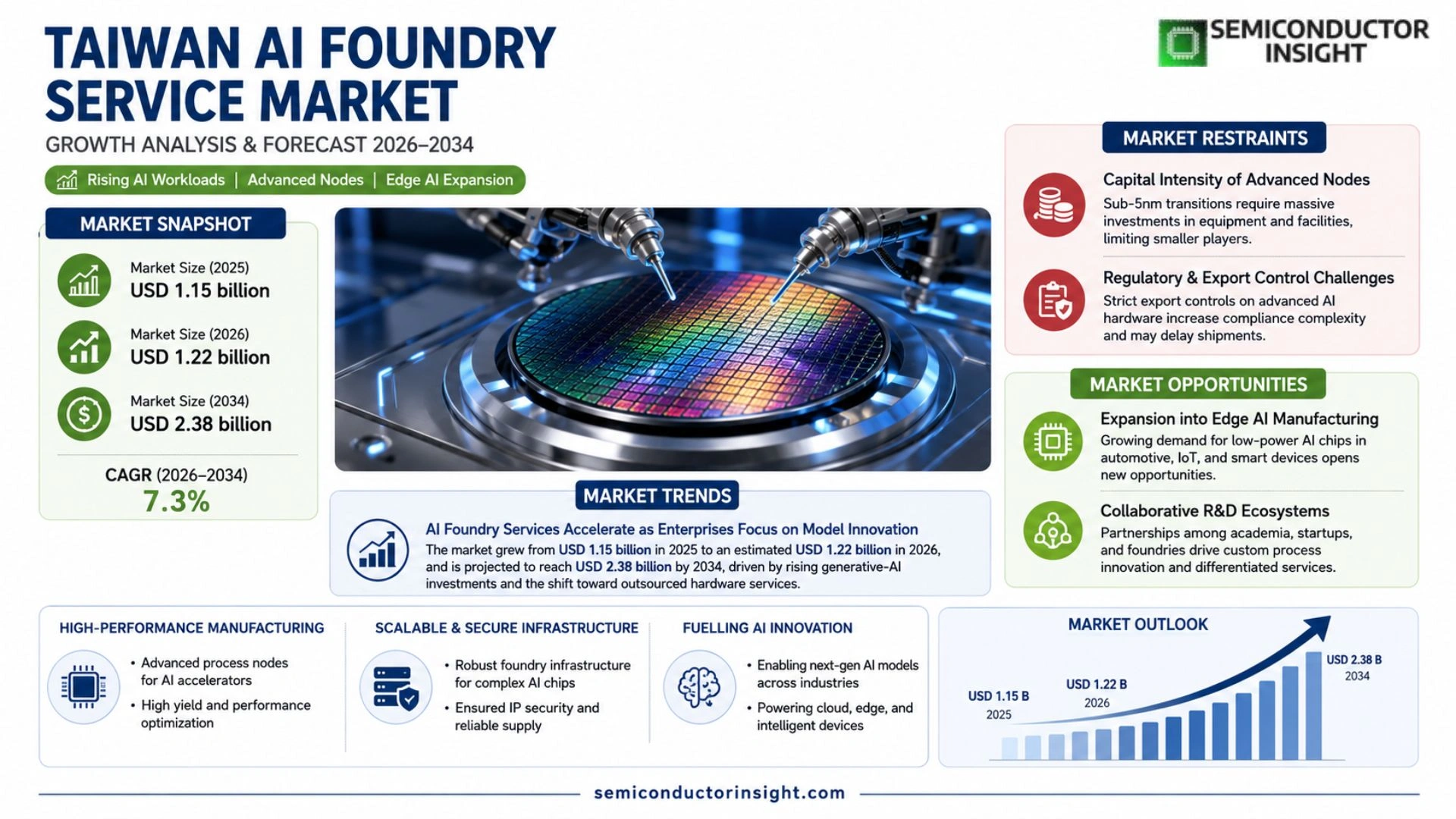
Global Taiwan AI foundry service market size was valued at USD 1.15 billion in 2025. The market is forecasted to rise from USD 1.22 billion in 2026 to USD 2.38 billion by 2034, exhibiting a CAGR of 7.3% during the forecast period.
AI foundry services comprise end‑to‑end platforms that let enterprises develop, train and deploy large‑scale artificial‑intelligence models without owning dedicated hardware. Providers deliver compute clusters, optimized software stacks and managed operations so customers can concentrate on model innovation rather than infrastructure upkeep.
The sector gains momentum because of heightened capital allocation toward generative‑AI projects, growing demand for privacy‑preserving on‑premise solutions, and Taiwan’s robust semiconductor ecosystem that underpins high‑performance accelerators. In addition, collaborations such as the March 2024 joint venture between MediaTek and a leading cloud AI provider demonstrate how local expertise merges with global cloud capabilities, encouraging broader adoption across manufacturing and fintech firms.
MARKET DRIVERS
Government Incentives and Policy Framework
The Taiwanese administration has rolled out a suite of fiscal credits and streamlined approval processes that lower the cost of establishing AI‑focused foundry lines. Manufacturers leveraging these incentives can recoup up to 30% of capital expenditures within the first two years, prompting rapid entry of new players into Taiwan AI Foundry Service Market.
Enterprise Demand for Specialized Chips
Local semiconductor firms report that over 60% of their recent orders specify AI‑optimized architectures, a shift driven by data‑center operators seeking lower latency. This surge in bespoke chip requests forces foundries to expand their advanced node offerings, directly expanding market size.
➤ “Increasing adoption of AI workloads is reshaping capacity allocation, with foundries now dedicating half of their 7nm output to AI designs.”
Strategic partnerships between Taiwanese foundries and global AI chip designers have accelerated technology transfer, allowing faster rollout of 3‑nm processes tailored for neural‑network inference. These collaborations enhance the competitive posture of Taiwan AI Foundry Service Market against regional rivals.
MARKET CHALLENGES
Talent Shortage in High‑Performance Design
While capital is abundant, the pool of engineers proficient in AI‑centric lithography remains limited. Companies report vacancy rates exceeding 45% for senior mask designers, inflating labor costs and extending time‑to‑market for new nodes.
Other Challenges
Supply‑Chain Volatility
Fluctuations in high‑purity gases and rare earth materials have introduced intermittent production bottlenecks, forcing foundries to hold larger safety inventories and compress profit margins.
MARKET RESTRAINTS
Capital Intensity of Advanced Nodes
Transitioning to sub‑5nm processes demands multi‑billion‑dollar investments in equipment and clean‑room upgrades. Smaller operators often lack the financial bandwidth to make these leaps, limiting the breadth of service providers within Taiwan AI Foundry Service Market.
Regulatory scrutiny over export controls for cutting‑edge AI hardware adds another layer of complexity, compelling firms to navigate compliance frameworks that can delay shipments and increase operational overhead.
MARKET OPPORTUNITIES
Expansion into Edge AI Manufacturing
Emerging demand for low‑power AI accelerators in autonomous vehicles, smart cameras, and IoT gateways presents a fertile niche. Foundries that can offer optimized 28nm and 14nm processes with integrated power‑management IP stand to capture a sizable share of this growing segment.
Furthermore, the rise of collaborative R&D hubs,where academia, startups, and established foundries co‑develop bespoke process modules,creates pathways for differentiated service offerings that are difficult for competitors to replicate.
Taiwan AI Foundry Service Market Trends
AI Foundry Services Accelerate as Enterprises Focus on Model Innovation
AI foundry market moved from a valuation of USD 1.15 billion in 2025 to an estimated USD 1.22 billion in 2026, with forecasts indicating a climb to USD 2.38 billion by 2034. This trajectory reflects a steady uptick in enterprises allocating budget to generative‑AI initiatives while seeking to off‑load the complexity of hardware management. In Taiwan, the convergence of a world‑class semiconductor supply chain and rising demand for on‑premise, privacy‑preserving AI solutions strengthens the business case for outsourcing model training and deployment to specialist foundry platforms. Companies that tap these services can redirect engineering talent toward algorithmic breakthroughs rather than infrastructure upkeep.
Other Trends
Strategic Partnerships Linking Chipmakers and Cloud Leaders
March 2024 saw a joint venture between MediaTek and a prominent cloud AI provider, illustrating how Taiwanese hardware expertise is being married to global cloud scale. The partnership accelerates the rollout of AI accelerators that are pre‑tuned for large‑language‑model workloads, offering manufacturing firms rapid access to compute power that aligns with local data‑sovereignty requirements. Such collaborations lower entry barriers for mid‑size players in fintech and smart‑factory sectors, prompting a broader adoption curve across the island’s industrial base.
Emergence of Vertical‑Specific AI Foundry Offerings
Recent months have revealed a discernible shift toward sector‑focused foundry services. Providers are packaging model‑training pipelines that incorporate regulatory constraints for finance, as well as real‑time inference stacks optimized for robotics in automotive assembly lines. This specialization reduces time‑to‑value, because customers inherit pre‑validated data pipelines and compliance checks. For Taiwan AI Foundry Service Market, the trend signals a move away from generic compute rentals toward value‑added solutions that embed industry knowledge, thereby fostering higher margin opportunities for service vendors.
COMPETITIVE LANDSCAPE
Key Industry Players
Taiwan AI Foundry Service Market – Competitive Overview
MediaTek dominates the Taiwanese AI foundry scene, leveraging its deep ASIC design expertise and the island’s semiconductor supply chain. The March 2024 joint venture with a leading global cloud AI provider blends MediaTek’s edge‑accelerator portfolio with elastic cloud resources, enabling enterprises to scale generative‑AI workloads without owning hardware. This alliance captured a sizable share of early‑adopter manufacturing and fintech customers, who value the blend of low‑latency inference and on‑premise data protection. MediaTek’s pricing model,pay‑as‑you‑go compute plus managed‑service layers,has forced rivals to adopt comparable subscription structures, reshaping the regional cost baseline. The firm’s ability to bundle wafer‑level optimizations with software stacks has positioned it as the de‑facto reference architecture for large‑scale model training in Taiwan.
Beyond MediaTek, the market fragments across several specialized providers. TSMC recently announced an AI‑foundry service that repurposes its advanced process nodes for AI‑centric workloads, targeting customers that need custom silicon but lack design capacity. Foxconn’s AI Cloud unit offers turnkey AI infrastructure built on its massive data‑center footprint, appealing to manufacturers seeking end‑to‑end integration. Trend Micro contributes security‑focused AI platforms that emphasize privacy‑preserving inference, a niche gaining traction among regulated finance firms. Delta Electronics differentiates with edge‑optimized AI boxes that combine power‑efficiency with real‑time analytics, while Quanta Cloud supplies hyperscale GPU clusters tailored for research institutions. Acer, UMC, Realtek, Gigabyte, and QNAP round out the ecosystem, each carving out a segment,whether through cost‑effective AI workstations, foundry‑level silicon services, networking‑centric AI accelerators, or intelligent storage solutions. The diversity of offerings forces customers to evaluate trade‑offs between performance, integration depth, and operational overhead, driving a competitive environment that rewards both breadth of portfolio and depth of engineering support.
List of Key AI Foundry Service Companies Profiled
- MediaTek
- TSMC
- Foxconn
- Trend Micro
- Delta Electronics
- Quanta Cloud
- Acer
- UMC
- Realtek
- Gigabyte
- QNAP
- Elan Microelectronics
- IBASE
- Microsoft Azure Taiwan
- Google Cloud Taiwan
Segment Analysis:
| Segment Category | Sub-Segments | Key Insights |
| By Type |
|
Managed AI Foundry serves as the primary driver in Taiwan’s market because: – Providers bundle compute, software stacks and operational support, allowing enterprises to focus on model innovation. – The strong semiconductor base ensures low‑latency, high‑throughput hardware that aligns with the managed service model. – Clients appreciate the reduced capital burden and rapid time‑to‑value, especially in fast‑moving sectors such as fintech and manufacturing. |
| By Application |
|
Generative AI Model Training dominates due to: – High demand for large‑scale model development that leverages Taiwan’s high‑performance accelerators. – Partnerships such as the MediaTek joint venture bring cloud‑grade expertise to local customers. – The service enables rapid experimentation without the need for in‑house GPU farms, accelerating innovation cycles. |
| By End User |
|
Semiconductor Manufacturing emerges as the leading end‑user because: – Firms require privacy‑preserving on‑premise AI to protect IP while optimizing yield. – The proximity to Taiwan’s chip fabs enables tight integration with proprietary accelerators. – Foundry services accelerate adoption of AI‑driven defect detection and process control. |
| By Deployment Model |
|
Hybrid is gaining traction as it balances: – Flexibility of cloud resources for peak training workloads. – Control and data sovereignty of on‑premise inference for regulated sectors. – Seamless workload migration enabled by standardized APIs and Taiwan’s robust network infrastructure. |
| By Industry Vertical |
|
Manufacturing leads because: – AI foundry services empower real‑time quality monitoring and predictive maintenance. – Integration with local chip makers reduces latency for edge AI deployments on factory floors. – The sector’s appetite for cost‑effective scalability aligns with the managed service model. |
Regional Analysis: Taiwan AI Foundry Service Market
Asia-Pacific
Local AI chip designers have matured from experimental labs to commercial players, prompting Taiwan’s foundries to tailor process options that balance density with thermal efficiency. This evolution encourages designers to embed Taiwan‑specific design‑for‑manufacturability guidelines early in their architecture phases.
The concentration of advanced packaging expertise in Taiwan creates a buffer against global disruptions. Clients across the region appreciate the ability to secure critical capacity through multi‑year agreements that incorporate risk‑sharing clauses.
Harmonization of export‑control regimes between Taiwan and key Asia‑Pacific economies simplifies cross‑border technology transfer, allowing AI startups to adopt cutting‑edge process nodes without protracted compliance delays.
A steady stream of engineering talent migrates from regional universities into Taiwan’s fab ecosystem, reinforcing the feedback loop between academic research and commercial chip production in the AI domain.
North America
Companies in the United States and Canada view Taiwan as a gateway to high‑volume AI silicon production. The combination of mature design houses and Taiwan’s process leadership offers a cost‑effective alternative to domestic fabs. However, heightened scrutiny of technology transfer has prompted larger players to negotiate more granular service‑level agreements that protect IP while still leveraging Taiwan’s rapid turnaround capabilities.
Europe
European AI ventures are increasingly interested in Taiwan’s foundry services to meet the EU’s ambition of becoming a global AI hardware supplier. Partnerships often involve joint R&D programmes funded by Horizon Europe, where Taiwanese process experts co‑author architecture refinements that satisfy stringent energy‑efficiency standards prevalent in European markets.
South America
While still nascent, the South American segment is exploring Taiwan’s foundry capacity to accelerate the rollout of AI‑enabled telecommunications infrastructure. Local telecom operators perceive Taiwan’s ability to produce customized ASICs as a lever to differentiate service offerings in competitive markets such as Brazil and Argentina.
Middle East & Africa
In this region, sovereign wealth funds and technology incubators are beginning to allocate capital toward AI chip design firms that intend to partner with Taiwanese foundries. The strategic focus is on building AI processing capability for security and oil‑field analytics, where Taiwan’s precision manufacturing aligns with the need for rugged, low‑power solutions.
Report Scope
This market research report provides a comprehensive analysis of the Taiwan AI Foundry Service Market , covering the forecast period 2026–2034. It offers detailed insights into market dynamics, technological advancements, competitive landscape, and key trends shaping the industry.
Key focus areas of the report include:
- Market Overview: The report begins with an overview outlining its current market scenario, key growth indicators, and industry transformation drivers. It discusses macroeconomic factors, demand–supply balance, regulatory landscape, and the strategic role of semiconductors in powering advancements across industries such as automotive, telecommunications, consumer electronics, and industrial automation.
- Market Size & Forecast: Historical data and future projections for revenue, unit shipments, and market value across major regions and segments.
- Segmentation Analysis: Detailed breakdown by product type, technology, application, and end-user industry to identify high-growth segments and investment opportunities.
- Regional Insights: Insights into market performance across North America, Europe, Asia-Pacific, Latin America, and the Middle East & Africa, including country-level analysis where relevant.
- Competitive Landscape: Profiles of leading market participants, including their product offerings, R&D focus, manufacturing capacity, pricing strategies, and recent developments such as mergers, acquisitions, and partnerships.
- Technology Trends & Innovation: Assessment of emerging technologies, integration of AI/IoT, semiconductor design trends, fabrication techniques, and evolving industry standards.
- Market Drivers & Restraints: Evaluation of factors driving market growth along with challenges, supply chain constraints, regulatory issues, and market-entry barriers.
- Stakeholder Insights: Insights for component suppliers, OEMs, system integrators, investors, and policymakers regarding the evolving ecosystem and strategic opportunities.
Primary and secondary research methods are employed, including interviews with industry experts, data from verified sources, and real-time market intelligence to ensure the accuracy and reliability of the insights presented.
FREQUENTLY ASKED QUESTIONS:
What is the current market size of Taiwan AI Foundry Service Market?
-> Taiwan AI Foundry Service Market was valued at USD 1.15 billion in 2025 and is expected to reach USD 2.38 billion by 2034, reflecting a CAGR of 7.3% over the forecast period.
Which key companies operate in Taiwan AI Foundry Service Market?
-> Key players include MediaTek, which formed a joint venture with a leading global cloud AI provider in March 2024, as well as major cloud AI vendors such as Amazon Web Services, Google Cloud, and Microsoft Azure that are partnering with local semiconductor firms to deliver integrated foundry services.
What are the key growth drivers?
-> Key growth drivers include significant capital allocation toward generative‑AI projects, rising demand for privacy‑preserving on‑premise AI solutions, and Taiwan’s world‑class semiconductor ecosystem that enables high‑performance accelerators.
Which region dominates the market?
-> Asia‑Pacific leads the market, with Taiwan acting as a pivotal hub due to its advanced fab capacity and close integration with global AI cloud providers.
What are the emerging trends?
-> Emerging trends include the convergence of generative AI workloads with on‑premise privacy‑preserving architectures, increased co‑development between semiconductor foundries and cloud AI platforms, and the expansion of AI‑enabled solutions in manufacturing and fintech sectors.
Get Sample Report PDF for Exclusive Insights
Report Sample Includes
- Table of Contents
- List of Tables & Figures
- Charts, Research Methodology, and more...
 Download Sample Report PDF