
MARKET INSIGHTS
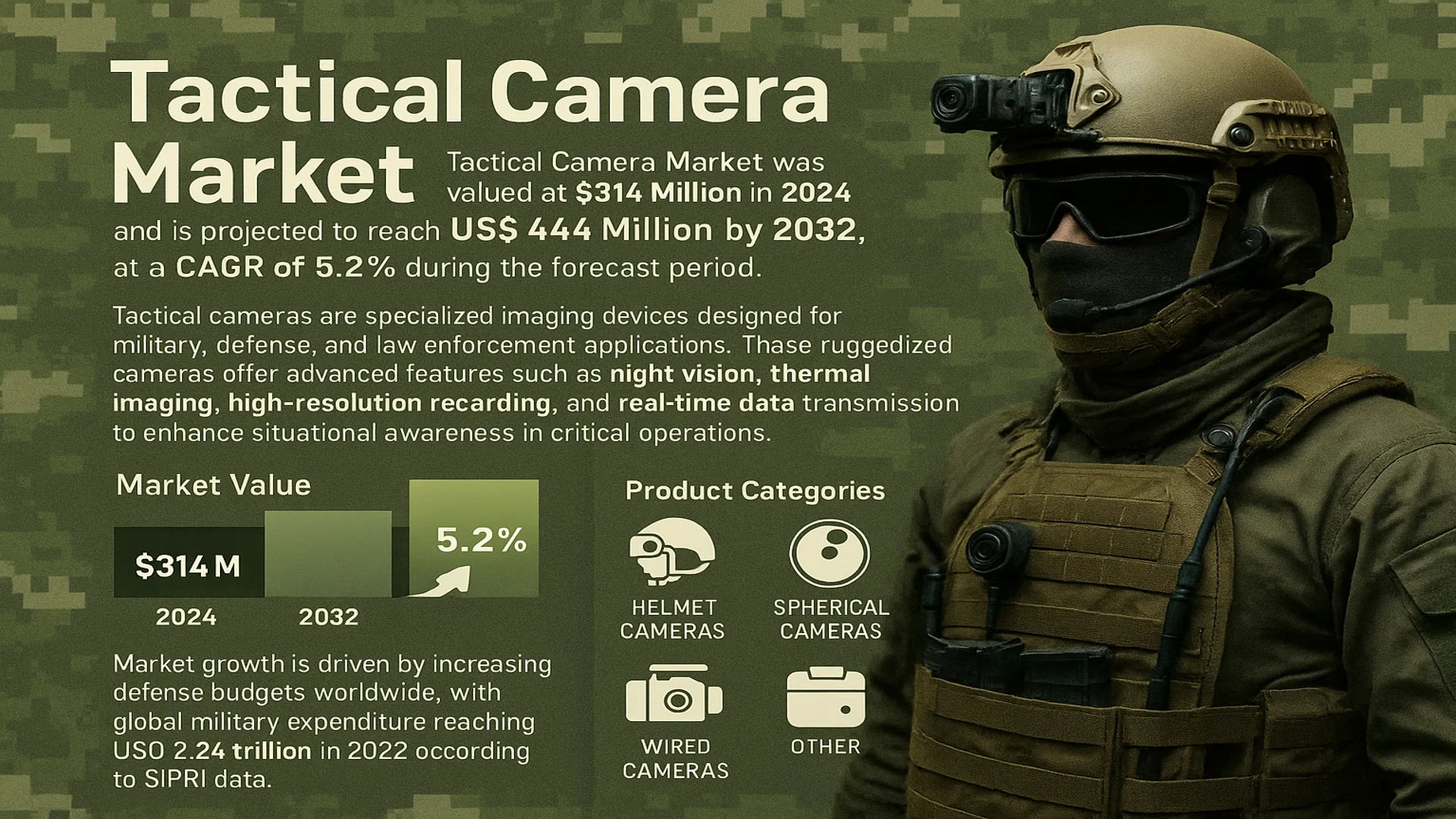
The global Tactical Camera Market was valued at 314 million in 2024 and is projected to reach US$ 444 million by 2032, at a CAGR of 5.2% during the forecast period.
Tactical cameras are specialized imaging devices designed for military, defense, and law enforcement applications. These ruggedized cameras offer advanced features such as night vision, thermal imaging, high-resolution recording, and real-time data transmission to enhance situational awareness in critical operations. The product categories include helmet cameras, spherical cameras, wired cameras, and other specialized variants optimized for harsh environments.
The market growth is driven by increasing defense budgets worldwide, with global military expenditure reaching USD 2.24 trillion in 2022 according to SIPRI data. North America dominates the market due to substantial U.S. defense spending, which accounted for 39% of global military budgets. Technological advancements in imaging sensors and growing demand for surveillance systems in asymmetric warfare scenarios are further accelerating market expansion. Key players like FLIR Systems and MOHOC are investing in next-generation thermal imaging and AI-powered analytics to maintain competitive advantage in this evolving sector.
MARKET DYNAMICS
MARKET DRIVERS
Rising Defense and Military Expenditure to Fuel Tactical Camera Demand
The tactical camera market is experiencing significant growth due to increased defense budgets globally. Recent data indicates worldwide military spending reached an all-time high of $2.24 trillion in 2022, marking an 3.7% increase from the previous year. The United States alone accounted for 39% of this spending at $877 billion. Tactical cameras are becoming indispensable for modern warfare and security operations, with applications ranging from surveillance to real-time battlefield assessment. Advanced models now feature thermal imaging, night vision capabilities, and AI-powered analytics, making them critical for military superiority and national security operations.
Technological Advancements in Imaging Systems Driving Market Expansion
Breakthroughs in camera technology are accelerating market adoption across multiple sectors. Modern tactical cameras now integrate multiple sensors, 360-degree capture capabilities, and ruggedized designs that withstand extreme conditions. Recent product launches feature multi-spectral imaging that combines visible light, infrared, and thermal spectra in a single device. These innovations provide military and law enforcement personnel with unprecedented situational awareness. The integration of AI for real-time object recognition and threat assessment is further increasing the value proposition of these systems, creating strong demand from defense and homeland security agencies.
Growing Homeland Security Applications Creating New Growth Avenues
Expanding security needs beyond traditional military applications are opening new opportunities for tactical camera adoption. Law enforcement agencies worldwide are increasingly deploying these systems for riot control, border monitoring, and critical infrastructure protection. The rising threat of terrorism and civil unrest has prompted governments to invest heavily in surveillance technologies. Tactical cameras offer advantages over traditional CCTV systems through their portability, resilience, and advanced analytical capabilities. This shift toward intelligent surveillance solutions is expected to maintain strong market growth through the forecast period.
MARKET RESTRAINTS
High Development and Deployment Costs Limiting Market Penetration
While demand grows, the tactical camera market faces significant cost-related barriers. Advanced imaging systems incorporating multiple spectral bands and AI processing require substantial R&D investment and specialized manufacturing capabilities. This results in high unit costs that can exceed several thousand dollars for premium models, making widespread adoption challenging for budget-constrained agencies. Additionally, the total cost of ownership extends beyond hardware to include training, maintenance, and software licensing, creating financial hurdles for smaller law enforcement organizations and developing nations.
Other Restraints
Export Control Regulations
Stringent international arms trade regulations complicate the global distribution of advanced tactical cameras. Many countries classify certain imaging technologies as dual-use items, requiring special export licenses that delay transactions and increase compliance costs. These regulatory barriers particularly affect manufacturers seeking to expand into emerging markets where growth potential is high but approval processes are complex and time-consuming.
Technology Obsolescence Risks
The rapid pace of innovation in imaging technologies creates challenges for procurement cycles. Military and law enforcement organizations often face difficulties justifying investments in systems that may become outdated within a few years. This concern is particularly relevant for agencies with long procurement and budgeting processes, potentially causing deferred purchasing decisions that slow market growth.
MARKET CHALLENGES
Data Security and Privacy Concerns Creating Adoption Barriers
The increasing sophistication of tactical cameras raises significant data governance challenges. Modern systems generate massive amounts of sensitive visual data that must be securely stored, processed, and shared. Recent high-profile data breaches have heightened awareness about vulnerabilities in surveillance systems, prompting stricter regulations around data handling. Balancing operational effectiveness with privacy protections remains an ongoing challenge, particularly for agencies operating in civilian environments where surveillance activities face public scrutiny.
Integration Complexity with Existing Infrastructure
Deploying tactical camera systems often requires complex integration with legacy command and control architectures. Many defense and law enforcement organizations operate heterogeneous technology ecosystems developed over decades, creating compatibility issues with modern IP-based camera systems. The technical challenges of integrating real-time video feeds with existing databases, analytics platforms, and communication networks can significantly delay deployments and increase implementation costs.
MARKET OPPORTUNITIES
Emerging Markets Present Significant Untapped Potential
Growing security expenditures in developing nations create substantial opportunities for market expansion. Many countries in Asia, the Middle East, and Africa are modernizing their defense and law enforcement capabilities, with increasing allocations for surveillance technologies. These regions often prefer cost-effective solutions that offer robust performance, creating opportunities for manufacturers that can balance advanced features with competitive pricing. Localized product development addressing specific regional requirements could unlock significant growth potential in these markets.
Commercial Sector Adoption Opening New Revenue Streams
While traditionally focused on government applications, tactical cameras are gaining traction in commercial sectors. Industrial facilities, private security firms, and critical infrastructure operators are increasingly adopting ruggedized surveillance solutions. Applications range from perimeter security at energy installations to wildlife monitoring in remote areas. This diversification reduces market dependence on government budgets while expanding the total addressable market for manufacturers. Strategic partnerships with system integrators and security service providers could accelerate penetration into these emerging commercial applications.
TACTICAL CAMERA MARKET TRENDS
Growing Military Expenditure Driving Demand for Tactical Cameras
The rising global military expenditure continues to bolster the demand for tactical cameras, with governments investing significantly in advanced surveillance and reconnaissance equipment. In 2022, global defense spending reached an estimated $2.24 trillion, reflecting a 3.7% increase from the previous year. The United States alone accounted for nearly 39% of this expenditure, allocating $877 billion to defense, which includes procurement of advanced tactical imaging solutions. Such high investments in defense infrastructure are accelerating the deployment of tactical cameras for mission-critical applications, including battlefield monitoring, intelligence gathering, and real-time situational awareness.
Other Trends
Integration of AI and AR for Enhanced Tactical Imaging
Innovation in tactical cameras is increasingly centered on leveraging artificial intelligence (AI) and augmented reality (AR) technologies to enhance real-time image processing and decision-making. These advancements enable features such as automated threat detection, motion tracking, and night vision optimization for improved operational efficiency in low-light conditions. Modern tactical cameras are also incorporating 4K ultra-HD resolution and thermal imaging capabilities, further expanding their applications in both military and law enforcement sectors. The integration of AI-driven analytics is turning tactical cameras into intelligent tools that can analyze environmental variables and provide actionable insights.
Rising Adoption in Law Enforcement and Disaster Response
Beyond military use, tactical cameras are becoming indispensable for law enforcement agencies, emergency responders, and security personnel. The ability to record high-definition footage in extreme conditions—such as rugged terrains, harsh weather, or low-visibility scenarios—makes these devices vital for search-and-rescue operations and emergency response missions. Additionally, an increasing number of police departments worldwide are equipping officers with body-worn tactical cameras to improve transparency and accountability. The shift toward smart policing and disaster management preparedness is further driving the market forward, with the global tactical camera market projected to reach $444 million by 2032 at a CAGR of 5.2%.
COMPETITIVE LANDSCAPE
Key Industry Players
Innovation-Driven Companies Compete for Market Share in Tactical Camera Space
The global tactical camera market features a moderately fragmented competitive landscape with a mix of established defense contractors and specialized surveillance technology providers. FLIR Systems (now part of Teledyne Technologies) has maintained market leadership through its advanced thermal imaging systems and strong government contracts, particularly in North America and Europe. The company’s 2021 acquisition by Teledyne for $8.2 billion significantly expanded its technological capabilities and market reach, making it a dominant force in tactical imaging solutions.
Bounce Imaging has emerged as a disruptive player with its patented 360° throwable cameras designed for military and law enforcement applications. Meanwhile, MOHOC continues to gain traction with its ruggedized helmet-mounted camera systems adopted by several NATO armed forces. The company grew its revenue by 18% in 2023 through strategic partnerships with defense contractors.
Recent technological advancements in night vision capabilities and AI-powered image analysis have intensified competition, with companies racing to develop cameras that integrate real-time analytics. Tactical Electronics made significant strides in this area with its 2023 launch of the REACT series featuring on-device object recognition.
Regional suppliers like PLAN BETA (Germany) and TSE Inc. (U.S.) are strengthening their positions through niche product differentiation and localized support networks. PLAN BETA notably secured a €14 million contract with the Bundeswehr in Q1 2024 for its next-generation surveillance cameras.
List of Key Tactical Camera Companies Profiled
- FLIR Systems (U.S.)
- Bounce Imaging (U.S.)
- MOHOC (U.S.)
- Apex Vanguard Ltd (UK)
- NOVESTOM (France)
- PLAN BETA (Germany)
- Police1 (U.S.)
- Tactical Electronics (U.S.)
- TSE Inc. (U.S.)
- Zistos (U.S.)
Segment Analysis:
By Type
Helmet Camera Segment Leads Due to Increased Adoption in Military and Defense Operations
The market is segmented based on type into:
- Helmet Camera
- Subtypes: Night Vision, Thermal Imaging, and others
- Spherical Camera
- Wired Camera
- Others
By Application
Military Segment Dominates Owing to Rising Global Defense Expenditure and Modernization Programs
The market is segmented based on application into:
- Defense
- Military
- Enforcement
- Others
By End-User
Government Agencies Lead the Market Due to Strategic Surveillance and Security Needs
The market is segmented based on end-user into:
- Government Agencies
- Law Enforcement
- Private Security Firms
- Others
Regional Analysis: Tactical Camera Market
North America
North America dominates the tactical camera market, driven by high military spending and advanced defense R&D initiatives. With the U.S. allocating $877 billion in military expenditure in 2022, the region leads in adopting cutting-edge surveillance technologies. The demand for helmet-mounted and spherical cameras is particularly strong among law enforcement and special operations units. Additionally, stringent homeland security protocols and growing investments in border surveillance further stimulate market growth. Key players like FLIR and Tactical Electronics are expanding their production capacities to meet the region’s demand for rugged, high-resolution imaging solutions.
Europe
Europe’s tactical camera market thrives on collaborative defense programs and modernization efforts, particularly in Germany, France, and the U.K. The region’s focus on counter-terrorism and urban security has accelerated deployments of wired and wireless tactical cameras. The EU’s emphasis on interoperable defense systems also encourages standardization in camera technologies. While economic constraints in some countries limit rapid adoption, partnerships between manufacturers like NOVESTOM and PLAN BETA and government agencies ensure steady innovation, particularly in thermal and night-vision capabilities.
Asia-Pacific
The Asia-Pacific region is the fastest-growing market, fueled by escalating territorial tensions and military modernization in China, India, and Japan. China’s rapid advancement in indigenous defense technologies has reduced reliance on imports, while India’s focus on border security drives demand for tactical cameras. However, cost sensitivity in Southeast Asian markets results in a preference for mid-range products. Local manufacturers like Apex Vanguard Ltd are gaining traction by offering competitive pricing, though international brands dominate the high-end segment.
South America
South America’s market is nascent but shows potential, with Brazil and Argentina investing in police and military upgrades. Economic instability hampers large-scale procurement, but rising crime rates and drug-trafficking surveillance needs are creating opportunities. The adoption of tactical cameras remains limited to urban enforcement units, with wired systems being the most common due to budget constraints. Regional partnerships with global suppliers aim to improve accessibility to advanced solutions.
Middle East & Africa
The Middle East’s strategic defense investments, particularly in Saudi Arabia and the UAE, support demand for high-end tactical cameras. Conflicts and counterinsurgency operations in the region prioritize real-time surveillance, driving purchases of drones with integrated camera systems. Africa’s market is fragmented, with South Africa leading in adoption due to its advanced defense infrastructure. Elsewhere, funding gaps and geopolitical instability slow growth, though peacekeeping missions present niche opportunities for suppliers.
Technology Trends for the Market
Advancements in AI-powered image processing and miniaturization are reshaping tactical cameras, enhancing their utility in covert operations. Thermal imaging and low-light capabilities are now standard, while integration with IoT platforms enables real-time data sharing. The shift toward modular designs allows customization for diverse operational needs, from urban policing to battlefield reconnaissance. However, cybersecurity risks and high costs remain barriers, particularly for smaller defense budgets.
Report Scope
This market research report provides a comprehensive analysis of the global Tactical Camera market, covering the forecast period 2024–2032. It offers detailed insights into market dynamics, technological advancements, competitive landscape, and key trends shaping the industry.
Key focus areas of the report include:
- Market Size & Forecast: Historical data and future projections for revenue, unit shipments, and market value across major regions and segments. The global Tactical Camera market was valued at USD 314 million in 2024 and is projected to reach USD 444 million by 2032, growing at a CAGR of 5.2%.
- Segmentation Analysis: Detailed breakdown by product type (Helmet Camera, Spherical Camera, Wired Camera, Others) and application (Defense, Military, Enforcement, Others) to identify high-growth segments.
- Regional Outlook: Insights into market performance across North America, Europe, Asia-Pacific, Latin America, and Middle East & Africa, with country-level analysis of key markets.
- Competitive Landscape: Profiles of leading market participants including MOHOC, FLIR, Tactical Electronics, and others, covering their product portfolios, strategies, and recent developments.
- Technology Trends & Innovation: Assessment of emerging technologies in tactical imaging, night vision capabilities, and integration with AI/ML for enhanced situational awareness.
- Market Drivers & Restraints: Evaluation of factors including increasing military expenditure (global spending reached USD 2.24 trillion in 2022 per SIPRI) and security needs versus supply chain constraints.
- Stakeholder Analysis: Insights for defense contractors, system integrators, government agencies, and investors regarding the evolving market ecosystem.
The research employs primary and secondary methods, including expert interviews and verified data sources, to ensure accuracy and reliability.
FREQUENTLY ASKED QUESTIONS:
What is the current market size of Global Tactical Camera Market?
-> Tactical Camera Market was valued at 314 million in 2024 and is projected to reach US$ 444 million by 2032, at a CAGR of 5.2% during the forecast period.
Which key companies operate in Global Tactical Camera Market?
-> Key players include MOHOC, FLIR, Tactical Electronics, Apex Vanguard Ltd, Bounce Imaging, and Eastman Kodak, among others.
What are the key growth drivers?
-> Key growth drivers include rising global military expenditure (USD 2.24 trillion in 2022), increasing security needs, and technological advancements in imaging systems.
Which region dominates the market?
-> North America leads the market due to high defense spending, while Asia-Pacific shows the fastest growth.
What are the emerging trends?
-> Emerging trends include AI-powered image analysis, thermal imaging integration, and miniaturization of tactical cameras.

Get Sample Report PDF for Exclusive Insights
Report Sample Includes
- Table of Contents
- List of Tables & Figures
- Charts, Research Methodology, and more...
 Download Sample Report PDF


