Supercapacitor Market Insights
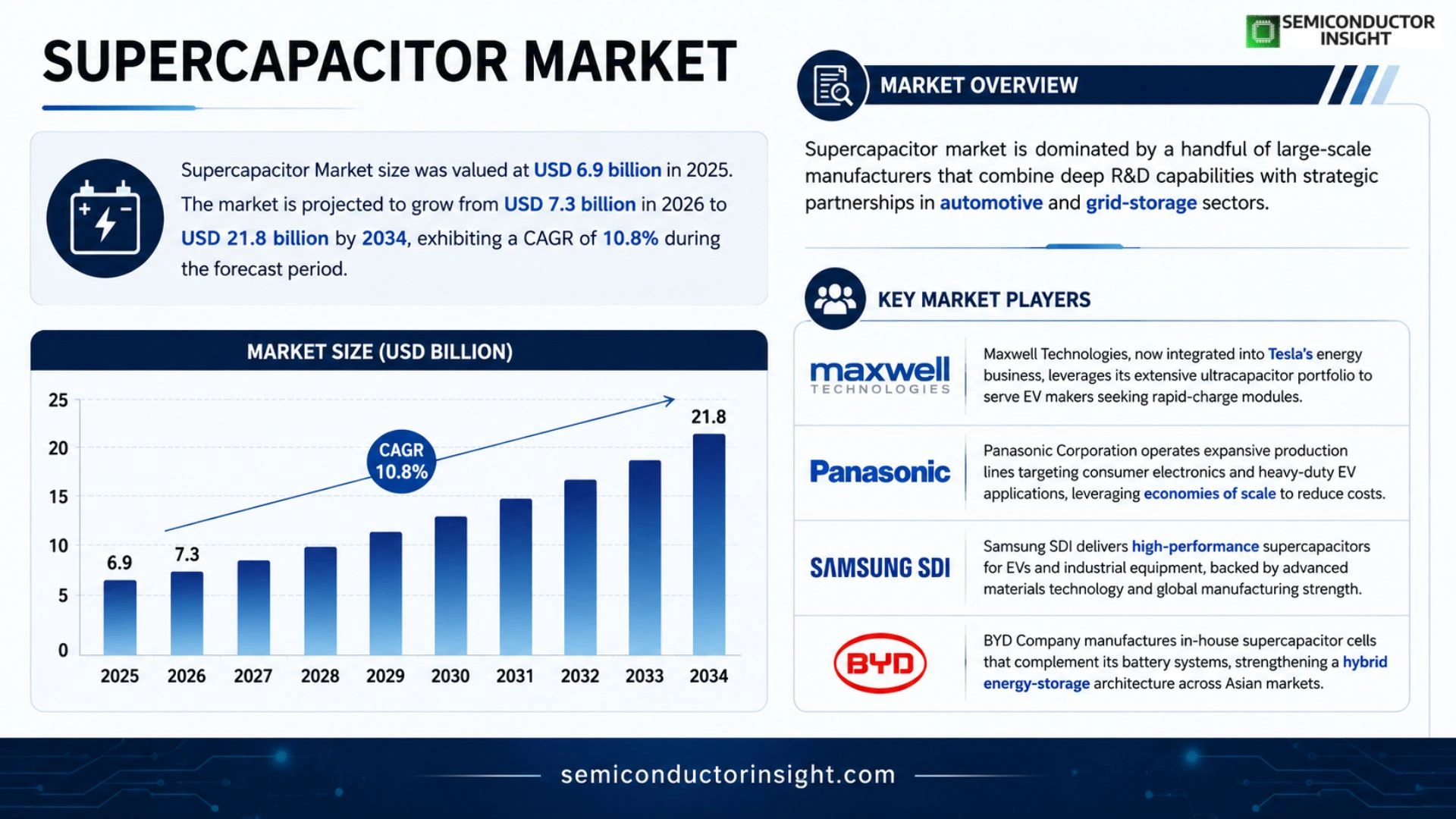
Global Supercapacitor Market size was valued at USD 6.9 billion in 2025. The market is projected to grow from USD 7.3 billion in 2026 to USD 21.8 billion by 2034, exhibiting a CAGR of 10.8% during the forecast period.
Supercapacitors,also called ultracapacitors or electrochemical capacitors,are energy‑storage devices that sit between traditional capacitors and rechargeable batteries. They store energy via electrostatic charge separation on high‑surface‑area electrodes such as activated carbon or emerging graphene composites, delivering rapid charge‑discharge cycles, high power density, and exceptionally long cycle life.
The market is experiencing robust expansion because electric‑vehicle adoption accelerates demand for fast‑charging solutions while renewable‑energy integration drives interest in grid‑level storage that can smooth intermittency. Furthermore, advances in nanomaterial engineering have reduced equivalent series resistance, enabling higher energy density comparable to lithium‑ion cells. Key players,including Maxwell Technologies (Tesla), Panasonic Corporation, Samsung SDI, and BYD Company,are investing heavily in next‑generation graphene designs and forming strategic partnerships with automotive OEMs. Regulatory incentives for low‑carbon infrastructure across Europe and Asia further reinforce growth momentum.
MARKET DRIVERS
Increasing Demand for Energy Storage
The rapid growth of renewable power generation has created a pressing need for reliable short‑term storage. Supercapacitor Market benefits from this trend because supercapacitors can deliver high power density and rapid charge‑discharge cycles, complementing slower‑responding batteries in hybrid storage systems.
Electrification of Transportation
Governments worldwide are setting ambitious targets for electric vehicle (EV) adoption. Supercapacitors are increasingly integrated into regenerative braking systems and power‑assist modules, providing the burst power required for acceleration while enhancing overall vehicle efficiency.
➤ Industry analysts project that enhanced power‑density designs will capture a larger share of the automotive segment within the next five years.
In addition, advances in graphene‑based electrode materials are improving energy density, making supercapacitors more competitive for both consumer electronics and grid‑support applications, further propelling Supercapacitor Market.
MARKET CHALLENGES
High Initial Capital Costs
While production yields have improved, the cost per farad remains higher than that of conventional batteries. This price differential limits large‑scale adoption in price‑sensitive sectors such as residential energy storage.
Other Challenges
Material Limitations
Current electrolyte formulations can restrict operating voltage windows, and the availability of high‑purity carbon nanomaterials adds supply chain complexity. These material constraints impede further reductions in overall system cost.
MARKET RESTRAINTS
Temperature Sensitivity
Supercapacitor performance degrades at extreme temperatures. In hot climates, self‑discharge rates increase, while in sub‑zero environments, capacitance can drop noticeably. Mitigating these effects requires additional thermal management, which adds to system complexity and cost.
MARKET OPPORTUNITIES
Grid‑Scale Storage Solutions
Utility operators are exploring hybrid storage architectures that pair supercapacitors with lithium‑ion batteries. The rapid response of supercapacitors can smooth short‑duration fluctuations in renewable generation, creating a niche where Supercapacitor Market can expand without directly competing with long‑duration battery technologies.
Supercapacitor Market Trends
Rapid Growth Driven by EV Adoption and Renewable Integration
Supercapacitor Market is experiencing a pronounced acceleration as electric‑vehicle manufacturers prioritize fast‑charging solutions to meet consumer expectations for short dwell times. Because ultracapacitors can deliver high power bursts while tolerating millions of charge cycles, they are becoming a preferred complement to lithium‑ion batteries in hybrid powertrains. Concurrently, utilities are deploying the technology to smooth the intermittency of solar and wind farms, offering rapid response that stabilizes grid frequency without sacrificing efficiency. Policy incentives across Europe and Asia further reinforce this trajectory, encouraging low‑carbon infrastructure projects that integrate ultracapacitor‑based storage at both vehicle and grid scales.
Other Trends
Grid‑Level Energy Storage
At the utility level, Supercapacitor Market is supporting the transition toward more resilient distribution networks. Advanced control algorithms now allow grid operators to dispatch ultracapacitor banks within seconds, providing instantaneous load balancing during peak demand spikes or sudden renewable output drops. This capability reduces reliance on costly peaking generators and improves overall system reliability. Moreover, modular designs enable incremental capacity expansion, aligning investment with evolving grid needs while maintaining a low environmental footprint.
Nanomaterial Engineering and Energy Density Improvements
Recent breakthroughs in nanomaterial engineering are reshaping performance expectations for ultracapacitors. Graphene‑based electrodes and engineered carbon aerogels have lowered equivalent series resistance, allowing energy densities that approach those of conventional batteries while preserving superior power delivery. Leading manufacturers are scaling these designs through strategic partnerships with automotive OEMs, accelerating commercialization timelines. As production volumes increase, cost pressures ease, positioning the technology for broader adoption across consumer electronics, public transportation, and stationary storage applications. The convergence of material science, policy support, and system integration signals sustained momentum for Supercapacitor Market in the coming years.
COMPETITIVE LANDSCAPE
Key Industry Players
Supercapacitor Market Competitive Overview
Supercapacitor market is dominated by a handful of large‑scale manufacturers that combine deep R&D capabilities with strategic partnerships in automotive and grid‑storage sectors. Maxwell Technologies, now integrated into Tesla’s energy business, leverages its extensive ultracapacitor portfolio to serve electric‑vehicle (EV) makers seeking rapid‑charge modules. Panasonic Corporation and Samsung SDI operate expansive production lines that target both consumer electronics and heavy‑duty EV applications, capitalising on economies of scale to drive down costs. BYD Company, a vertically‑integrated EV giant, manufactures in‑house supercapacitor cells that complement its battery systems, reinforcing a hybrid energy‑storage architecture that is gaining traction in Asian markets. Collectively, these leaders shape market structure through high‑volume output, aggressive patent filing, and joint‑venture agreements that lock in long‑term supply contracts with OEMs.
Beyond the headline names, a vibrant cohort of niche innovators fuels differentiation and emerging technology adoption. Companies such as Nesscap (Japan) and Ioxus (USA) specialise in high‑voltage cell designs for aerospace and rail‑transit applications. NEC Energy Solutions focuses on grid‑level modules that provide fast frequency regulation, while Avacon (Germany) tailors graphene‑enhanced electrodes for higher energy density. Other notable players include Skeleton Technologies (Estonia), known for its patented curvilinear graphene plates, and KEC International (India), which supplies ruggedised supercapacitors for renewable‑energy micro‑grids. This diversified ecosystem broadens the competitive landscape, ensuring continuous innovation across cost, performance, and form‑factor dimensions.
List of Key Supercapacitor Companies Profiled
- Maxwell Technologies (Tesla)
- Panasonic Corporation
- Samsung SDI
- BYD Company
- Nesscap
- Ioxus
- NEC Energy Solutions
- Avacon
- Skeleton Technologies
- KEC International
- Ferroamp
- Vishay Intertechnology
Segment Analysis:
| Segment Category | Sub-Segments | Key Insights |
| By Type |
|
Electric Double‑Layer Capacitors (EDLC) • Dominates the market because its technology is mature and widely scalable • Provides exceptional power density and extremely long cycle life, making it the default choice for most manufacturers • Serves as the baseline platform on which advanced designs are built, ensuring reliability across automotive and grid applications |
| By Application |
|
Automotive • Fast‑charging capability aligns perfectly with electric‑vehicle acceleration demands • Supports regenerative‑braking systems that recover energy efficiently • Enhances vehicle power‑train resilience by supplying high‑power bursts during start‑stop cycles |
| By End User |
|
Automotive OEMs • Prioritize supercapacitors for rapid charge‑discharge cycles that improve vehicle efficiency • Leverage the technology to meet stringent emission regulations through energy recovery • Seek reliable, low‑maintenance storage that complements battery systems in hybrid architectures |
| By Technology |
|
Graphene‑based • Offers dramatically lower equivalent series resistance, enabling ultra‑fast charging • Provides higher surface area than traditional activated carbon, pushing energy density toward battery levels • Attracts strategic partnerships from leading automotive and consumer‑electronics firms seeking next‑generation performance |
| By Innovation |
|
High Energy‑Density Designs • Blend of pseudocapacitive materials and advanced nanostructuring raises stored energy without sacrificing power • Aligns with grid‑level storage needs where longer discharge durations are essential • Fuels interest from renewable‑energy integrators aiming to smooth intermittency while maintaining rapid response |
Regional Analysis: North America
The automotive sector is a major driver for the supercapacitor market in the US, with applications in hybrid, electric, and autonomous vehicles. The need for rapid energy delivery and recharge capabilities makes supercapacitors an attractive alternative to traditional batteries in certain applications.
Consumer electronics, including smartphones, laptops, and tablets, increasingly utilize supercapacitors for power backup and enhancing device performance. Their ability to deliver high bursts of power is particularly beneficial for demanding applications.
Industrial applications, such as power tools, robotics, and industrial automation, are benefiting from the reliability and long lifespan of supercapacitors for energy storage and backup power solutions in the supercapacitor market.
The growing demand for renewable energy is driving the adoption of supercapacitors for grid-scale energy storage, helping to stabilize the power grid and integrate intermittent energy sources within the supercapacitor market.
Europe
Europe demonstrates a significant and expanding supercapacitor market, characterized by a strong emphasis on sustainability and technological advancement. Stringent environmental regulations and government support for green technologies are key drivers for the adoption of energy storage solutions. The automotive industry in Europe is actively incorporating supercapacitors into hybrid and electric vehicles to enhance efficiency and performance. Furthermore, the increasing deployment of renewable energy sources, such as solar and wind power, is creating substantial opportunities for supercapacitor applications in grid stabilization and energy storage. The robust research and development ecosystem across European nations fosters innovation in supercapacitor materials and designs, ensuring continued growth in this sector of the supercapacitor market. Businesses are focusing on developing advanced supercapacitor technologies to meet the evolving demands of the European energy landscape.
Asia-Pacific
Asia-Pacific is emerging as the fastest-growing supercapacitor market globally, driven by rapid industrialization, increasing urbanization, and substantial investments in renewable energy infrastructure. China, in particular, represents a dominant force in the region, with significant demand for supercapacitors in electric vehicles, consumer electronics, and energy storage systems. Government policies promoting energy efficiency and the adoption of electric mobility are further fueling market expansion. The electronics manufacturing hub in Asia-Pacific also contributes significantly to the demand for supercapacitors in various electronic devices. The cost-effectiveness of supercapacitors compared to batteries in certain applications is also a key factor driving adoption in this dynamic region of the supercapacitor market.
South America
The supercapacitor market in South America is showing promising growth potential, primarily driven by the expanding automotive and energy sectors. Brazil and Argentina are key markets in the region, with increasing demand for supercapacitors in electric vehicles, particularly in the two-wheeled vehicle segment. The growing adoption of renewable energy sources and the need for reliable energy storage solutions are also contributing to market expansion. Government initiatives promoting sustainable transportation and energy development are expected to further boost the supercapacitor market in South America.
Middle East & Africa
The supercapacitor market in the Middle East and Africa is experiencing steady growth, driven by increasing investments in infrastructure development, renewable energy projects, and the growing automotive sector. The demand for supercapacitors in transportation, particularly in electric buses and vehicles, is a key growth driver. The region’s abundant solar resources create significant opportunities for supercapacitor applications in grid-scale energy storage. Governments in the Middle East are also focusing on diversifying their energy mix, further promoting the adoption of innovative energy storage technologies within the supercapacitor market.
Report Scope
This market research report provides a comprehensive analysis of the Supercapacitor Market , covering the forecast period 2026–2034. It offers detailed insights into market dynamics, technological advancements, competitive landscape, and key trends shaping the industry.
Key focus areas of the report include:
- Market Overview: The report begins with an overview outlining its current market scenario, key growth indicators, and industry transformation drivers. It discusses macroeconomic factors, demand–supply balance, regulatory landscape, and the strategic role of semiconductors in powering advancements across industries such as automotive, telecommunications, consumer electronics, and industrial automation.
- Market Size & Forecast: Historical data and future projections for revenue, unit shipments, and market value across major regions and segments.
- Segmentation Analysis: Detailed breakdown by product type, technology, application, and end-user industry to identify high-growth segments and investment opportunities.
- Regional Insights: Insights into market performance across North America, Europe, Asia-Pacific, Latin America, and the Middle East & Africa, including country-level analysis where relevant.
- Competitive Landscape: Profiles of leading market participants, including their product offerings, R&D focus, manufacturing capacity, pricing strategies, and recent developments such as mergers, acquisitions, and partnerships.
- Technology Trends & Innovation: Assessment of emerging technologies, integration of AI/IoT, semiconductor design trends, fabrication techniques, and evolving industry standards.
- Market Drivers & Restraints: Evaluation of factors driving market growth along with challenges, supply chain constraints, regulatory issues, and market-entry barriers.
- Stakeholder Insights: Insights for component suppliers, OEMs, system integrators, investors, and policymakers regarding the evolving ecosystem and strategic opportunities.
Primary and secondary research methods are employed, including interviews with industry experts, data from verified sources, and real-time market intelligence to ensure the accuracy and reliability of the insights presented.
FREQUENTLY ASKED QUESTIONS:
What is the current market size of Supercapacitor Market?
-> Supercapacitor Market was valued at USD 6.9 billion in 2025 and is expected to reach USD 21.8 billion by 2034.
Which key companies operate in Supercapacitor Market?
-> Key players include Maxwell Technologies (Tesla), Panasonic Corporation, Samsung SDI, and BYD Company, among others.
What are the key growth drivers?
-> Key growth drivers include rapid adoption of electric vehicles, renewable‑energy integration for grid‑level storage, and advances in nanomaterial engineering that improve energy density.
Which region dominates the market?
-> Asia-Pacific is the fastest‑growing region, while Europe remains a dominant market due to strong regulatory incentives.
What are the emerging trends?
-> Emerging trends include graphene‑based electrode designs, higher‑energy‑density nanomaterials, and strategic partnerships between supercapacitor manufacturers and automotive OEMs.

Get Sample Report PDF for Exclusive Insights
Report Sample Includes
- Table of Contents
- List of Tables & Figures
- Charts, Research Methodology, and more...
 Download Sample Report PDF