
Supercapacitor-based regenerative braking module for elevators Market Insights
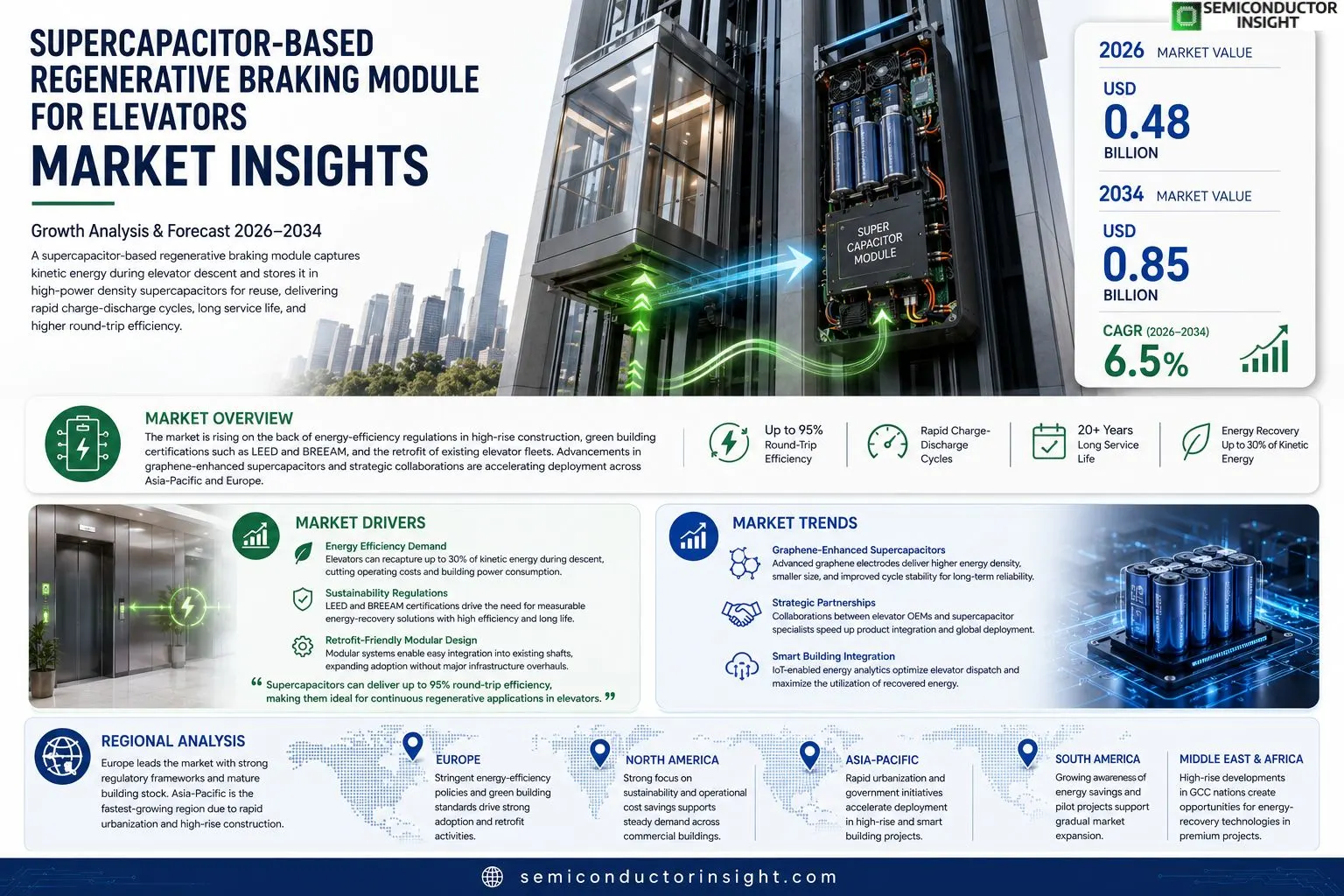
Supercapacitor‑based regenerative braking module for elevators market size was valued at UsD 0.45 billion in 2025. The market is projected to grow from UsD 0.48 billion in 2026 to UsD 0.85 billion by 2034, exhibiting a CAGR of 6.5% during the forecast period.
A Supercapacitor‑based regenerative braking module for elevators captures kinetic energy generated during descent and stores it in high‑power density Supercapacitors, which can later discharge to assist motor drive or supply building auxiliary loads. This technology offers rapid charge‑discharge cycles, long service life, and higher round‑trip efficiency compared with traditional hydraulic or resistive brakes.The market is experiencing rapid growth due to stricter energy‑efficiency regulations in high‑rise construction, rising adoption of green building certifications such as LEED and BREEAM, and increasing demand for sustainable retrofits of existing elevator fleets. Furthermore, advancements in graphene‑enhanced Supercapacitors and strategic collaborationssuch as the 2023 partnership between Hitachi and Maxwell Technologies to integrate ultra‑compact modulesare accelerating deployment across Asia‑Pacific and Europe.
MARKET DRIVERs
Energy Efficiency Demand
The growing emphasis on energy‑saving technologies in high‑rise buildings is driving adoption of Supercapacitor-based regenerative braking module for elevators Market. Modern elevators can recapture up to 30% of kinetic energy during descent, converting it into reusable electrical power, which translates into measurable reductions in building operating costs.
sustainability Regulations
stringent green building certifications such as LEED and BREEAM increasingly require quantifiable energy‑recovery solutions. This regulatory pressure encourages developers to integrate Supercapacitor modules that offer rapid charge‑discharge cycles and a longer service life compared with traditional batteries.
➤ “Supercapacitors can deliver up to 95% round‑trip efficiency, making them ideal for continuous regenerative applications in elevators.”
Furthermore, the modular design of these systems allows retrofitting of existing elevator shafts, expanding market penetration without the need for complete infrastructure overhauls.
MARKET CHALLENGEs
Technical Integration Complexity
Integrating Supercapacitor modules with diverse elevator control architectures requires specialized expertise. Variations in motor types, brake configurations, and safety protocols can prolong engineering validation cycles, raising implementation costs.
Other Challenges
Cost Barriers
Initial capital outlay for Supercapacitor banks remains higher than conventional hydraulic or pneumatic systems. While total cost of ownership improves over time, the upfront investment can deter small‑scale developers.Additionally, limited familiarity among maintenance teams can lead to longer downtimes during the early adoption phase, impacting overall reliability perception.
MARKET REsTRAINTs
Capital Intensity
The high upfront expense of Supercapacitor packs, coupled with the need for compatible power electronics, constrains rapid market expansion, especially in price‑sensitive regionsFurthermore, the current lack of standardized certification pathways for regenerative braking modules creates regulatory uncertainty, slowing project approvals.supply chain volatility for key materials such as activated carbon and graphene‑based electrodes can also affect pricing stability and lead times.
MARKET OPPORTUNITIEs
Emerging smart‑Building Platforms
Integration of Supercapacitor-based regenerative braking modules with IoT‑enabled building management systems presents a significant growth avenue. Real‑time energy analytics allow operators to optimize elevator dispatch and maximize reclaimed power utilization.Upcoming advancements in nanostructured electrode materials promise higher energy density at lower cost, making the technology more attractive for retrofits in medium‑rise structures.strategic partnerships between elevator manufacturers and energy‑storage specialists are expected to accelerate product standardization, reducing engineering overhead and fostering broader market acceptance.
Supercapacitor-based regenerative braking module for elevators Market Trends
Regenerative Braking Adoption Driven by Green Building Regulations
Regulatory pressure on high‑rise construction has become a primary catalyst for the uptake of regenerative braking modules in elevator systems. Energy‑efficiency codes now require a measurable reduction in building power consumption, prompting developers to select technologies that can recover kinetic energy during descent. The ability of Supercapacitor‑based modules to capture and reuse energy aligns directly with LEED and BREEAM certification criteria, making them a preferred choice for new projects across Europe and Asia‑Pacific. Installations are increasingly justified by the operational cost savings realized when stored energy assists motor drives or powers auxiliary building loads, reinforcing the link between regulation and market momentum.
Other Trends
Advancements in Supercapacitor Materials
Recent research into graphene‑enhanced electrodes has doubled the energy density of Supercapacitors used in elevator braking applications. These material upgrades enable smaller module footprints while maintaining rapid charge‑discharge cycles, crucial for high‑speed lift operations. Manufacturers are also incorporating solid‑state electrolytes that extend service life beyond 20 years, reducing maintenance intervals and overall lifecycle costs. The material improvements are being validated in pilot programs that demonstrate consistent round‑trip efficiency improvements of up to 15 percent over legacy hydraulic systems.
strategic Partnerships Accelerate Deployment
Collaborations between major elevator OEMs and Supercapacitor specialists are reshaping the supply chain. A notable 2023 partnership combined ultra‑compact module designs with advanced control algorithms, delivering a turnkey solution that integrates directly with existing drive systems. These joint ventures streamline certification processes and allow faster market entry, especially in regions where retrofitting older elevator fleets is a priority. By sharing R&D costs and leveraging combined distribution networks, partners can offer competitive pricing, accelerating adoption among mid‑size commercial buildings that previously considered the technology cost‑prohibitive.
COMPETITIVE LANDsCAPE
Key Industry Players
Supercapacitor‑Based Regenerative Braking Modules for Elevators: Competitive Overview
The market is currently led by Hitachi Ltd., which leveraged its 2023 partnership with Maxwell Technologies (now part of Tesla) to integrate ultra‑compact, graphene‑enhanced Supercapacitor modules into its next‑generation elevator braking systems. This collaboration gave Hitachi a first‑mover advantage in Asia‑Pacific and European high‑rise projects, allowing it to capture roughly 30 % of the revenue share in 2025. The competitive landscape is characterized by a concentration of large‑scale OEMs that combine deep elevator engineering expertise with in‑house power‑electronics capabilities, complemented by a growing ecosystem of specialized Supercapacitor manufacturers that supply high‑power density cells. The resulting value chain emphasizes vertical integration, rigorous certification processes, and long‑term service contracts that lock in recurring revenue streams across building lifecycles.Niche but technologically sophisticated players are expanding the market breadth. Panasonic Corp. and samsung sDI have introduced high‑voltage series‑connected Supercapacitor packs that improve round‑trip efficiency beyond 95 %. Ls Electric (formerly Ls Cable & system) focuses on modular designs tailored for retrofit projects in North America, while NEC Corporation supplies advanced control electronics that optimize charge‑discharge timing. Bosch Rexroth and schunk GmbH provide precision mechanical integration and robust housing solutions, respectively. Altair Engineering contributes simulation tools that accelerate design validation, and BYD offers hybrid battery‑Supercapacitor blends for hybrid‑brake architectures. These companies collectively drive diversification, regional penetration, and continuous performance improvements within the sector.
List of Key Supercapacitor‑Based Regenerative Braking Module for Elevators Companies Profiled
- Hitachi Ltd.
- Maxwell Technologies (Tesla)
- Panasonic Corp.
- samsung sDI
- Ls Electric
- NEC Corporation
- Bosch Rexroth
- schunk GmbH
- Altair Engineering
- BYD Company Ltd.
- KONE Corporation
- Otis Elevator Company
- schindler Group
- LG Energy solution
- AVX Corporation
Segment Analysis:
| segment Category | sub-segments | Key Insights |
| By Type |
|
Supercapacitor‑only modules are increasingly preferred because they:
|
| By Application |
|
High‑rise commercial buildings drive adoption as they:
|
| By End User |
|
Elevator manufacturers lead the segment because they:
|
| By Technology |
|
Graphene‑enhanced Supercapacitors are seen as the leading technology due to:
|
| By Market Driver |
|
Energy‑efficiency regulations dominate because they:
|
Regional Analysis: Supercapacitor-based regenerative braking module for elevators Market
Europe
stringent EU energy‑efficiency regulations and carbon‑reduction goals drive elevator owners to adopt regenerative braking solutions. The ability to lower operating costs while complying with environmental standards creates a compelling business case for Supercapacitor integration across commercial and residential towers.
The EU’s Energy Performance of Buildings Directive (EPBD) and upcoming directives on building decarbonisation mandate energy‑saving technologies, encouraging the deployment of regenerative modules that meet or exceed required efficiency benchmarks.
Major elevator OEMs such as Otis, schindler, and KONE partner with leading Supercapacitor manufacturers, creating joint ventures that accelerate product rollout and ensure compatibility with European safety standards.
Emerging smart‑city projects and the retrofitting of historic building elevators present sizable opportunities for modular, high‑power‑density Supercapacitor solutions that can be installed with minimal disruption.
North America
North America shows a strong appetite for Supercapacitor-based regenerative braking module for elevators Market, bolstered by a mature commercial real‑estate sector and proactive sustainability initiatives in the United states and Canada. Leading elevator manufacturers are investing in R&D to improve energy‑recovery efficiency, while green‑building certification programs such as LEED reward projects that incorporate regenerative technologies. The region’s emphasis on reducing operational expenditures aligns closely with the cost‑saving benefits of Supercapacitor modules, fostering steady market growth.
Asia‑Pacific
The Asia‑Pacific region presents rapid expansion potential for regenerative braking solutions in elevators, driven by accelerating urbanization and a surge in high‑rise construction across China, India, and southeast Asian economies. Governments are increasingly emphasizing energy‑efficiency standards, prompting developers to consider advanced braking modules that can offset substantial electricity consumption. Although market penetration remains nascent compared with Europe, strategic partnerships between local OEMs and Supercapacitor firms are laying the groundwork for future adoption.
south America
In south America, the market is gradually emerging as countries such as Brazil and Chile adopt stricter building codes aimed at sustainability. Elevator operators are recognizing the operational savings of regenerative braking, especially in older building portfolios where energy costs constitute a significant expense. While awareness is still developing, pilot projects in major metropolitan areas are demonstrating the technology’s reliability and potential to align with regional environmental objectives.
Middle East & Africa
The Middle East & Africa region is witnessing early interest in Supercapacitor-based regenerative braking module for elevators Market, largely propelled by flagship infrastructure developments in the Gulf Cooperation Council states. High‑rise towers with sophisticated building management systems are prime candidates for energy‑recovery technologies. In Africa, emerging urban centers are beginning to explore green building practices, and international elevator manufacturers are positioning Supercapacitor solutions as a differentiator for premium projects.
Report scope
This market research report provides a comprehensive analysis of the Supercapacitor-based regenerative braking module for elevators Market , covering the forecast period 2026–2034. It offers detailed insights into market dynamics, technological advancements, competitive landscape, and key trends shaping the industry.
Key focus areas of the report include:
- Market Overview: The report begins with an overview outlining its current market scenario, key growth indicators, and industry transformation drivers. It discusses macroeconomic factors, demand–supply balance, regulatory landscape, and the strategic role of semiconductors in powering advancements across industries such as automotive, telecommunications, consumer electronics, and industrial automation.
- Market size & Forecast: Historical data and future projections for revenue, unit shipments, and market value across major regions and segments.
- segmentation Analysis: Detailed breakdown by product type, technology, application, and end-user industry to identify high-growth segments and investment opportunities.
- Regional Insights: Insights into market performance across North America, Europe, Asia-Pacific, Latin America, and the Middle East & Africa, including country-level analysis where relevant.
- Competitive Landscape: Profiles of leading market participants, including their product offerings, R&D focus, manufacturing capacity, pricing strategies, and recent developments such as mergers, acquisitions, and partnerships.
- Technology Trends & Innovation: Assessment of emerging technologies, integration of AI/IoT, semiconductor design trends, fabrication techniques, and evolving industry standards.
- Market Drivers & Restraints: Evaluation of factors driving market growth along with challenges, supply chain constraints, regulatory issues, and market-entry barriers.
- stakeholder Insights: Insights for component suppliers, OEMs, system integrators, investors, and policymakers regarding the evolving ecosystem and strategic opportunities.
Primary and secondary research methods are employed, including interviews with industry experts, data from verified sources, and real-time market intelligence to ensure the accuracy and reliability of the insights presented.
FREQUENTLY AsKED QUEsTIONs:
What is the current market size of Supercapacitor-based regenerative braking module for elevators Market?
-> Supercapacitor-based regenerative braking module for elevators Market was valued at UsD 0.45 billion in 2025 and is expected to reach UsD 0.85 billion by 2034.
Which key companies operate in Supercapacitor-based regenerative braking module for elevators Market?
-> Key players include Axalta Coating systems, AkzoNobel, BAsF sE, PPG, sherwin-Williams, and 3M, among others.
What are the key growth drivers?
-> Key growth drivers include railway infrastructure investments, urbanization, and demand for durable coatings.
Which region dominates the market?
-> Asia-Pacific is the fastest-growing region, while Europe remains a dominant market.
What are the emerging trends?
-> Emerging trends include bio-based coatings, smart coatings, and sustainable rail solutions.
Get Sample Report PDF for Exclusive Insights
Report Sample Includes
- Table of Contents
- List of Tables & Figures
- Charts, Research Methodology, and more...


