
Supercapacitor balancing IC Market Insights
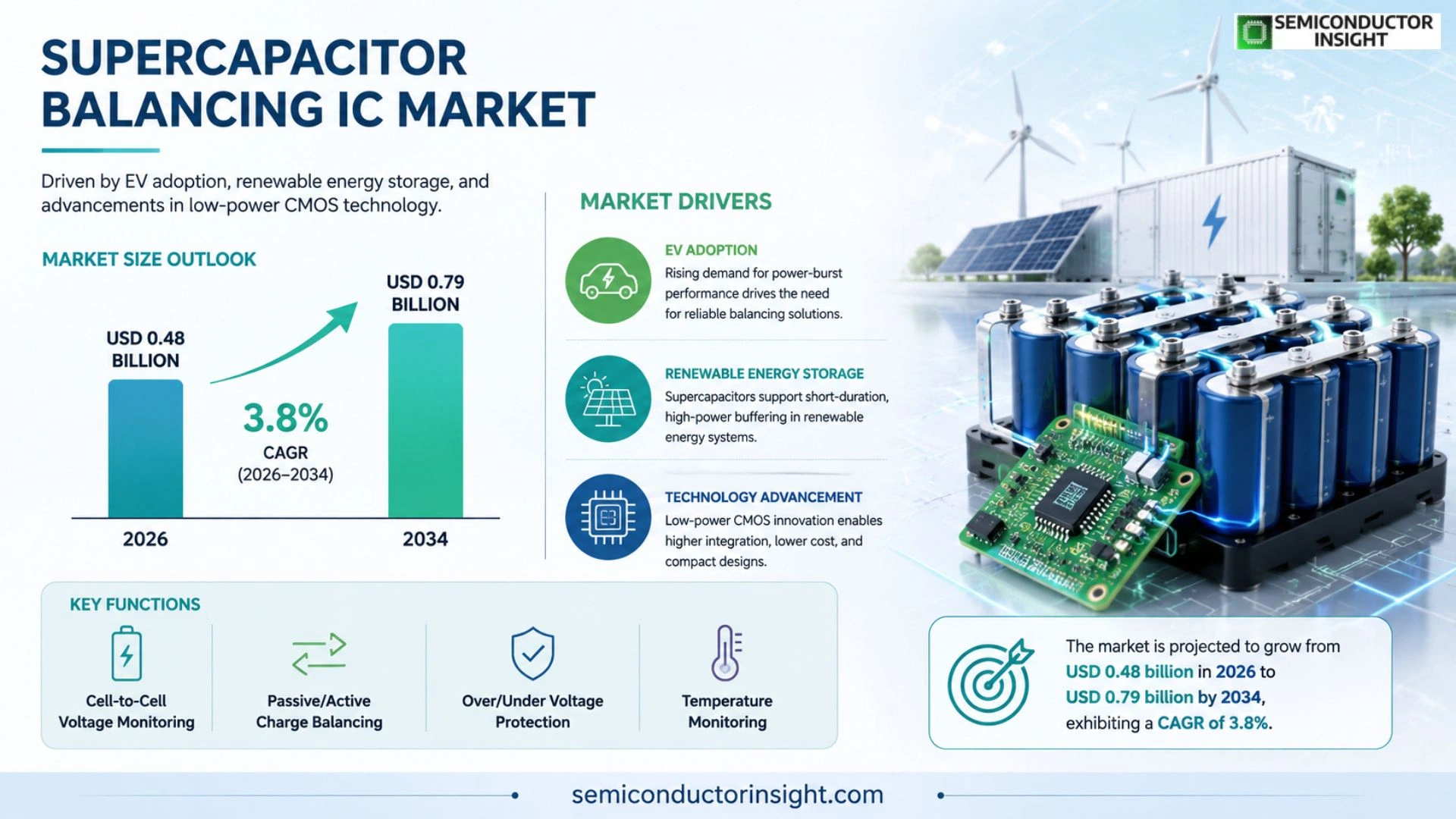
Global Supercapacitor balancing IC market size was valued at USD 0.46 billion in 2025. The market is projected to grow from USD 0.48 billion in 2026 to USD 0.79 billion by 2034, exhibiting a CAGR of 3.8% during the forecast period.
Supercapacitor balancing integrated circuits (ICs) are specialized semiconductor devices designed to monitor and equalize voltage across individual cells within a supercapacitor bank. These ICs provide real‑time cell‑to‑cell voltage detection, passive or active charge redistribution, and protection functions such as over‑voltage, under‑voltage, and temperature monitoring.
The market is experiencing rapid growth because electric‑vehicle adoption accelerates worldwide and renewable‑energy storage systems increasingly rely on supercapacitors for power‑burst applications. Furthermore, advancements in low‑power CMOS technology enable higher integration density and lower cost, making balancing solutions attractive for consumer electronics and industrial UPS systems.
MARKET DRIVERS
Increasing Demand for Energy‑Efficient Power Management
Supercapacitor balancing IC market is propelled by the rapid adoption of renewable energy systems and portable electronics that require high‑efficiency power conversion. Manufacturers are integrating balancing ICs to extend cell life and improve overall system reliability, creating a clear growth trajectory.
Advancements in Semiconductor Process Technologies
New silicon‑on‑insulator (SOI) and advanced CMOS processes enable lower quiescent currents and higher voltage tolerance, making balancing ICs more attractive for both automotive and grid‑scale applications. These technological gains reduce overall bill‑of‑materials costs, encouraging broader market penetration.
➤ The convergence of IoT‑enabled devices and smart‑grid initiatives is accelerating the integration of supercapacitor balancing solutions.
Consequently, original equipment manufacturers (OEMs) are prioritizing design‑for‑balance strategies, which further amplifies demand across multiple end‑use segments.
MARKET CHALLENGES
Cost Sensitivity in High‑Volume Applications
Despite performance benefits, the incremental cost of integrating balancing ICs remains a hurdle for price‑competitive markets such as consumer wearables and low‑cost EVs. manufacturers must balance the added expense against the projected gains in longevity and safety.
Other Challenges
Supply Chain Volatility
Fluctuations in semiconductor wafer availability and raw‑material pricing can lead to lead‑time extensions, directly impacting the rollout schedules of supercapacitor‑based systems.
MARKET RESTRAINTS
Regulatory Compliance and Certification Hurdles
Stringent safety standards for high‑voltage energy storage devices require extensive testing and certification of balancing ICs. The time‑consuming approval process can delay product launches, especially in regions with evolving regulatory frameworks.
MARKET OPPORTUNITIES
Emerging Markets for Electric Mobility
Rapid expansion of electric two‑wheelers, buses, and micro‑mobility solutions in Asia‑Pacific and Latin America opens new avenues for Supercapacitor balancing IC market. These platforms demand compact, reliable balancing solutions to manage high‑cycle‑life supercapacitor banks, presenting a sizable growth opportunity for component suppliers.
Supercapacitor balancing IC Market Trends
Growth Driven by EV Adoption and Renewable Energy Storage
Supercapacitor balancing IC market is experiencing a notable shift as electric‑vehicle manufacturers integrate larger supercapacitor packs to meet power‑burst demands. This shift encourages semiconductor suppliers to embed cell‑to‑cell voltage monitoring and active charge redistribution directly into power‑train modules. At the same time, renewable‑energy storage installations are leveraging supercapacitors for short‑duration, high‑power buffering, creating a need for reliable balancing solutions that protect against over‑voltage and temperature excursions. Recent advances in low‑power CMOS processes enable higher integration density, reducing board space and overall system cost, which is especially relevant for consumer electronics that require compact UPS functionality.
Other Trends
Technology Advancements
Innovation in active balancing architectures is a key subtopic within the market. Modern ICs now support bidirectional current flow, allowing faster equalization across cells and improving overall energy efficiency. Integration of digital diagnostics provides real‑time health metrics that can be accessed by host controllers for predictive maintenance. Moreover, the migration toward 3‑V and 5‑V supply domains aligns balancing ICs with emerging IoT devices, expanding their applicability beyond automotive and grid‑scale storage. These technological refinements are reducing component counts and simplifying board layout, which in turn accelerates time‑to‑market for new product designs.
Competitive Landscape Evolution
Key players such as Texas Instruments, Analog Devices, NXP Semiconductors, and Renesas Electronics are consolidating their portfolios through targeted acquisitions and collaborative development programs. Product launches frequently emphasize integrated protection features, such as over‑temperature shutdown and fault‑tolerant communication interfaces, that differentiate offerings in a crowded marketplace. Partnerships with original equipment manufacturers are accelerating the adoption of balancing ICs in next‑generation electric‑vehicle platforms, while strategic alliances with renewable‑energy system integrators are fostering tailored solutions for grid‑level storage projects. This competitive momentum is expected to sustain a steady stream of innovation across Supercapacitor balancing IC market.
COMPETITIVE LANDSCAPE
Key Industry Players
Supercapacitor Balancing IC Market Competitive Overview
Supercapacitor balancing IC market is anchored by a handful of semiconductor giants that dominate both technology development and volume production. Texas Instruments leads with its BQ series that integrates high‑precision voltage detection and active charge redistribution, serving automotive EV modules and industrial UPS systems. Analog Devices, after absorbing Maxim Integrated, offers a broad portfolio that combines low‑power CMOS design with robust protection features, positioning it as a preferred supplier for consumer‑electronics and renewable‑energy storage. NXP Semiconductors leverages its automotive heritage to deliver ICs optimized for high‑temperature operation, while Renesas Electronics focuses on automotive safety‑critical applications, emphasizing reliability and long‑term supply. These four firms collectively control a majority of the market’s revenue, establishing a tiered structure where large OEMs partner with them for platform‑level designs, and smaller system integrators source specialty parts from niche vendors.
Beyond the dominant tier, several specialized players enrich the competitive landscape with differentiated technologies. Infineon Technologies supplies active balancing solutions that exploit SiC‑based power stages for high‑efficiency charge transfer. STMicroelectronics offers ultra‑low‑power balancing ICs targeting IoT devices and portable electronics. ON Semiconductor and Microchip Technology provide cost‑effective parts for mass‑market UPS and backup power systems. Rohm Semiconductor, Skyworks Solutions, and Cypress Semiconductor (now part of Infineon) contribute niche capabilities such as integrated temperature sensing and high‑frequency communication interfaces, enabling system designers to tailor balancing architectures to specific application constraints.
List of Key Supercapacitor Balancing IC Companies Profiled
- Texas Instruments
- Analog Devices
- NXP Semiconductors
- Renesas Electronics
- Infineon Technologies
- STMicroelectronics
- ON Semiconductor
- Microchip Technology
- Rohm Semiconductor
- Skyworks Solutions
- Cypress Semiconductor
- Maxim Integrated (now part of Analog Devices)
Segment Analysis:
| Segment Category | Sub-Segments | Key Insights |
| By Type |
|
Passive Balancing ICs are the prevailing choice because they provide a straightforward charge‑sharing mechanism with minimal component count.
Active solutions are gaining traction where higher efficiency and tighter voltage equalisation are required, especially in electric‑vehicle power‑train packs. |
| By Application |
|
Electric Vehicles lead the demand as manufacturers look to harness supercapacitors for rapid charge‑discharge cycles.
Renewable‑energy installations rely on balancing ICs to maintain stability in grid‑supporting storage banks, while consumer and industrial segments adopt the technology for compact, high‑reliability backup solutions. |
| By End User |
|
Automotive OEMs drive the most sophisticated balancing solutions, demanding high reliability and robust thermal management.
Energy‑storage integrators focus on modularity and ease of integration, whereas device manufacturers value compact footprints and low power consumption. |
| By Integration Architecture |
|
Integrated Balancing Modules are gaining momentum as designers seek to reduce board space and simplify routing.
Standalone ICs continue to serve niche applications requiring flexible layout, while SoC solutions appeal to high‑volume automotive platforms demanding deep integration. |
| By Functional Feature |
|
Voltage Monitoring is the core differentiator, ensuring cell balance and preventing premature wear.
The combination of these functional features creates a compelling value proposition for system designers across all end‑user segments. |
Regional Analysis: Supercapacitor balancing IC Market
U.S. Federal and Canadian policies prioritize low‑emission transportation, offering tax credits that indirectly boost demand for high‑efficiency balancing solutions across the automotive supply chain.
Advances in CMOS scaling and integrated sensor fusion enable next‑generation ICs with lower power draw and enhanced diagnostics, reinforcing North America’s leadership in innovation.
Europe
Europe’s market is shaped by ambitious decarbonization targets and a strong automotive heritage. Manufacturers are focusing on high‑efficiency balancing ICs to meet the stringent emissions standards set by the EU, especially in Germany and France. Collaborative research programs funded by the European Commission aim to streamline integration of balancing technologies into both passenger‑vehicle and commercial‑vehicle platforms. While the region lags slightly behind North America in overall volume, its emphasis on sustainable design and regulatory compliance drives steady qualitative growth.
Asia-Pacific
The Asia‑Pacific region is rapidly expanding its footprint in Supercapacitor balancing IC market, propelled by massive EV roll‑outs in China, India, and Southeast Asia. Local semiconductor manufacturers are scaling production capacities to meet rising demand from battery pack integrators. Government subsidies for clean‑energy projects and aggressive targets for renewable storage further stimulate adoption. Although the market is still maturing, the sheer scale of automotive and grid‑storage deployments promises a swift upward trajectory.
South America
In South America, market dynamics are influenced by growing interest in renewable‑energy storage and nascent EV adoption in Brazil, Argentina, and Chile. Regional utilities are piloting micro‑grid solutions that rely on precise cell balancing to improve reliability. While infrastructure constraints remain, strategic partnerships with North American technology providers are introducing advanced balancing ICs, laying the groundwork for future expansion as policy frameworks evolve.
Middle East & Africa
The Middle East & Africa region presents a heterogeneous landscape, with the Gulf countries investing heavily in solar‑plus‑storage projects that require sophisticated power‑management components. Meanwhile, African markets are beginning to explore off‑grid storage solutions to address energy access challenges. Balancing ICs are valued for their ability to enhance longevity of storage systems in harsh climatic conditions. Though current volumes are modest, ongoing investments in renewable infrastructure suggest a gradual increase in demand for high‑reliability balancing technologies.
Report Scope
This market research report provides a comprehensive analysis of the Supercapacitor balancing IC Market , covering the forecast period 2026–2034. It offers detailed insights into market dynamics, technological advancements, competitive landscape, and key trends shaping the industry.
Key focus areas of the report include:
- Market Overview: The report begins with an overview outlining its current market scenario, key growth indicators, and industry transformation drivers. It discusses macroeconomic factors, demand–supply balance, regulatory landscape, and the strategic role of semiconductors in powering advancements across industries such as automotive, telecommunications, consumer electronics, and industrial automation.
- Market Size & Forecast: Historical data and future projections for revenue, unit shipments, and market value across major regions and segments.
- Segmentation Analysis: Detailed breakdown by product type, technology, application, and end-user industry to identify high-growth segments and investment opportunities.
- Regional Insights: Insights into market performance across North America, Europe, Asia-Pacific, Latin America, and the Middle East & Africa, including country-level analysis where relevant.
- Competitive Landscape: Profiles of leading market participants, including their product offerings, R&D focus, manufacturing capacity, pricing strategies, and recent developments such as mergers, acquisitions, and partnerships.
- Technology Trends & Innovation: Assessment of emerging technologies, integration of AI/IoT, semiconductor design trends, fabrication techniques, and evolving industry standards.
- Market Drivers & Restraints: Evaluation of factors driving market growth along with challenges, supply chain constraints, regulatory issues, and market-entry barriers.
- Stakeholder Insights: Insights for component suppliers, OEMs, system integrators, investors, and policymakers regarding the evolving ecosystem and strategic opportunities.
Primary and secondary research methods are employed, including interviews with industry experts, data from verified sources, and real-time market intelligence to ensure the accuracy and reliability of the insights presented.
FREQUENTLY ASKED QUESTIONS:
What is the current market size of Supercapacitor balancing IC Market?
-> Supercapacitor balancing IC market size is projected to grow from USD 0.48 billion in 2026 to USD 0.79 billion by 2034.
Which key companies operate in Supercapacitor balancing IC Market?
-> Key players include Texas Instruments, Analog Devices, Maxim Integrated (now part of Analog Devices), NXP Semiconductors, and Renesas Electronics.
What are the key growth drivers?
-> Key growth drivers include electric‑vehicle adoption, renewable‑energy storage demand, and low‑power CMOS advancements.
Which region dominates the market?
-> Region dominance is not specified in the source data.
What are the emerging trends?
-> Emerging trends include integration of balancing ICs in EV power‑burst applications and advanced low‑power CMOS technology.
Get Sample Report PDF for Exclusive Insights
Report Sample Includes
- Table of Contents
- List of Tables & Figures
- Charts, Research Methodology, and more...



