Submetering (Heat/Cool Allocation) Sensor IC Market Insights
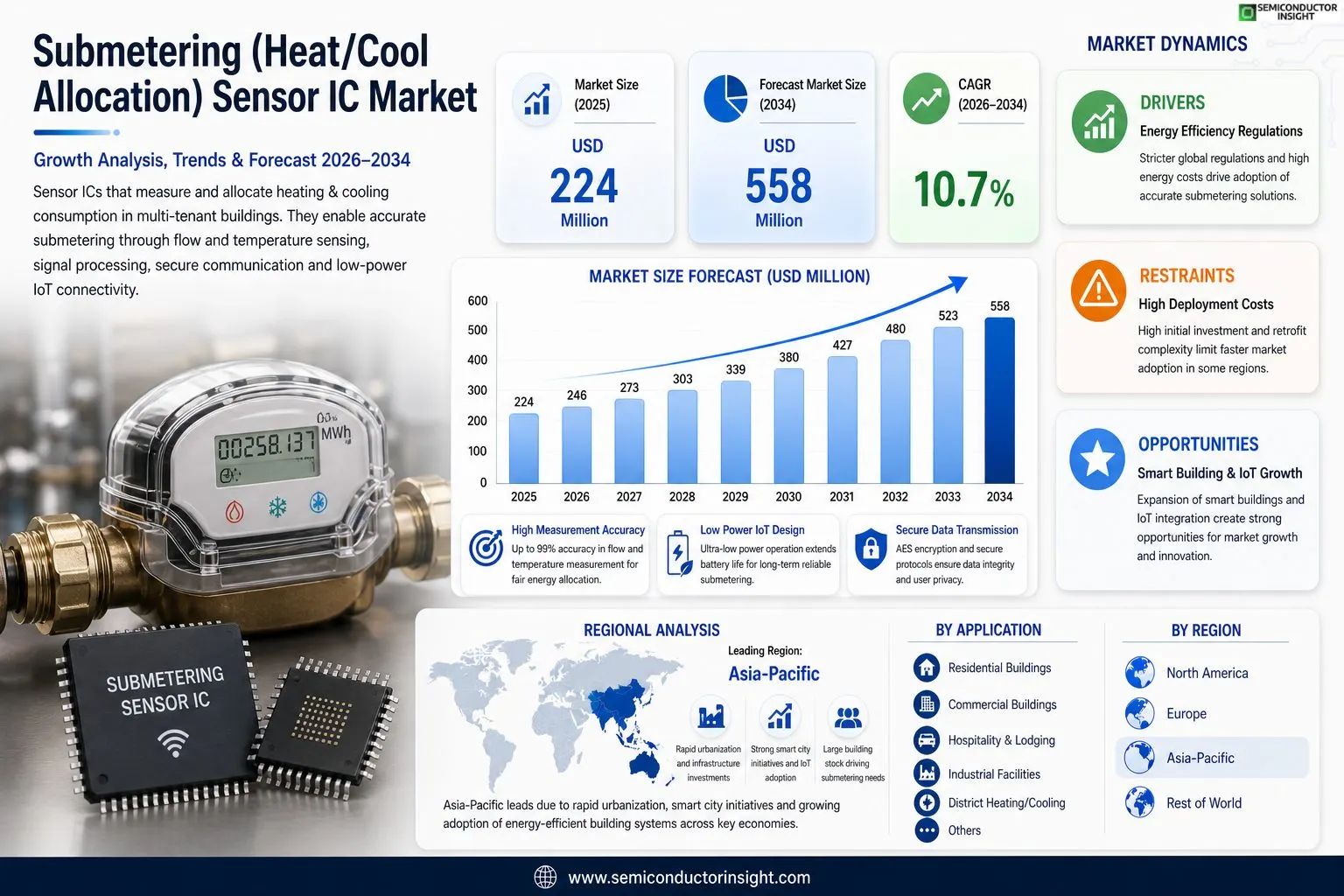
Global Submetering (Heat/Cool Allocation) Sensor IC market size was valued at USD 224 million in 2025. The market is projected to grow from USD 246 million in 2025 to USD 558 million by 2034, exhibiting a CAGR of 10.7% during the forecast period.
Submetering (Heat/Cool Allocation) Sensor ICs are specialized integrated circuits vital for precise energy distribution in multi-tenant buildings. These ICs handle signal processing from flow and temperature sensors to calculate heating and cooling consumption, covering processes like flow detection, thermal differential computation, data encryption, and wireless transmission. The ICs include ultrasonic flow ICs, temperature sensor interfaces, A/D converters, MCUs, and RF modules.
The market is experiencing rapid growth due to several factors, including stricter energy regulations worldwide, surging adoption of smart buildings, and escalating utility costs. Additionally, advancements in low-power IoT technologies and semiconductor miniaturization are driving expansion. Initiatives by key players further fuel this momentum. For instance, in early 2024, Texas Instruments enhanced its ultrasonic sensing portfolio with a new IC offering improved accuracy for heat/cool metering applications. Texas Instruments Incorporated, Analog Devices, Inc., STMicroelectronics, Renesas Electronics Corporation, and Infineon Technologies AG are some of the key players that operate in the market with a wide range of portfolios.
MARKET DRIVERS
Regulatory Push for Energy Efficiency
Stricter global regulations on energy consumption in commercial and residential buildings are accelerating adoption of Submetering (Heat/Cool Allocation) Sensor IC Market. Governments in Europe and North America mandate precise heat and cooling allocation for fair utility billing, driving demand for advanced sensor ICs that offer high accuracy up to 99% in usage measurement.
Smart Building and IoT Integration
The proliferation of smart buildings equipped with IoT ecosystems is a key driver, as Submetering (Heat/Cool Allocation) Sensor ICs enable real-time data collection for optimized HVAC systems. Market growth is projected at a CAGR of 9.2% through 2030, fueled by integration with building management software.
➤ Cost Savings for Property Owners: Submetering solutions reduce disputes over utility bills by 40%, promoting tenant satisfaction and retention in multi-family housing.
Additionally, rising energy costs worldwide are compelling facility managers to deploy these sensor ICs, enhancing overall energy management strategies in Submetering (Heat/Cool Allocation) Sensor IC Market.
MARKET CHALLENGES
High Initial Deployment Costs
Installation of Submetering (Heat/Cool Allocation) Sensor ICs in existing buildings poses significant upfront expenses, often exceeding $5,000 per unit for retrofits. This deters adoption in cost-sensitive markets, particularly in developing regions where budget constraints limit infrastructure upgrades.
Other Challenges
Compatibility with Legacy Systems
Many older HVAC setups lack interfaces for modern sensor ICs, requiring custom engineering that increases complexity and delays implementation in Submetering (Heat/Cool Allocation) Sensor IC Market.
Data Security Concerns
With increased connectivity, vulnerabilities to cyberattacks threaten user privacy, as sensor data transmission demands robust encryption protocols not yet standardized across all devices.
MARKET RESTRAINTS
Semiconductor Supply Chain Disruptions
Ongoing global chip shortages restrict production capacity for Submetering (Heat/Cool Allocation) Sensor ICs, leading to delivery delays of up to 6 months and elevated prices by 15-20% in recent years.Regulatory compliance varies by region, with stringent certifications like UL and CE slowing market entry for new entrants in Submetering (Heat/Cool Allocation) Sensor IC Market.Limited awareness among small-scale property owners further hampers widespread penetration, as education on long-term ROI remains insufficient.
MARKET OPPORTUNITIES
Expansion in Emerging Markets
Rapid urbanization in Asia-Pacific and Latin America opens avenues for Submetering (Heat/Cool Allocation) Sensor ICs, where multi-tenant high-rises demand accurate allocation amid rising energy demands projected to grow 12% annually.Advancements in edge AI enable predictive maintenance features, positioning these ICs as integral to next-gen smart grids and reducing operational costs by 25%.Partnerships with green building initiatives, such as LEED certifications, provide incentives for adoption, boosting Submetering (Heat/Cool Allocation) Sensor IC Market in sustainable developments.
Submetering (Heat/Cool Allocation) Sensor IC Market Trends
Advancements in Ultrasonic Sensing and Low-Power Integration
Submetering (Heat/Cool Allocation) Sensor IC Market continues to evolve as manufacturers prioritize higher accuracy and energy efficiency in integrated circuits designed for multi-tenant building applications. These specialized ICs combine signal processing from flow and temperature sensors to enable precise calculation of heating and cooling consumption, incorporating features such as ultrasonic flow measurement, thermal differential computation, data encryption, and wireless data transmission capabilities. Leading semiconductor companies have introduced enhanced solutions that support ultrasonic metering with reduced power consumption, extending battery life in wireless deployments while maintaining measurement precision required for fair cost allocation.
Other Trends
Rising Demand Driven by Energy Regulations and Smart Building Adoption
Stricter global energy efficiency regulations are accelerating the integration of advanced sensor ICs in submetering systems for heat and cool allocation. Building operators and utilities increasingly rely on these ICs to support individual consumption tracking in residential and commercial multi-unit structures, promoting transparency in utility billing and encouraging end-user conservation behaviors. The surge in smart building initiatives further amplifies demand, as Submetering (Heat/Cool Allocation) Sensor IC solutions facilitate seamless connectivity with building automation platforms and IoT networks for real-time monitoring.
Technological Miniaturization and IoT Compatibility
Semiconductor miniaturization trends have enabled more compact Submetering (Heat/Cool Allocation) Sensor IC designs that integrate multiple functions,including A/D converters, microcontrollers, and RF modules,into single packages. This progress supports lower overall system costs and simplifies installation in space-constrained environments. Low-power IoT technologies play a pivotal role, allowing these ICs to operate efficiently in battery-powered or energy-harvesting setups common in modern metering infrastructure.
Innovation by Key Industry Players
Established semiconductor manufacturers are actively expanding their portfolios to address evolving requirements in heat and cool allocation metering. Texas Instruments has strengthened its ultrasonic sensing offerings with solutions optimized for improved accuracy in heat metering applications, supporting both ultrasonic and traditional flow measurement approaches. Other prominent participants, including Analog Devices, Inc., STMicroelectronics, Renesas Electronics Corporation, and Infineon Technologies AG, continue to develop comprehensive ranges of sensor interface ICs, precision analog components, and wireless-enabled solutions tailored for submetering systems. These efforts focus on combining high-performance signal conditioning with robust data security features to meet stringent industry standards for reliability and privacy in energy allocation networks.
Overall, Submetering (Heat/Cool Allocation) Sensor IC Market reflects a balanced progression toward smarter, more efficient energy management tools. As adoption of district heating and cooling networks expands alongside urban development, these integrated circuits remain essential for delivering accurate, cost-effective submetering performance across diverse building types. Continued emphasis on regulatory compliance, connectivity, and power optimization positions the sector for sustained technological refinement in the coming years.
COMPETITIVE LANDSCAPE
Key Industry Players
Submetering (Heat/Cool Allocation) Sensor IC Market
Submetering (Heat/Cool Allocation) Sensor IC Market features a mix of established semiconductor leaders and specialized metering solution providers. Texas Instruments Incorporated stands out as a leading player with its advanced ultrasonic sensing portfolio, recently enhanced for improved accuracy in heat and cooling metering applications. The market structure is moderately concentrated among analog and mixed-signal IC specialists who supply critical components such as ultrasonic flow ICs, temperature sensor interfaces, A/D converters, and low-power MCUs essential for precise energy allocation in multi-tenant buildings.
Other significant players include semiconductor giants offering comprehensive sensor interface and RF solutions tailored to IoT-enabled submetering devices, alongside metering system integrators that incorporate these ICs into complete heat cost allocator and thermal energy metering solutions. Competition centers on advancements in low-power consumption, miniaturization, data security features, and wireless connectivity to meet evolving regulatory demands for energy efficiency and smart building infrastructure.
List of Key Submetering (Heat/Cool Allocation) Sensor IC Companies Profiled
- Texas Instruments Incorporated
- Texas Instruments Incorporated
- Analog Devices, Inc.
- STMicroelectronics
- Renesas Electronics Corporation
- Infineon Technologies AG
- Kamstrup A/S
- Danfoss
- Diehl Metering
- ZENNER International
- Itron Inc.
- Landis+Gyr
- Apator S.A.
- Siemens AG
- Honeywell International Inc.
Segment Analysis:
| Segment Category | Sub-Segments | Key Insights |
| By Type |
|
Ultrasonic Flow Sensor ICs lead the segment due to their non-intrusive measurement capabilities that deliver exceptional precision in detecting fluid flow variations essential for accurate heat and cool allocation. These ICs excel in handling complex signal processing for thermal energy calculations while supporting low-power operation critical for battery-powered submetering devices. Their integration with advanced digital signal processing enables robust performance even in fluctuating temperature environments typical of multi-tenant HVAC systems. Key advantages include enhanced reliability through contactless operation, which minimizes maintenance needs and contamination risks in closed-loop heating and cooling circuits. This technology facilitates seamless data encryption and wireless transmission, supporting modern smart building infrastructures where real-time consumption insights drive operational efficiency. |
| By Application |
|
HVAC Sub-Metering stands out as the leading application owing to its central role in optimizing energy distribution within sophisticated building management systems. Sensor ICs in this space enable granular monitoring of heating and cooling flows, empowering facility operators to implement dynamic load balancing and identify inefficiencies promptly. The integration of precise thermal differential computation supports compliance with evolving energy efficiency standards while enhancing occupant comfort through equitable allocation. These solutions promote proactive maintenance by delivering actionable consumption patterns that inform system upgrades and operational adjustments. Furthermore, the ability to combine flow detection with temperature sensing in compact IC designs streamlines installation in retrofitted and new-build HVAC infrastructures, fostering sustainable practices across diverse building portfolios. |
| By End User |
|
Residential Multi-Tenant Buildings represent the leading end-user segment as these ICs facilitate fair and transparent billing for individual apartments based on actual heat and cool consumption. In such environments, the sensor ICs support compact, reliable designs that integrate effortlessly into existing piping and control systems without disrupting daily operations. They encourage energy-conscious behavior among residents by providing clear usage feedback, ultimately contributing to overall building sustainability goals. The low-power and wireless capabilities of these ICs prove particularly valuable in large-scale residential complexes where centralized data collection enhances management efficiency. Moreover, their robust signal processing ensures consistent performance across varying load conditions common in apartment heating and cooling demands, reinforcing long-term system durability and user satisfaction. |
| By Technology |
|
Wireless IoT Enabled emerges as the dominant technology due to its flexibility in enabling remote monitoring and seamless data integration within smart building ecosystems. These ICs incorporate advanced RF modules that support secure, real-time transmission of consumption data, eliminating the need for extensive cabling and simplifying deployment in both new and retrofit projects. The technology aligns perfectly with the push toward connected infrastructures, allowing centralized analytics platforms to aggregate insights from multiple submetering points efficiently. Enhanced encryption features safeguard sensitive usage information while low-power design extends operational life in battery-dependent setups. This approach not only streamlines installation processes but also facilitates predictive maintenance and demand-response strategies that optimize energy flows across heating and cooling networks. |
| By Measurement Principle |
|
Ultrasonic Transit-Time leads this segment through its superior accuracy in measuring flow velocity without physical contact with the medium. This principle enables reliable performance in diverse fluid conditions encountered in heat and cool allocation systems, supporting precise computation of energy consumption. ICs based on this technology integrate sophisticated timing circuits and digital processing to deliver consistent results even under turbulent flows or temperature swings. Their non-invasive nature reduces installation complexity and potential points of failure compared to traditional methods. Additionally, the approach supports miniaturization trends in semiconductor design, allowing compact solutions that fit modern space-constrained metering applications while maintaining high fidelity in data output for effective allocation and billing purposes. |
Regional Analysis: Submetering (Heat/Cool Allocation) Sensor IC Market
North America
North America represents the leading region in Submetering (Heat/Cool Allocation) Sensor IC Market due to its mature building automation ecosystem and early adoption of energy-efficient infrastructure. The region demonstrates a strong shift toward granular energy monitoring within both residential and commercial applications, driven by regulatory emphasis on sustainability and transparent utility billing. Submetering technologies, including advanced heat and cooling allocation sensors, are widely implemented in multifamily housing, commercial complexes, and institutional facilities to improve resource accountability and operational efficiency.The market also benefits from the high penetration of smart buildings and IoT-driven energy management platforms, which increasingly rely on sensor ICs capable of accurate thermal measurement and low-power operation. Innovation clusters across the U.S. and Canada continue to integrate advanced semiconductor technologies, enabling more compact designs and improved signal processing within submetering architectures. Furthermore, facility managers and property developers are prioritizing systems that support real-time analytics and predictive maintenance, which creates sustained demand for high-performance sensor ICs. As utility providers encourage consumers to adopt consumption-based billing practices, the region remains at the forefront of technological upgrades, shaping the next wave of heat and cooling allocation solutions.
North America maintains a highly advanced smart building infrastructure, which accelerates adoption of Submetering (Heat/Cool Allocation) Sensor IC technologies. Developers increasingly deploy sensors that enable real-time data collection for HVAC optimization. The growing preference for automated building controls supports the integration of smaller, energy-efficient ICs that enhance system responsiveness and improve overall operational visibility.
Regulatory bodies continue to strengthen energy conservation requirements, prompting property managers to adopt advanced submetering approaches. These policies encourage more precise monitoring of heat and cooling usage, increasing the demand for modern sensor ICs with enhanced accuracy. The alignment of municipal sustainability goals with building codes further drives market growth across multiple asset classes.
The region’s semiconductor innovation ecosystem accelerates advancements in sensor IC design, resulting in improved signal stability, reduced power consumption, and enhanced reliability. These innovations strengthen applications ranging from HVAC monitoring to complex thermal distribution management, making North America a hub for engineering breakthroughs in heat and cooling allocation systems.
Increasing demand for consumption-based billing in multifamily housing fuels widespread deployment of submetering technologies. Property developers view heat and cooling allocation sensors as essential tools for improving cost transparency and supporting tenant accountability. This trend is expected to expand further as residents seek greater control over energy usage patterns.
Europe
Europe remains a critical market for Submetering (Heat/Cool Allocation) Sensor IC solutions, supported by strong environmental regulations and a long-standing focus on energy conservation. The region’s strict sustainability standards encourage the adoption of advanced submetering frameworks in residential, commercial, and public-sector buildings. Ongoing modernization of district heating systems, particularly in Northern and Central Europe, drives the need for sensor ICs capable of precise thermal measurement in variable operating conditions. Additionally, widespread retrofitting of older buildings supports market expansion, as property owners implement intelligent energy management technologies to meet efficiency targets. The integration of IoT-enabled devices across the region promotes real-time data collection, enabling more efficient heat and cooling allocation within diverse building types.
Asia-Pacific
Asia-Pacific is experiencing accelerated adoption driven by rapid urbanization, the expansion of smart city initiatives, and rising awareness of energy conservation. Countries such as China, Japan, South Korea, and India are increasingly implementing smart building solutions that rely on high-performance sensor ICs. Growing investments in commercial infrastructure and high-density residential developments create significant opportunities for submetering systems that support optimized HVAC management. The region also benefits from strong semiconductor manufacturing capabilities, which reduce production costs and foster innovation in compact, high-precision IC designs. Emerging energy efficiency policies across Asia-Pacific continue to influence building developers to integrate advanced submetering and thermal allocation systems at early stages of construction planning.
South America
South America is gradually expanding its presence in Submetering (Heat/Cool Allocation) Sensor IC Market as energy efficiency gains importance across urban centers. Countries such as Brazil, Chile, and Colombia are prioritizing infrastructure modernization, including HVAC optimization across commercial properties and multifamily housing. Although adoption levels vary by country, increasing demand for transparent utility billing and the need to reduce energy waste stimulate interest in submetering technologies. The region’s developing smart building initiatives support the integration of IoT-enabled sensing systems, encouraging the use of sensor ICs that deliver reliable performance in diverse climatic environments. Continued investments in real estate modernization and sustainability awareness are expected to strengthen the market’s outlook.
Middle East & Africa
The Middle East & Africa region is witnessing steady growth as governments and private developers implement energy management solutions across high-temperature climates where cooling efficiency is a priority. Modern commercial developments, luxury residential complexes, and large-scale public buildings increasingly incorporate submetering systems to manage cooling loads more precisely. Sensor ICs designed for thermal allocation play a vital role in supporting these objectives, particularly in environments requiring continuous climate control. Additionally, sustainability frameworks across Gulf nations encourage the adoption of intelligent building technologies that monitor HVAC consumption. In Africa, ongoing urban growth and infrastructure investments gradually expand the market, with early-stage adoption occurring in emerging smart city projects and modern residential developments.
Report Scope
This market research report provides a comprehensive analysis of the Submetering (Heat/Cool Allocation) Sensor IC Market , covering the forecast period 2026–2034. It offers detailed insights into market dynamics, technological advancements, competitive landscape, and key trends shaping the industry.
Key focus areas of the report include:
- Market Overview: The report begins with an overview outlining its current market scenario, key growth indicators, and industry transformation drivers. It discusses macroeconomic factors, demand–supply balance, regulatory landscape, and the strategic role of semiconductors in powering advancements across industries such as automotive, telecommunications, consumer electronics, and industrial automation.
- Market Size & Forecast: Historical data and future projections for revenue, unit shipments, and market value across major regions and segments.
- Segmentation Analysis: Detailed breakdown by product type, technology, application, and end-user industry to identify high-growth segments and investment opportunities.
- Regional Insights: Insights into market performance across North America, Europe, Asia-Pacific, Latin America, and the Middle East & Africa, including country-level analysis where relevant.
- Competitive Landscape: Profiles of leading market participants, including their product offerings, R&D focus, manufacturing capacity, pricing strategies, and recent developments such as mergers, acquisitions, and partnerships.
- Technology Trends & Innovation: Assessment of emerging technologies, integration of AI/IoT, semiconductor design trends, fabrication techniques, and evolving industry standards.
- Market Drivers & Restraints: Evaluation of factors driving market growth along with challenges, supply chain constraints, regulatory issues, and market-entry barriers.
- Stakeholder Insights: Insights for component suppliers, OEMs, system integrators, investors, and policymakers regarding the evolving ecosystem and strategic opportunities.
Primary and secondary research methods are employed, including interviews with industry experts, data from verified sources, and real-time market intelligence to ensure the accuracy and reliability of the insights presented.
FREQUENTLY ASKED QUESTIONS:
What is the current market size of Submetering (Heat/Cool Allocation) Sensor IC Market?
-> Submetering (Heat/Cool Allocation) Sensor IC Market was valued at USD 224 million in 2025 and is expected to reach USD 558 million by 2034, reflecting a CAGR of 10.7%.
Which key companies operate in Submetering (Heat/Cool Allocation) Sensor IC Market?
-> Key players include Texas Instruments Incorporated, Analog Devices, Inc., STMicroelectronics, Renesas Electronics Corporation, and Infineon Technologies AG, among others.
What are the key growth drivers?
-> Key growth drivers include stricter global energy regulations, rising adoption of smart buildings, increasing utility costs, advancements in low-power IoT technologies, and semiconductor miniaturization.
Which region dominates the market?
-> The reference content does not specify a dominating region for Submetering (Heat/Cool Allocation) Sensor IC Market.
What are the emerging trends?
-> Emerging trends include advancements in low-power IoT sensing technologies, semiconductor miniaturization, enhanced wireless communication capabilities, and improved accuracy in ultrasonic sensing ICs.

Get Sample Report PDF for Exclusive Insights
Report Sample Includes
- Table of Contents
- List of Tables & Figures
- Charts, Research Methodology, and more...
 Download Sample Report PDF