MARKET INSIGHTS
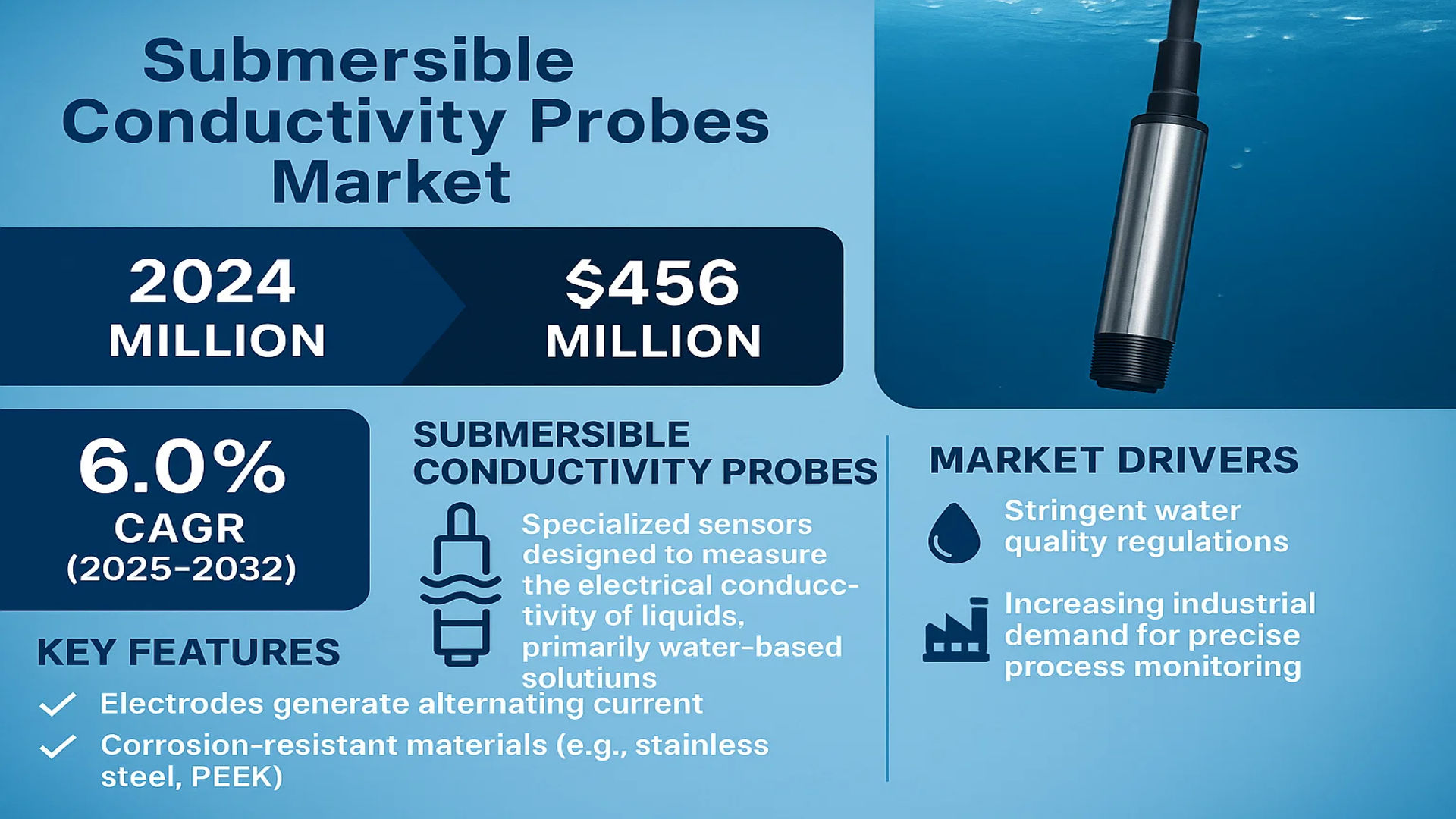
The global Submersible Conductivity Probes Market size was valued at US$ 287 million in 2024 and is projected to reach US$ 456 million by 2032, at a CAGR of 6.0% during the forecast period 2025-2032.
Submersible conductivity probes are specialized sensors designed to measure the electrical conductivity of liquids, primarily water-based solutions. These devices feature electrodes that generate an alternating current to assess ionic concentration, with measurements directly correlating to dissolved solids content. The probes consist of corrosion-resistant materials like stainless steel or PEEK, connected via shielded cables to monitoring equipment for real-time data acquisition.
Market growth is driven by stringent water quality regulations and increasing industrial demand for precise process monitoring. The wastewater treatment sector accounts for over 35% of probe deployments, followed by chemical processing (22%) and food & beverage industries (18%). Recent advancements include smart probes with IoT connectivity and self-cleaning electrodes, addressing challenges like biofouling in continuous monitoring applications. Key players like Emerson, HORIBA, and Hanna Instruments are expanding their portfolios with modular designs capable of measuring multiple parameters including temperature and pH alongside conductivity.
MARKET DYNAMICS
MARKET DRIVERS
Growing Water Quality Monitoring Requirements to Fuel Submersible Conductivity Probe Demand
The global emphasis on water quality management is accelerating the adoption of submersible conductivity probes across multiple industries. With increasing industrial pollution and stricter environmental regulations, real-time water quality monitoring has become essential. The wastewater treatment sector alone contributes over 35% of the total demand for these probes, as they provide crucial conductivity measurements indicating dissolved solids concentration. Municipal water treatment plants are rapidly modernizing their infrastructure, with conductivity monitoring systems becoming standard for process control and regulatory compliance.
Industrial Automation Trends to Drive Market Expansion
Industry 4.0 initiatives are transforming process industries through automation, creating significant demand for smart monitoring solutions like submersible conductivity probes. Pharmaceutical manufacturing, which requires precise water quality control throughout production cycles, has seen a 28% increase in conductivity probe adoption over the past three years. These digital sensors integrate seamlessly with SCADA and DCS systems, enabling automated process adjustments that improve efficiency and product consistency. The food and beverage industry particularly benefits from hygienic probe designs that maintain product quality while meeting sanitation standards.
Technological Advancements in Sensor Design to Accelerate Adoption
Manufacturers are innovating probe designs to overcome traditional limitations, with newer models offering 25% longer lifespans and 15% better accuracy compared to previous generations. Features like titanium housings, PTFE cables, and modular designs now dominate premium product lines. Recent developments in multi-parameter sensors combining conductivity with pH, ORP, and temperature measurements are reducing installation complexity while providing comprehensive water quality data. Such innovations make the probes more valuable for critical applications like semiconductor manufacturing where ultrapure water monitoring is essential.
MARKET RESTRAINTS
High Initial Investment Costs to Limit Market Penetration
While submersible conductivity probes deliver long-term value, their premium pricing remains a barrier for smaller operations. Advanced industrial-grade probes with multiple parameters can cost 3-5 times more than basic models, putting them beyond reach for many developing markets. Installation often requires complementary equipment like transmitters and calibration tools, adding to the total cost of ownership. This financial hurdle is particularly evident in municipal water systems with limited budgets, where over 40% of facilities still rely on manual sampling methods.
Other Restraints
Maintenance Complexity
Regular cleaning and calibration requirements increase operational costs, with industrial probes needing servicing every 1-3 months. Biofouling in wastewater applications can reduce measurement accuracy by up to 30% if not addressed promptly.
Limited Applications in Extreme Conditions
While probe materials have improved, operations in high-temperature or high-pressure environments still require specialized and costly solutions. This restricts adoption in sectors like geothermal energy and deep-sea applications.
MARKET OPPORTUNITIES
Emerging Economies to Offer Significant Growth Potential
Developing nations present substantial opportunities as they invest in water infrastructure and industrial modernization. Countries implementing smart city initiatives are incorporating advanced water monitoring systems, with projected growth rates exceeding 15% annually in these regions. The Asia Pacific market alone is expected to account for 45% of new installations by 2030, driven by rapid industrialization and environmental awareness.
Additional Opportunities
Expansion of Aquaculture Industry
The growing aquaculture sector requires precise water quality monitoring, creating demand for durable marine-grade conductivity probes. Saltwater applications now represent one of the fastest-growing segments.
Development of IoT-Enabled Solutions
Wireless conductivity probes with cloud connectivity enable remote monitoring across distributed facilities. This innovation is proving particularly valuable for environmental monitoring networks and decentralized water systems.
MARKET CHALLENGES
Accuracy Maintenance in Complex Fluids to Challenge Manufacturers
Ensuring measurement precision in heterogeneous fluids remains technically challenging, particularly in wastewater streams containing oils and suspended solids. Some industrial effluents can cause measurement drift of up to 20% without frequent calibration. Manufacturers are developing advanced compensation algorithms and self-cleaning mechanisms, but complete solutions for all fluid types remain elusive.
Other Challenges
Standardization Issues
Lack of unified calibration protocols across manufacturers creates compatibility challenges in multi-vendor installations. This complicates system integration and data comparability across facilities.
Competition from Alternative Technologies
Emerging optical measurement techniques threaten traditional electrode-based probes in certain applications. While conductivity probes maintain advantages in cost and robustness, technology substitution could impact future growth.
SUBERSIBLE CONDUCTIVITY PROBES MARKET TRENDS
Growing Demand for Water Quality Monitoring Drives Market Expansion
The global submersible conductivity probes market is experiencing robust growth, primarily driven by the increasing need for precise water quality measurement across industries. In 2024, the market was valued at an estimated multi-million-dollar figure, with projections suggesting steady growth through 2032 at a significant compound annual growth rate. The water and wastewater treatment sector represents the largest application segment, accounting for over 30% of total market demand, as governments worldwide implement stricter regulations for water purity standards. The probes’ ability to provide real-time conductivity measurements makes them indispensable for environmental compliance and process optimization.
Other Trends
Technological Advancements in Sensor Design
Manufacturers are increasingly focusing on developing corrosion-resistant and durable probes capable of withstanding harsh industrial environments. Recent innovations include the integration of smart sensors with IoT capabilities, allowing remote monitoring and data collection. Modular probe designs have gained popularity, offering end-users flexibility in configuration and easier maintenance. The adoption of advanced materials like PEEK (polyetheretherketone) has significantly improved probe longevity in aggressive chemical environments, particularly in the chemical processing and pharmaceutical industries where measurement accuracy is critical for quality control.
Industrial Automation Fuels Adoption Across Sectors
The expansion of industrial automation across multiple verticals has created substantial demand for reliable conductivity measurement solutions. In the food and beverage industry, conductivity probes play a vital role in monitoring cleaning-in-place (CIP) systems, ensuring proper sanitation without manual intervention. Similarly, power plants utilize these probes for boiler feedwater and cooling water treatment, where slight variations in conductivity can indicate potential equipment scaling or corrosion issues. The paper manufacturing sector has seen particular growth in probe adoption, with conductivity monitoring becoming standard practice for process water treatment and effluent control systems.
COMPETITIVE LANDSCAPE
Key Industry Players
Market Leaders Focus on Innovation and Expansion Amid Rising Demands
The global submersible conductivity probes market features a competitive landscape with a mix of established corporations and emerging players striving to capitalize on the growing demand for water quality monitoring solutions. Emerson Electric Co. holds a dominant position, commanding significant market share due to its comprehensive product portfolio and strong distribution networks across key industrial regions. The company has maintained its leadership by continuously investing in high-precision probe technologies tailored for harsh industrial environments.
HORIBA, Ltd. and Hanna Instruments have emerged as prominent contenders, collectively accounting for over 30% of the 2024 market revenue. Their success stems from specialized solutions for niche applications in pharmaceutical and food processing industries, where measurement accuracy is critical. Recent collaborations with research institutions have further strengthened their technological edge in conductivity measurement systems.
The market has witnessed intensified competition as companies expand their geographic footprints through strategic acquisitions. AMETEK, Inc. notably enhanced its Asia-Pacific presence with two regional acquisitions in 2023, while Van London-Phoenix Company has been focusing on customized probe solutions for municipal water treatment facilities. This expansion trend is expected to continue, particularly in developing economies where infrastructure upgrades drive demand for advanced water monitoring equipment.
Mid-sized players are gaining traction through innovation in probe materials and connectivity features. AquaMetrix recently launched smart conductivity probes with IoT capabilities, while Turtle Tough has seen success with its ultra-durable probes designed for mining and heavy industrial applications. These specialized offerings help smaller companies carve out profitable niches in an increasingly crowded market.
List of Key Submersible Conductivity Probe Manufacturers
- Emerson Electric Co. (U.S.)
- HORIBA, Ltd. (Japan)
- Hanna Instruments, Inc. (U.S.)
- AMETEK, Inc. (U.S.)
- Van London-Phoenix Company (U.S.)
- AquaMetrix (U.S.)
- Turtle Tough (Australia)
- Seametrics (U.S.)
- pHionics Inc. (U.S.)
- Greenspan Technology Pty Ltd (Australia)
- Observator Instruments (Netherlands)
- PMC-Sierra (Canada)
Segment Analysis:
By Type
Stainless Steel Probes Lead the Market Due to Superior Corrosion Resistance and Durability
The market is segmented based on type into:
- Stainless Steel
- Subtypes: 316L, 304, Titanium-coated, and others
- PEEK (Polyether ether ketone)
- Others
- Subtypes: PVDF, PTFE, and specialty composites
By Application
Chemical Industry Segment Dominates with High Utilization in Process Monitoring and Control
The market is segmented based on application into:
- Chemical Industry
- Bio-pharmacy
- Food & Beverage
- Paper Industry
- Metallurgical Industry
- Others
By Measurement Range
Wide-Range Probes Gain Traction for Multi-Purpose Industrial Applications
The market is segmented based on measurement range into:
- Low Range (0-200 µS/cm)
- Medium Range (200-20,000 µS/cm)
- High Range (Above 20,000 µS/cm)
By End User
Industrial Sector Accounts for Major Adoption Due to Strict Process Control Requirements
The market is segmented based on end user into:
- Industrial Manufacturing
- Water Treatment Plants
- Research Laboratories
- Environmental Monitoring Agencies
- Others
Regional Analysis: Submersible Conductivity Probes Market
North America
North America leads the global Submersible Conductivity Probes market, driven by strict environmental regulations and advanced industrial infrastructure. The U.S. dominates regional demand, with significant investments in water treatment facilities exceeding $50 billion annually. Key players like Emerson and AquaMetrix provide high-precision probes for applications ranging from municipal water management to pharmaceutical manufacturing. Stringent EPA guidelines on water quality monitoring further accelerate adoption, particularly for corrosion-resistant stainless steel and PEEK-based probes. The region’s focus on IoT-enabled real-time monitoring solutions presents additional growth opportunities, with smart sensor integration becoming a standard in industrial process control.
Europe
Europe maintains a strong position in the Submersible Conductivity Probes market, with Germany and France as primary demand centers. The EU’s Water Framework Directive mandates continuous water quality assessment, propelling probe adoption in wastewater treatment plants and food processing industries. Manufacturers like HORIBA and Observator emphasize eco-friendly designs compliant with REACH regulations. A notable trend is the rising deployment of multi-parameter probes combining conductivity with pH and temperature sensing – particularly in Scandinavian countries with extensive aquaculture operations. However, market growth faces mild headwinds from bureaucratic approval processes for new sensor technologies.
Asia-Pacific
The Asia-Pacific market demonstrates the fastest growth, projected at nearly 8.5% CAGR through 2032. China’s aggressive industrialization and India’s Smart Cities Mission drive demand, with over 60% of regional sales coming from the chemical and power generation sectors. Local manufacturers like Vatturkar Industrial compete on price-sensitive stainless steel probes, while Japanese firms lead in precision instruments for electronics manufacturing. Unique challenges include the need for probes capable of monitoring highly turbid water in emerging economies. Southeast Asia’s expanding semiconductor industry presents untapped potential for ultra-pure water conductivity measurement solutions.
South America
South America shows moderate but steady market growth, with Brazil accounting for 45% of regional probe deployments. Mining operations and agricultural water management systems constitute primary end-users, favoring rugged probe designs from brands like Turtle Tough. Infrastructure limitations hinder full market potential, though Chile’s copper mining boom drives specialized probe demand for slurry monitoring. Economic volatility occasionally disrupts supply chains, prompting local manufacturers to develop import-substitute products. The lack of standardized water monitoring regulations across countries remains a persistent market restraint.
Middle East & Africa
This emerging market witnesses increasing probe adoption in desalination plants and oilfield operations, particularly in GCC countries. Saudi Arabia’s Vision 2030 investments in water infrastructure create opportunities for advanced conductivity monitoring systems. African nations show patchy demand concentrated in South Africa and Morocco, where EU-funded water projects specify probe requirements. The market suffers from limited technical expertise in probe maintenance, driving demand for supplier-provided calibration services. Though currently small, the region’s market holds long-term potential with urbanization and industrialization trends.
Report Scope
This market research report provides a comprehensive analysis of the global Submersible Conductivity Probes market, covering the forecast period 2025–2032. It offers detailed insights into market dynamics, technological advancements, competitive landscape, and key trends shaping the industry.
Key focus areas of the report include:
- Market Size & Forecast: Historical data and future projections for revenue, unit shipments, and market value across major regions and segments.
- Segmentation Analysis: Detailed breakdown by product type (Stainless Steel, PEEK, Others), application (Chemical Industry, Bio-pharmacy, Food & Beverage, etc.), and end-user industry.
- Regional Outlook: Insights into market performance across North America, Europe, Asia-Pacific, Latin America, and Middle East & Africa with country-level analysis.
- Competitive Landscape: Profiles of leading market participants including Hanna, Emerson, HORIBA, and others, covering product offerings, R&D focus, and strategic developments.
- Technology Trends & Innovation: Assessment of emerging sensor technologies, IoT integration, and advanced materials in conductivity measurement.
- Market Drivers & Restraints: Evaluation of water quality monitoring needs, industrial process control demands, and regulatory challenges.
- Stakeholder Analysis: Strategic insights for manufacturers, suppliers, system integrators, and investors in the water quality monitoring ecosystem.
Primary and secondary research methods are employed, including interviews with industry experts and data from verified sources, to ensure accuracy and reliability.
FREQUENTLY ASKED QUESTIONS:
What is the current market size of Global Submersible Conductivity Probes Market?
->Submersible Conductivity Probes Market size was valued at US$ 287 million in 2024 and is projected to reach US$ 456 million by 2032, at a CAGR of 6.0% during the forecast period 2025-2032.
Which key companies operate in Global Submersible Conductivity Probes Market?
-> Key players include Hanna Instruments, Emerson Electric, HORIBA, AMETEK, and Seametrics, holding approximately 45% market share collectively.
What are the key growth drivers?
-> Primary drivers include increasing water quality regulations, growing industrial automation, and rising demand from wastewater treatment plants.
Which region dominates the market?
-> North America currently leads with 38% market share, while Asia-Pacific is expected to grow at the fastest rate (6.2% CAGR) through 2032.
What are the emerging trends?
-> Emerging trends include smart probes with wireless connectivity, corrosion-resistant materials, and integration with IoT water monitoring systems.

Get Sample Report PDF for Exclusive Insights
Report Sample Includes
- Table of Contents
- List of Tables & Figures
- Charts, Research Methodology, and more...
 Download Sample Report PDF