Sub-terahertz D-band P2P front-haul for 6G Market Insights
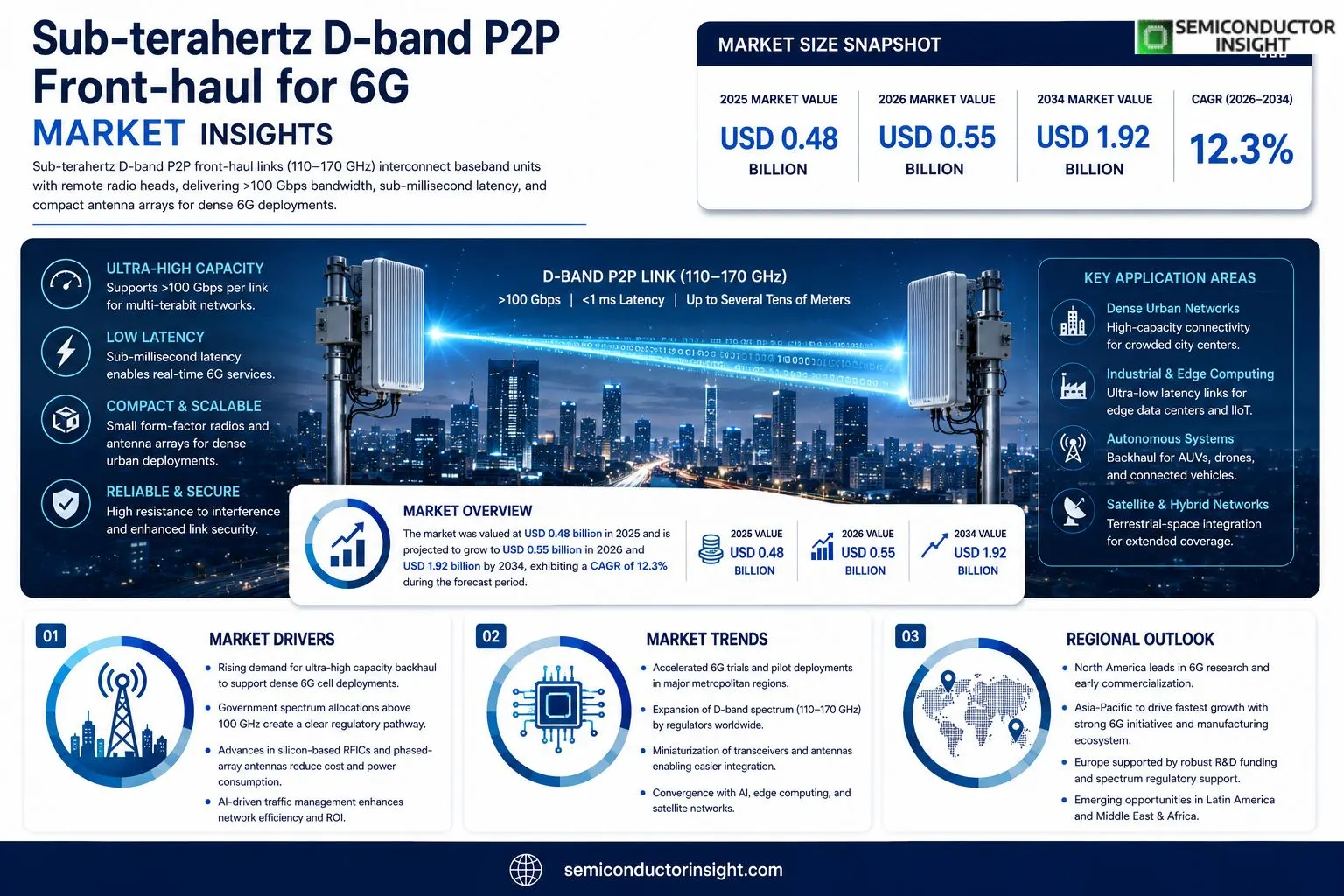
Sub-terahertz D-band P2P front-haul for 6G market size was valued at USD 0.48 billion in 2025. The market is projected to grow from USD 0.55 billion in 2026 to USD 1.92 billion by 2034, exhibiting a CAGR of 12.3% during the forecast period.
Sub‑terahertz D‑band point‑to‑point (P2P) front‑haul refers to wireless links operating in the 110–170 GHz spectrum that interconnect baseband units with remote radio heads in next‑generation cellular networks. These links deliver ultra‑high bandwidth (often >100 Gbps), sub‑millisecond latency, and compact antenna arrays, enabling dense urban deployments of 6G services such as holographic communication and massive IoT.The market is experiencing rapid growth because telecom operators are accelerating 6G trials while governments expand spectrum allocations above 100 GHz. Advances in silicon‑based phased‑array transceivers and cost‑effective manufacturing are further lowering barriers to entry. Key playersincluding Nokia, Ericsson, Samsung Electronics, and Huaweiare broadening their portfolios and forging strategic partnerships to capture emerging demand.
MARKET DRIVERS
Rising Demand for Ultra‑High Capacity Backhaul
The rapid rollout of dense 6G cells is pushing network operators to seek back‑haul technologies that can sustain exceeding 200 Gbps per link. Sub‑terahertz D‑band P2P front‑haul for 6G Market uniquely provides the spectrum width required to meet these capacity targets while maintaining low latency, positioning it as a cornerstone for next‑generation mobile infrastructure.
Regulatory Momentum and Spectrum Allocation
Several national regulators have earmarked the 140‑170 GHz D‑band for commercial use by 2025, creating a clear policy pathway that accelerates deployment plans. This coordinated allocation reduces uncertainty and encourages investment in equipment ecosystems tailored to Sub‑terahertz D‑band P2P front‑haul for 6G Market.
➤ “Adopting D‑band backhaul will unlock multi‑terabit metropolitan networks, a prerequisite for true 6G experiences.”
Combined with the emergence of AI‑driven traffic management, the technology promises operational cost efficiencies that outweigh initial capital outlays, reinforcing its attractiveness to telecom operators worldwide.
MARKET CHALLENGES
Technical Complexity and Hardware Costs
Designing reliable transceivers that operate reliably at Sub‑terahertz frequencies demands advanced semiconductor processes and precision manufacturing, driving component costs well above traditional microwave solutions. This cost premium can delay large‑scale rollouts, especially in cost‑sensitive markets.Integration with existing fiber‑backed infrastructure also poses interoperability challenges, requiring sophisticated hybrid network designs that can increase planning complexity.
Other Challenges
Manufacturing Scale‑up
Current production volumes are limited to niche defense projects, resulting in long lead times. Scaling up will require substantial investment in new fab lines and supply‑chain coordination.
MARKET RESTRAINTS
Limited Ecosystem Maturity
Sub‑terahertz D‑band P2P front‑haul for 6G Market suffers from a sparse vendor ecosystem, with only a handful of manufacturers offering complete end‑to‑end solutions. This scarcity hampers competitive pricing and slows technology diffusion.High power consumption of current prototype modules also raises concerns for sustainable deployment, particularly in remote or energy‑constrained sites.Standardization efforts are still in early draft stages, creating regulatory ambiguity that can deter early adopters from committing capital.
MARKET OPPORTUNITIES
Emerging Edge‑Computing Scenarios
Edge‑computing clusters require ultra‑low latency and high‑throughput links to process data near the user. Sub‑terahertz D‑band P2P front‑haul for 6G Market can deliver the necessary bandwidth, opening revenue streams in autonomous vehicles, AR/VR, and industrial IoT sectors.Integration with low‑earth‑orbit satellite constellations presents a hybrid terrestrial‑space backhaul model, expanding coverage to underserved regions and creating new market niches.Urban dense network densification projects are projected to adopt D‑band solutions to overcome the spatial limitations of millimeter‑wave, offering multi‑gigabit per user experiences in city centers.
Sub-terahertz D-band P2P front-haul for 6G Market Trends
Accelerating 6G Trials Drive Infrastructure Demand
Telecom operators worldwide are scaling 6G proof‑of‑concept deployments, and the need for ultra‑high‑capacity front‑haul links has become a decisive factor. Sub‑terahertz D‑band point‑to‑point (P2P) front‑haul provides the bandwidth (>100 Gbps) and sub‑millisecond latency required for holographic video, immersive reality, and massive machine‑type communications. Early‑stage commercial trials in major metropolitan areas demonstrate that fiber‑grade performance can be achieved with compact antenna arrays, reducing both capital expenditure and site acquisition time. This operational momentum is encouraging network planners to prioritize D‑band P2P solutions in their rollout roadmaps.
Other Trends
Spectrum Allocation and Regulatory Momentum
Government agencies in the United States, European Union, Japan, and South Korea have opened additional blocks above 100 GHz for mobile use. The coordinated release of contiguous spectrum slices simplifies channel planning and supports carrier aggregation across the D‑band. Regulatory bodies are also issuing guidelines that streamline certification for high‑frequency equipment, which shortens time‑to‑market for new transceiver designs. The combined effect of expanded allocations and clearer compliance pathways is lowering entry barriers for service providers and equipment manufacturers alike.
Technology Advancements Lower Cost Barriers
Recent breakthroughs in silicon‑based phased‑array transceivers and low‑loss waveguide technologies have reduced the bill‑of‑materials for D‑band radios by roughly 30 % compared with early prototypes. Mass‑production techniques, such as advanced wafer‑level packaging, enable higher yield and predictable performance at scale. As a result, leading vendorsincluding Nokia, Ericsson, Samsung Electronics, and Huaweiare launching portfolio extensions that target mid‑range operators seeking cost‑effective high‑frequency solutions. These product improvements are expected to accelerate adoption across dense urban zones where fiber deployment remains logistically challenging.
COMPETITIVE LANDSCAPE
Key Industry Players
Rapid Expansion of Sub‑terahertz D‑band Front‑haul for 6G (2025‑2034)
The Sub‑terahertz D‑band point‑to‑point (P2P) front‑haul market is being shaped by a handful of telecom equipment giants that possess deep RF expertise and sizable R&D budgets. Nokia, Ericsson, Samsung Electronics and Huawei dominate the high‑volume segment, leveraging mature silicon‑based phased‑array transceiver platforms to deliver >100 Gbps links with sub‑millisecond latency. Their extensive carrier‑grade portfolios enable seamless integration with existing 5G infrastructure while extending into the 110‑170 GHz spectrum required for 6G trials. Complementing these leaders, Intel and Qualcomm contribute cutting‑edge semiconductor IP, fostering ecosystem alignment and cost reductions that lower entry barriers for new network rollouts. Collectively, these firms dictate pricing structures, set performance benchmarks, and drive standard‑setting activities within bodies such as ITU‑R and 3GPP, reinforcing a market structure that favors vertically integrated solutions and strategic alliances with spectrum‑holding operators.
Beyond the dominant tier, a diverse set of niche innovators enriches the competitive landscape with specialized components and test solutions. Companies such as Marvell, Broadcom, Skyworks Solutions and Xilinx (AMD) focus on high‑frequency front‑end modules, digital‑beamforming ASICs, and power‑efficient PA architectures. Test and measurement specialists including Keysight Technologies, Rohde & Schwarz, and Anritsu provide the validation platforms essential for certification of ultra‑wideband links. Regional players like Fujitsu, ZTE, and NTT Docomo contribute localized deployments and integration services, often partnering with the major vendors to address dense‑urban 6G scenarios. These smaller yet technically proficient firms accelerate innovation cycles, driving performance improvements and expanding the overall addressable market for Sub‑terahertz D‑band P2P front‑haul.
List of Key Sub-terahertz D-band P2P Front-haul Companies Profiled
- Nokia
- Ericsson
- Samsung Electronics
- Huawei
- Intel
- Qualcomm
- Marvell
- Broadcom
- Skyworks Solutions
- Xilinx (AMD)
- Keysight Technologies
- Rohde & Schwarz
- Fujitsu
- ZTE
- NTT Docomo
Segment Analysis:
| Segment Category | Sub-Segments | Key Insights |
| By Type |
|
Fixed Wireless Access
|
| By Application |
|
Urban Dense Networks
|
| By End User |
|
Telecom Operators
|
| By Deployment Scenario |
|
Hotspot Zones
|
| By Technology Architecture |
|
Phased‑Array Antennas
|
Regional Analysis: North America
North America
The enterprise sector in North America is actively seeking solutions to enhance data transfer speeds and network capacity. Sub-terahertz D-band P2P front-haul offers a compelling proposition for connecting geographically dispersed facilities, supporting demanding applications like high-definition video streaming and large-scale data analytics.
Government agencies and defense organizations in North America are keenly interested in the secure and high-bandwidth communication capabilities offered by Sub-terahertz D-band P2P front-haul. Its potential for resilient and low-latency connectivity makes it ideal for critical applications.
Scientific research institutions across North America are leveraging advanced wireless technologies like Sub-terahertz D-band P2P front-haul to facilitate large data transfers and enable complex computational tasks. This technology is vital for areas such as astronomy and high-energy physics.
The automotive industry in North America is exploring Sub-terahertz D-band P2P front-haul for enabling advanced features like vehicle-to-everything (V2X) communication and autonomous driving capabilities, requiring ultra-reliable and low-latency connections.
North America
The North American market for Sub-terahertz D-band P2P front-haul for 6G is characterized by a strong emphasis on innovation and technological advancement. The region’s well-established telecommunications infrastructure and high levels of digital literacy create a favorable environment for the adoption of cutting-edge wireless technologies. The increasing demand for high-bandwidth applications, coupled with government initiatives promoting advanced communication networks, is expected to drive significant growth in the market. Key players in North America are actively investing in research and development to commercialize Sub-terahertz D-band P2P front-haul solutions.
Europe
Europe is also anticipated to witness considerable growth in Sub-terahertz D-band P2P front-haul for 6G Market. Several European nations are prioritizing investments in 6G research and development, recognizing its potential to foster innovation and economic growth. The focus on sustainable technologies and efficient resource utilization may influence the adoption patterns of this technology within the region.
Asia-Pacific
The Asia-Pacific region presents a massive market opportunity for Sub-terahertz D-band P2P front-haul for 6G, driven by rapid urbanization, increasing internet penetration, and a burgeoning digital economy. Several countries in the region are actively investing in upgrading their telecommunications infrastructure to support the demands of 6G and beyond.
South America
South America is expected to experience moderate growth in Sub-terahertz D-band P2P front-haul for 6G Market. The increasing demand for high-speed internet and the expansion of digital services are driving the need for advanced wireless connectivity.
Middle East & Africa
The Middle East and Africa represent emerging markets for Sub-terahertz D-band P2P front-haul for 6G, with significant potential for growth in the coming years. The increasing investments in telecommunications infrastructure and the growing adoption of digital technologies are creating new opportunities for market players.
Report Scope
This market research report provides a comprehensive analysis of the Sub-terahertz D-band P2P front-haul for 6G Market , covering the forecast period 2026–2034. It offers detailed insights into market dynamics, technological advancements, competitive landscape, and key trends shaping the industry.
Key focus areas of the report include:
- Market Overview: The report begins with an overview outlining its current market scenario, key growth indicators, and industry transformation drivers. It discusses macroeconomic factors, demand–supply balance, regulatory landscape, and the strategic role of semiconductors in powering advancements across industries such as automotive, telecommunications, consumer electronics, and industrial automation.
- Market Size & Forecast: Historical data and future projections for revenue, unit shipments, and market value across major regions and segments.
- Segmentation Analysis: Detailed breakdown by product type, technology, application, and end-user industry to identify high-growth segments and investment opportunities.
- Regional Insights: Insights into market performance across North America, Europe, Asia-Pacific, Latin America, and the Middle East & Africa, including country-level analysis where relevant.
- Competitive Landscape: Profiles of leading market participants, including their product offerings, R&D focus, manufacturing capacity, pricing strategies, and recent developments such as mergers, acquisitions, and partnerships.
- Technology Trends & Innovation: Assessment of emerging technologies, integration of AI/IoT, semiconductor design trends, fabrication techniques, and evolving industry standards.
- Market Drivers & Restraints: Evaluation of factors driving market growth along with challenges, supply chain constraints, regulatory issues, and market-entry barriers.
- Stakeholder Insights: Insights for component suppliers, OEMs, system integrators, investors, and policymakers regarding the evolving ecosystem and strategic opportunities.
Primary and secondary research methods are employed, including interviews with industry experts, data from verified sources, and real-time market intelligence to ensure the accuracy and reliability of the insights presented.
FREQUENTLY ASKED QUESTIONS:
What is the current market size of Sub-terahertz D-band P2P front-haul for 6G Market?
-> Sub-terahertz D-band P2P front-haul for 6G Market was valued at USD 0.48 billion in 2025 and is expected to reach USD 1.92 billion by 2034.
Which key companies operate in Sub-terahertz D-band P2P front-haul for 6G Market?
-> Key players include Nokia, Ericsson, Samsung Electronics, Huawei, among others.
What are the key growth drivers?
-> Key growth drivers include accelerating 6G trials by telecom operators, expanded spectrum allocations above 100 GHz by governments, advances in silicon‑based phased‑array transceivers, and cost‑effective manufacturing processes.
Which region dominates the market?
-> The reference does not specify a dominant region for this market.
What are the emerging trends?
-> Emerging trends include the deployment of ultra‑high bandwidth (>100 Gbps) links, integration of AI‑driven network management, and the development of compact antenna arrays for dense urban 6G deployments.
Get Sample Report PDF for Exclusive Insights
Report Sample Includes
- Table of Contents
- List of Tables & Figures
- Charts, Research Methodology, and more...
 Download Sample Report PDF