Sub-GHz Transceiver Market Insights
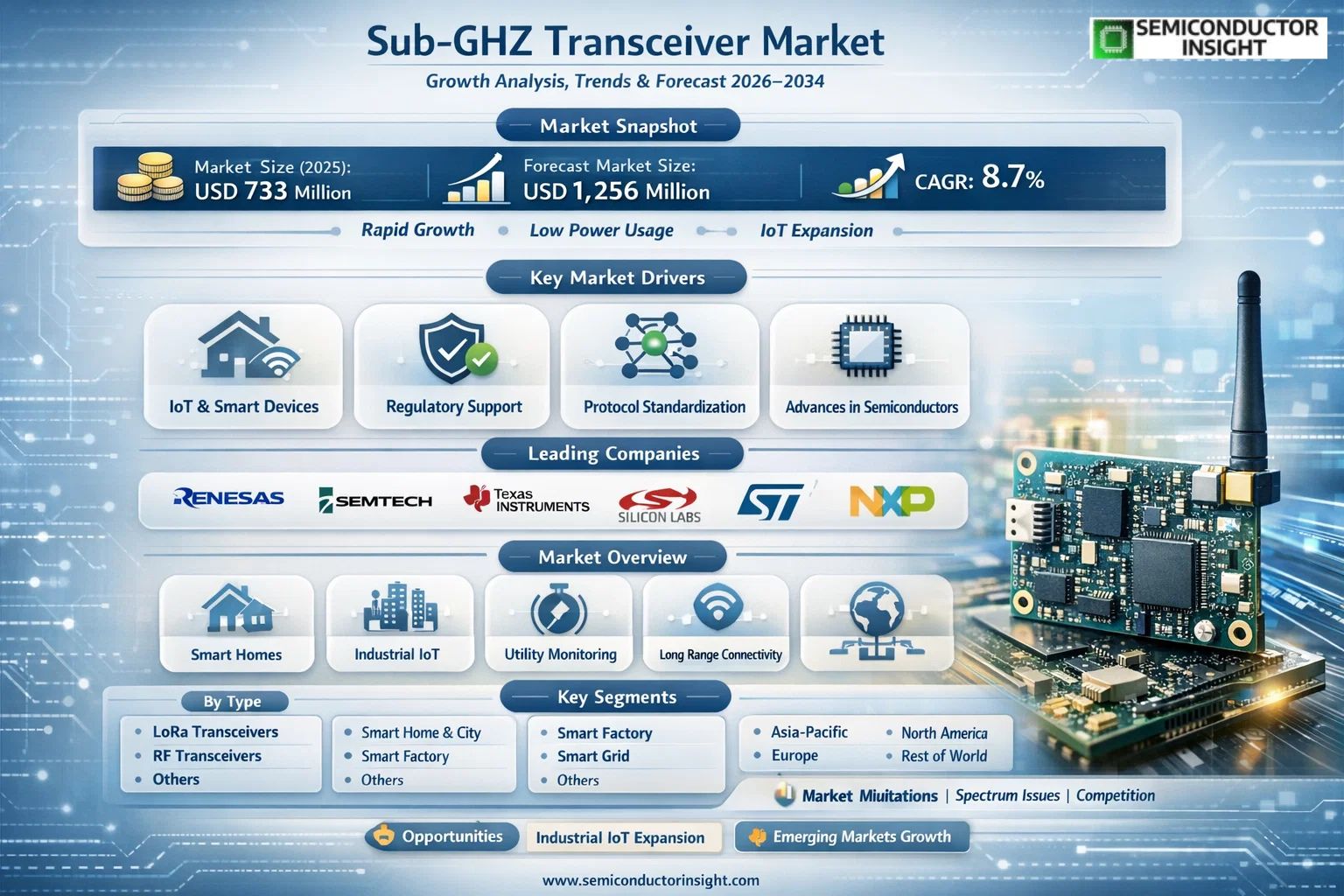
Global Sub-GHz transceiver market size was valued at USD 733 million in 2025. The market is projected to grow from USD 796.8 million in 2026 to USD 1,256 million by 2034, exhibiting a CAGR of 8.7% during the forecast period.
A Sub-GHz transceiver is a communication device capable of transmitting and receiving data in the sub-1 GHz frequency range, typically between 300 MHz and 1 GHz. These components are fundamental to wireless communication systems designed for short-range or low-power applications, offering advantages like excellent signal penetration and longer range compared to higher-frequency alternatives like Wi-Fi or Bluetooth. This makes them particularly suitable for environments with physical obstacles.
The market is experiencing robust growth driven by the accelerating deployment of Internet of Things (IoT) networks across smart homes, cities, factories, and grids. The inherent benefits of Sub-GHz technology for reliable, low-power, wide-area communication are key enablers. Furthermore, advancements in low-power semiconductor design and the standardization of protocols like LoRaWAN are creating new opportunities. Initiatives by leading players are also fueling expansion; for instance, companies like Semtech, with its LoRa technology, and Texas Instruments, with its extensive RF portfolio, continuously launch integrated solutions that simplify design and reduce power consumption for developers. Other key players operating in this competitive landscape include Renesas Electronics Corporation, Silicon Labs (a subsidiary of Skyworks Solutions), STMicroelectronics N.V., and NXP Semiconductors N.V., all offering a wide range of products.
MARKET DRIVERS
Proliferation of IoT and M2M Communication
The primary force propelling the Sub-GHz Transceiver Market is the exponential growth of the Internet of Things and machine-to-machine networks. Sub-GHz transceivers offer superior range and penetration through obstacles compared to higher-frequency alternatives like 2.4 GHz, which is critical for applications in smart cities, industrial automation, and smart agriculture. Their lower power consumption directly enables longer battery life for remote sensors, a decisive factor in large-scale deployments. This technical synergy is accelerating adoption across utility metering, asset tracking, and building automation systems globally.
Robust Regulatory Frameworks and Standardization
Well-defined and stable regulatory environments for license-free Sub-GHz bands, such as 868 MHz in Europe and 915 MHz in North America, provide a reliable foundation for product development. Furthermore, the maturation of robust wireless protocols like Wireless M-Bus, LoRaWAN, and proprietary standards from major chip vendors has created a versatile ecosystem. This standardization reduces development risk and time-to-market for OEMs, encouraging more investment and innovation within the Sub-GHz Transceiver Market.
➤ The demand for reliable, long-range connectivity in harsh industrial environments, where 2.4 GHz signals are often unsuitable, is creating a durable niche for Sub-GHz solutions.
Additionally, advancements in transceiver design are improving spectral efficiency and coexistence capabilities, allowing denser network deployments. The relentless pursuit of cost-reduced, highly integrated radio chips further drives volume adoption in price-sensitive, high-volume IoT segments.
MARKET CHALLENGES
Technical Limitations and Competitive Pressures
Despite its advantages, the Sub-GHz Transceiver Market faces distinct technical hurdles. The fundamental trade-off for long range and penetration is lower data throughput compared to Wi-Fi or Bluetooth. This limits its use in applications requiring high-speed data transfer, keeping it largely within the domain of low-data-rate sensor networks. Simultaneously, emerging Low-Power Wide-Area Network technologies operating in licensed cellular bands present competitive pressure by offering managed, wide-area connectivity directly, challenging private Sub-GHz network deployments.
Other Challenges
Regional Fragmentation of Frequency Bands
The lack of a globally harmonized Sub-GHz license-free band necessitates regional product variants (e.g., 868 MHz vs. 915 MHz), increasing R&D and manufacturing complexity for multinational vendors and potentially fragmenting the market.
Integration and Design Complexity
Achieving optimal performance with Sub-GHz transceivers often requires significant RF design expertise for antenna matching and compliance testing, which can be a barrier for smaller developers and slow down integration cycles.
MARKET RESTRAINTS
Spectrum Congestion and Interference Risks
A key restraint on the growth of the Sub-GHz Transceiver Market is the increasing congestion in popular license-free bands. As deployment densities rise in urban and industrial settings, the risk of co-channel interference between different networks escalates. This can degrade link reliability and network performance, potentially undermining the core value proposition of robust communication. Managing this requires sophisticated channel access algorithms and careful network planning, adding operational overhead. Furthermore, incumbent users and differing national regulations can restrict available bandwidth, limiting scalability in some regions.
MARKET OPPORTUNITIES
Expansion in Advanced Industrial IoT and Smart Infrastructure
Significant opportunities for the Sub-GHz Transceiver Market lie in the deepening digitization of critical infrastructure and Industry 4.0. Applications such as predictive maintenance, where wireless vibration and temperature sensors monitor machinery, or extensive environmental monitoring across oil and gas fields, demand the unique range/penetration characteristics of Sub-GHz. The rollout of advanced metering infrastructure for electricity, gas, and water on a global scale remains a substantial, long-term driver. The integration of enhanced security features like hardware encryption directly into transceiver ICs is also opening doors in government and security-sensitive commercial applications.
Hybrid Multi-Radio Solutions and Emerging Regions
The trend toward multi-radio system-on-chip designs, combining Sub-GHz with Bluetooth Low Energy or cellular IoT modems, creates new product categories for versatile connectivity platforms. These hybrid solutions allow devices to leverage the strengths of each radio type, broadening market appeal. Concurrently, developing economies in Asia-Pacific, Latin America, and Africa present greenfield opportunities for smart utility and agricultural sensor networks, where Sub-GHz’s cost-effectiveness and range are highly advantageous for new infrastructure projects.
Sub-GHz Transceiver Market Trends
Expansion of Smart Infrastructure Applications
The proliferation of smart city and smart grid initiatives is a primary driver for the Sub-GHz Transceiver Market. These devices operate below 1 GHz, offering superior signal range and penetration compared to higher frequency alternatives, making them ideal for large-scale, low-power sensor networks. The demand is particularly pronounced in applications such as utility metering, environmental monitoring, and distributed asset tracking, where long battery life and reliable connectivity are critical. The smart factory segment also presents a significant growth vector, with Sub-GHz Transceivers enabling robust machine-to-machine communication in industrial environments fraught with signal interference.
Other Trends
Consolidation and Portfolio Development
The competitive landscape is marked by strategic consolidation as key manufacturers like Renesas, Semtech, and Texas Instruments enhance their offerings through product development and acquisitions. The focus is on creating highly integrated, low-power System-on-Chip (SoC) solutions that reduce bill-of-materials costs for OEMs. This trend of portfolio expansion aims to provide comprehensive wireless connectivity suites, catering to diverse protocols within the sub-GHz band to capture a larger share of the IoT connectivity market.
Technological Shift Towards Advanced Modulation Schemes
There is a discernible trend towards the adoption of more sophisticated modulation techniques in Sub-GHz Transceiver design. While simpler protocols remain prevalent, newer transceivers are increasingly supporting advanced schemes like LoRa and other spread-spectrum technologies. This evolution enhances the spectral efficiency and resilience of communication links, enabling higher data throughput and more robust networks essential for modern IoT applications. This technological progression is crucial for meeting the complex demands of next-generation smart infrastructure projects and supporting dense device deployments.
COMPETITIVE LANDSCAPE
Key Industry Players
Market Consolidation and Niche Specialization Drive Strategic Positioning
Global Sub-GHz transceiver market is characterized by the dominance of a handful of leading semiconductor manufacturers, with the top five players accounting for a significant consolidated revenue share. Renesas Electronics, Semtech, Texas Instruments, Silicon Labs, and STMicroelectronics are pivotal in shaping market dynamics through their extensive portfolios and deep integration in key applications like Smart Home, Smart City, and Industrial IoT. These major players leverage significant R&D investments to develop advanced, low-power, long-range communication solutions, including proprietary protocols like LoRa from Semtech. The competitive landscape is heavily influenced by technological innovation, strategic partnerships with module makers, and the ability to offer complete system solutions, creating high barriers to entry for new competitors.
Beyond the market leaders, several other established and niche companies maintain important positions by catering to specific regional demands, application segments, or offering cost-optimized alternatives. Companies such as NXP Semiconductors provide robust solutions for automotive and industrial markets, while others focus on ultra-low-power designs for battery-operated sensor networks. The market also sees activity from firms specializing in RF integration for smart metering and building automation. This diverse ecosystem ensures competition across different price and performance tiers, driving continuous advancements in power efficiency, range, and network reliability for Sub-GHz wireless connectivity.
List of Key Sub-GHz Transceiver Companies Profiled
- Renesas Electronics Corporation
- Semtech Corporation
- Texas Instruments Incorporated
- Silicon Labs
- STMicroelectronics N.V.
- NXP Semiconductors N.V.
- Analog Devices, Inc.
- Microchip Technology Inc.
- Qorvo, Inc.
- Infineon Technologies AG
- Nordic Semiconductor ASA
- CEVA, Inc.
- Telit
- u-blox Holding AG
- Murata Manufacturing Co., Ltd.
Segment Analysis:
| Segment Category | Sub-Segments | Key Insights |
| By Type |
|
LoRa Transceivers are a dominant force, driven by their exceptional long-range and low-power capabilities which are ideal for wide-area IoT networks. Industry momentum around LoRaWAN standards is creating a robust ecosystem, encouraging adoption across diverse applications. This segment benefits from strong strategic focus from key semiconductor manufacturers who are continually enhancing integration and power efficiency to support the proliferation of sensor networks and smart infrastructure projects globally. |
| By Application |
|
Smart Home and Smart City applications represent the leading demand driver, fueled by massive investments in urban and residential automation. The inherent advantages of Sub-GHz signals, such as superior wall and obstacle penetration, make them indispensable for reliable connectivity in dense urban environments and within buildings. This segment is further propelled by the growing integration of these transceivers into security systems, smart meters, and municipal IoT deployments, creating a continuous pipeline of demand as cities and consumers prioritize connected, efficient living spaces. |
| By End User |
|
Industrial & Manufacturing end-users are at the forefront, leveraging Sub-GHz transceivers for mission-critical automation and monitoring. The robust and interference-resistant nature of sub-1 GHz communication is crucial for reliable data links in harsh industrial environments with heavy machinery. This segment’s growth is tightly coupled with Industry 4.0 initiatives, where these components enable wireless sensor networks for predictive maintenance, asset tracking, and process optimization, providing a tangible return on investment through operational efficiency and reduced downtime. |
| By Communication Protocol |
|
Standardized Protocols like LoRaWAN are gaining significant traction as the leading segment due to the ecosystem benefits they provide, including interoperability and reduced development risk for OEMs. The move towards standardization is a key market trend, as it lowers barriers to entry and fosters innovation in application development. While proprietary protocols remain important for specialized, high-security use cases, the broad industry shift to open standards is driving volume adoption and creating more future-proof solutions for large-scale, multi-vendor IoT deployments. |
| By Integration Level |
|
Highly Integrated SoCs (System-on-Chip) are increasingly preferred as the leading integration approach, offering significant advantages in design simplicity, board space savings, and power management. This trend is particularly strong for high-volume applications in consumer and industrial IoT, where reducing time-to-market and total system cost is paramount. Leading semiconductor companies are competing aggressively in this space, embedding microcontrollers, memory, and advanced security features alongside the transceiver radio, which simplifies the design process for engineers and accelerates the development of compact, power-efficient end devices. |
Regional Analysis: Sub-GHz Transceiver Market
Asia-Pacific
The region’s unparalleled electronics manufacturing capacity ensures a steady, cost-effective supply of Sub-GHz transceiver chips and modules. Concentrated design and fabrication expertise enables rapid prototyping and volume production for global IoT device brands, making it the primary global supply hub.
National policies in China, Japan, and South Korea aggressively fund smart grid deployments, smart city sensor networks, and industrial IoT, all of which heavily utilize Sub-GHz technology for its penetration and range, creating systematic, large-scale public sector demand for transceivers.
A massive and tech-savvy consumer base is driving adoption of smart home devices like security systems, environmental sensors, and appliance controllers that rely on Sub-GHz transceivers for robust, interference-free communication within residential complexes and urban environments.
Beyond consumer tech, strong growth in agricultural tech, remote asset monitoring in logistics, and building automation across the region’s expanding commercial real estate sector provides multiple, resilient vertical markets for Sub-GHz transceiver integration and innovation.
North America
North America, led by the United States, is a critical innovation and early-adoption center for the Sub-GHz transceiver market. The region is characterized by high investment in research and development from leading semiconductor firms and a mature ecosystem for advanced IoT solutions. Key demand stems from modernizing utility infrastructure with advanced metering infrastructure (AMI), deploying expansive agricultural and environmental monitoring networks across vast rural and suburban areas, and integrating smart building technologies in commercial real estate. The regulatory environment and established standards for wireless communication in industrial, scientific, and medical bands provide a stable framework for deployment. Furthermore, strong venture capital funding for industrial IoT and smart city startups continually seeds new applications, ensuring North America remains a high-value market focused on cutting-edge, reliability-critical Sub-GHz transceiver deployments.
Europe
Europe represents a sophisticated and regulation-driven market for Sub-GHz transceiver technology. The region’s growth is heavily influenced by stringent EU directives on energy efficiency, which propel the modernization of building management systems and smart grid technologies. There is significant deployment in home and building automation, driven by both consumer demand for energy savings and regulatory pushes for sustainable infrastructure. The industrial sector in Germany, Italy, and France utilizes these transceivers for robust machine-to-machine communication in factory automation and process control environments. Additionally, Europe’s focus on privacy and data security influences the design and implementation of Sub-GHz networks, favoring solutions that offer secure, low-power, and reliable data links for applications like smart lighting, HVAC control, and automotive telematics, supported by a strong base of engineering expertise.
South America
The Sub-GHz transceiver market in South America is emerging, with growth primarily driven by specific regional needs. Key applications include utility metering, where countries are investing in modernizing electrical grids to reduce losses and improve billing efficiency, often in challenging geographical terrains where Sub-GHz’s range is advantageous. Agricultural monitoring across large farms in Brazil and Argentina is another significant driver, using sensor networks for climate and soil condition tracking. Urban development projects in major cities are also beginning to incorporate smart city pilot programs for traffic management and public lighting. While the market is smaller and faces challenges related to economic volatility and infrastructure investment cycles, the fundamental benefits of Sub-GHz technology for long-range, low-maintenance communication align well with the continent’s development needs, indicating steady, niche-driven growth.
Middle East & Africa
The Middle East & Africa region presents a dynamic landscape for the Sub-GHz transceiver market, characterized by dual drivers of ambitious smart city mega-projects and essential infrastructure development. In the Gulf Cooperation Council countries, extensive investments in futuristic urban developments create demand for integrated building automation, smart utility management, and environmental monitoring systems. Conversely, in parts of Africa, the technology is pivotal for leapfrogging traditional infrastructure, enabling applications like off-grid solar power monitoring, remote water pump control, and basic agricultural telemetry in areas with limited cellular coverage. The technology’s ability to operate reliably in harsh environmental conditions and over long distances makes it suitable for both the high-tech urban environments of the Middle East and the remote, infrastructure-light settings found across Africa, positioning the Sub-GHz transceiver as a key enabler for regional digital transformation.
Report Scope
This market research report provides a comprehensive analysis of the Sub-GHz Transceiver Market , covering the forecast period 2026–2034. It offers detailed insights into market dynamics, technological advancements, competitive landscape, and key trends shaping the industry.
Key focus areas of the report include:
- Market Overview: The report begins with an overview outlining its current market scenario, key growth indicators, and industry transformation drivers. It discusses macroeconomic factors, demand–supply balance, regulatory landscape, and the strategic role of semiconductors in powering advancements across industries such as automotive, telecommunications, consumer electronics, and industrial automation.
- Market Size & Forecast: Historical data and future projections for revenue, unit shipments, and market value across major regions and segments.
- Segmentation Analysis: Detailed breakdown by product type, technology, application, and end-user industry to identify high-growth segments and investment opportunities.
- Regional Insights: Insights into market performance across North America, Europe, Asia-Pacific, Latin America, and the Middle East & Africa, including country-level analysis where relevant.
- Competitive Landscape: Profiles of leading market participants, including their product offerings, R&D focus, manufacturing capacity, pricing strategies, and recent developments such as mergers, acquisitions, and partnerships.
- Technology Trends & Innovation: Assessment of emerging technologies, integration of AI/IoT, semiconductor design trends, fabrication techniques, and evolving industry standards.
- Market Drivers & Restraints: Evaluation of factors driving market growth along with challenges, supply chain constraints, regulatory issues, and market-entry barriers.
- Stakeholder Insights: Insights for component suppliers, OEMs, system integrators, investors, and policymakers regarding the evolving ecosystem and strategic opportunities.
Primary and secondary research methods are employed, including interviews with industry experts, data from verified sources, and real-time market intelligence to ensure the accuracy and reliability of the insights presented.
FREQUENTLY ASKED QUESTIONS:
What is the current market size of Sub-GHz Transceiver Market?
-> Global Sub-GHz Transceiver Market was valued at USD 733 million in 2025 and is projected to reach USD 1256 million by 2034, growing at a CAGR of 8.7% during the forecast period.
What is a Sub-GHz Transceiver?
-> A Sub-GHz Transceiver is a communication device capable of transmitting and receiving data in the sub-1 GHz frequency range (typically 300 MHz to 1 GHz). These devices are commonly used in wireless systems for short-range or low-power applications.
Which key companies operate in Sub-GHz Transceiver Market?
-> Key players in the market include Renesas, Semtech, Texas Instruments, Silicon Labs, STMicroelectronics, and NXP, among others. Global top five players held a significant revenue share in 2025.
What are the key market segments by type?
-> The market is segmented by Type into LoRa Transceivers, RF Transceivers, and Others. The LoRa Transceivers segment is expected to show notable growth.
What are the primary application areas?
-> Primary application areas include Smart Home and Smart City, Smart Factory, Smart Grid, and Others, reflecting its use in enabling wireless connectivity for IoT and industrial systems.

Get Sample Report PDF for Exclusive Insights
Report Sample Includes
- Table of Contents
- List of Tables & Figures
- Charts, Research Methodology, and more...
 Download Sample Report PDF