MARKET INSIGHTS
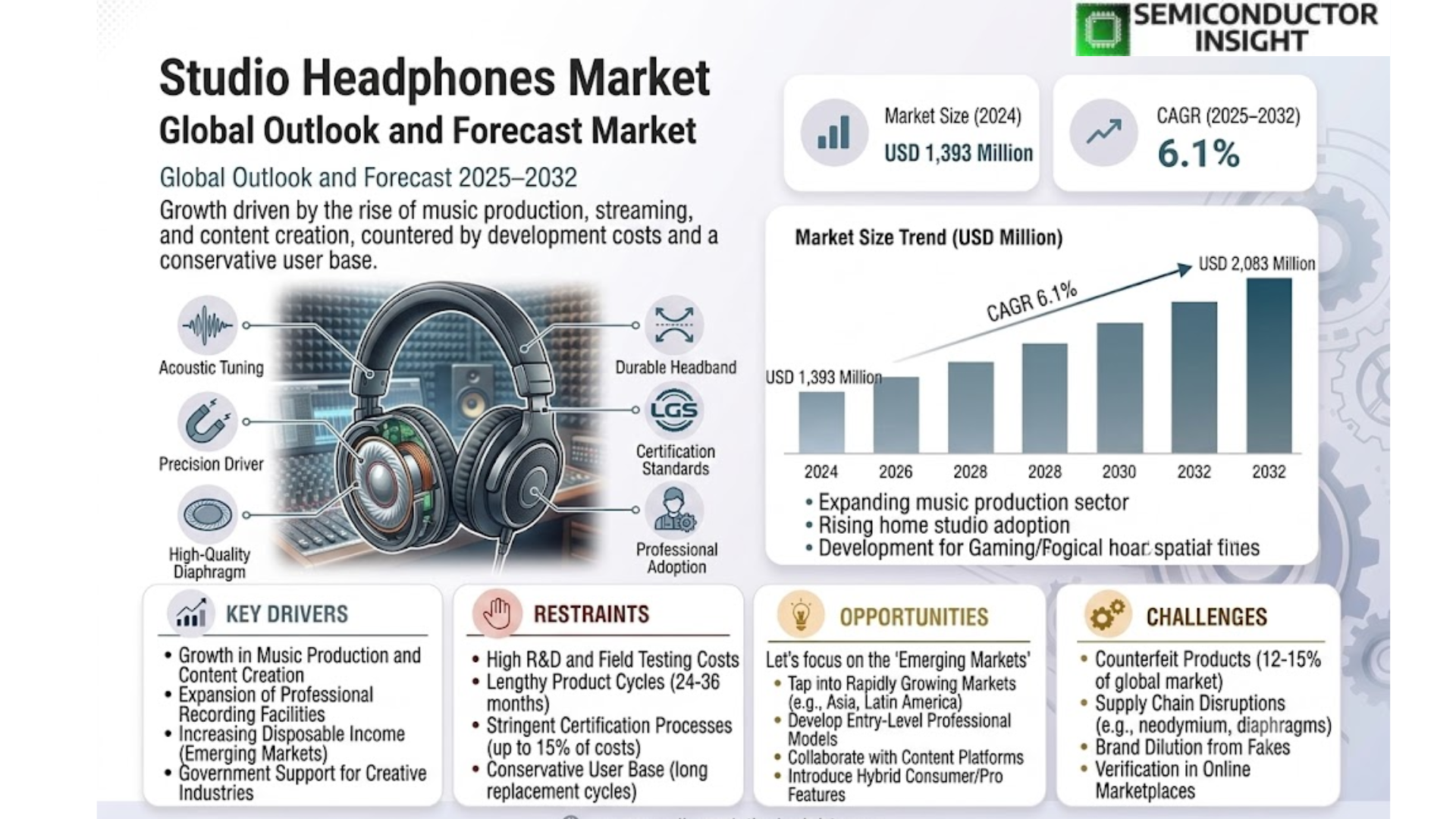
The global Studio Headphones Market was valued at 1393 million in 2024 and is projected to reach US$ 2083 million by 2032, at a CAGR of 6.1% during the forecast period.
Studio headphones are professional-grade audio devices engineered for critical listening, recording, and mixing applications. These headphones are characterized by a flat frequency response to deliver uncolored and accurate audio reproduction, robust construction for durability, and effective noise attenuation or isolation. Key design types include Closed Back, Semi-Open Back, and Fully-Open Back models, each offering distinct acoustic properties for different professional use cases.
The market is experiencing steady growth driven by the expansion of the global music production industry, the proliferation of home recording studios, and rising demand from podcasters and content creators. Furthermore, technological advancements in driver design and materials are enhancing sound quality and user comfort. The market is fragmented, with key players like Beyerdynamic holding a significant share. North America is a dominant production hub, accounting for over 30% of the global market value, reflecting the region’s strong media and entertainment sector.
MARKET DYNAMICS
MARKET DRIVERS
Rising Demand for Professional Audio Content Creation to Drive Studio Headphones Market
The global studio headphones market is experiencing robust growth driven by the expanding professional audio content creation industry. With the proliferation of streaming platforms, podcasting, and home recording studios, demand for high-fidelity monitoring equipment has surged significantly. The music production industry alone generates over $26 billion annually, with professional-grade headphones being essential tools for sound engineers and artists. This growth is further accelerated by the increasing number of home studios, which now account for approximately 65% of all recording facilities worldwide. The need for accurate sound reproduction in mixing and mastering processes has made studio headphones indispensable, with closed-back models particularly favored for their superior noise isolation and precise frequency response.
Technological Advancements in Driver Design and Materials to Boost Market Growth
Continuous innovation in driver technology and material science is significantly enhancing studio headphone performance and comfort. Manufacturers are investing heavily in research and development to create transducers with improved frequency response, lower distortion, and better transient response. Recent advancements include the adoption of planar magnetic drivers, which offer superior detail retrieval and faster response times compared to traditional dynamic drivers. Additionally, the use of advanced materials such as memory foam for ear cushions and lightweight alloys for headbands has improved wearing comfort during extended sessions. These technological improvements are crucial for professional users who require both accuracy and comfort during long mixing and mastering sessions, driving replacement cycles and premium product adoption.
Moreover, the integration of wireless technology with professional-grade audio performance is creating new market segments. While maintaining critical audio specifications, several leading manufacturers have introduced wireless models that incorporate high-resolution codecs and low-latency transmission, addressing the needs of modern content creators who value both mobility and audio fidelity.
➤ For instance, recent product launches featuring hybrid connectivity options demonstrate how manufacturers are balancing professional audio requirements with consumer convenience trends.
Furthermore, the growing emphasis on environmental sustainability has led to the development of headphones using recycled materials and modular designs that extend product lifespan, aligning with both professional and consumer values while driving market differentiation.
MARKET CHALLENGES
Intense Price Competition and Market Saturation to Challenge Growth Trajectory
The studio headphones market faces significant challenges from intense price competition and market saturation, particularly in the mid-range segment. With over 200 brands competing globally, manufacturers struggle to maintain profitability while offering competitive pricing. The average selling price for professional studio headphones has decreased by approximately 18% over the past five years due to increased competition from both established audio companies and new market entrants. This price erosion affects research and development budgets, potentially slowing innovation cycles and limiting the introduction of breakthrough technologies. Additionally, the market’s fragmentation makes it difficult for companies to achieve economies of scale, further squeezing profit margins and challenging sustainable business growth.
Other Challenges
Counterfeit Products and Brand Dilution
The proliferation of counterfeit studio headphones poses a substantial challenge to market integrity and brand reputation. Counterfeit products account for an estimated 12-15% of the global headphone market, often mimicking popular professional models while using inferior components. These products not only divert sales from legitimate manufacturers but also damage brand perception when consumers experience poor performance from counterfeit items. The situation is particularly acute in online marketplaces where authenticity verification is challenging, requiring significant investment in anti-counterfeiting measures and consumer education.
Supply Chain Disruptions and Component Shortages
Global supply chain vulnerabilities continue to challenge headphone manufacturers, with critical component shortages affecting production timelines and costs. Specialized components including neodymium magnets, precision drivers, and high-quality diaphragm materials face periodic shortages, leading to production delays and increased manufacturing costs. These disruptions have been exacerbated by geopolitical tensions and trade restrictions, forcing manufacturers to diversify their supply chains and implement costly inventory buffer strategies to maintain consistent product availability.
MARKET RESTRAINTS
High Development Costs and Lengthy Product Cycles to Deter Market Expansion
The studio headphones market faces significant restraints due to the substantial investment required for product development and the lengthy research and testing cycles involved. Developing professional-grade headphones requires extensive acoustic engineering, material science research, and rigorous testing protocols to meet industry standards. The development cycle for a new flagship model typically spans 24-36 months, with research and development costs often exceeding $2 million per product. This extended timeline and high capital requirement create barriers for new market entrants and limit the pace of innovation among established players. Additionally, the need for extensive field testing with professional audio engineers further extends product development cycles, delaying market entry and potentially missing optimal market windows.
Furthermore, the certification processes for professional audio equipment add another layer of complexity and cost. Meeting international standards for frequency response, distortion levels, and build quality requires specialized testing equipment and certification fees, which can represent up to 15% of total development costs. These requirements particularly affect smaller manufacturers who may lack the resources for comprehensive testing facilities, limiting their ability to compete effectively in the professional segment.
Additionally, the conservative nature of professional audio users presents a challenge for market expansion. Audio engineers and producers often prefer established models with proven track records, creating resistance to adopting new technologies or brands. This conservatism extends product lifecycles and reduces replacement frequency, as professionals may use the same headphones for 5-7 years before considering upgrades, thereby restraining market growth rates.
MARKET OPPORTUNITIES
Emerging Markets and Technological Convergence to Create Lucrative Growth Opportunities
The studio headphones market presents significant growth opportunities through expansion into emerging markets and the convergence of professional and consumer audio technologies. Developing regions, particularly in Asia and Latin America, are experiencing rapid growth in music production and content creation industries. The number of professional recording facilities in these regions has grown by over 40% in the past three years, creating substantial demand for professional audio equipment. This growth is complemented by increasing disposable incomes and government support for creative industries, making these markets particularly attractive for headphone manufacturers seeking new growth avenues beyond saturated Western markets.
Technological convergence between professional and consumer audio segments offers another substantial opportunity. The blurring lines between professional and consumer audio requirements have created a new category of ‘prosumer’ products that combine professional-grade audio performance with consumer-friendly features and pricing. This segment has grown by approximately 28% annually as content creators, podcasters, and audiophiles seek equipment that bridges the gap between consumer convenience and professional accuracy. Manufacturers who successfully navigate this convergence can capture value across multiple market segments while leveraging economies of scale.
Additionally, the integration of artificial intelligence and smart features presents untapped opportunities for market differentiation. AI-powered sound optimization, automated frequency response calibration, and intelligent noise cancellation are emerging technologies that could redefine studio headphone functionality. These technologies not only enhance user experience but also create new revenue streams through software subscriptions and premium features, potentially transforming the traditional headphone business model from hardware sales to ongoing service relationships.
STUDIO HEADPHONES MARKET TRENDS
Advancements in Wireless and Smart Technology Integration to Emerge as a Trend in the Market
The global studio headphones market is witnessing a significant paradigm shift, driven by the relentless integration of wireless and smart technologies. While the core demand for high-fidelity, accurate sound reproduction remains paramount, manufacturers are increasingly incorporating features like Bluetooth connectivity, active noise cancellation (ANC), and companion app control to cater to modern, mobile-centric workflows. This evolution is broadening the application of studio-grade headphones beyond the traditional studio environment into fields like podcasting, live streaming, and mobile content creation. The adoption of high-resolution codecs such as LDAC and aptX HD is crucial, as they strive to deliver a near-lossless wireless audio experience that meets the critical listening standards of professionals. This technological convergence is expanding the total addressable market, attracting a new demographic of prosumers and content creators who demand both professional audio quality and modern convenience.
Other Trends
Rising Demand for Personalized and Ergonomic Designs
Beyond pure audio performance, there is a growing emphasis on personalized comfort and ergonomic design, driven by the need for extended wear during long studio sessions. Manufacturers are investing heavily in research to develop lighter materials, improved cushioning with memory foam, and adjustable headbands that reduce fatigue and prevent hearing damage associated with prolonged use. This focus on user-centric design is becoming a key differentiator in a competitive market, as comfort directly impacts productivity and creative flow. The market has seen a notable increase in models offering replaceable parts, such as ear pads and cables, enhancing product longevity and sustainability. This trend is particularly pronounced in the premium segment, where consumers expect a product that is both a high-performance tool and a durable, comfortable accessory for daily use.
Expansion of Content Creation and Home Studio Markets
The massive expansion of the content creation economy and the proliferation of home studios are powerful drivers of market growth. The number of individuals engaged in professional and semi-professional audio work—including music production, podcasting, and video editing—has surged, a trend accelerated by remote work culture. This has created a sustained demand for reliable, high-quality monitoring tools that are accessible and scalable. While the high-end market segment continues to be dominated by established brands, a vibrant mid-tier segment has emerged, offering exceptional value and performance, thus lowering the entry barrier for new creators. This democratization of professional audio equipment is fueling volume sales and fostering a highly competitive landscape where innovation in driver technology and frequency response accuracy is paramount for capturing market share.
COMPETITIVE LANDSCAPE
Key Industry Players
Leading Brands Focus on Acoustic Innovation and Market Expansion
The global studio headphones market is characterized by a highly fragmented competitive landscape, featuring a mix of established audio giants, specialized professional audio companies, and emerging players. This fragmentation is driven by diverse consumer needs across professional studios, home recording setups, and critical listening applications. While the market has numerous participants, a few key players have established significant brand recognition and market share through decades of audio engineering expertise.
Beyerdynamic GmbH stands as the global market leader, holding approximately 5% of the total market share in 2024. The company’s dominance is attributed to its legendary models like the DT series, renowned for their flat frequency response, durability, and comfort during extended studio sessions. Their strong manufacturing presence in Germany and global distribution network have solidified their position as a preferred choice for audio professionals worldwide.
Sennheiser and Audio-Technica also command substantial market presence, competing closely through their innovative driver technologies and robust product portfolios. Sennheiser’s HD series, particularly the HD 600 and HD 650, are industry standards for critical listening and mixing, valued for their precise sound reproduction. Audio-Technica, with its ATH-M50x series, has achieved remarkable commercial success by offering professional-grade sound at accessible price points, effectively bridging the professional and prosumer markets.
These leading companies are actively pursuing growth through continuous research and development in acoustic technology, driver design, and materials science. Recent initiatives focus on developing wireless studio-grade headphones with minimal latency, integrating advanced noise-cancellation for tracking applications, and enhancing ergonomic designs for improved comfort. Furthermore, strategic expansion into emerging markets in Asia-Pacific and Latin America represents a key growth vector, as the number of home studios and content creators continues to rise globally.
Meanwhile, other significant players like Sony, Shure, and AKG (a Harman International brand under Samsung Electronics) are strengthening their positions through strategic acquisitions, partnerships with music institutions, and by leveraging their broader consumer electronics ecosystems. Sony, for instance, leverages its expertise in both consumer and professional audio to cater to a wide spectrum of users, from amateur musicians to top-tier recording studios.
List of Key Studio Headphone Companies Profiled
- Beyerdynamic GmbH (Germany)
- Sennheiser electronic GmbH & Co. KG (Germany)
- AKG Acoustics GmbH (Austria)
- Grado Labs (U.S.)
- Audio-Technica Corporation (Japan)
- Beats Electronics (Apple Inc.) (U.S.)
- KOSS Corporation (U.S.)
- Sony Corporation (Japan)
- Pioneer Corporation (Japan)
- Shure Incorporated (U.S.)
- Samson Technologies Corp. (U.S.)
- Denon Professional (Japan)
Segment Analysis:
By Type
Closed Back Headphones Segment Dominates the Market Due to Superior Sound Isolation and Accuracy in Professional Environments
The market is segmented based on type into:
- Closed Back
- Subtypes: Over-ear, On-ear, and others
- Semi-Open Back
- Fully-Open Back
By Application
Studio Recording Segment Leads Due to Critical Demand for Flat Frequency Response and Precision Monitoring
The market is segmented based on application into:
- Studio Recording
- Live Sound and Stage Monitoring
- Critical Listening and Mastering
- Broadcasting and Podcasting
- Others
By End User
Professional Audio Engineers and Producers Segment Leads Due to High Equipment Standards and Continuous Usage
The market is segmented based on end user into:
- Professional Audio Engineers and Producers
- Musicians and Performers
- Broadcasting and Media Companies
- Educational and Training Institutions
- Home Studio Enthusiasts
By Price Range
Mid-Range Segment Leads Due to Optimal Balance Between Professional Features and Affordability
The market is segmented based on price range into:
- Entry-Level/Budget
- Mid-Range
- Premium/High-End
Regional Analysis: Studio Headphones Market
North America
North America holds a dominant position in the global studio headphones market, accounting for over 31% of the total production value. This leadership is driven by a highly developed professional audio industry, significant investments in music production, podcasting, and gaming content creation, and the presence of major manufacturers like Beyerdynamic, which commands a 5% global market share. The region’s demand is characterized by a preference for high-fidelity, durable closed-back models essential for critical studio monitoring and sound isolation. While the market is mature, continuous innovation in wireless technology and the sustained growth of the creator economy provide steady momentum for premium product segments.
Europe
Europe represents a sophisticated and quality-conscious market for studio headphones, underpinned by a rich musical heritage and a strong professional audio engineering sector. The region shows a pronounced demand for precision audio equipment from renowned brands like Sennheiser and AKG, with a significant application in critical listening and mixing. European consumers and professionals prioritize acoustic accuracy, build quality, and long-term reliability over cost, supporting a robust market for high-end products. Furthermore, the region’s thriving electronic music scene and numerous professional recording studios fuel consistent demand for specialized headphones capable of handling high sound pressure levels with clarity.
Asia-Pacific
The Asia-Pacific region is the fastest-growing market for studio headphones, fueled by a massive expansion of its music, film, and media industries. While cost sensitivity makes entry-level and mid-range models popular, there is a rapidly growing appetite for premium brands like Audio-Technica and Sony among a burgeoning professional class. The region’s growth is further accelerated by widespread urbanization, increasing disposable income, and the proliferation of home recording studios. However, the market is highly competitive, with a vast number of local manufacturers offering affordable alternatives, which pressures international brands to balance performance with value.
South America
The studio headphones market in South America is emerging, presenting significant long-term growth opportunities driven by a growing cultural emphasis on music production and a rising number of local recording studios. However, market expansion is tempered by economic volatility and currency fluctuations, which make imported high-end products less accessible. This has led to a market structure where demand is primarily focused on more affordable, durable models suitable for stage and general studio use. Brands with a strong distribution network and localized pricing strategies are best positioned to capitalize on the region’s potential.
Middle East & Africa
The market in the Middle East & Africa is nascent but shows promising development, particularly in urban centers and wealthier nations investing in media infrastructure and entertainment hubs. Demand is primarily driven by professional applications in newly established studios and a growing interest in content creation. However, the market’s progression is constrained by limited purchasing power for high-end audio equipment and a less developed retail and distribution network for professional audio gear. Growth is expected to be gradual, focusing on reliable, mid-range products that offer a balance of performance and affordability for emerging professionals.
Report Scope
This market research report provides a comprehensive analysis of the global and regional Studio Headphones markets, covering the forecast period 2025–2032. It offers detailed insights into market dynamics, technological advancements, competitive landscape, and key trends shaping the industry.
Key focus areas of the report include:
- Market Size & Forecast: Historical data and future projections for revenue, unit shipments, and market value across major regions and segments.
- Segmentation Analysis: Detailed breakdown by product type, technology, application, and end-user industry to identify high-growth segments and investment opportunities.
- Regional Outlook: Insights into market performance across North America, Europe, Asia-Pacific, Latin America, and the Middle East & Africa, including country-level analysis where relevant.
- Competitive Landscape: Profiles of leading market participants, including their product offerings, R&D focus, manufacturing capacity, pricing strategies, and recent developments such as mergers, acquisitions, and partnerships.
- Technology Trends & Innovation: Assessment of emerging technologies, integration of AI/IoT, semiconductor design trends, fabrication techniques, and evolving industry standards.
- Market Drivers & Restraints: Evaluation of factors driving market growth along with challenges, supply chain constraints, regulatory issues, and market-entry barriers.
- Stakeholder Analysis: Insights for component suppliers, OEMs, system integrators, investors, and policymakers regarding the evolving ecosystem and strategic opportunities.
Primary and secondary research methods are employed, including interviews with industry experts, data from verified sources, and real-time market intelligence to ensure the accuracy and reliability of the insights presented.
FREQUENTLY ASKED QUESTIONS:
What is the current market size of Global Studio Headphones Market?
-> Studio Headphones Market was valued at 1393 million in 2024 and is projected to reach US$ 2083 million by 2032, at a CAGR of 6.1% during the forecast period.
Which key companies operate in Global Studio Headphones Market?
-> Key players include Beyerdynamic, Sennheiser, AKG, Audio-Technica, Sony, and Shure, among others.
What are the key growth drivers?
-> Key growth drivers include rising music production activities, growth in podcasting, increasing home studio setups, and demand for high-fidelity audio equipment.
Which region dominates the market?
-> North America is the dominant market, accounting for over 31% of global production value, while Asia-Pacific is the fastest-growing region.
What are the emerging trends?
-> Emerging trends include wireless studio headphones with low-latency technology, integration of AI for sound optimization, and sustainable materials in headphone construction.

Get Sample Report PDF for Exclusive Insights
Report Sample Includes
- Table of Contents
- List of Tables & Figures
- Charts, Research Methodology, and more...
 Download Sample Report PDF