
Market Insights
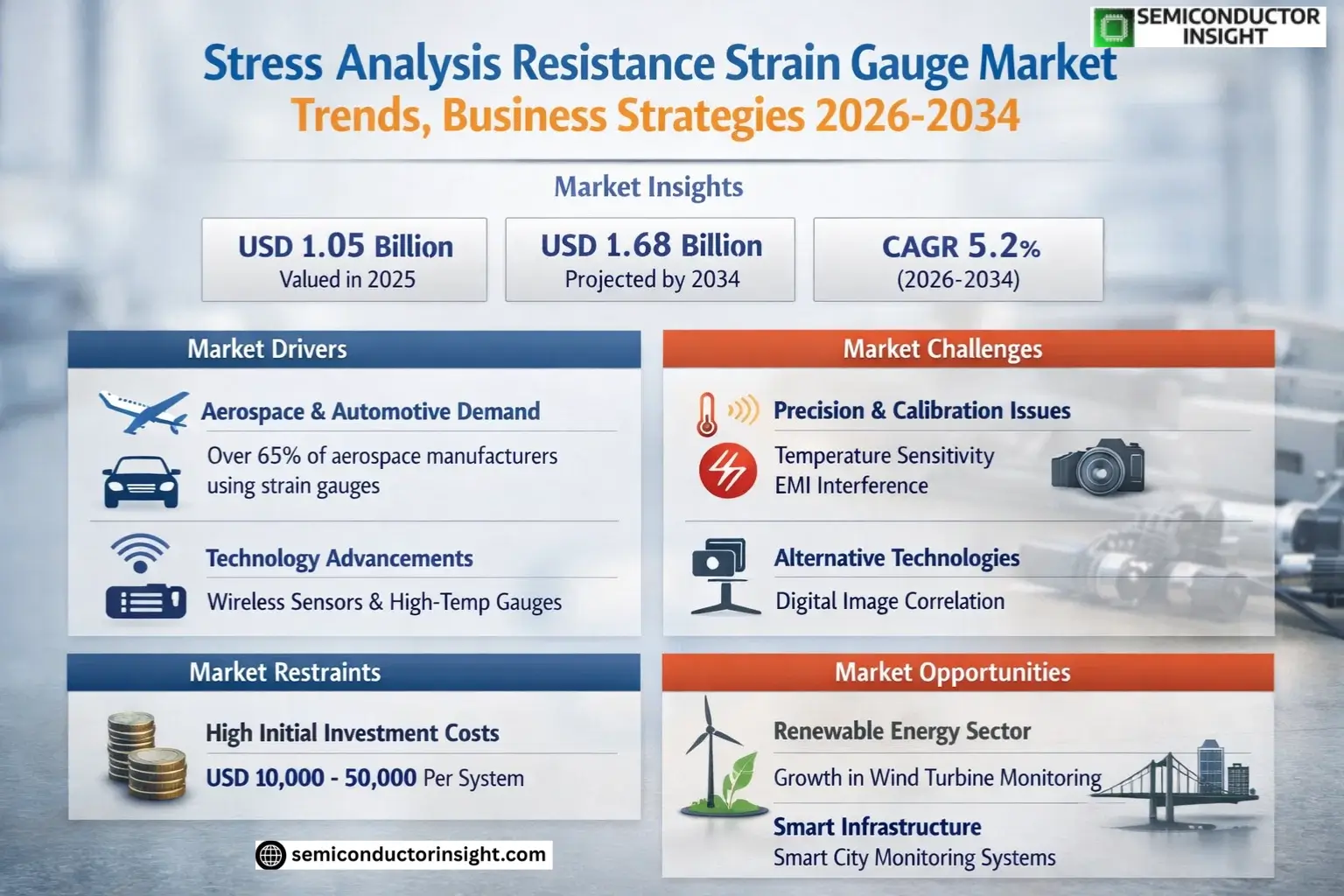
Global Stress Analysis Resistance Strain Gauge Market size was valued at USD 1.05 billion in 2025. The market is projected to grow from USD 1.12 billion in 2026 to USD 1.68 billion by 2034, exhibiting a CAGR of 5.2% during the forecast period.
Stress analysis resistance strain gauges are precision sensors designed to measure mechanical deformation in materials by converting strain into measurable electrical resistance changes. These devices play a critical role in structural health monitoring across industries, offering real-time data on stress distribution, load testing, and material fatigue analysis. The technology encompasses various types including foil strain gauges, semiconductor strain gauges, and thin-film variants, each suited for specific measurement requirements.
Market growth is driven by increasing infrastructure development projects requiring structural integrity monitoring and rising adoption in aerospace component testing. However, the emergence of alternative sensing technologies presents competitive challenges. Key manufacturers like HBM and Vishay continue to innovate with advanced materials and wireless connectivity options to maintain market leadership.
MARKET DRIVERS
Growing Demand in Aerospace and Automotive Industries
Stress Analysis Resistance Strain Gauge Market is witnessing significant growth due to increasing applications in aerospace and automotive sectors. These industries rely on precise strain measurement for structural integrity testing, driving demand for high-accuracy strain gauges. Over 65% of aerospace manufacturers now incorporate resistance strain gauges in their quality control processes.
Advancements in Measurement Technologies
Technological innovations in stress analysis resistance strain gauge systems, including wireless data transmission and miniaturized sensors, are expanding market potential. The development of high-temperature resistant strain gauges has opened new applications in harsh environments like turbine engines and industrial machinery.
Increasing investments in infrastructure development worldwide are further fueling demand for structural health monitoring systems using resistance strain gauges.
MARKET CHALLENGES
High Precision Requirements and Calibration Complexities
Stress Analysis Resistance Strain Gauge Market faces technical challenges related to maintaining measurement accuracy in variable environmental conditions. Temperature fluctuations and electromagnetic interference can affect readings, requiring complex compensation techniques that increase system costs.
Other Challenges
Competition from Alternative Technologies
Emerging non-contact measurement methods like digital image correlation are gaining traction, particularly in applications where surface mounting of strain gauges isn’t feasible.
Skilled Labor Shortage
Proper installation and interpretation of resistance strain gauge data requires specialized training, creating a bottleneck in market expansion.
MARKET RESTRAINTS
High Initial Investment Costs
The capital-intensive nature of stress analysis resistance strain gauge systems, particularly for high-precision applications, limits adoption among small and medium enterprises. Complete measurement systems can cost between USD 10,000-USD 50,000, creating a significant barrier to entry for some potential users.
MARKET OPPORTUNITIES
Expansion in Renewable Energy Sector
The growing wind energy market presents significant opportunities for stress analysis resistance strain gauges, particularly in blade and tower monitoring. Strain measurement systems are becoming standard in wind turbine maintenance programs, with the sector’s demand expected to grow 12% annually over the next five years.
Emerging Applications in Smart Infrastructure
Smart city initiatives worldwide are driving adoption of structural health monitoring systems using networked resistance strain gauges for bridges, tunnels, and buildings. The Asia-Pacific region is leading this adoption, accounting for 45% of new installations in 2023.
Stress Analysis Resistance Strain Gauge Market Trends
Increasing Demand in Aerospace and Civil Engineering Applications
The Stress Analysis Resistance Strain Gauge market is witnessing steady growth driven by rising applications in aerospace structural testing and civil engineering projects. These sensors provide critical data for material stress evaluation in aircraft components and large-scale infrastructure, ensuring safety and durability. Manufacturers are developing high-temperature resistant variants to meet aerospace industry requirements.
Other Trends
Advancements in Foil Strain Gauge Technology
Foil strain gauges continue to dominate the Stress Analysis Resistance Strain Gauge market segment, with manufacturers improving their temperature compensation capabilities and fatigue life. Recent developments include ultra-thin gauge designs for precision measurements in mechanical manufacturing applications, particularly in automotive component testing.
Regional Market Developments in Asia-Pacific
China and Japan are emerging as key growth markets for Stress Analysis Resistance Strain Gauges, supported by expanding industrial sectors and infrastructure investments. Local manufacturers are increasing production capacities to compete with global leaders like HBM and Vishay, particularly in semiconductor strain gauge segments.
Integration with IoT and Smart Monitoring Systems
The market is observing a trend toward wireless strain gauge systems that integrate with IoT platforms, enabling real-time structural health monitoring. This development is particularly relevant for applications in bridges, tunnels, and industrial equipment where continuous strain measurement is critical.
Technological Specialization for Medical Applications
Medical equipment manufacturers are increasingly adopting specialized Stress Analysis Resistance Strain Gauges for biomechanical research and prosthetic development. These applications require ultra-sensitive variants with biocompatible materials, creating niche opportunities for market players.
COMPETITIVE LANDSCAPE
Key Industry Players
Global Strain Gauge Market Dominated by Electromechanical Measurement Specialists
Stress Analysis Resistance Strain Gauge Market is characterized by the dominance of electromechanical measurement specialists, with HBM and Vishay leading the global landscape. According to industry reports, these two players collectively accounted for over 30% of market share in 2025, benefiting from their extensive product portfolios and strong R&D capabilities. The market exhibits moderate consolidation, with the top five manufacturers holding approximately 45% revenue share, while regional players maintain strong positions in local markets.
Niche specialists like KYOWA and TML have carved out significant positions in aerospace and civil engineering applications respectively. Emerging Asian manufacturers, particularly AVIC Electrical Measurement and Yiling, are gaining traction through competitive pricing and government-supported R&D initiatives. The market also features specialized players such as Omega Engineering for high-precision applications and Piezo Systems for thin-film strain gauges, creating a diversified competitive environment.
List of Key Stress Analysis Resistance Strain Gauge Companies Profiled
- HBM
- Vishay Precision Group
- KYOWA Electronic Instruments
- AVIC Electrical Measurement
- AVIC Group
- LCT
- TML (Tokyo Measuring Instruments Lab)
- Yiling Electronic
- Omega Engineering
- Piezo Systems
- Hualanhai
- Zemic Europe
- NMB Technologies
- FUTEK Advanced Sensor Technology
- Strain Measurement Devices
Segment Analysis:
| Segment Category | Sub-Segments | Key Insights |
| By Type |
|
Foil Strain Gauge dominates the market due to several key advantages:
|
| By Application |
|
Aerospace emerges as the most critical application segment because:
|
| By End User |
|
OEMs represent the most significant end-user segment due to:
|
| By Measurement Type |
|
Dynamic Strain Measurement shows strong growth potential because:
|
| By Installation Method |
|
Bonded Strain Gauges maintain market leadership as they:
|
Regional Analysis: Stress Analysis Resistance Strain Gauge Market
North America leads in developing smart strain gauges with IoT integration, offering real-time stress analysis capabilities. This technological edge supports predictive maintenance applications across industrial sectors.
Aerospace and defense sectors account for significant demand, with strain gauges used in aircraft component testing. The automotive industry increasingly adopts these solutions for lightweight vehicle design validation.
Strict safety regulations in energy and construction sectors mandate precise stress analysis, creating consistent demand for high-quality resistance strain gauge solutions throughout the region.
A concentration of leading manufacturers, research labs, and end-users creates a collaborative environment for strain gauge innovation, with frequent technology transfers between military and civilian applications.
Europe
Europe represents a mature market for Stress Analysis Resistance Strain Gauges, characterized by advanced manufacturing standards and stringent quality requirements. The region’s automotive OEMs and industrial equipment manufacturers drive sophisticated demand patterns. Germany and France lead in adoption due to their strong mechanical engineering sectors. European aerospace applications are particularly demanding, requiring high-precision strain measurement for safety-critical components. The market benefits from cross-border research collaborations and standardized testing protocols across EU member states.
Asia-Pacific
The Asia-Pacific Stress Analysis Resistance Strain Gauge Market is experiencing rapid growth, fueled by expanding industrial sectors and infrastructure development. Japan leads in technological adoption, while China’s manufacturing boom creates substantial demand. Emerging applications in renewable energy projects and high-speed rail networks present new opportunities. The region benefits from cost-competitive manufacturing of strain gauge components, though premium applications still rely on imported high-end solutions. Government initiatives supporting industrial automation further stimulate market expansion.
South America
South America’s market for Stress Analysis Resistance Strain Gauges shows steady growth, primarily driven by mining, oil & gas, and construction sectors. Brazil dominates regional demand with its substantial industrial base. Infrastructure projects across the continent create opportunities for structural health monitoring applications. The market faces challenges from economic volatility but benefits from increasing foreign investments in industrial capacity expansion and technology transfer agreements with global manufacturers.
Middle East & Africa
The Middle East & Africa region exhibits growing demand for Stress Analysis Resistance Strain Gauges, particularly in oilfield applications and large-scale construction projects. Gulf countries lead in adoption due to their energy sector investments and ambitious infrastructure programs. Africa shows potential with emerging industrial sectors, though market penetration remains limited by infrastructure challenges. The region presents opportunities for specialized high-temperature strain gauge solutions suited for harsh environmental conditions.
Report Scope
This market research report provides a comprehensive analysis of the Stress Analysis Resistance Strain Gauge Market , covering the forecast period 2025–2034. It offers detailed insights into market dynamics, technological advancements, competitive landscape, and key trends shaping the industry.
Key focus areas of the report include:
- Market Overview: The report begins with an overview outlining its current market scenario, key growth indicators, and industry transformation drivers. It discusses macroeconomic factors, demand–supply balance, regulatory landscape, and the strategic role of strain gauges in measuring stress and strain across industries such as aerospace, civil engineering, mechanical manufacturing, and medical equipment.
- Market Size & Forecast: Historical data and future projections for revenue, unit shipments, and market value across major regions and segments.
- Segmentation Analysis: Detailed breakdown by product type, including Foil Strain Gauge, Semiconductor Strain Gauge, Thin Film Strain Gauge, and Others to identify high-growth segments and investment opportunities.
- Regional Insights: Insights into market performance across North America, Europe, Asia, South America, and the Middle East & Africa, including country-level analysis where relevant.
- Competitive Landscape: Profiles of leading market participants, including their product offerings, R&D focus, manufacturing capacity, pricing strategies, and recent developments such as mergers, acquisitions, and partnerships.
- Technology Trends & Innovation: Assessment of emerging technologies, integration of advanced measurement techniques, and evolving industry standards.
- Market Drivers & Restraints: Evaluation of factors driving market growth along with challenges, supply chain constraints, regulatory issues, and market-entry barriers.
- Stakeholder Insights: Insights for component suppliers, OEMs, system integrators, investors, and policymakers regarding the evolving ecosystem and strategic opportunities.
Primary and secondary research methods are employed, including interviews with industry experts, data from verified sources, and real-time market intelligence to ensure the accuracy and reliability of the insights presented.
FREQUENTLY ASKED QUESTIONS:
What is the current market size of Stress Analysis Resistance Strain Gauge Market?
-> Stress Analysis Resistance Strain Gauge Market size was valued at USD 1.05 billion in 2025. The market is projected to grow from USD 1.12 billion in 2026 to USD 1.68 billion by 2034, exhibiting a CAGR of 5.2% during the forecast period.
Which key companies operate in the Stress Analysis Resistance Strain Gauge Market?
-> Key players include HBM, Vishay, KYOWA, AVIC Electrical Measurement, AVIC Group, LCT, TML, Yiling, Omega, Piezo, and Hualanhai.
What are the key product segments in this market?
-> The market is segmented by product type into Foil Strain Gauge, Semiconductor Strain Gauge, Thin Film Strain Gauge, and Others.
Which region dominates the market?
-> Asia is a key growth region, with China projected to reach USD million by 2034.
What are the major application areas?
-> Major applications include Aerospace, Civil Engineering, Mechanical Manufacturing, Medical Equipment, and Others.
Get Sample Report PDF for Exclusive Insights
Report Sample Includes
- Table of Contents
- List of Tables & Figures
- Charts, Research Methodology, and more...
 Download Sample Report PDF





