Strain Gauge for Force Sensors Market Insights
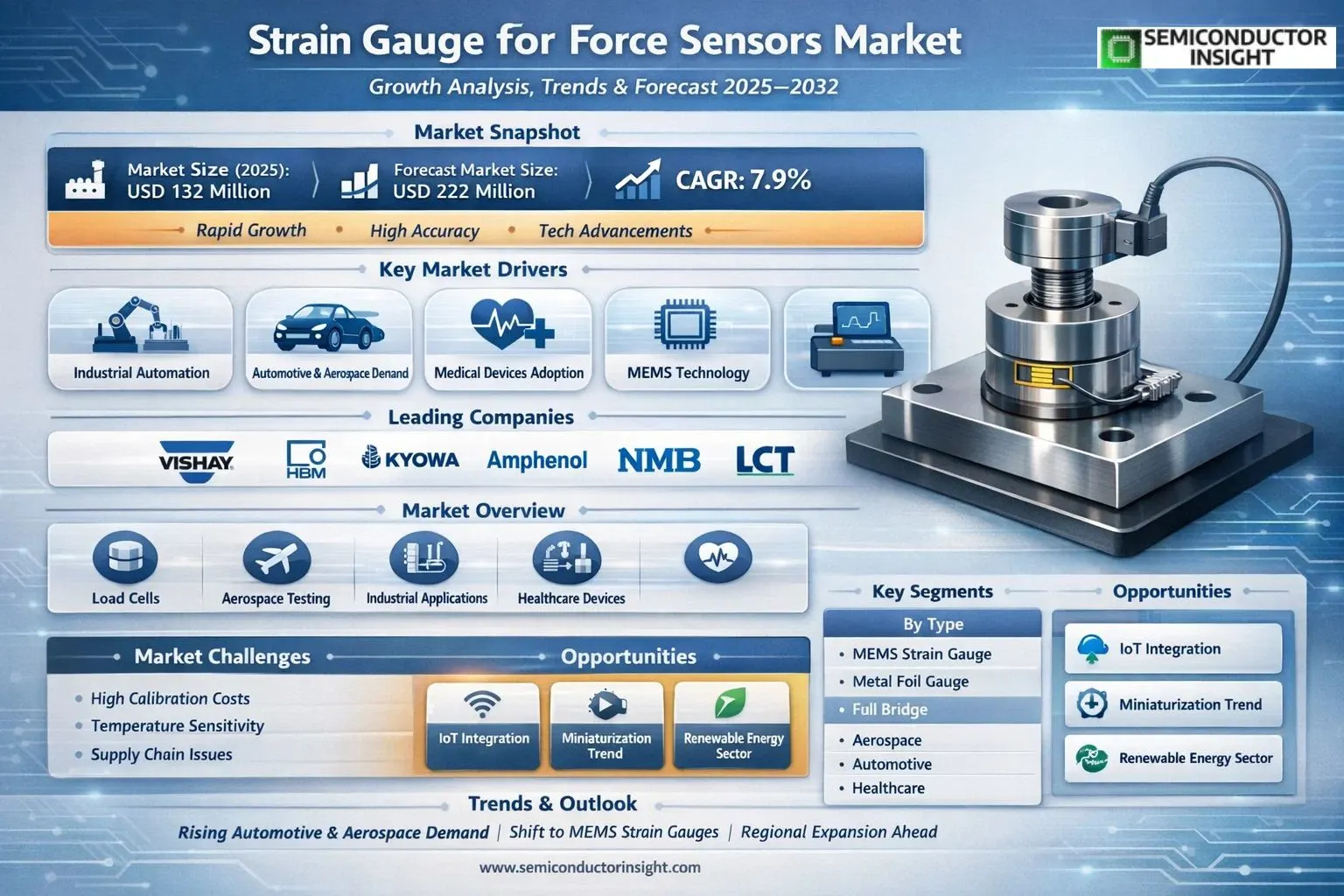
Global Strain Gauge for Force Sensors market size was valued at USD 132 million in 2025. The market is projected to reach USD 222 million by 2032, exhibiting a CAGR of 7.9% during the forecast period.
Strain Gauge for Force Sensors is a sensing element used to measure force by detecting minute deformations or strain in a material. It works by converting mechanical deformation caused by applied force into an electrical signal, which can then be measured and analyzed. These sensors are essential in applications requiring precise force detection, such as load cells and pressure transducers.
The market is experiencing steady growth due to several factors, including surging demand in automotive testing, aerospace structural monitoring, and industrial automation. Furthermore, advancements in micro-electro-mechanical systems (MEMS) technology enhance sensitivity and miniaturization, driving broader adoption. While challenges like high precision calibration persist, key players continue to innovate. For instance, companies are focusing on durable foil and silicon-based gauges for harsh environments. VISHAY, HBM, KYOWA, Amphenol, NMB, LCT, Omega, TML, BCM, and Piezo-Metrics are some of the key players operating in the market with diverse portfolios tailored to various industries.
MARKET DRIVERS
Advancements in Industrial Automation
Strain Gauge for Force Sensors Market is propelled by the rapid expansion of industrial automation, where precision force measurement is essential for robotics and machinery. With global automation investments reaching approximately $200 billion annually, demand for reliable strain gauge-based sensors has surged, enabling accurate load monitoring in manufacturing processes.
Growth in Automotive and Aerospace Sectors
In the automotive industry, strain gauges integrated into force sensors support advanced driver-assistance systems (ADAS) and electric vehicle (EV) development, contributing to a market segment valued at over 35% of total share. Aerospace applications further drive growth through structural health monitoring, where lightweight yet durable sensors ensure safety and performance under extreme conditions.
➤ Healthcare and Medical Devices Boost Adoption
Emerging medical technologies, such as robotic surgery and prosthetics, rely on strain gauge force sensors for haptic feedback, fostering innovation and expanding market penetration in healthcare.
MARKET CHALLENGES
High Manufacturing Costs and Complexity
Strain Gauge for Force Sensors Market faces hurdles from intricate fabrication processes involving semiconductor materials, leading to production costs that can exceed 20% higher than alternative sensing technologies. This complexity hampers scalability for small to medium enterprises seeking cost-effective solutions.
Other Challenges
Temperature Sensitivity and Calibration Issues
Environmental variations pose significant challenges, as strain gauges exhibit drift rates up to 0.1% per degree Celsius, necessitating frequent recalibration and increasing operational downtime in harsh industrial settings.Supply chain disruptions, particularly for rare earth materials used in foil gauges, have intensified vulnerabilities, with lead times extending by 30-50% in recent years.
MARKET RESTRAINTS
Competition from Alternative Technologies
Intense rivalry from piezoelectric and optical force sensors restrains Strain Gauge for Force Sensors Market, as these alternatives offer superior dynamic response times, capturing over 25% of high-frequency applications traditionally held by strain gauges.Regulatory standards for sensor accuracy in safety-critical industries, such as automotive and aerospace, impose stringent testing requirements, slowing market entry and elevating compliance costs by up to 15% for new products.Market saturation in mature regions like North America and Europe limits growth potential, with penetration rates already exceeding 60%, shifting focus to less developed areas with infrastructural gaps.
MARKET OPPORTUNITIES
Integration with IoT and Industry 4.0
Strain Gauge for Force Sensors Market holds substantial promise through IoT integration, enabling real-time data analytics in smart factories projected to grow at a 12% CAGR through 2030. Wireless strain gauge modules facilitate predictive maintenance, reducing downtime by 20-30%.Miniaturization trends open doors in consumer electronics and wearables, where compact force sensors enhance user interfaces in devices like fitness trackers and gaming controllers.Expansion into renewable energy sectors, including wind turbine monitoring and structural testing for solar installations, presents untapped potential, with investments forecasted to drive 8-10% annual market uplift.
Strain Gauge for Force Sensors Market Trends
Rising Demand in Automotive and Aerospace Applications
Strain Gauge for Force Sensors Market is experiencing robust growth driven by expanding applications in automotive and aerospace sectors, where precise force measurement is critical for safety and performance. Automotive manufacturers integrate these sensors into advanced driver-assistance systems (ADAS) and electric vehicle battery management, requiring gauges that detect subtle strains under dynamic loads. Similarly, aerospace applications demand high-reliability strain gauges for structural health monitoring in aircraft components, ensuring compliance with stringent regulatory standards. This trend reflects broader industry shifts toward lightweight materials and enhanced precision, positioning strain gauges as essential components in next-generation vehicles and aircraft.
Other Trends
Shift Toward MEMS Silicon Strain Gauges
MEMS silicon strain gauges are gaining traction over traditional metal foil types due to their compact size, higher sensitivity, and compatibility with integrated electronics, particularly in industrial automation and consumer electronics. This evolution supports miniaturization trends, enabling deployment in robotics and medical devices where space constraints are paramount. Industry surveys indicate manufacturers prioritizing MEMS development to meet demands for faster response times and improved temperature stability, fostering innovation across product lines.
Regional Expansion and Competitive Dynamics
Asia-Pacific regions, including China and Japan, are pivotal in Strain Gauge for Force Sensors Market expansion, fueled by rapid industrialization and automotive production surges, while North America maintains leadership through aerospace innovations. Key players such as VISHAY, HBM, KYOWA, Amphenol, and NMB dominate with focused R&D strategies, mergers, and customized solutions to address regional needs. Competitive pressures are intensifying as suppliers respond to challenges like supply chain disruptions and raw material fluctuations, emphasizing durable designs and quality certifications. Overall, these dynamics underscore a market poised for sustained evolution through technological integration and diversified applications.
COMPETITIVE LANDSCAPE
Key Industry Players
Top Manufacturers in Strain Gauge for Force Sensors Market
Strain Gauge for Force Sensors Market is dominated by a few established leaders, with Vishay Precision Group (VISHAY), HBM (Hottinger Baldwin Messtechnik), and KYOWA Electronic Instruments emerging as the top players. These companies collectively hold a substantial market share, estimated at over 40% of global revenue in 2025, reflecting an oligopolistic structure where innovation in precision sensing and material technology drives competitive advantage. Vishay leads with its advanced foil strain gauge technologies, widely adopted in automotive and aerospace applications, while HBM excels in high-accuracy measurement solutions for industrial testing. The market’s growth, projected from $132 million in 2025 to $222 million by 2032 at a 7.9% CAGR, underscores the importance of these incumbents in setting standards for MEMS silicon and metal foil strain gauges.
Beyond the frontrunners, niche players like Amphenol, NMB Technologies, LCT Transducers, and Omega Engineering contribute significantly through specialized offerings in force measurement for industrial and other sectors. Companies such as Tokyo Measuring Instruments Lab (TML), BCM Sensor Technologies, and Piezo-Metrics focus on customized solutions, capturing segments like aerospace and automotive where reliability under extreme conditions is paramount. Emerging regional contenders from Asia, including Zhonghang Electronic Measuring Instruments and Xiamen Loadcell Technology, are gaining traction via cost-effective manufacturing, intensifying competition and fostering innovation in applications across North America, Europe, and Asia-Pacific markets.
List of Key Strain Gauge for Force Sensors Companies Profiled
- VISHAY
- HBM
- KYOWA
- Amphenol
- NMB
- LCT
- Omega
- TML
- BCM
- Piezo-Metrics
- Zhonghang Electronic Measuring Instruments
- Xiamen Loadcell Technology
- Zhejiang Huangyan Testing Instrument Factory
- Shandong Jinzhong Technology Group
- Guangdong South China Sea Electronic Measuring Technology
Segment Analysis:
| Segment Category | Sub-Segments | Key Insights |
| By Type |
|
Metal Foil Strain Gauge
|
| By Application |
|
Automotive
|
| By End User |
|
Original Equipment Manufacturers (OEMs)
|
| By Configuration |
|
Full Bridge
|
| By Resistance |
|
350 Ohm
|
Regional Analysis: Strain Gauge for Force Sensors Market
Asia-Pacific
The region excels in scaling production of strain gauges for force sensors, with clusters in Shenzhen and Tokyo driving efficiency. Low-cost materials and skilled labor support high-volume output for automotive and consumer goods, enabling competitive pricing and quick market responsiveness in Strain Gauge for Force Sensors Market.
Asia-Pacific’s automotive boom integrates strain gauges into braking systems, suspension testing, and EV battery monitoring. Japanese precision and Chinese assembly prowess ensure reliable force detection, supporting the shift toward autonomous vehicles and lightweight materials in this dynamic market segment.
Robotics and factory automation in South Korea and China demand ultra-sensitive force sensors for precise gripping and assembly. Strain gauge advancements enhance feedback loops, reducing errors and boosting productivity across electronics and heavy machinery applications.
R&D centers in Singapore and Taiwan pioneer foil and semiconductor strain gauges, exporting to global markets. Collaborations with international firms accelerate adoption in aerospace, fortifying Asia-Pacific’s role as an innovation leader in Strain Gauge for Force Sensors Market.
North America
North America sustains a sophisticated Strain Gauge for Force Sensors Market, anchored by aerospace and defense leadership. The United States spearheads high-performance applications in aircraft load testing and missile guidance, where precision outweighs cost. Canada’s resource sector employs rugged sensors for mining equipment and oil rigs, enduring harsh conditions. Medical device innovations, including robotic surgery tools, integrate advanced strain gauges for tactile feedback. Strong IP frameworks and university-industry ties drive material science breakthroughs, like wireless strain sensing. While mature, the market evolves through sustainability-focused upgrades in automotive testing and renewable energy monitoring, balancing import dependencies with domestic customization to maintain technological edge.
Europe
Europe’s Strain Gauge for Force Sensors Market thrives on precision engineering heritage, particularly in Germany and Switzerland. Automotive giants utilize these sensors for emissions testing and crash simulations, aligning with stringent safety norms. Aerospace firms in France and the UK embed them in satellite components and UAVs for vibration analysis. Industrial machinery in Italy demands durable force measurement for quality control. EU-funded initiatives promote smart manufacturing, enhancing sensor integration in IoT platforms. Challenges like energy costs spur efficiency innovations, positioning Europe as a hub for customized, high-reliability solutions amid cross-border collaborations.
South America
South America’s Strain Gauge for Force Sensors Market gains momentum from resource extraction and agriculture mechanization. Brazil leads with sensors in heavy mining trucks for overload prevention and soil compaction monitoring in precision farming. Argentina’s automotive assembly lines adopt them for quality assurance. Infrastructure projects in infrastructure projects across Chile and Peru integrate force sensors for bridge and dam safety. Emerging local fabrication reduces import reliance, while tech transfers from global players foster growth. Economic volatilities challenge expansion, yet rising industrial investments signal untapped potential in this evolving landscape.
Middle East & Africa
The Middle East & Africa Strain Gauge for Force Sensors Market is propelled by oil & gas and construction booms. Saudi Arabia and UAE deploy sensors in drilling rigs and pipeline integrity checks for pressure management. South Africa’s mining operations rely on them for conveyor and hoist safety. Infrastructure megaprojects across the region, from skyscrapers to desalination plants, incorporate force monitoring. Limited local production drives imports, but diversification efforts into renewables introduce wind and solar applications. Skill development and partnerships enhance adoption, laying foundations for sustained regional market maturation.
Report Scope
This market research report provides a comprehensive analysis of Strain Gauge for Force Sensors Market, covering the forecast period 2025–2032. It offers detailed insights into market dynamics, technological advancements, competitive landscape, and key trends shaping the industry.
Key focus areas of the report include:
- Market Overview: The report begins with an overview outlining its current market scenario, key growth indicators, and industry transformation drivers. It discusses macroeconomic factors, demand–supply balance, regulatory landscape, and the strategic role of strain gauges in powering advancements across industries such as aerospace, automotive, industrial, and others.
- Market Size & Forecast: Historical data and future projections for revenue, unit shipments, and market value across major regions and segments.
- Segmentation Analysis: Detailed breakdown by product type, technology, application, and end-user industry to identify high-growth segments and investment opportunities.
- Regional Insights: Insights into market performance across North America, Europe, Asia, South America, Middle East & Africa, including country-level analysis where relevant.
- Competitive Landscape: Profiles of leading market participants, including their product offerings, R&D focus, manufacturing capacity, pricing strategies, and recent developments such as mergers, acquisitions, and partnerships.
- Technology Trends & Innovation: Assessment of emerging technologies, MEMS silicon strain gauges, metal foil gauges, fabrication techniques, and evolving industry standards.
- Market Drivers & Restraints: Evaluation of factors driving market growth along with challenges, supply chain constraints, regulatory issues, and market-entry barriers.
- Stakeholder Insights: Insights for component suppliers, OEMs, system integrators, investors, and policymakers regarding the evolving ecosystem and strategic opportunities.
Primary and secondary research methods are employed, including interviews with industry experts, data from verified sources, and real-time market intelligence to ensure the accuracy and reliability of the insights presented.
FREQUENTLY ASKED QUESTIONS:
What is the current market size of Strain Gauge for Force Sensors Market?
-> Global Strain Gauge for Force Sensors market was valued at USD 132 million in 2025 and is projected to reach USD 222 million by 2032, at a CAGR of 7.9% during the forecast period.
Which key companies operate in Strain Gauge for Force Sensors Market?
-> Key players include VISHAY, HBM, KYOWA, Amphenol, NMB, LCT, Omega, TML, BCM, Piezo-Metrics, among others.
What are the key growth drivers?
-> Key growth drivers include demand for precise force measurement in aerospace, automotive, industrial applications, industry trends, technological advancements.
Which region dominates the market?
-> Asia, particularly China, and North America dominate the market.
What are the emerging trends?
-> Emerging trends include MEMS Silicon Strain Gauge segment growth, metal foil strain gauges, integration in various applications.

Get Sample Report PDF for Exclusive Insights
Report Sample Includes
- Table of Contents
- List of Tables & Figures
- Charts, Research Methodology, and more...
 Download Sample Report PDF