
MARKET INSIGHTS
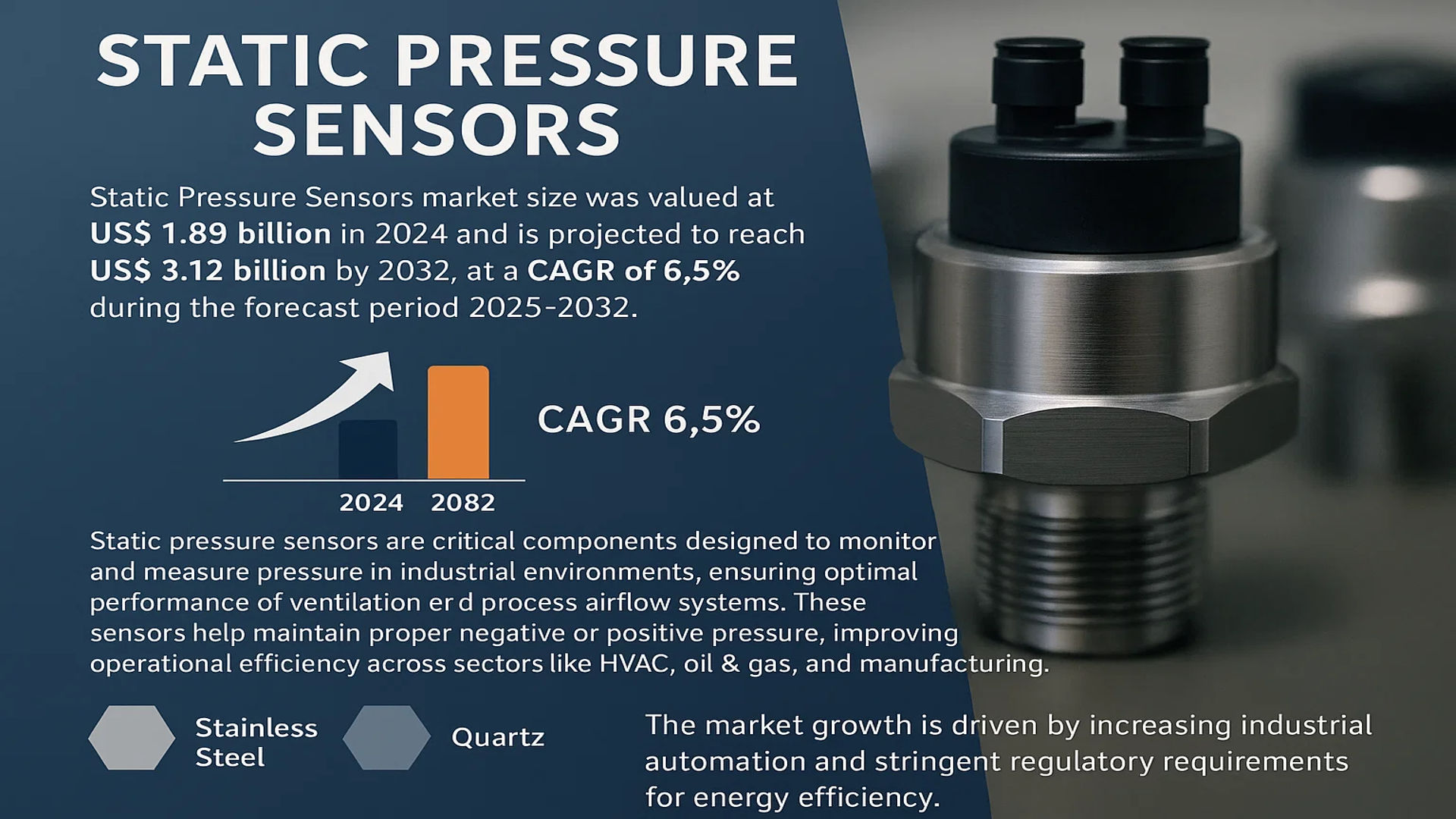
The global Static Pressure Sensors Market size was valued at US$ 1.89 billion in 2024 and is projected to reach US$ 3.12 billion by 2032, at a CAGR of 6.5% during the forecast period 2025-2032.
Static pressure sensors are critical components designed to monitor and measure pressure in industrial environments, ensuring optimal performance of ventilation and process airflow systems. These sensors help maintain proper negative or positive pressure, improving operational efficiency across sectors like HVAC, oil & gas, and manufacturing. Key variants include stainless steel, quartz, and other specialized materials, each offering distinct advantages for different applications.
The market growth is driven by increasing industrial automation and stringent regulatory requirements for energy efficiency. While traditional wired sensors dominate, emerging wireless and MEMS-based technologies are gaining traction due to advantages like reduced maintenance costs and enhanced precision. Major players like Honeywell, Siemens, and Schneider Electric are investing in smart sensor technologies, including AI-enabled self-calibration features, to strengthen their market position.
MARKET DYNAMICS
MARKET DRIVERS
Industrial Automation and Smart Manufacturing to Accelerate Static Pressure Sensor Adoption
The rapid advancement of Industry 4.0 and industrial automation is significantly driving demand for static pressure sensors across manufacturing sectors. These sensors play a critical role in maintaining optimal pressure conditions in automated production lines, HVAC systems, and process control applications. The global industrial automation market is growing at a compound annual growth rate of nearly 8%, creating substantial opportunities for pressure sensing technologies. Modern static pressure sensors with digital outputs and IoT connectivity enable real-time monitoring and predictive maintenance, reducing downtime by up to 30% in industrial facilities.
Stringent Environmental Regulations Fuel Demand for Emission Control Systems
Increasing environmental regulations worldwide are compelling industries to implement advanced emission control systems that rely on precise pressure monitoring. Static pressure sensors are essential components in flue gas desulfurization units, catalytic converters, and scrubber systems across power plants and manufacturing facilities. Recent updates to clean air standards in major economies have driven a 15-20% annual increase in demand for high-accuracy pressure sensors capable of withstanding harsh industrial environments. The oil & gas sector alone accounts for approximately 25% of industrial pressure sensor deployments for emission monitoring applications.
Moreover, the integration of artificial intelligence with pressure monitoring systems enables predictive analysis of equipment failure and optimized energy consumption.
➤ For instance, advanced static pressure sensors can detect minute pressure fluctuations that signal impending pump failures up to 72 hours before they occur, significantly reducing maintenance costs.
Furthermore, the growing adoption of wireless sensor networks in industrial settings eliminates costly wiring installations while providing reliable pressure data across distributed systems.
MARKET RESTRAINTS
High Initial Costs and Integration Challenges Limit SME Adoption
While large industrial facilities readily adopt advanced static pressure sensors, small and medium enterprises face significant barriers due to high implementation costs. A complete pressure monitoring system with sensors, controllers, and networking infrastructure can require capital investments exceeding $50,000 for mid-sized facilities. Additionally, integrating new sensor technologies with legacy industrial control systems presents technical challenges that may require specialized engineering support. Retrofitting older equipment with modern pressure sensing solutions accounts for nearly 40% of total implementation costs in some industries.
Technical Limitations in Extreme Environments Constrain Application Scope
Certain industrial applications demand pressure sensors capable of operating in extreme temperatures exceeding 500°C or submerged in corrosive chemicals. While MEMS-based sensors offer excellent performance in standard conditions, their reliability decreases significantly in such harsh environments. The nuclear energy sector reports nearly 20% higher failure rates for conventional pressure sensors compared to purpose-built alternatives. Developing sensors that maintain accuracy while withstanding extreme conditions remains an ongoing challenge for manufacturers, limiting market penetration in certain critical industries.
MARKET OPPORTUNITIES
Emerging IIoT Applications Create New Demand for Smart Pressure Sensors
The Industrial Internet of Things (IIoT) revolution is creating substantial opportunities for next-generation static pressure sensors with embedded intelligence. Smart sensors featuring self-diagnostic capabilities, wireless connectivity, and edge computing functionality are experiencing 35% annual growth in adoption rates. These advanced units can process pressure data locally and communicate only actionable insights, reducing network bandwidth requirements by up to 70%. Major industrial equipment manufacturers are increasingly embedding these intelligent sensors directly into pumps, compressors, and turbines during production.
Renewable Energy Sector Presents Untapped Potential for Specialized Sensors
The rapid expansion of renewable energy infrastructure creates new application areas for specialized pressure sensors. Wind turbine hydraulic systems require precise pressure monitoring to optimize blade pitch control, while concentrated solar power plants need robust sensors capable of withstanding both high temperatures and thermal cycling. The hydrogen energy sector particularly demands pressure sensors with enhanced safety features for storage and transportation applications. These emerging renewable energy markets are projected to account for over 15% of total industrial pressure sensor demand within the next five years.
MARKET CHALLENGES
Supply Chain Disruptions Impact Sensor Manufacturing and Availability
The global semiconductor shortage continues to affect production schedules for advanced pressure sensors that incorporate signal conditioning chips and microcontrollers. Lead times for certain MEMS components have extended from 8-12 weeks to 6-9 months, causing project delays across multiple industries. Additionally, fluctuations in rare earth metal prices impact the cost structure of sensor manufacturing, with neodymium and other critical materials seeing price volatility exceeding 40% annually.
Other Challenges
Cybersecurity Risks in Networked Systems
As industrial pressure sensors become increasingly connected to enterprise networks, they present potential entry points for cyber attacks. Recent studies indicate that unprotected industrial IoT devices experience security breaches 30% more frequently than traditional IT systems. Implementing robust encryption and access controls adds complexity and cost to pressure monitoring solutions.
Calibration and Maintenance Requirements
Maintaining measurement accuracy over time requires regular calibration, particularly for sensors operating in variable environmental conditions. Industrial facilities report that calibration and maintenance activities account for 15-20% of total cost of ownership for pressure monitoring systems, creating operational challenges for asset management teams.
STATIC PRESSURE SENSORS MARKET TRENDS
Miniaturization and Wireless Integration Reshape Sensor Applications
The global static pressure sensor market is witnessing a transformation with the rapid adoption of miniaturized and wireless sensor technologies. Micro-electro-mechanical systems (MEMS) have emerged as a dominant trend, offering advantages such as compact size, low power consumption, and high precision. These sensors are increasingly being embedded in HVAC systems, industrial automation, and smart buildings to monitor airflows with minimal energy consumption. Furthermore, wireless static pressure sensors utilizing RF, optical fiber, or inductive coupling eliminate the need for complex wiring, reducing installation costs and maintenance efforts. The market for wireless pressure sensors is projected to expand significantly, driven by demand from industries requiring real-time monitoring with minimal physical infrastructure.
Other Trends
Energy Efficiency and Industrial Automation Drive Demand
Growing emphasis on energy-efficient solutions in commercial and industrial sectors has accelerated the adoption of static pressure sensors. These sensors optimize HVAC systems by ensuring optimal airflow, thereby reducing energy wastage. In industrial automation, static pressure sensors are integrated into pneumatic and hydraulic systems to enhance operational efficiency and prevent equipment failure. The shift towards Industry 4.0 and IoT-enabled solutions further bolsters the demand for sensors that can provide predictive maintenance insights via cloud-based data analytics.
Smart Features and AI Integration Enhance Functionality
The integration of artificial intelligence (AI) and smart features into static pressure sensors marks another critical trend. Advanced sensors now incorporate self-calibration, self-diagnosis, and predictive failure detection, improving reliability in harsh industrial environments. AI-driven data processing enables real-time adjustments in complex systems like oil & gas pipelines and smart buildings. Additionally, advancements in piezoresistive and capacitive sensing technologies have refined sensitivity, allowing for more accurate pressure measurements in critical applications. As industries seek higher precision and automation, these innovations are expected to shape the static pressure sensor market’s growth trajectory in the coming years.
COMPETITIVE LANDSCAPE
Key Industry Players
Innovation and Strategic Expansion Drive Market Leadership in Static Pressure Sensors
The global static pressure sensors market exhibits a competitive yet dynamic landscape, characterized by established players and emerging innovators striving to enhance their market share. Siemens AG and Honeywell International Inc. dominate the industry, leveraging their extensive technological expertise and diversified product portfolios. Siemens, for instance, holds a significant market share due to its advanced industrial automation solutions, while Honeywell’s strong foothold in aerospace and building automation sectors reinforces its leadership position.
Meanwhile, companies like TE Connectivity and PCB Piezotronics are gaining traction through specialized sensor solutions catering to niche applications. TE Connectivity’s robust MEMS-based pressure sensors have found increasing adoption in automotive and medical industries, contributing to their market growth. PCB Piezotronics, on the other hand, specializes in high-performance sensors for harsh environments, a segment that continues to witness rising demand.
Strategic acquisitions and collaborations further shape the competitive dynamics. For instance, Schneider Electric expanded its smart building solutions portfolio by integrating static pressure sensors into its EcoStruxure platform, enhancing energy efficiency and operational intelligence. Similarly, Kistler Group has strengthened its market position through partnerships with industrial automation providers, reinforcing its technological edge.
While consolidation is evident among top-tier players, mid-sized firms such as Setra Systems and Alpha Instruments compete by focusing on precision and customization. These companies emphasize reliability in critical applications, including HVAC and oil & gas, where sensor accuracy is paramount. Furthermore, regional players like Fuji Electric in Asia-Pacific are expanding their market footprint by offering cost-effective yet high-quality solutions for emerging industrial demands.
List of Key Static Pressure Sensors Companies Profiled
- Siemens AG (Germany)
- Honeywell International Inc. (U.S.)
- TE Connectivity (Switzerland)
- PCB Piezotronics (U.S.)
- Schneider Electric (France)
- Kistler Group (Switzerland)
- Setra Systems (U.S.)
- Alpha Instruments (U.S.)
- Fuji Electric (Japan)
- Johnson Controls (Ireland)
- Baker Hughes (U.S.)
- Munters (Sweden)
- SAUTER (Germany)
- Phason Controls (Canada)
- TROX GmbH (Germany)
Segment Analysis:
By Type
Stainless Steel Segment Leads Due to Durability and High-Pressure Tolerance in Harsh Environments
The market is segmented based on type into:
- Stainless Steel
- Subtypes: 316L, 304, and others
- Quartz
- Silicon
- Subtypes: MEMS-based, piezoresistive, and others
- Ceramic
- Others
By Application
Oil & Gas Segment Dominates with High Demand for Pressure Monitoring in Drilling and Refining
The market is segmented based on application into:
- Oil & Gas
- Architecture (HVAC systems)
- Coal Industry
- Pharmaceutical Manufacturing
- Others
By Technology
MEMS-based Sensors Gain Traction Due to Miniaturization and Smart Industrial Applications
The market is segmented based on technology into:
- Piezoresistive
- Capacitive
- Optical
- MEMS-based
- Others
By End-User
Industrial Sector Accounts for Major Share Due to Widespread Process Control Requirements
The market is segmented based on end-user into:
- Industrial
- Commercial
- Research & Development
- Government & Defense
- Others
Regional Analysis: Static Pressure Sensors Market
Asia-Pacific
The Asia-Pacific region dominates the global static pressure sensors market, accounting for over 40% of global demand in 2024. This leadership position stems from rapid industrialization across China, India, and Southeast Asia coupled with massive infrastructure development projects. China’s ‘Made in China 2025’ initiative is accelerating smart manufacturing adoption, driving demand for MEMS-based pressure sensors in industrial automation. Japan and South Korea continue to innovate with advanced quartz and silicon-based sensors for precision applications. While cost-sensitive markets still favor conventional sensors, there’s growing traction for IoT-enabled wireless variants in smart city projects across the region.
North America
North America represents the second-largest market, characterized by stringent performance standards and early adoption of smart sensor technologies. The U.S. accounts for nearly 80% of regional demand, driven by aerospace, defense, and energy sector applications. Recent infrastructure bills have allocated over $50 billion for industrial modernization, creating opportunities for cutting-edge pressure monitoring systems. Canadian markets show strong growth in oil & gas applications, particularly for ruggedized sensors capable of withstanding extreme conditions. The region leads in developing AI-integrated sensor solutions with self-diagnostic capabilities.
Europe
Europe maintains a strong position in high-end static pressure sensor manufacturing, with German and Swiss companies leading technological innovation. EU regulations regarding energy efficiency and Industry 4.0 adoption are pushing demand for precision sensors in building automation and manufacturing. The automotive sector remains a key consumer, particularly for EV battery pressure monitoring systems. While growth has been steady, economic uncertainties and energy crises have temporarily slowed some industrial investments. Nonetheless, Western Europe continues to drive advancements in optical fiber-based pressure sensing technologies.
Middle East & Africa
This emerging market shows promising growth, particularly in Gulf Cooperation Council (GCC) countries. Oil-rich nations are investing heavily in pipeline monitoring systems, creating demand for explosion-proof static pressure sensors. UAE’s smart city initiatives have adopted wireless sensor networks for building management. However, adoption rates in African markets remain low due to infrastructure limitations, though South Africa and Nigeria are showing gradual uptake in mining and water treatment applications. The region presents long-term potential as industrial diversification programs gain momentum.
South America
South America represents the smallest but steadily growing market, with Brazil accounting for nearly 60% of regional demand. Agriculture equipment manufacturers and mining operations are key end-users of durable pressure sensors. Economic volatility has constrained faster adoption, but recent stabilization in Argentina and Chile is renewing industrial investments. Local manufacturers are focusing on cost-effective solutions, while multinationals are introducing advanced MEMS sensors for oil refineries and chemical plants. The region is gradually embracing smart sensor technologies, though at a slower pace than global counterparts.
Report Scope
This market research report provides a comprehensive analysis of the global Static Pressure Sensors market, covering the forecast period 2024–2032. It offers detailed insights into market dynamics, technological advancements, competitive landscape, and key trends shaping the industry.
Key focus areas of the report include:
- Market Size & Forecast: Historical data and future projections for revenue, unit shipments, and market value across major regions and segments. The global Static Pressure Sensors market was valued at US$ 1.89 billion in 2024 and is projected to reach US$ 3.12 billion by 2032, growing at a CAGR of 6.5% during the forecast period.
- Segmentation Analysis: Detailed breakdown by product type (Stainless Steel, Quartz, Others), application (Achitechive, Oil & Gas, Coal Industry, Others), and end-user industry to identify high-growth segments and investment opportunities.
- Regional Outlook: Insights into market performance across North America, Europe, Asia-Pacific, Latin America, and the Middle East & Africa, with Asia-Pacific expected to witness the highest growth rate of 6.1% CAGR during 2024-2032.
- Competitive Landscape: Profiles of leading market participants, including their product offerings, R&D focus, manufacturing capacity, pricing strategies, and recent developments. The top five companies accounted for approximately 38% of global market share in 2024.
- Technology Trends & Innovation: Assessment of emerging technologies including MEMS-based sensors, wireless and battery-free systems, and integration of AI for smart pressure monitoring solutions.
- Market Drivers & Restraints: Evaluation of factors driving market growth such as increasing industrial automation and HVAC system demand, along with challenges like supply chain disruptions and raw material price volatility.
- Stakeholder Analysis: Insights for component suppliers, OEMs, system integrators, investors, and policymakers regarding the evolving ecosystem and strategic opportunities in pressure sensing technologies.
Primary and secondary research methods are employed, including interviews with industry experts, data from verified sources, and real-time market intelligence to ensure the accuracy and reliability of the insights presented.
FREQUENTLY ASKED QUESTIONS:
What is the current market size of Global Static Pressure Sensors Market?
-> Static Pressure Sensors market size was valued at US$ 1.89 billion in 2024 and is projected to reach US$ 3.12 billion by 2032, at a CAGR of 6.5% during the forecast period 2025-2032.
Which key companies operate in Global Static Pressure Sensors Market?
-> Key players include Honeywell, Siemens, Schneider Electric, TE Connectivity, and Fuji Electric, among others.
What are the key growth drivers?
-> Key growth drivers include increasing industrial automation, growing HVAC system installations, and demand for smart building technologies.
Which region dominates the market?
-> Asia-Pacific is the fastest-growing region, while North America remains the largest market in terms of revenue share.
What are the emerging trends?
-> Emerging trends include wireless sensor networks, MEMS-based miniaturization, and integration with IoT platforms.

Get Sample Report PDF for Exclusive Insights
Report Sample Includes
- Table of Contents
- List of Tables & Figures
- Charts, Research Methodology, and more...
 Download Sample Report PDF




