
MARKET INSIGHTS
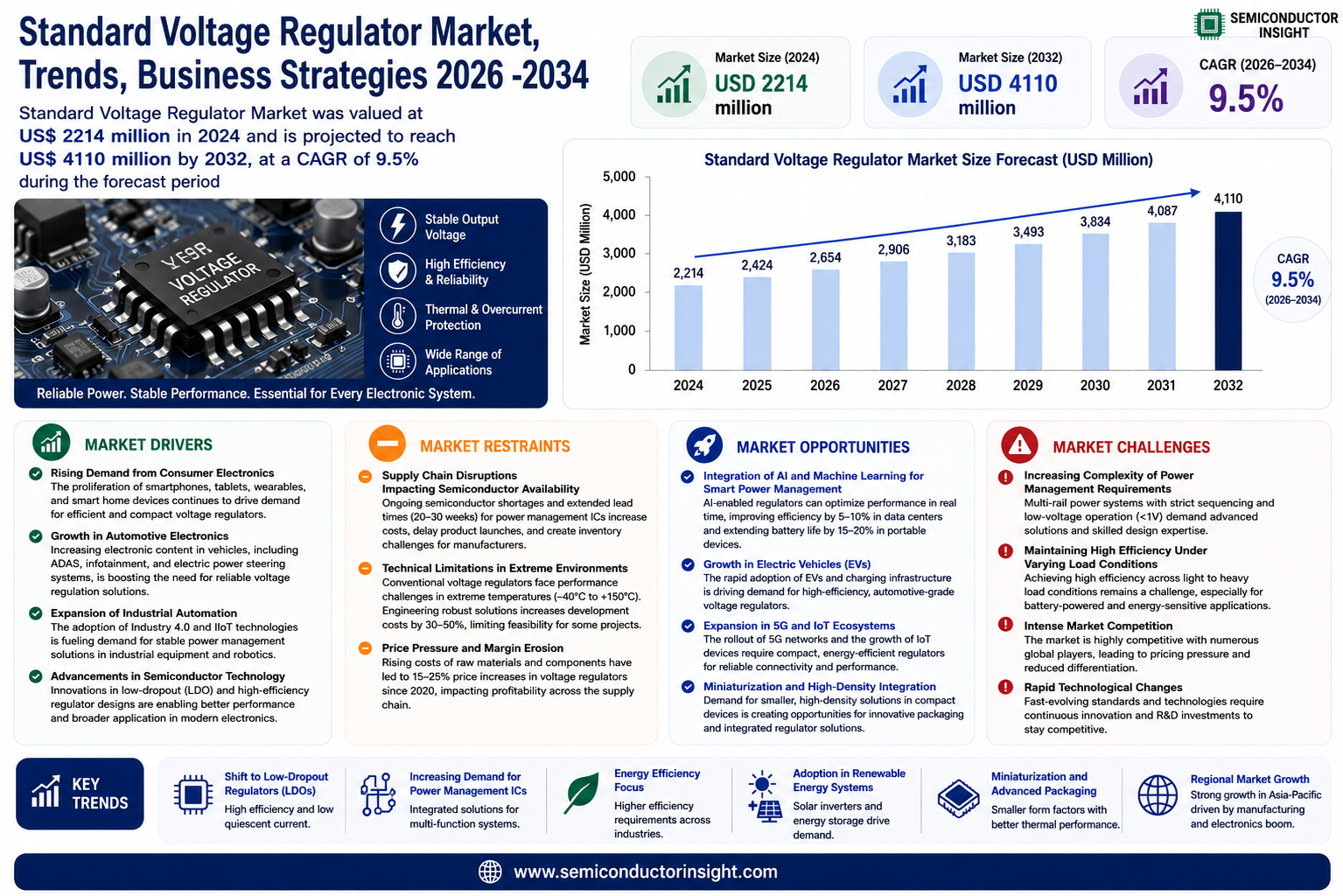
Standard Voltage Regulator Market was valued at 2214 million in 2024 and is projected to reach US$ 4110 million by 2032, at a CAGR of 9.5% during the forecast period.
Standard voltage regulators are electronic circuits designed to maintain a constant output voltage level despite variations in input voltage or load conditions. These critical components ensure stable power supply in applications ranging from consumer electronics to industrial automation. The two primary types are linear regulators (low-noise, simple design) and switching regulators (higher efficiency, complex design), with growing adoption of hybrid solutions.
The market growth is driven by increasing electronics integration across industries – particularly in automotive (EV power systems grew 65% in 2023), renewable energy (global solar installations up 35% YoY), and IoT devices (projected 29 billion units by 2030). However, design challenges in miniaturization and thermal management present constraints. Key players like Texas Instruments (holding 18% market share) and Infineon Technologies are investing in wide-bandgap semiconductor solutions to address these challenges, with recent breakthroughs in GaN-based regulators showing 15% efficiency improvements.
 MARKET DYNAMICS
MARKET DRIVERS
Rising Demand for Energy-Efficient Solutions Across Industries
The global push toward energy efficiency is significantly boosting the standard voltage regulator market. With increasing environmental regulations and corporate sustainability goals, industries are actively seeking power management solutions that minimize energy waste. Voltage regulators play a crucial role in optimizing power consumption across various applications, from consumer electronics to industrial automation. The market is witnessing a notable shift toward switching regulators, which typically offer 70-95% efficiency compared to 30-60% in traditional linear regulators. This efficiency improvement translates directly into reduced operational costs and lower carbon footprints, making high-performance voltage regulators increasingly attractive to cost-conscious businesses.
Accelerated Adoption of IoT and Smart Devices
The explosive growth of IoT devices and smart technologies is creating sustained demand for compact, reliable voltage regulation solutions. With projections indicating over 29 billion connected IoT devices by 2030, the need for stable power management in space-constrained applications has never been higher. Modern voltage regulators are evolving to meet these demands, with innovations like fully integrated power management ICs (PMICs) that combine multiple regulation functions in single-chip solutions. These advancements enable seamless integration into wearables, smart home devices, and industrial sensors while improving overall system reliability.
The automotive sector’s rapid electrification represents another major growth driver. As vehicles incorporate more electronic systems – from advanced driver assistance systems (ADAS) to infotainment – the automotive voltage regulator market is expected to grow at a compound annual growth rate exceeding 12% through 2030. This growth is further supported by the transition to electric vehicles, where precise voltage regulation is critical for battery management systems and power electronics.
MARKET RESTRAINTS
Supply Chain Disruptions Impacting Semiconductor Availability
The voltage regulator market continues to face significant challenges from ongoing semiconductor supply chain constraints. Many standard voltage regulators rely on specialized semiconductor components that remain subject to allocation and extended lead times. Recent industry reports indicate that average lead times for power management ICs have stabilized at 20-30 weeks, still well above pre-pandemic levels of 8-12 weeks. These extended lead times force equipment manufacturers to maintain larger inventories, increasing working capital requirements and potentially delaying product launches.
Furthermore, the geopolitical landscape has introduced additional complexity, with trade restrictions and export controls affecting the availability of certain semiconductor manufacturing materials. These constraints have led to price increases of 15-25% across many voltage regulator product categories since 2020, squeezing profit margins throughout the supply chain.
Technical Limitations in Extreme Environments
While voltage regulators have achieved impressive performance gains in standard operating conditions, their reliability in extreme environments remains a significant restraint. Applications in aerospace, automotive under-hood conditions, and industrial settings often require operation at temperature extremes (-40°C to +150°C) where conventional regulators struggle to maintain specifications. This limitation is particularly problematic as industries push for more ruggedized electronics in harsh environments. The additional engineering and testing required to develop robust solutions for these applications can increase development costs by 30-50%, making projects less economically viable for some manufacturers.
MARKET CHALLENGES
Increasing Complexity of Power Management Requirements
Modern electronic systems present increasingly complex power management challenges that standard voltage regulators must address. With processors and ASICs requiring multiple voltage rails (often at different voltage levels and with strict sequencing requirements), the traditional approach of discrete regulators becomes impractical. System designers now demand integrated solutions that can provide multiple regulated outputs while maintaining high efficiency across different load conditions. This complexity has led to an emerging skills gap, as many design engineers lack experience with advanced power architecture techniques.
The transition to lower voltage levels in digital circuits (now commonly below 1V) has introduced additional challenges. Maintaining tight voltage regulation at these levels requires precise control and low-noise performance that pushes the limits of conventional regulator designs. Voltage deviations that were previously acceptable at higher voltages (3.3V or 5V) now represent significant percentage variations that can impact system reliability and performance.
MARKET OPPORTUNITIES
Integration of AI and Machine Learning for Smart Power Management
The incorporation of artificial intelligence and machine learning into power management systems represents a significant growth opportunity for voltage regulator manufacturers. Smart regulators with adaptive algorithms can optimize performance in real-time based on load conditions, ambient temperature, and power quality. Early implementations in data center power supplies have demonstrated efficiency improvements of 5-10% through intelligent voltage regulation. The ability to predict load changes and preemptively adjust regulation parameters is particularly valuable in battery-powered applications, where it can extend operating time by 15-20%.
Expansion into Renewable Energy Applications
The rapid growth of renewable energy systems creates substantial opportunities for advanced voltage regulation solutions. Solar micro-inverters, wind turbine controllers, and energy storage systems all require sophisticated voltage regulation to maximize energy harvesting and conversion efficiency. The global market for renewable energy is projected to grow at nearly 9% annually through 2030, with voltage regulators playing a critical role in system performance. Manufacturers that can provide reliable, high-efficiency solutions tailored to these applications stand to benefit significantly from this expansion.
Emerging applications in edge computing and 5G infrastructure also present compelling opportunities. The deployment of thousands of small cell sites and edge data centers requires robust power management solutions that can operate reliably in diverse environmental conditions while meeting stringent efficiency requirements. Voltage regulators optimized for these applications must balance performance, reliability, and cost to succeed in these high-growth markets.
STANDARD VOLTAGE REGULATOR MARKET TRENDS
Rising Demand for Miniaturized and Energy-Efficient Voltage Regulators
The increasing adoption of compact electronic devices across consumer electronics, automotive, and industrial applications is driving demand for miniaturized voltage regulators. Modern designs prioritize high power density and low quiescent current to extend battery life in portable devices. The global shift toward energy-efficient solutions has accelerated the development of regulators with 95%+ efficiency ratings, reducing thermal losses in applications ranging from IoT sensors to electric vehicle powertrains. Recent advancements in semiconductor packaging, such as chip-scale and wafer-level packages, enable smaller footprints while meeting stringent EMI/EMC requirements.
Other Trends
Automotive Electrification
The automotive industry’s transition toward 48V mild-hybrid systems and advanced driver-assistance systems (ADAS) is creating substantial demand for robust voltage regulation solutions. Modern vehicles require precise voltage control for sensitive electronics operating in harsh environments, with temperature ranges extending from -40°C to 150°C. The proliferation of in-vehicle infotainment systems and autonomous driving technologies further compounds this need, with projections indicating automotive voltage regulator demand will grow at over 11% CAGR through 2030.
Industrial Automation and Smart Grid Expansion
Industrial 4.0 initiatives and smart grid deployments are significantly increasing the adoption of three-phase voltage regulators with advanced monitoring capabilities. These systems require voltage stabilization across diverse loads while maintaining compatibility with renewable energy inputs. The integration of digital control loops and predictive maintenance features allows real-time adjustment to load variations. In industrial settings, voltage regulators with ±0.5% output accuracy are becoming standard to protect sensitive automation equipment from power quality issues that cause downtime costs exceeding $50 billion annually.
COMPETITIVE LANDSCAPE
Key Industry Players
Semiconductor Giants and Power Electronics Leaders Dominate Market Dynamics
The global standard voltage regulator market exhibits a highly competitive landscape, characterized by the dominance of established semiconductor companies and specialized power electronics manufacturers. Texas Instruments emerges as the clear market leader, commanding approximately 18% revenue share in 2024 thanks to its comprehensive product portfolio spanning linear, switching, and low-dropout (LDO) regulators.
Infineon Technologies and ON Semiconductor follow closely, collectively holding around 25% market share. These companies benefit from strong automotive and industrial sector relationships, crucial given voltage regulators’ critical role in vehicle electrification and factory automation systems. Their technological edge in developing high-efficiency power management ICs gives them significant competitive advantage in mid-range voltage applications (3V-24V).
The market also features strong contenders like STMicroelectronics and NXP Semiconductors, who are aggressively expanding their voltage regulator offerings through strategic R&D investments. Recent developments include STMicroelectronics’ introduction of radiation-hardened regulators for aerospace applications, demonstrating the industry’s move toward specialized solutions.
Meanwhile, emerging players such as ROHM Semiconductor and Diodes Incorporated are gaining traction by focusing on niche segments like ultra-low-power IoT devices. Their ability to deliver cost-optimized solutions while maintaining reliability makes them formidable competitors in price-sensitive markets.
List of Key Standard Voltage Regulator Companies Profiled
- Texas Instruments (U.S.)
- Infineon Technologies (Germany)
- ON Semiconductor (U.S.)
- STMicroelectronics (Switzerland)
- NXP Semiconductors (Netherlands)
- ROHM Semiconductor (Japan)
- Diodes Incorporated (U.S.)
- Analog Devices, Inc. (U.S.)
- Siemens (Germany)
The competitive environment continues evolving as companies pursue both organic growth and strategic acquisitions. Recent moves include Texas Instruments’ expansion of its 300mm wafer production capacity to meet growing voltage regulator demand, while Infineon strengthens its market position through vertical integration of power semiconductor manufacturing. Such developments underscore the market’s dynamic nature and the strategic importance of reliable voltage regulation across industries.
Segment Analysis:
By Type
Linear Voltage Regulators Hold Major Share Due to Cost-Effectiveness and Simplicity in Low-Power Applications
The market is segmented based on type into:
- Linear Voltage Regulators
- Subtypes: Fixed Output, Adjustable Output
- Switching Voltage Regulators
- Subtypes: Buck, Boost, Buck-Boost, Flyback
- Low Dropout (LDO) Regulators
- Zener Diode Regulators
- Others
By Application
Consumer Electronics Dominates Application Segment Owing to Pervasive Use in Smart Devices and Home Appliances
The market is segmented based on application into:
- Consumer Electronics
- Automotive Electronics
- Industrial Equipment
- Telecommunications
- Medical Devices
By End User
Original Equipment Manufacturers (OEMs) Lead Demand Due to High Volume Production Needs
The market is segmented based on end user into:
- Original Equipment Manufacturers (OEMs)
- Aftermarket
- Maintenance & Repair Organizations
- Research Institutions
Regional Analysis: Standard Voltage Regulator Market
North America
North America remains a dominant player in the global standard voltage regulator market, driven by strong technological adoption and robust industrial demand. The U.S. accounts for over 65% of regional revenue, with key sectors like automotive, aerospace, and medical technology pushing demand for high-precision voltage regulation. Strict energy efficiency standards, such as the Department of Energy’s (DOE) mandates for power devices, are accelerating the shift toward advanced switching regulators. Meanwhile, Canada’s growing investments in renewable energy infrastructure create opportunities for grid-compatible voltage stabilization solutions. However, higher production costs and semiconductor supply chain challenges pose constraints to market expansion.
Europe
Europe’s mature electronics manufacturing sector ensures steady demand for voltage regulators, particularly in Germany, Italy, and France. The region benefits from stringent EU safety certifications (e.g., CE, RoHS), which compel manufacturers to prioritize reliability and efficiency. Industrial automation and electric vehicle (EV) adoption—especially with the EU’s 2035 combustion engine ban—are significant growth drivers. However, geopolitical tensions affecting semiconductor imports and slower adoption of newer technologies in Eastern Europe present hurdles. Companies are increasingly investing in modular and miniaturized voltage regulation systems to cater to space-constrained applications in medical and IoT devices.
Asia-Pacific
The Asia-Pacific region is the fastest-growing market for voltage regulators, projected to account for 48% of global demand by 2030. China leads in both production and consumption, supported by its vast electronics manufacturing base and government initiatives like “Made in China 2025.” India’s automotive and consumer electronics boom is fueling demand for cost-effective linear regulators, while Japan and South Korea focus on high-efficiency IC regulators for precision applications. Despite rapid growth, price sensitivity in emerging economies and inconsistent regulatory frameworks create localized challenges. The region also sees increasing R&D in gallium nitride (GaN)-based regulators for next-gen power efficiency.
South America
South America’s market is emerging, with Brazil and Argentina as the primary adopters of voltage regulation technology. Industrial modernization in mining and oil & gas sectors is driving demand for ruggedized regulators, while urbanization spurs growth in consumer electronics. However, economic instability and import dependency on semiconductor components hinder market scalability. Local manufacturers face difficulties competing with Asian and North American suppliers in terms of pricing and innovation. Recent trade agreements to bolster regional semiconductor production could gradually improve accessibility.
Middle East & Africa
This region shows nascent but promising growth, largely tied to infrastructure development in the GCC countries (e.g., UAE, Saudi Arabia) and renewable energy projects in North Africa. Voltage regulator adoption is concentrated in oil & gas, telecommunications, and grid stabilization applications. While the lack of local manufacturing capabilities results in reliance on imports, initiatives like Saudi Arabia’s Vision 2030 aim to strengthen domestic electronics production. Energy diversification efforts, particularly solar power integration, are expected to boost demand for voltage regulation solutions over the next decade.
Report Scope
This market research report provides a comprehensive analysis of the Global Standard Voltage Regulator Market, covering the forecast period 2025–2032. It offers detailed insights into market dynamics, technological advancements, competitive landscape, and key trends shaping the industry.
Key focus areas of the report include:
- Market Size & Forecast: Historical data and future projections for revenue, unit shipments, and market value across major regions and segments. The market was valued at USD 2,214 million in 2024 and is projected to reach USD 4,110 million by 2032, growing at a CAGR of 9.5%.
- Segmentation Analysis: Detailed breakdown by product type (Three Phase, Dual Phase, Single Phase), application (Automotive, Aerospace, Medical Technology, etc.), and end-user industry to identify high-growth segments.
- Regional Outlook: Insights into market performance across North America, Europe, Asia-Pacific, Latin America, and Middle East & Africa, including country-level analysis of key markets like the US, China, and Germany.
- Competitive Landscape: Profiles of 20+ leading market participants including Texas Instruments, ON Semiconductor, Infineon Technologies, and STMicroelectronics, covering their market share, product portfolios, and strategic developments.
- Technology Trends & Innovation: Assessment of emerging regulator technologies, integration with IoT systems, energy efficiency improvements, and miniaturization trends.
- Market Drivers & Restraints: Evaluation of factors like increasing electronics adoption, renewable energy growth, and supply chain challenges affecting component availability.
- Stakeholder Analysis: Strategic insights for component manufacturers, OEMs, system integrators, and investors regarding market opportunities and competitive positioning.
The research employs primary interviews with industry experts and analysis of verified market data to ensure accuracy and reliability of all projections and insights.
FREQUENTLY ASKED QUESTIONS:
What is the current market size of Global Standard Voltage Regulator Market?
-> Standard Voltage Regulator Market was valued at 2214 million in 2024 and is projected to reach US$ 4110 million by 2032, at a CAGR of 9.5% during the forecast period.
Which key companies operate in Global Standard Voltage Regulator Market?
-> Key players include Texas Instruments, ON Semiconductor, Infineon Technologies, STMicroelectronics, Analog Devices, and NXP Semiconductors, among others.
What are the key growth drivers?
-> Key growth drivers include rising electronics adoption across industries, increasing demand for energy-efficient solutions, and growth in renewable energy systems.
Which region dominates the market?
-> Asia-Pacific dominates the market due to strong electronics manufacturing, while North America leads in technological innovation.
What are the emerging trends?
-> Emerging trends include integration of AI for smart voltage regulation, development of ultra-low-power regulators, and increasing adoption in electric vehicles.

Get Sample Report PDF for Exclusive Insights
Report Sample Includes
- Table of Contents
- List of Tables & Figures
- Charts, Research Methodology, and more...
 Download Sample Report PDF