Spin-transfer torque MRAM based microcontroller replacement chip Market Insights
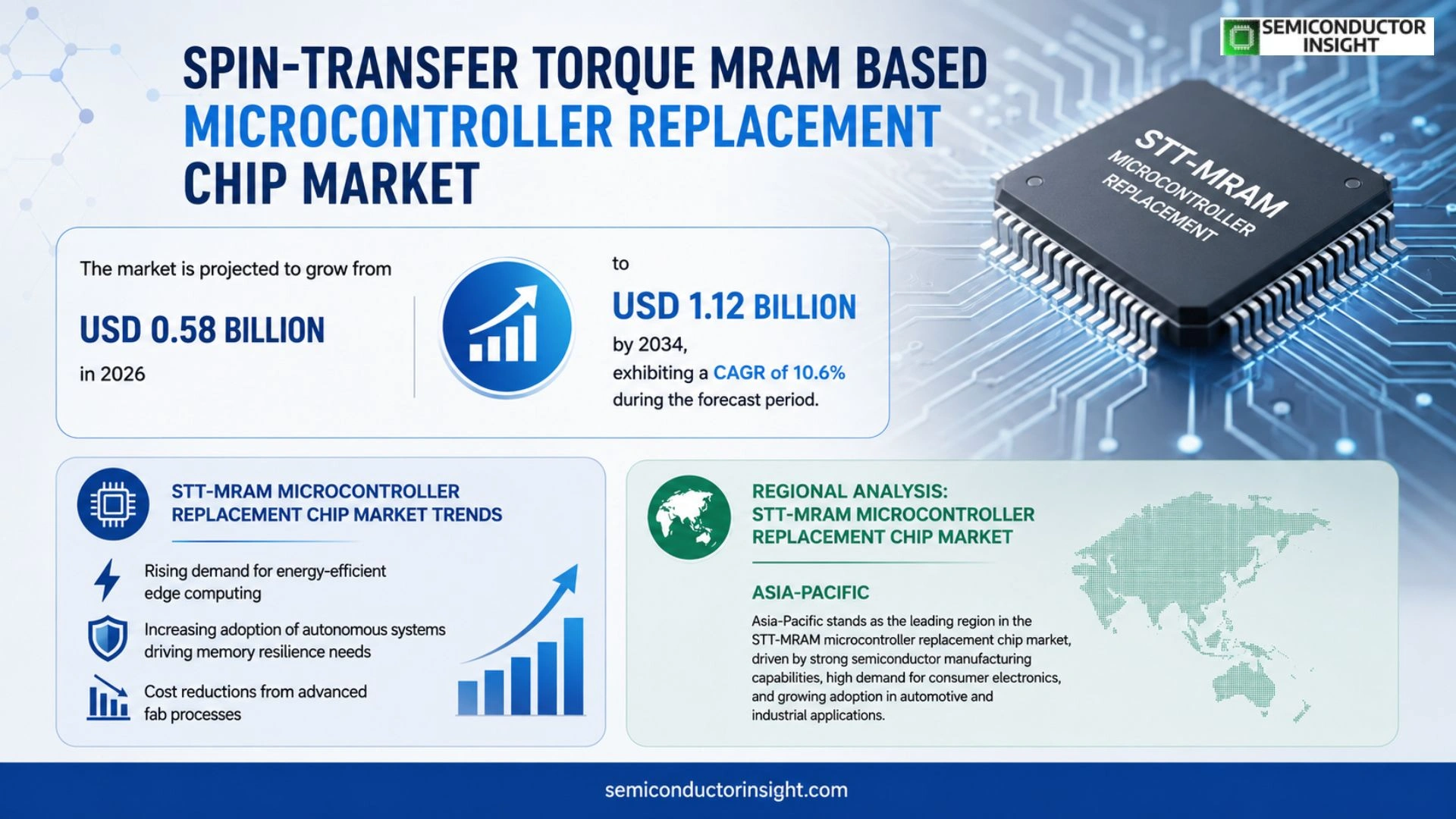
Global Spin-transfer torque MRAM based microcontroller replacement chip market size was valued at USD 0.45 billion in 2025. The market is projected to grow from USD 0.58 billion in 2026 to USD 1.12 billion by 2034, exhibiting a CAGR of approximately 10.6% during the forecast period.
Spin‑transfer torque MRAM (STT‑MRAM) chips are non‑volatile memory devices that combine magnetic tunnel junctions with CMOS logic to deliver fast read/write speeds, low power consumption, and unlimited endurance. When integrated as a microcontroller replacement, they enable instant-on operation and eliminate the need for separate flash storage.
The market is experiencing rapid growth due to several factors, including rising demand for energy‑efficient edge computing, increasing adoption of autonomous systems that require robust memory resilience, and ongoing cost reductions driven by advanced fab processes. Furthermore, strategic collaborations,such as Everspin’s partnership with TSMC for advanced node production,and expanding product portfolios from Samsung Electronics, Intel and NXP are expected to further accelerate market expansion.
MARKET DRIVERS
Growing Demand for Low‑Power, High‑Reliability Memory
Spin‑transfer torque MRAM based microcontroller replacement chip Market is being propelled by the exponential growth of IoT devices, electric‑vehicle electronics, and aerospace systems that require memory solutions with near‑zero standby power and superior data retention. Manufacturers are prioritizing chips that can sustain operation under extreme temperature ranges while reducing overall system power budgets.
Advancements in Spin‑Transfer Torque Technology
Recent breakthroughs in materials engineering,such as the adoption of low‑damping ferromagnetic alloys,and refined write‑current reduction techniques have lowered the energy per bit to under 10 pJ. This technical progress enables higher density arrays at smaller node sizes, making STT‑MRAM a viable replacement for traditional flash in microcontroller architectures.
➤ Industry analysts estimate that the STT‑MRAM segment attached to microcontrollers will achieve a CAGR of roughly 18 % through 2032, driven by these efficiency gains.
Beyond performance, the non‑volatile nature of STT‑MRAM eliminates the need for separate backup power sources, simplifying board designs and shortening time‑to‑market for next‑generation embedded platforms.
MARKET CHALLENGES
Technical Integration Barriers
Design teams encounter compatibility issues when integrating STT‑MRAM chips with legacy microcontroller families, particularly concerning voltage‑level translation and timing closure. The need for specialized design kits and verification flows adds to development overhead, slowing adoption in conservative industrial segments.
Other Challenges
Manufacturing Yield and Cost
Current fab processes for high‑density MRAM still suffer from lower yield rates compared with mature NAND flash, leading to elevated unit costs that can deter price‑sensitive OEMs.
MARKET RESTRAINTS
High Production Costs
The capital-intensive nature of spin‑torque deposition equipment, combined with limited wafer‑scale adoption, results in a cost structure that remains higher than competing volatile memory technologies. Until economies of scale are realized, many manufacturers will continue to favor conventional SRAM or Flash for cost‑critical applications.
MARKET OPPORTUNITIES
Edge Computing and Autonomous Systems
The rise of edge AI accelerators and autonomous driving platforms creates a compelling niche for STT‑MRAM microcontroller replacements, where instantaneous power‑on, radiation tolerance, and deterministic latency are paramount. Strategic partnerships between chip designers and vehicle‑grade OEMs are expected to unlock new revenue streams and accelerate market penetration.
Spin-transfer torque MRAM based microcontroller replacement chip Market Trends
Growth Driven by Edge‑Computing Demand
Spin‑transfer torque MRAM based microcontroller replacement chip Market is shifting from early‑stage adoption to a broader presence in edge‑computing devices. The 2025 market valuation of USD 0.45 billion has already moved to an estimated USD 0.58 billion in 2026, reflecting strong buyer interest in instant‑on operation and the ability to remove separate flash storage. This transition is especially notable in battery‑powered sensors and IoT gateways where low standby power and fast wake‑up times directly impact device uptime and overall energy costs. The combination of magnetic tunnel junctions with CMOS logic delivers read/write speeds that meet the latency requirements of real‑time analytics at the edge, while the non‑volatile nature guarantees data retention without power.
Other Trends
Resilience for Autonomous and Rugged Applications
Autonomous systems such as driver‑less vehicles, drones and industrial robots require memory that can survive extreme temperature swings, vibration and radiation exposure. STT‑MRAM’s unlimited endurance and magnetic data stability make it a preferred choice for safety‑critical control loops, where any loss of program state could lead to system failure. OEMs are therefore qualifying these chips for high‑integrity platforms, a move that deepens the market’s link to the growing autonomous technology sector.
Strategic Partnerships Accelerating Cost Reductions
Industry collaborations are lowering the total cost of ownership for these chips. The partnership between Everspin and TSMC to produce advanced‑node STT‑MRAM has streamlined the manufacturing flow, resulting in a noticeable reduction in wafer‑level pricing. At the same time, expanded product portfolios from Samsung Electronics, Intel and NXP introduce higher‑density memory blocks, enabling microcontroller designs that can embed 64 KB to 256 KB of on‑chip storage without sacrificing latency. These strategic moves not only improve price competitiveness against conventional flash but also broaden the addressable application set, from consumer wearables to aerospace control units.
COMPETITIVE LANDSCAPE
Key Industry Players
Spin‑transfer torque MRAM based microcontroller replacement chip market competitive overview
The market is currently led by Everspin Technologies, which leverages its long‑standing expertise in STT‑MRAM and a strategic partnership with TSMC to produce advanced‑node chips that serve as direct microcontroller replacements. Everspin’s product line benefits from high‑density memory‑logic integration, offering instant‑on capability and eliminating separate flash, which positions it as the de‑facto benchmark for performance and reliability. The company’s aggressive roadmap and strong IP portfolio have created a tier‑1 supply chain that many system‑level designers favor when targeting edge‑computing and autonomous applications.
Beyond the leader, a robust cohort of semiconductor giants and specialized innovators expands the ecosystem. Samsung Electronics and Intel Corporation are rapidly scaling volume production with aggressive pricing, while NXP Semiconductors focuses on automotive‑grade qualifications. Micron Technology, STMicroelectronics, and Texas Instruments provide niche solutions tailored to low‑power IoT devices. Additional contributors such as Renesas Electronics, GlobalFoundries, SK Hynix, Fujitsu, and Infineon (Cypress) engage in targeted R&D collaborations, enriching the market with diversified process options and application‑specific firmware support.
List of Key Spin‑transfer torque MRAM based microcontroller replacement chip Companies Profiled
- Everspin Technologies
- Samsung Electronics
- Intel Corporation
- NXP Semiconductors
- Micron Technology
- STMicroelectronics
- Texas Instruments
- Renesas Electronics
- GlobalFoundries
- SK Hynix
- Fujitsu Limited
- Infineon Technologies (Cypress)
- IBM Research
- Marvell Technology Group
- TSMC (Taiwan Semiconductor Manufacturing Company)
Segment Analysis:
| Segment Category | Sub-Segments | Key Insights |
| By Type |
|
Integrated STT‑MRAM MCU
|
| By Application |
|
Edge AI inference processors
|
| By End User |
|
Automotive electronic control units
|
| By Integration Level |
|
Full system‑on‑chip (SoC) solutions
|
| By System Requirement |
|
Radiation‑hardening
|
Regional Analysis: North America
The automotive sector is a primary driver for Spin-transfer torque MRAM adoption, demanding robust and reliable memory for various applications, including advanced driver-assistance systems (ADAS) and in-vehicle infotainment. The increasing complexity of automotive electronics necessitates high-performance and durable memory solutions.
Industrial automation is witnessing a surge in the use of microcontroller replacement chips with enhanced memory capabilities. The need for real-time data processing and reliable operation in harsh industrial environments propels the demand for Spin-transfer torque MRAM.
Consumer electronics continue to drive the need for compact, high-performance memory solutions. Spin-transfer torque MRAM plays a crucial role in enabling advancements in smartphones, wearables, and other electronic devices, offering increased speed and power efficiency.
The aerospace and defense sectors demand highly reliable and secure memory solutions. Spin-transfer torque MRAM’s endurance and resistance to extreme conditions make it well-suited for mission-critical applications in this domain.
Europe
Europe exhibits a strong focus on energy efficiency and data security, influencing the demand for Spin-transfer torque MRAM based microcontroller replacement chips. The automotive and industrial sectors are key consumers in this region, with increasing adoption in electric vehicles and smart manufacturing initiatives. Stringent data privacy regulations further drive the need for secure memory solutions. The European market benefits from a highly skilled workforce and a robust research and development ecosystem. The replacement chip market is expected to see steady growth driven by these factors.
Asia-Pacific
Asia-Pacific is poised to be the fastest-growing market for Spin-transfer torque MRAM based microcontroller replacement chips. The region’s burgeoning electronics manufacturing hubs, particularly in China, Japan, and South Korea, are major contributors to this growth. The rapid expansion of the automotive and industrial sectors, coupled with increasing investments in 5G and IoT technologies, are fueling demand. Government initiatives promoting domestic semiconductor production also support market expansion. The replacement chip market here will benefit from the scale of electronics production and growing end-market applications.
South America
South America presents a moderate growth opportunity for Spin-transfer torque MRAM based microcontroller replacement chips. The region’s growing industrial sector and increasing adoption of automotive technologies are key drivers. The expanding consumer electronics market, particularly in Brazil and Chile, also contributes to demand. While the market is less mature than North America or Asia-Pacific, it offers potential for future growth as infrastructure development progresses and technological adoption increases.
Middle East & Africa
The Middle East & Africa represents an emerging market for Spin-transfer torque MRAM based microcontroller replacement chips. The region’s growing investments in infrastructure, automotive manufacturing, and smart city initiatives are driving demand. The increasing adoption of advanced electronics in various sectors, including oil and gas and defense, further contributes to market growth. While the market is relatively small currently, it holds significant potential for expansion in the coming years as economies develop and technological adoption rises.
Report Scope
This market research report provides a comprehensive analysis of the Spin-transfer torque MRAM based microcontroller replacement chip Market , covering the forecast period 2026–2034. It offers detailed insights into market dynamics, technological advancements, competitive landscape, and key trends shaping the industry.
Key focus areas of the report include:
- Market Overview: The report begins with an overview outlining its current market scenario, key growth indicators, and industry transformation drivers. It discusses macroeconomic factors, demand–supply balance, regulatory landscape, and the strategic role of semiconductors in powering advancements across industries such as automotive, telecommunications, consumer electronics, and industrial automation.
- Market Size & Forecast: Historical data and future projections for revenue, unit shipments, and market value across major regions and segments.
- Segmentation Analysis: Detailed breakdown by product type, technology, application, and end-user industry to identify high-growth segments and investment opportunities.
- Regional Insights: Insights into market performance across North America, Europe, Asia-Pacific, Latin America, and the Middle East & Africa, including country-level analysis where relevant.
- Competitive Landscape: Profiles of leading market participants, including their product offerings, R&D focus, manufacturing capacity, pricing strategies, and recent developments such as mergers, acquisitions, and partnerships.
- Technology Trends & Innovation: Assessment of emerging technologies, integration of AI/IoT, semiconductor design trends, fabrication techniques, and evolving industry standards.
- Market Drivers & Restraints: Evaluation of factors driving market growth along with challenges, supply chain constraints, regulatory issues, and market-entry barriers.
- Stakeholder Insights: Insights for component suppliers, OEMs, system integrators, investors, and policymakers regarding the evolving ecosystem and strategic opportunities.
Primary and secondary research methods are employed, including interviews with industry experts, data from verified sources, and real-time market intelligence to ensure the accuracy and reliability of the insights presented.
FREQUENTLY ASKED QUESTIONS:
What is the current market size of Spin-transfer torque MRAM based microcontroller replacement chip Market?
-> Spin-transfer torque MRAM based microcontroller replacement chip Market was valued at USD 0.45 billion in 2025 and is expected to reach USD 1.12 billion by 2034.
Which key companies operate in Spin-transfer torque MRAM based microcontroller replacement chip Market?
-> Key players include Everspin Technologies, Samsung Electronics, Intel Corporation, NXP Semiconductors, and TSMC, among others.
What are the key growth drivers?
-> Key growth drivers include rising demand for energy‑efficient edge computing, increasing adoption of autonomous systems requiring robust memory resilience, and cost reductions driven by advanced fab processes.
Which region dominates the market?
-> Asia-Pacific shows strong adoption due to extensive semiconductor manufacturing, while North America and Europe also contribute significantly to market growth.
What are the emerging trends?
-> Emerging trends include strategic collaborations for advanced node production (e.g., Everspin‑TSMC), expansion of product portfolios by Samsung, Intel and NXP, and integration of STT‑MRAM with AI/IoT edge solutions.
Get Sample Report PDF for Exclusive Insights
Report Sample Includes
- Table of Contents
- List of Tables & Figures
- Charts, Research Methodology, and more...