Spatial Computing Display Market Insights
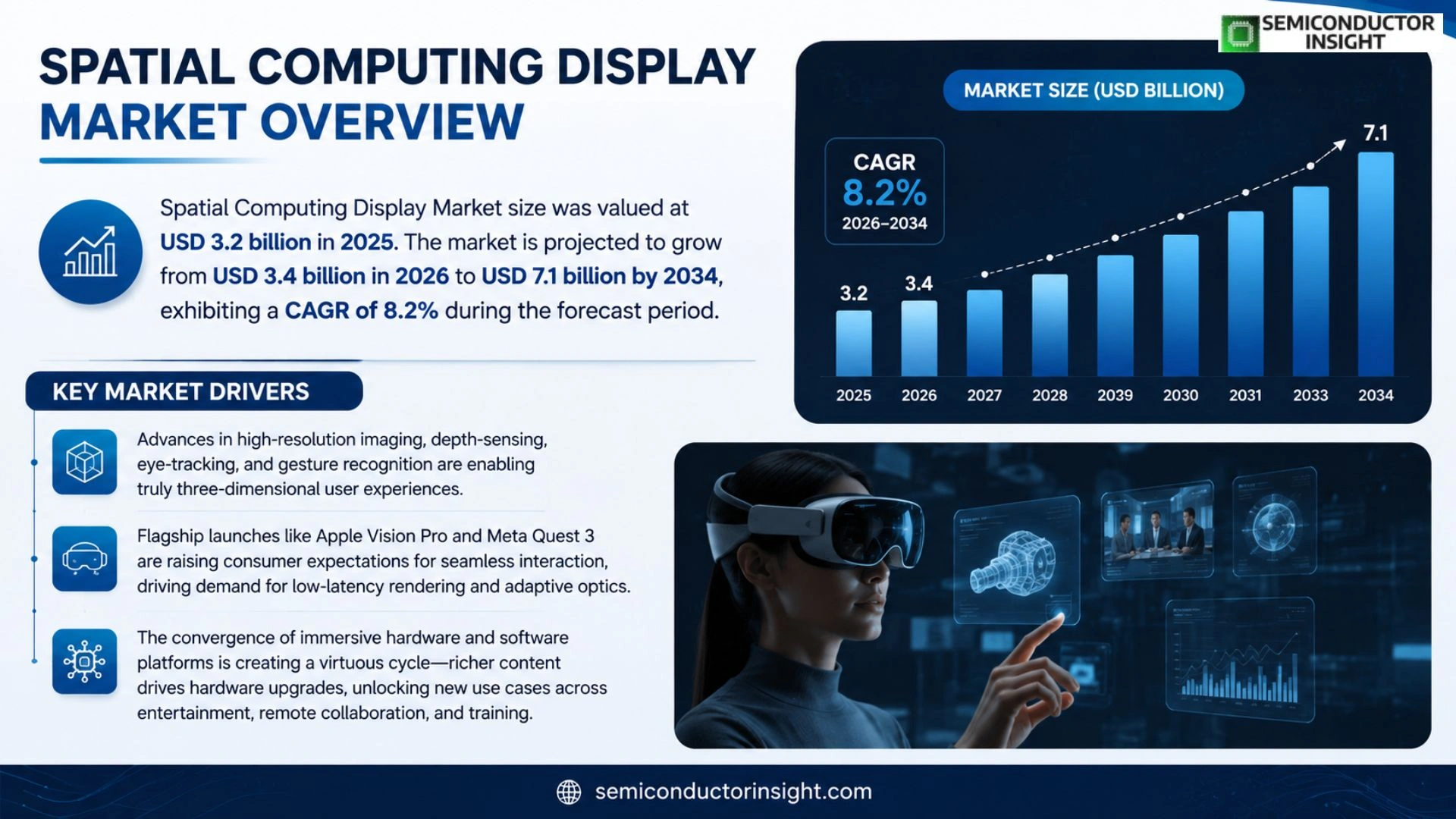
Spatial Computing Display Market size was valued at USD 3.2 billion in 2025. The market is projected to grow from USD 3.4 billion in 2026 to USD 7.1 billion by 2034, exhibiting a CAGR of 8.2% during the forecast period.
Spatial computing displays are advanced visual interfaces that combine high‑resolution imaging with depth‑sensing, eye‑tracking and gesture recognition to render immersive three‑dimensional content. These displays enable seamless interaction between digital objects and the physical environment, supporting applications such as augmented reality (AR), virtual reality (VR) and mixed reality (MR) across consumer electronics, industrial training and remote collaboration.
The market is accelerating because enterprises are investing heavily in XR solutions, while consumer demand spikes following flagship product launches like Apple Vision Pro and Meta Quest 3. Furthermore, declining sensor costs and improvements in low‑latency rendering are expanding adoption across sectors such as healthcare, manufacturing and education. Key players,including Microsoft, Samsung Electronics, Sony Corporation and Lenovo,are driving innovation through strategic partnerships and continuous R&D investments.
MARKET DRIVERS
Growing Adoption of Augmented and Virtual Reality
The surge in enterprise and consumer deployment of AR/VR solutions is fueling demand for high‑resolution, low‑latency spatial computing displays. Manufacturers are investing heavily in micro‑LED and holographic waveguide technologies to meet the performance expectations of immersive applications.
Advancements in Sensor Fusion and AI‑Driven Rendering
Recent breakthroughs in sensor fusion enable precise depth perception, while AI‑accelerated rendering reduces computational load, making wearable spatial displays more comfortable and power‑efficient. These technical gains are expanding the addressable market across education, healthcare, and industrial training.
➤ “The integration of AI with spatial optics is projected to increase device adoption rates by double digits annually,”
Combined, these factors are driving a robust growth trajectory for Spatial Computing Display Market, positioning it as a cornerstone of next‑generation user experiences.
MARKET CHALLENGES
High Development Costs and Limited Component Supply
Developing cutting‑edge display stacks requires substantial R&D capital, and the scarcity of high‑quality optical components creates bottlenecks. Smaller firms often face financial constraints that hinder rapid market entry.
Other Challenges
Regulatory and Safety Concerns
Stringent health and safety regulations for near‑eye displays necessitate extensive testing, extending time‑to‑market and increasing compliance expenditures.
Moreover, consumer perception regarding eye strain and motion sickness remains a barrier that manufacturers must address through ergonomic design and adaptive refresh‑rate technologies.
MARKET RESTRAINTS
Limited Battery Life in Wearable Form Factors
Current battery technologies struggle to sustain prolonged operation of high‑brightness spatial displays, especially in lightweight head‑mounted units. This energy limitation restricts use cases to short‑duration sessions, curbing broader adoption.
MARKET OPPORTUNITIES
Enterprise Training and Remote Collaboration Platforms
Enterprises are exploring spatial displays to enhance remote collaboration, simulation‑based training, and real‑time data visualization. Investments in these verticals are expected to unlock new revenue streams and accelerate market penetration.
Spatial Computing Display Market Trends
Emerging Immersive Interaction Technologies
Spatial Computing Display Market is being reshaped by advances in high‑resolution imaging combined with depth‑sensing, eye‑tracking and gesture recognition. These capabilities enable truly three‑dimensional user experiences that blend digital content with the physical environment. Recent flagship launches, such as the Apple Vision Pro and Meta Quest 3, demonstrate how consumer expectations are shifting toward seamless interaction, pushing manufacturers to prioritize low‑latency rendering and adaptive optics. Analysts observe that the convergence of immersive hardware and software platforms is creating a virtuous cycle: richer content drives hardware upgrades, which in turn unlocks new application scenarios across entertainment, remote collaboration and training.
Other Trends
Sensor Integration and Cost Reduction
One of the most pronounced drivers Spatial Computing Display Market is the ongoing decline in sensor component costs. As CMOS depth sensors and infrared arrays become more affordable, device makers can integrate multiple sensing modalities without inflating price points. This economic shift is encouraging broader adoption in sectors that previously hesitated due to cost barriers, such as healthcare diagnostics and precision manufacturing. Moreover, tighter integration of sensors with display drivers reduces system latency, enhancing real‑time interactivity for mixed‑reality applications.
Enterprise Adoption and Vertical Expansion
Enterprises are allocating increasing budgets toward spatial computing solutions to improve training efficiency, remote assistance, and product design. Companies like Microsoft, Samsung Electronics, Sony Corporation and Lenovo are forming strategic partnerships with software providers to deliver turnkey XR ecosystems for industrial use. In manufacturing, spatial displays guide workers through complex assembly steps, reducing error rates. In education, immersive visualizations support experiential learning, particularly in anatomy and engineering curricula. The cumulative effect is a steady widening of Spatial Computing Display Market’s addressable verticals, reinforcing its role as a foundational technology for next‑generation digital workspaces.
COMPETITIVE LANDSCAPE
Key Industry Players
Spatial Computing Display Market Competitive Overview
The market is currently dominated by a handful of technology conglomerates that combine deep hardware expertise with advanced sensor integration. Microsoft leads through its Azure Mixed Reality platform and HoloLens line, leveraging large enterprise contracts to secure recurring revenue streams and driving the industrial XR segment. Apple’s entrance with Vision Pro has re‑energized consumer demand, rapidly scaling the premium segment, prompting a surge in component orders and influencing supply‑chain dynamics. Meta Platforms, under the Quest 3 banner, continues to capture volume‑driven adoption in both entertainment and education, benefitting from a robust app ecosystem and aggressive pricing. Samsung Electronics supplies high‑resolution micro‑LED panels, eye‑tracking modules, and flexible OLED displays that power multiple OEMs, reinforcing its role as a critical component supplier. Together these leaders shape a market structure where vertical integration, strategic partnerships, and control over silicon‑level IP dictate access to the fast‑growing USD 7.1 billion 2034 opportunity, while the market expands from USD 3.4 billion in 2026 at an 8.2% CAGR.
Beyond the headline names, a vibrant ecosystem of niche innovators fuels differentiation and specialized use‑cases. HTC’s Vive Focus series targets enterprise training with lightweight optics and integrated hand‑tracking, while Qualcomm’s Snapdragon XR2 chipset enables on‑device AI for real‑time depth sensing across a wide range of headsets. Vuzix and Magic Leap focus on compact, wearable optics for field service and medical imaging, positioning themselves in high‑value professional markets. PTC leverages its industrial AR software to embed spatial displays directly into manufacturing workflows, creating subscription‑based value‑add services. Panasonic, Sharp, and Huawei contribute advanced display panel technologies, high‑brightness coatings, and 5G connectivity that enhance latency‑critical applications in remote collaboration and telemedicine. Google’s ARCore ecosystem expands software support for third‑party hardware, encouraging broader adoption. These companies, although smaller in revenue, provide critical complementary capabilities,ranging from sensor miniaturization to developer tools,that enrich the overall competitive landscape and sustain long‑term market resilience.
List of Key Spatial Computing Display Companies Profiled
- Microsoft
- Apple
- Meta Platforms
- Samsung Electronics
- Sony Corporation
- Lenovo
- HTC
- Qualcomm
- Vuzix
- Magic Leap
- PTC
- Panasonic
- Sharp
- Huawei
- Google (Alphabet)
Segment Analysis:
| Segment Category | Sub-Segments | Key Insights |
| By Type |
|
AR Displays
|
| By Application |
|
Industrial Training
|
| By End User |
|
Enterprises
|
| By Interaction Modality |
|
Eye‑Tracking
|
| By Industry Vertical |
|
Healthcare
|
Regional Analysis: North America
North America
The enterprise sector is a primary driver for Spatial Computing Display Market growth in North America. Applications in areas such as design and engineering, manufacturing, and healthcare are gaining traction. These displays enable collaborative workflows, remote assistance, and enhanced visualization of complex data.
The gaming and entertainment industry in North America is significantly contributing to the demand for immersive spatial computing displays. The pursuit of realistic and engaging experiences is driving innovation in display technologies, including higher refresh rates and wider field-of-view options.
Spatial computing displays are finding increasing application in healthcare, particularly in medical imaging and surgical planning. These displays offer enhanced visualization of 3D anatomical data, facilitating more accurate diagnoses and treatment strategies.
The retail sector is exploring the potential of spatial computing displays to enhance the customer experience. Applications such as virtual try-on, interactive product visualization, and immersive shopping environments are gaining momentum.
North America
The market is characterized by significant investment in research and development, fostering innovation in display technologies and spatial computing solutions. The presence of major technology companies, coupled with strong academic partnerships, creates a fertile ground for market growth. The adoption of spatial computing displays is expected to accelerate in the coming years, driven by increasing consumer awareness and the development of compelling use cases. While challenges remain regarding cost and the need for standardization, the long-term prospects for the North American Spatial Computing Display Market are highly promising.
Europe
Europe represents a substantial market for Spatial Computing Display Market, with a strong emphasis on industrial applications and research initiatives. The region’s robust manufacturing sector and focus on technological advancement are key drivers for demand. Key players are investing in developing spatial computing solutions for areas such as automotive, aerospace, and industrial automation. Regulatory frameworks and data privacy concerns are important considerations for market growth in Europe.
Asia-Pacific
Asia-Pacific is poised for the fastest growth Spatial Computing Display Market. The region’s burgeoning consumer electronics market, coupled with increasing government support for technology development, is fueling demand. China, in particular, is emerging as a dominant player, with significant investments in AR/VR technologies and related display solutions. The growing adoption of smart devices and the expansion of e-commerce are further driving market growth in Asia-Pacific.
South America
South America is an emerging market for Spatial Computing Display Market, with significant potential for growth in the coming years. The region’s increasing internet penetration and rising disposable incomes are driving demand for consumer electronics and related technologies. Opportunities exist in areas such as education, healthcare, and entertainment.
Middle East & Africa
The Middle East & Africa region represents a relatively nascent market for Spatial Computing Display Market. However, with increasing investments in technology and infrastructure development, the region is expected to witness significant growth in the long term. Opportunities exist in areas such as tourism, military applications, and industrial training.
Report Scope
This market research report provides a comprehensive analysis of the Spatial Computing Display Market , covering the forecast period 2026–2034. It offers detailed insights into market dynamics, technological advancements, competitive landscape, and key trends shaping the industry.
Key focus areas of the report include:
- Market Overview: The report begins with an overview outlining its current market scenario, key growth indicators, and industry transformation drivers. It discusses macroeconomic factors, demand–supply balance, regulatory landscape, and the strategic role of semiconductors in powering advancements across industries such as automotive, telecommunications, consumer electronics, and industrial automation.
- Market Size & Forecast: Historical data and future projections for revenue, unit shipments, and market value across major regions and segments.
- Segmentation Analysis: Detailed breakdown by product type, technology, application, and end-user industry to identify high-growth segments and investment opportunities.
- Regional Insights: Insights into market performance across North America, Europe, Asia-Pacific, Latin America, and the Middle East & Africa, including country-level analysis where relevant.
- Competitive Landscape: Profiles of leading market participants, including their product offerings, R&D focus, manufacturing capacity, pricing strategies, and recent developments such as mergers, acquisitions, and partnerships.
- Technology Trends & Innovation: Assessment of emerging technologies, integration of AI/IoT, semiconductor design trends, fabrication techniques, and evolving industry standards.
- Market Drivers & Restraints: Evaluation of factors driving market growth along with challenges, supply chain constraints, regulatory issues, and market-entry barriers.
- Stakeholder Insights: Insights for component suppliers, OEMs, system integrators, investors, and policymakers regarding the evolving ecosystem and strategic opportunities.
Primary and secondary research methods are employed, including interviews with industry experts, data from verified sources, and real‑time market intelligence to ensure the accuracy and reliability of the insights presented.
FREQUENTLY ASKED QUESTIONS:
What is the current market size of Spatial Computing Display Market?
-> Spatial Computing Display Market size was valued at USD 3.2 billion in 2025. The market is projected to grow from USD 3.4 billion in 2026 to USD 7.1 billion by 2034, exhibiting a CAGR of 8.2%.
Which key companies operate Spatial Computing Display Market?
-> Key players include Microsoft, Samsung Electronics, Sony Corporation, and Lenovo, among others.
What are the key growth drivers?
-> Key growth drivers include heavy enterprise investment in XR solutions, consumer demand spikes from flagship product launches such as Apple Vision Pro and Meta Quest 3, declining sensor costs, and improvements in low‑latency rendering.
Which region dominates the market?
-> The source does not specify a single dominant region; adoption is expanding globally across North America, Europe, and Asia‑Pacific.
What are the emerging trends?
-> Emerging trends include integration of high‑resolution imaging with depth‑sensing, eye‑tracking and gesture recognition, as well as the convergence of AR, VR, and MR applications in healthcare, manufacturing, and education.

Get Sample Report PDF for Exclusive Insights
Report Sample Includes
- Table of Contents
- List of Tables & Figures
- Charts, Research Methodology, and more...
 Download Sample Report PDF