Southeast Asia AI Chip Assembly and Test Market Insights
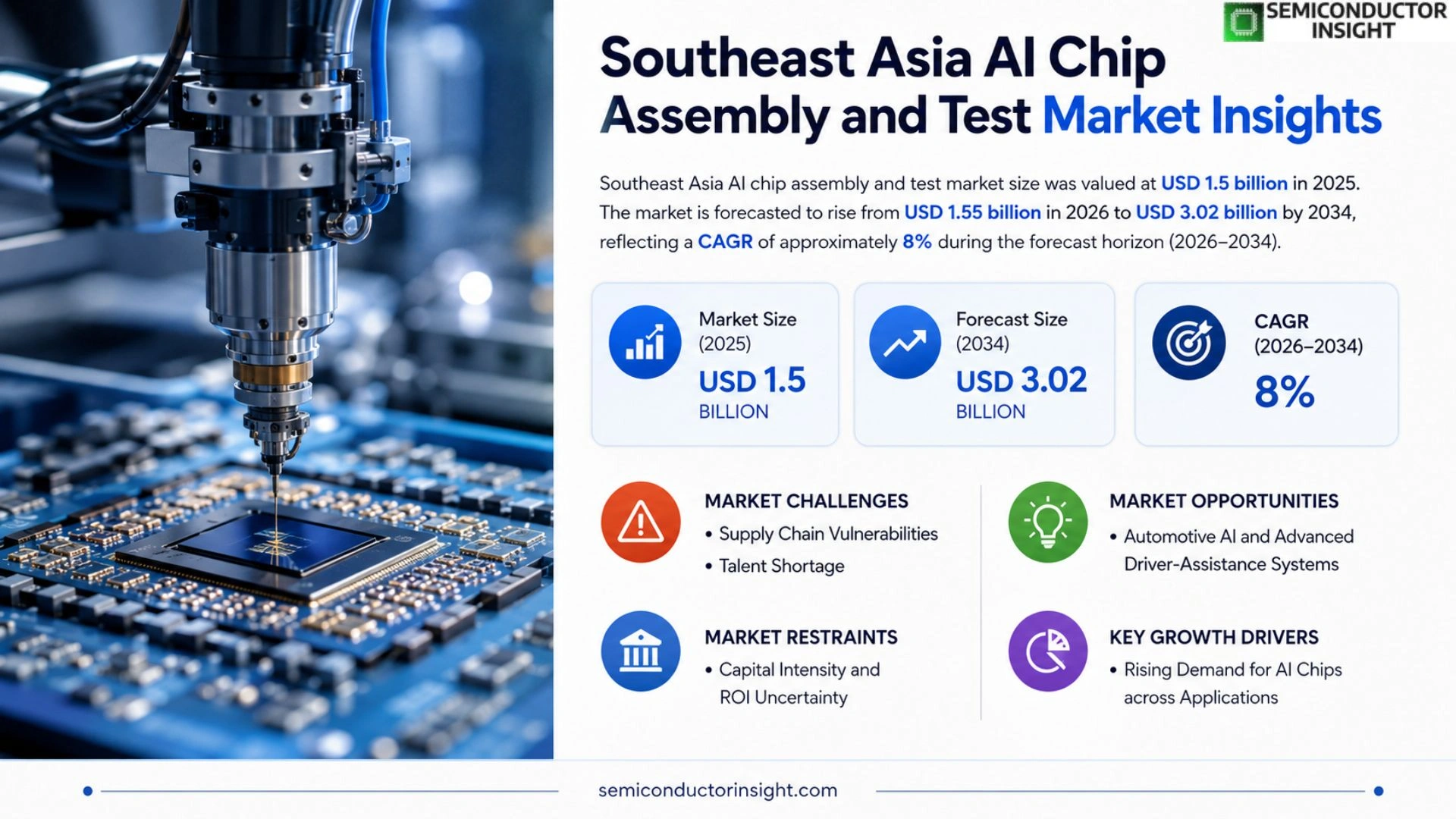
Southeast Asia AI chip assembly and test market size was valued at USD 1.5 billion in 2025. The market is forecasted to rise from USD 1.55 billion in 2026 to USD 3.02 billion by 2034, reflecting a compound annual growth rate of approximately 8 % during the forecast horizon.
AI chip assembly and test services encompass wafer‑level packaging, substrate integration, die‑attach, wire‑bonding or flip‑chip bonding, followed by electrical validation, thermal characterization, and reliability screening tailored for artificial‑intelligence accelerators. These processes transform silicon dies into fully qualified modules ready for deployment in data‑center servers, edge devices, or autonomous systems.
MARKET DRIVERS
Rising Demand for Edge AI Solutions
Southeast Asia AI Chip Assembly and Test Market is buoyed by a surge in edge‑computing deployments across smart‑city projects, industrial IoT, and consumer electronics. Companies are prioritising localized chip assembly to cut latency, a factor that directly translates into higher margins for regional test houses.
Government Incentives and Infrastructure Investments
National semiconductor agendas in Singapore, Malaysia, and Thailand now allocate multi‑billion‑dollar budgets for fab upgrades and testing facilities. These policy actions reduce entry barriers, encouraging multinational firms to anchor operations within Southeast Asia AI Chip Assembly and Test Market.
➤ Localization of test services trims lead‑times by up to 30 % while shielding OEMs from geopolitical supply shocks.
As OEMs increasingly view the region as a strategic node for AI‑chip validation, the competitive landscape shifts toward firms that can couple rapid turnaround with stringent quality controls, thereby cementing the market’s growth trajectory.
MARKET CHALLENGES
Supply Chain Vulnerabilities
Although demand is strong, Southeast Asia AI Chip Assembly and Test Market grapples with component shortages that stem from concentrated upstream suppliers in East Asia. Disruptions force test operators to hold larger safety stocks, eroding profitability.
Other Challenges
Talent Shortage
The scarcity of engineers proficient in AI‑specific test methodologies limits capacity expansion. Companies are compelled to invest heavily in training programs, diverting resources from core scaling initiatives.
MARKET RESTRAINTS
Capital Intensity and ROI Uncertainty
Establishing state‑of‑the‑art assembly lines and high‑precision test equipment demands capital outlays that often exceed USD 200 million per facility. Given the nascent nature of AI‑chip demand in the region, investors remain cautious about long‑term returns within Southeast Asia AI Chip Assembly and Test Market.
MARKET OPPORTUNITIES
Automotive AI and Advanced Driver‑Assistance Systems
The rollout of Level‑2 and Level‑3 autonomous features across Southeast Asian fleets creates a distinct niche for specialized AI‑chip testing. Firms that can certify safety‑critical silicon under local regulatory frameworks will capture premium contracts, unlocking new revenue streams within Southeast Asia AI Chip Assembly and Test Market.
Southeast Asia AI Chip Assembly and Test Market Trends
Accelerating Edge Deployment Fuels Service Expansion
The surge in edge‑oriented artificial‑intelligence workloads is reshaping the regional value chain. Companies that once relied on offshore facilities are now establishing assembly and test lines closer to end‑users to cut latency and secure supply continuity. This shift is prompting manufacturers in Singapore, Vietnam and the Philippines to upgrade clean‑room capacity and adopt higher‑density interconnects that meet the power‑efficiency demands of modern AI accelerators. The strategic move reduces freight cycles, trims inventory risk, and aligns with local data‑sovereignty regulations that are tightening across the association of Southeast Asian nations. As a result, Southeast Asia AI Chip Assembly and Test Market is seeing a reallocation of capital toward more modular production footprints that can be scaled in response to fluctuating order books.
Other Trends
Integration of Advanced Thermal Management
Thermal constraints have become a decisive factor for AI silicon that operates at multi‑watt densities. Vendors are increasingly embedding micro‑fluidic cooling channels and leveraging high‑thermal‑conductivity substrates during the assembly phase. By validating heat dissipation early, test labs can certify reliability for autonomous‑driving modules and compact edge servers, which are otherwise prone to throttling. The emphasis on thermal profiling is prompting test providers to invest in infrared imaging arrays and accelerated aging rigs, thereby differentiating their service portfolios and commanding premium pricing for validated, mission‑critical modules.
Supply‑Chain Resilience Gains Momentum
Recent disruptions highlighted the fragility of long‑haul logistics for high‑precision components. In response, regional players are pursuing dual‑sourcing strategies for critical materials such as high‑purity copper and specialty epoxies. Collaborative agreements with local material suppliers have shortened lead times and introduced greater transparency into bill‑of‑materials tracking. This evolution supports manufacturers that need to meet rapid design‑to‑volume cycles while maintaining stringent quality checkpoints. For customers of Southeast Asia AI Chip Assembly and Test Market, the emerging resilience framework translates into more predictable rollout schedules for AI‑enabled products, reinforcing the region’s appeal as a hub for next‑generation silicon delivery.
COMPETITIVE LANDSCAPE
Key Industry Players
Southeast Asia AI Chip Assembly and Test Market – Competitive Overview
The assembly and test segment is anchored by a handful of multinational service providers whose regional hubs sit primarily in Singapore and Malaysia. ASE Group commands the largest share, leveraging a vertically integrated platform that stretches from wafer‑level packaging to final reliability qualification. Its extensive equipment base, coupled with a portfolio of process‑qualified lines for AI accelerators, allows customers to transition from die to qualified module within a single footprint. This scale creates a de‑facto tier‑one tier where large data‑center designers and system integrators channel most of their volume, reinforcing a market structure that favours high‑mix, high‑volume contracts and marginally squeezes smaller operators.
Beyond ASE, a constellation of specialized firms adds depth to the ecosystem. STATS ChipPAC (now under JCET) concentrates on advanced substrate integration and flip‑chip bonding, attracting edge‑device OEMs that require compact form‑factors. Amkor Technology and ChipMOS complement the landscape with robust testing capabilities, especially in thermal screening for autonomous platforms. Regional manufacturers such as Foxconn in Vietnam and Powertech Technology in Malaysia focus on cost‑effective die‑attach and wire‑bonding services for emerging AI‑enabled consumer electronics. GlobalFoundries and NXP supply niche metrology and validation expertise, while Infineon and Intel maintain selective assembly lines to support their own AI‑centric product roadmaps. Collectively, these players nurture a competitive environment where service differentiation—through turnaround time, technology node coverage, or reliability guarantees—becomes a decisive factor for end‑users.
List of Key AI Chip Assembly and Test Companies Profiled
- ASE Group
- STATS ChipPAC
- Amkor Technology
- ChipMOS Technologies
- JCET Group
- Powertech Technology (PTI)
- Foxconn Technology Group
- GlobalFoundries
- NXP Semiconductors
- Infineon Technologies
- Intel Corporation
- Samsung Electronics
Segment Analysis:
| Segment Category | Sub-Segments | Key Insights |
| By Type |
|
Discrete AI Chips
|
| By Application |
|
Data Center Accelerators
|
| By End User |
|
Cloud Service Providers
|
| By Integration Level |
|
Chiplet Integration
|
| By Deployment Scenario |
|
High‑Performance Computing
|
Regional Analysis: Southeast Asia AI Chip Assembly and Test Market
Governments across the region have introduced tax holidays for capital equipment and fast‑track licensing for AI‑focused fabs, shaping a regulatory environment that accelerates assembly line commissioning while safeguarding intellectual property.
Partnerships between semiconductor firms and technical institutes generate curricula centered on AI testing protocols, ensuring a steady supply of engineers proficient in both hardware validation and software integration.
Companies are establishing multi‑source procurement frameworks for critical substrates and test equipment, reducing exposure to single‑point failures and enhancing operational continuity.
Early‑stage co‑engineering projects with AI device manufacturers enable assemblers to tailor test suites, aligning performance validation with application‑specific requirements.
North America
While the United States remains a hub for AI chip design, its assembly and test activities are increasingly outsourced to Asia‑Pacific to exploit cost advantages. North American firms are leveraging offshore partnerships to speed up prototype validation, yet they retain final‑stage certification domestically to satisfy regulatory standards. This hybrid model pushes North American vendors to develop robust remote monitoring capabilities, ensuring quality control across distant test sites.
Europe
European chipmakers, especially those in Germany and the Netherlands, view Southeast Asia as a strategic extension of their supply networks. The emphasis on sustainability within EU policy drives European firms to select assembly partners that demonstrate green manufacturing practices, such as energy‑efficient testing chambers. Consequently, European entities are influencing local providers to adopt environmental metrics, creating a niche for eco‑focused test services.
South America
South American markets, still in the early stages of AI hardware adoption, monitor Southeast Asia AI Chip Assembly and Test Market as a benchmark for establishing their own capabilities. Investment interest from Brazilian tech conglomerates is prompting exploratory visits to Singaporean test facilities, with a view to replicate best practices in localized pilot projects. The region’s cautious approach underscores a desire to avoid premature capital outlays while learning from mature ecosystems.
Middle East & Africa
In the Middle East, sovereign wealth funds are allocating capital toward joint ventures that connect Gulf AI startups with Southeast Asian test houses, seeking to bridge the gap between innovative algorithms and reliable hardware validation. African tech hubs, meanwhile, regard the Southeast Asia model as a template for building regional assembly clusters that can serve both local and export markets, emphasizing capacity building through knowledge transfer agreements.
Report Scope
This market research report provides a comprehensive analysis of the Southeast Asia AI Chip Assembly and Test Market , covering the forecast period 2026–2034. It offers detailed insights into market dynamics, technological advancements, competitive landscape, and key trends shaping the industry.
Key focus areas of the report include:
- Market Overview: The report begins with an overview outlining its current market scenario, key growth indicators, and industry transformation drivers. It discusses macroeconomic factors, demand–supply balance, regulatory landscape, and the strategic role of semiconductors in powering advancements across industries such as automotive, telecommunications, consumer electronics, and industrial automation.
- Market Size & Forecast: Historical data and future projections for revenue, unit shipments, and market value across major regions and segments.
- Segmentation Analysis: Detailed breakdown by product type, technology, application, and end-user industry to identify high-growth segments and investment opportunities.
- Regional Insights: Insights into market performance across North America, Europe, Asia-Pacific, Latin America, and the Middle East & Africa, including country-level analysis where relevant.
- Competitive Landscape: Profiles of leading market participants, including their product offerings, R&D focus, manufacturing capacity, pricing strategies, and recent developments such as mergers, acquisitions, and partnerships.
- Technology Trends & Innovation: Assessment of emerging technologies, integration of AI/IoT, semiconductor design trends, fabrication techniques, and evolving industry standards.
- Market Drivers & Restraints: Evaluation of factors driving market growth along with challenges, supply chain constraints, regulatory issues, and market-entry barriers.
- Stakeholder Insights: Insights for component suppliers, OEMs, system integrators, investors, and policymakers regarding the evolving ecosystem and strategic opportunities.
Primary and secondary research methods are employed, including interviews with industry experts, data from verified sources, and real-time market intelligence to ensure the accuracy and reliability of the insights presented.
FREQUENTLY ASKED QUESTIONS:
What is the current market size of Southeast Asia AI Chip Assembly and Test Market?
-> Southeast Asia AI Chip Assembly and Test Market was valued at USD 1.5 billion in 2025 and is expected to reach USD 3.02 billion by 2034.
Which key companies operate in Southeast Asia AI Chip Assembly and Test Market?
-> Key players include Axalta Coating Systems, AkzoNobel, BASF SE, PPG, Sherwin-Williams, and 3M, among others.
What are the key growth drivers?
-> Key growth drivers include railway infrastructure investments, urbanization, and demand for durable coatings.
Which region dominates the market?
-> Asia-Pacific is the fastest-growing region, while Europe remains a dominant market.
What are the emerging trends?
-> Emerging trends include bio-based coatings, smart coatings, and sustainable rail solutions.
Get Sample Report PDF for Exclusive Insights
Report Sample Includes
- Table of Contents
- List of Tables & Figures
- Charts, Research Methodology, and more...
 Download Sample Report PDF