South Korea HBM Memory for AI Export Market Insights
Global South Korea HBM memory for AI Export market size was valued at USD 10 billion in 2025. The market is projected to grow from USD 10 billion in 2025 to USD 30 billion by 2034, exhibiting a CAGR of approximately 13% during the forecast period.
HBM (High‑Bandwidth Memory) is a stacked DRAM architecture that delivers ultra‑high data rates and low power consumption, making it essential for AI accelerators, graphics processors and high‑performance computing platforms. By vertically integrating multiple DRAM dies through through‑silicon vias (TSVs), HBM provides bandwidths exceeding 400 GB/s per stack while occupying a fraction of the footprint of conventional DDR memory.
The upward trajectory stems from surging demand for large‑scale neural‑network training and inference workloads, which require massive parallelism that only HBM can sustain efficiently. South Korean firms such as Samsung Electronics and SK Hynix dominate export volumes because of their advanced TSV processes and capacity‑scaling strategies; recent joint programs with leading AI chipset designers have accelerated adoption across cloud providers and hyperscale data centers.
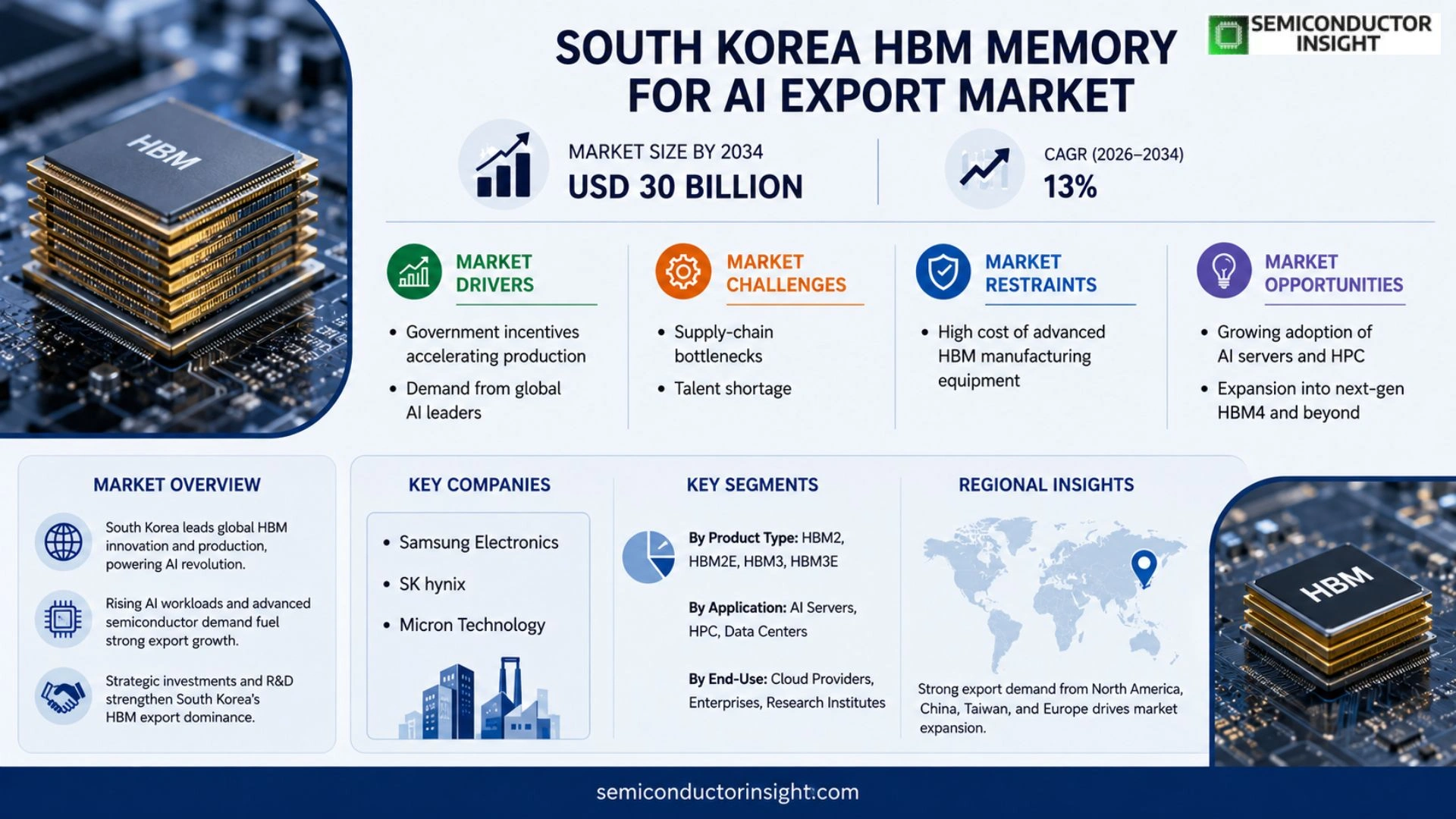
MARKET DRIVERS
Government Incentives Accelerating Production
Recent fiscal packages targeting semiconductor fabs have lowered the effective cost of expanding HBM lines. South Korea HBM Memory for AI Export Market benefits from reduced tax rates and direct subsidies, which translate into shorter payback periods for new equipment. Investors interpret these measures as a signal that the ecosystem will sustain high‑volume manufacturing, prompting quicker allocation of capital.
Demand from Global AI Leaders
Leading AI cloud providers are refreshing their server pools with next‑generation GPUs that require increased bandwidth, and HBM is the only memory that meets those specifications. The migration from legacy DRAM to HBM creates a direct pipeline of orders that flows through South Korean foundries, giving exporters a clear revenue stream.
➤ South Korea’s HBM capacity expansion aligns with AI server orders, ensuring a steady export flow.
Because the technology stack for AI inference and training is maturing rapidly, OEMs are locking in supply contracts well in advance. This pre‑commitment reduces market volatility and allows manufacturers to plan production schedules with confidence.
MARKET CHALLENGES
Supply‑Chain Bottlenecks
Advanced lithography tools remain scarce, and the lead time for high‑resolution masks can exceed six months. When a single wafer batch is delayed, downstream assembly lines experience a ripple effect, jeopardizing delivery commitments for AI customers.
Other Challenges
Talent Shortage
The niche expertise required for HBM design,particularly for stack integration and thermal management,is concentrated in a few research hubs. Companies find it costly to recruit or train engineers, which slows product rollout.
MARKET RESTRAINTS
High Capital Expenditure
Establishing a fab capable of producing 8‑stack HBM chips demands multi‑billion‑dollar investments in cleanrooms, wafer handling, and inspection systems. Smaller players lack the financial muscle to enter the market, constraining competitive dynamics.
The financing environment, while supportive, imposes stringent return‑on‑investment targets that can delay or cancel planned capacity upgrades. This caution limits the speed at which supply can respond to emerging AI demand.
Furthermore, the long lead time for equipment procurement means that any shift in market sentiment will be reflected in output only after a considerable lag, reinforcing the current supply‑side rigidity.
MARKET OPPORTUNITIES
Specialized HBM Variants for Edge AI
Edge devices that process AI locally require memory with lower power envelopes but comparable bandwidth. Developing such variants opens a niche that is largely untapped by traditional data‑center suppliers, allowing South Korean exporters to capture differentiated revenue.
Strategic alliances with AI hardware startups can accelerate co‑development of application‑specific HBM modules, shortening time‑to‑market and creating joint‑ownership of intellectual property.
Export‑focused certification programs that streamline customs clearance for semiconductor shipments can reduce lead times for overseas customers, enhancing the attractiveness of South Korean HBM offerings in competitive markets.
South Korea HBM Memory for AI Export Market Trends
Supply‑Chain Consolidation Reinforces Export Leadership
The convergence of advanced through‑silicon‑via (TSV) capability and aggressive capacity‑scaling programmes has positioned South Korean manufacturers at the apex of the global HBM export ecosystem. By standardising wafer‑level testing and leveraging a vertically integrated fab network, these firms reduce time‑to‑market for new stack configurations, a factor that matters to AI chipset vendors operating under tight product‑release cycles. The outcome is a pronounced shift: customers increasingly source entire HBM solutions from a single Korean supplier rather than piecing together components from disparate regions. This consolidation not only streamlines logistics but also creates pricing power that can be reinvested in next‑generation process refinements.
Other Trends
Joint Development with AI Chipmakers
Strategic co‑engineering agreements between Samsung, SK Hynix and leading AI accelerator designers have accelerated the migration of HBM into both training and inference platforms. By aligning memory‑controller firmware with proprietary compute pipelines early in the design phase, partners achieve bandwidth utilisation rates above 80 %,a metric that directly translates into lower total‑cost‑of‑ownership for hyperscale data‑centre operators. The collaborative model also shortens validation loops, allowing new stack densities to reach production within a twelve‑month window, a cadence that would be unattainable through conventional supply‑chain arrangements.
Emergence of Vertical Integration in End‑User Applications
Beyond the traditional server market, Korean HBM exporters are extending their reach into edge‑AI appliances and automotive vision systems. The ability to embed a 400 GB/s‑plus memory stack within a compact module satisfies the stringent power‑budget and form‑factor constraints of autonomous‑driving compute units. As OEMs seek to differentiate through on‑device AI capabilities, the demand for high‑bandwidth, low‑latency memory sourced from proven Korean providers is becoming a decisive factor in supplier selection. This trend signals a diversification of the export portfolio, reducing reliance on a single market segment and reinforcing the resilience of South Korea HBM Memory for AI Export Market overall.
COMPETITIVE LANDSCAPE
Key Industry Players
South Korea’s HBM Memory Suppliers Shaping the Global AI Export Market
Samsung Electronics remains the cornerstone of South Korea’s HBM export engine. Leveraging its 14‑nanometer TSV line, the company delivers HBM3 stacks that meet the bandwidth thresholds demanded by leading AI accelerator designers. Its ability to integrate large‑die footprints with a mature packaging ecosystem translates into reliable high‑volume shipments to hyperscale cloud operators. SK Hynix follows closely, having accelerated its HBM2E production through a dedicated fab in Icheon and a series of joint‑development agreements with chipset manufacturers. The competition between these two giants shapes pricing tiers, accelerates technology refresh cycles, and forces both to secure long‑term wafer supply contracts that underpin export stability.
Beyond the headline makers, a constellation of specialized firms sustains the HBM value chain. Samsung Electro‑Mechanics supplies high‑density interposers that enable the ultra‑thin form factor of modern stacks, while SK Siltron provides the silicon wafers required for TSV integration, reinforcing the overall supply robustness. LG Innotek’s advanced packaging solutions contribute to thermal management,a critical consideration for AI inference workloads. DB HiTek and Dongbu HiTek operate as foundries for peripheral logic and test‑chip production, offering flexibility for niche customers. ASE Korea and Amkor Technology’s Korean facilities extend the ecosystem with proven flip‑chip and wafer‑level packaging services, ensuring that export‑grade HBM modules meet stringent reliability standards. Collectively, these players create a layered competitive environment that permits South Korean exporters to address diverse AI application segments, from data‑center inference to edge‑compute accelerators.
List of Key HBM Memory Companies Profiled
- Samsung Electronics
- SK Hynix
- Samsung Electro‑Mechanics
- SK Siltron
- LG Innotek
- DB HiTek
- Dongbu HiTek
- ASE Korea
- Amkor Technology Korea
- SK Hynix System IC
- Samsung SDS (AI‑related supply‑chain services)
- SK Telecom (edge‑compute HBM integration)
Segment Analysis:
| Segment Category | Sub-Segments | Key Insights |
| By Type |
|
HBM3 is emerging as the preferred type for AI export customers because it combines higher bandwidth with modest power increase.
|
| By Application |
|
AI Training Accelerators drive the export demand for South Korean HBM due to their need for sustained high data throughput.
|
| By End User |
|
Hyperscale Data Centers are the primary end‑users shaping the export landscape.
|
| By Integration Approach |
|
Through‑Silicon Via (TSV) integration remains the dominant approach for AI export customers.
|
| By Market Channel |
|
Strategic Alliances with AI Chipmakers are shaping the competitive edge of South Korean HBM exporters.
|
Regional Analysis: South Korea HBM Memory for AI Export Market
Localized wafer fabs and advanced packaging lines reduce lead times, giving South Korean firms a tangible edge over rivals that must source components from distant suppliers. This proximity translates into tighter schedule control for AI hardware OEMs.
Government subsidies targeting AI‑related silicon have lowered capital barriers for HBM innovators. Tax credits linked to export volumes further incentivize firms to pursue overseas contracts, reinforcing the regional export thrust.
South Korean AI start‑ups and cloud providers consume large volumes of HBM, creating a feedback loop where internal demand validates designs that later become export‑ready products.
Close ties with Japanese AI chip designers and Taiwan’s foundry network enable South Korean firms to embed HBM modules into a diverse portfolio of AI accelerators destined for Europe and North America.
North America
North American AI leaders view South Korean HBM as a premium component that can shorten training cycles for large models. While most design houses in the United States lack in‑house HBM capacity, they depend on the reliability and performance pedigree of Korean memory to meet the performance thresholds demanded by cloud hyperscalers. The region’s competitive landscape therefore pushes South Korean exporters to adopt flexible support contracts and joint‑development roadmaps, ensuring that product roadmaps stay aligned with rapid algorithmic innovations in the United States.
Europe
European AI initiatives, particularly those centered on autonomous systems and industrial automation, place a premium on energy‑efficient memory. South Korean HBM offerings, praised for power‑performance optimization, fit neatly into these sustainability‑driven procurement criteria. Moreover, the EU’s emphasis on supply‑chain resilience has opened dialogue channels for South Korean firms to secure long‑term contracts, positioning them as trusted partners in a market that values regulatory compliance and traceability.
South America
In South America, AI adoption is accelerating within fintech and agritech sectors, yet the region still grapples with limited local silicon manufacturing. South Korean HBM thus arrives as a high‑value import that enables regional players to leapfrog in computational capability without building a domestic fab ecosystem. Export strategies that bundle technical support and training are gaining traction, helping local firms overcome integration hurdles and accelerate time‑to‑market for AI‑driven solutions.
Middle East & Africa
The Middle East and Africa are witnessing a surge in AI projects linked to smart city initiatives and oil‑field analytics. South Korean HBM, recognized for its bandwidth density, offers a compelling proposition for these data‑intensive applications. Partnerships that combine memory supply with on‑site engineering assistance are emerging as a differentiator, allowing exporters to navigate the region’s varied regulatory environments while addressing the performance expectations of high‑stakes AI deployments.
Report Scope
This market research report provides a comprehensive analysis of the South Korea HBM Memory for AI Export Market , covering the forecast period 2026–2034. It offers detailed insights into market dynamics, technological advancements, competitive landscape, and key trends shaping the industry.
Key focus areas of the report include:
- Market Overview: The report begins with an overview outlining its current market scenario, key growth indicators, and industry transformation drivers. It discusses macroeconomic factors, demand–supply balance, regulatory landscape, and the strategic role of semiconductors in powering advancements across industries such as automotive, telecommunications, consumer electronics, and industrial automation.
- Market Size & Forecast: Historical data and future projections for revenue, unit shipments, and market value across major regions and segments.
- Segmentation Analysis: Detailed breakdown by product type, technology, application, and end-user industry to identify high-growth segments and investment opportunities.
- Regional Insights: Insights into market performance across North America, Europe, Asia-Pacific, Latin America, and the Middle East & Africa, including country-level analysis where relevant.
- Competitive Landscape: Profiles of leading market participants, including their product offerings, R&D focus, manufacturing capacity, pricing strategies, and recent developments such as mergers, acquisitions, and partnerships.
- Technology Trends & Innovation: Assessment of emerging technologies, integration of AI/IoT, semiconductor design trends, fabrication techniques, and evolving industry standards.
- Market Drivers & Restraints: Evaluation of factors driving market growth along with challenges, supply chain constraints, regulatory issues, and market-entry barriers.
- Stakeholder Insights: Insights for component suppliers, OEMs, system integrators, investors, and policymakers regarding the evolving ecosystem and strategic opportunities.
Primary and secondary research methods are employed, including interviews with industry experts, data from verified sources, and real-time market intelligence to ensure the accuracy and reliability of the insights presented.
FREQUENTLY ASKED QUESTIONS:
What is the current market size of South Korea HBM Memory for AI Export Market?
-> South Korea HBM Memory for AI Export Market was valued at USD 10 billion in 2025 and is expected to reach USD 30 billion by 2034, reflecting a CAGR of approximately 13% during the forecast period.
Which key companies operate in South Korea HBM Memory for AI Export Market?
-> Key players include Samsung Electronics and SK Hynix, which dominate export volumes through advanced TSV processes and capacity‑scaling strategies.
What are the key growth drivers?
-> Key growth drivers include surging demand for large‑scale neural‑network training and inference workloads, expansion of data‑center AI accelerators, and the need for ultra‑high bandwidth memory in high‑performance computing platforms.
Which region dominates the market?
-> Asia-Pacific is the dominant region, with South Korea leading export volumes in the HBM memory segment.
What are the emerging trends?
-> Emerging trends include joint development programs between South Korean memory manufacturers and leading AI chipset designers, continued scaling of TSV technologies, and increased adoption of HBM in hyperscale cloud and edge AI infrastructures.
Get Sample Report PDF for Exclusive Insights
Report Sample Includes
- Table of Contents
- List of Tables & Figures
- Charts, Research Methodology, and more...
 Download Sample Report PDF