Solid State Relays for Industrial Market Insights
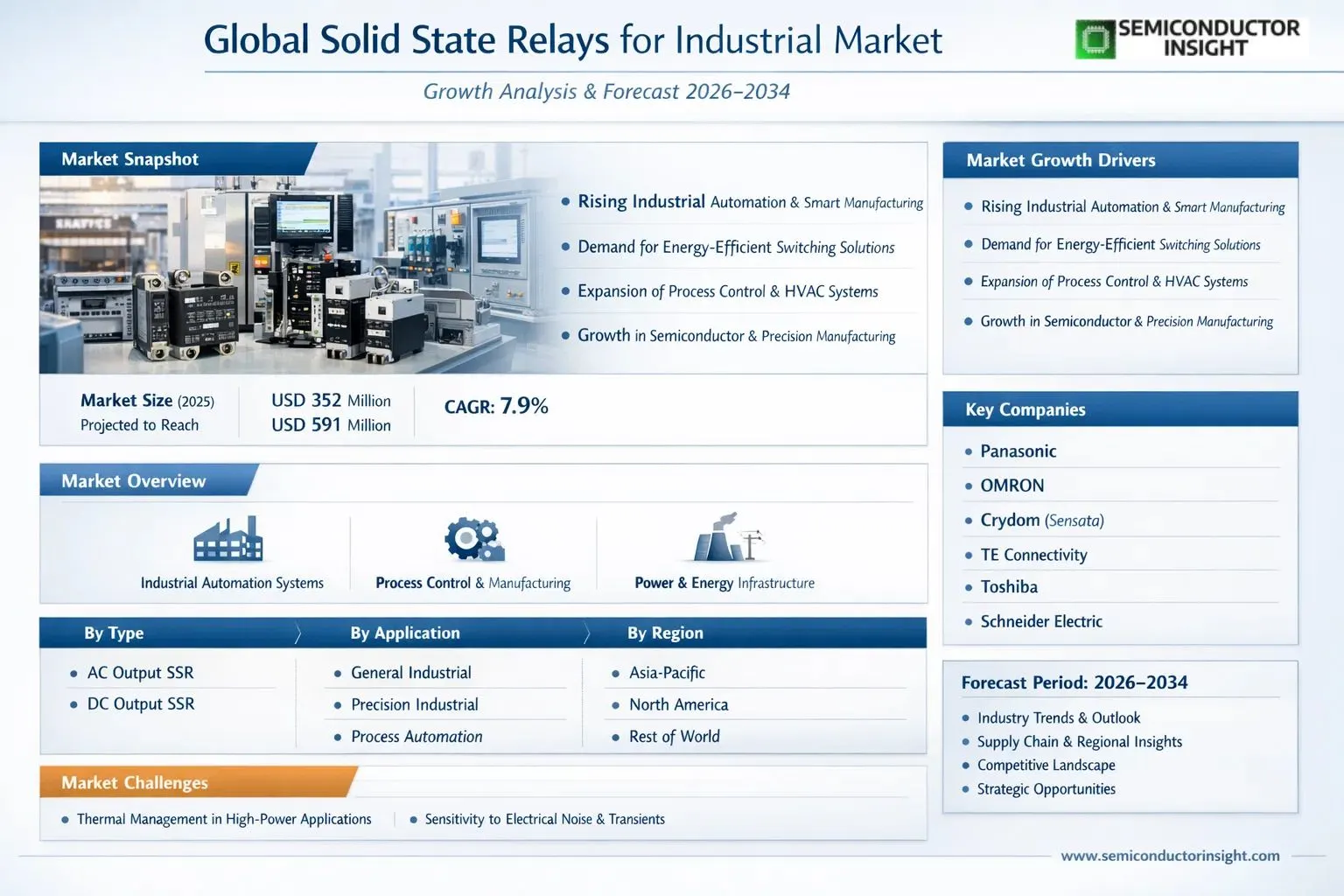
Global Solid State Relays for Industrial market size was valued at USD 352 million in 2025. The market is projected to grow from USD 379 million in 2026 to USD 591 million by 2034, exhibiting a CAGR of 7.9% during the forecast period.
A Solid State Relay (SSR) is an electronic switching device that controls the flow of electrical power in an industrial setting without the use of moving parts, unlike traditional electromechanical relays. SSRs are widely used in industrial applications for switching high-voltage or high-current loads due to their durability, fast switching speeds, and long-term reliability. These devices encompass various product types, including AC Output SSRs and DC Output SSRs, and serve a broad range of applications spanning general industrial and precision industrial segments.
The market is experiencing steady growth driven by the accelerating adoption of industrial automation, smart manufacturing technologies, and energy-efficient switching solutions across key end-use industries. Furthermore, the increasing deployment of SSRs in process control, packaging machinery, HVAC systems, and semiconductor manufacturing equipment is reinforcing demand globally. Leading manufacturers operating in Solid State Relays for Industrial market include Panasonic, Crydom, OMRON, Carlo Gavazzi, Sharp, TE Connectivity, Groupe Celduc, IXYS, Toshiba, and Fujitsu Limited, among others, each maintaining diversified product portfolios tailored to evolving industrial requirements.
MARKET DRIVERS
Accelerating Industrial Automation and Smart Manufacturing Adoption
The rapid proliferation of industrial automation across manufacturing, energy, and process industries is one of the most significant catalysts propelling demand for solid state relays for the industrial market. Unlike traditional electromechanical relays, solid state relays (SSRs) offer silent switching, longer operational lifespans, and superior compatibility with programmable logic controllers (PLCs) and distributed control systems (DCS). As industries worldwide invest heavily in Industry 4.0 frameworks, the need for reliable, high-speed switching components that can integrate seamlessly with digital architectures has surged. Solid state relays are increasingly specified in new automation projects due to their ability to switch millions of cycles without mechanical wear, directly reducing unplanned downtime in continuous-process industrial environments.
Rising Demand for Energy Efficiency and Precise Load Control
Energy efficiency mandates across industrial sectors are compelling plant engineers and system designers to transition from legacy electromechanical switching technologies to solid state relays for industrial applications. SSRs enable zero-crossing switching, which minimizes electrical noise and inrush current, thereby reducing energy losses at the switching moment. Industries such as plastics processing, food and beverage manufacturing, and semiconductor fabrication, where precise temperature and load control are mission-critical, are among the strongest adopters. The ability of solid state relays to interface directly with low-voltage control signals from digital controllers without requiring additional signal conditioning hardware further supports their growing penetration in energy-sensitive industrial facilities.
➤ The industrial sector’s pivot toward digitized, energy-optimized operations is structurally expanding the addressable market for solid state relays, with temperature control and power regulation applications representing consistently high-volume demand segments across global manufacturing hubs.
Government-driven energy efficiency standards and industrial decarbonization targets across major economies, including the European Union’s energy efficiency directive frameworks and comparable regulatory initiatives in North America and Asia-Pacific, are creating a sustained regulatory tailwind for solid state relay adoption in industrial markets. Procurement engineers are increasingly recognizing SSRs as a strategic component choice that simultaneously addresses compliance requirements and total cost of ownership objectives, as their elimination of moving parts substantially reduces maintenance intervals and associated labor costs over multi-year operational lifecycles.
MARKET CHALLENGES
Thermal Management Complexity in High-Power Industrial Switching Applications
One of the most persistent technical challenges confronting the solid state relay industrial market is effective thermal dissipation during sustained high-current switching operations. Solid state relays generate considerably more heat than their electromechanical counterparts when conducting large load currents, necessitating the use of heat sinks, thermal interface materials, and in some installations, active cooling mechanisms. In densely populated industrial control panels where space is constrained, accommodating adequate thermal management infrastructure adds engineering complexity and installation cost. Improper thermal design remains a leading cause of premature SSR failure in industrial deployments, and this challenge continues to limit adoption in certain high-power applications where electromechanical relays retain a cost and simplicity advantage.
Other Challenges
Higher Unit Cost Compared to Electromechanical Alternatives
The per-unit acquisition cost of solid state relays for industrial use remains meaningfully higher than equivalent electromechanical relays, creating a persistent barrier in cost-sensitive industrial procurement environments. While the total cost of ownership argument favors SSRs over longer operational periods due to reduced maintenance and longer service life, capital-constrained industrial buyers — particularly in emerging markets — frequently default to lower-cost electromechanical solutions. Overcoming this initial cost perception challenge requires expanded technical education and lifecycle cost modeling support from SSR manufacturers and their distribution channel partners.
Susceptibility to Voltage Transients and Electrical Noise
Solid state relays, due to their semiconductor-based construction, exhibit sensitivity to voltage spikes, transients, and electrical noise that are commonplace in heavy industrial electrical environments. Without adequate surge protection and EMI filtering in the system design, SSRs can experience nuisance triggering or permanent damage from inductive load switching events. This vulnerability demands careful application engineering and, in some cases, additional protective circuitry, adding to the system design burden for industrial automation engineers specifying solid state relay solutions in electrically harsh plant environments.
MARKET RESTRAINTS
Entrenched Preference for Electromechanical Relays Among Legacy Industrial Installations
A substantial portion of Global industrial installed base continues to operate control and switching infrastructure built around electromechanical relay technology. Replacement cycles in industrial facilities are characteristically long, often spanning decades, and plant operators frequently prioritize operational continuity over technology modernization. This installed-base inertia represents a meaningful structural restraint on the pace of solid state relay penetration in the industrial market, as switching to SSRs often requires modifications to control panel layouts, wiring configurations, and thermal management provisions that introduce short-term operational risk and capital expenditure. Industrial facilities operating under tight maintenance windows and production schedules are particularly reluctant to undertake component-level technology transitions.
Limited Suitability Across All Industrial Load Types
Solid state relays are not universally suited to all industrial switching applications, and this technical constraint functions as a market restraint in segments where SSR for industrial use cannot fully displace electromechanical alternatives. Applications involving very high inrush currents, such as direct motor starting for large industrial drives, or those requiring complete galvanic isolation under de-energized conditions, may favor traditional relay or contactor technologies. Additionally, SSRs exhibit leakage current in the off-state due to their semiconductor construction, which can be problematic in certain safety-critical industrial circuits. These inherent technical limitations define addressable market boundaries for solid state relay suppliers and constrain growth in specific high-power and safety-sensitive industrial verticals.
MARKET OPPORTUNITIES
Expansion of Renewable Energy Infrastructure and Industrial Power Management
The accelerating global build-out of solar power generation, wind energy installations, and battery energy storage systems is creating substantial incremental demand for solid state relays in the industrial market. SSRs are increasingly deployed in inverter systems, grid-tie controllers, and energy management switchgear within renewable energy facilities due to their fast switching speeds, high cycle endurance, and compatibility with digital control architectures. As industrial end-users invest in on-site renewable generation and microgrid capabilities to manage energy costs and sustainability commitments, the power electronics content of industrial facilities is rising, broadening the application scope for solid state relay components across energy infrastructure projects globally.
Growth in Industrial IoT Connectivity and Predictive Maintenance Platforms
The integration of Industrial Internet of Things (IIoT) platforms and predictive maintenance systems within manufacturing and process industries is opening new opportunity vectors for advanced solid state relay solutions targeting the industrial segment. Next-generation SSR products are being developed with embedded diagnostic capabilities, including internal temperature monitoring, load current sensing, and communication interfaces compatible with industrial fieldbus and Ethernet-based protocols. These intelligent SSR platforms enable condition-based maintenance strategies that align directly with the operational efficiency goals driving IIoT adoption. Industrial automation OEMs and system integrators specifying smart control architectures represent a high-value customer segment for SSR manufacturers capable of delivering diagnostics-enabled product platforms.
Emerging Opportunities in Semiconductor and Advanced Electronics Manufacturing
Global expansion of semiconductor fabrication capacity, driven by strategic investments in domestic chip manufacturing across the United States, European Union, Japan, and South Korea, is generating meaningful demand growth for precision industrial process control equipment — including solid state relays for industrial temperature and power management applications. Semiconductor fabs require exceptionally precise, contamination-free switching solutions for thermal processing equipment such as diffusion furnaces, chemical vapor deposition systems, and photolithography support infrastructure. The zero-arcing, EMI-free switching characteristics of solid state relays make them the preferred specification in cleanroom and ultra-precision process environments, positioning SSR suppliers to capture sustained volume from the ongoing wave of global semiconductor manufacturing capacity expansion.
Trends
Rising Industrial Automation Driving Demand for Solid State Relays
Solid State Relays for Industrial market is witnessing robust growth momentum driven by the accelerating pace of industrial automation across manufacturing, energy, and process control sectors. Unlike conventional electromechanical relays, solid state relays offer superior switching performance, longer operational lifespan, and silent operation — attributes increasingly valued in modern industrial environments. As manufacturers worldwide invest in smart factory infrastructure and programmable control systems, the adoption of solid state relays has expanded considerably across general and precision industrial applications. The shift from legacy relay technologies toward semiconductor-based switching solutions reflects a broader industry transition toward higher reliability and reduced maintenance overhead in critical operations.
Other Trends
Expansion of Precision Industrial Applications
Precision industrial applications are emerging as a significant growth avenue within Solid State Relays for Industrial market. Sectors such as semiconductor fabrication, medical device manufacturing, and laboratory automation demand switching components that deliver consistent performance under stringent operating conditions. Solid state relays meet these requirements through zero-bounce switching, low electromagnetic interference, and high repetition rates. As global precision manufacturing output continues to rise, particularly across Asia-Pacific economies including China, Japan, and South Korea, procurement of advanced solid state relay solutions is intensifying among system integrators and equipment manufacturers in these verticals.
AC Output SSR Segment Maintaining Technology Leadership
Within product segmentation, AC Output Solid State Relays continue to command a dominant share of the industrial market. Their compatibility with standard AC power infrastructure and suitability for motor control, heating element switching, and lighting systems makes them the preferred choice across a wide range of industrial installations. DC Output SSRs, meanwhile, are gaining traction in renewable energy systems, battery management applications, and DC-driven automation platforms, reflecting a diversification of the technology’s deployment base. Together, these two product categories serve the evolving power management needs of modern industrial facilities globally.
Competitive Landscape and Key Manufacturer Strategies
Solid State Relays for Industrial market is characterized by the presence of established global players alongside a growing number of regional manufacturers. Companies such as Panasonic, OMRON, Crydom, Carlo Gavazzi, TE Connectivity, Schneider, Siemens, and Rockwell Automation maintain strong competitive positions through continuous product innovation, broad distribution networks, and strategic partnerships with industrial automation integrators. Meanwhile, manufacturers from China — including Hongfa Technology, Xiamen Jinxinrong Electronics, and Zhejiang Chint Electrics — are strengthening their market presence by offering cost-competitive solutions tailored to high-volume industrial deployments.
Regional Trends Shaping Global Market Outlook
From a regional perspective, Asia-Pacific remains the most dynamic market for solid state relays in industrial applications, underpinned by robust manufacturing activity in China, India, and Southeast Asia. North America and Europe continue to represent mature but steadily evolving markets, where demand is being sustained by industrial modernization initiatives, energy efficiency mandates, and the replacement of aging electromechanical relay infrastructure. The Middle East and Africa region is gradually emerging as an incremental growth market, supported by ongoing investments in industrial infrastructure and process automation across key economies including Saudi Arabia and the UAE. These regional dynamics collectively reinforce a positive long-term outlook for Solid State Relays for Industrial market worldwide.
COMPETITIVE LANDSCAPE
Key Industry Players
Solid State Relays for Industrial Market Global Competitive Dynamics and Leading Manufacturer Profiles
Global Solid State Relays (SSR) for Industrial market is moderately consolidated, with a handful of established multinational corporations commanding a significant share of revenue. As of 2025, the market is valued at approximately USD 352 million and is projected to expand to USD 591 million by 2034, registering a robust CAGR of 7.9% over the forecast period. Leading the competitive hierarchy are companies such as Panasonic, OMRON, Crydom (a Sensata Technologies brand), TE Connectivity, and Schneider Electric, which collectively accounted for a substantial portion of global revenues in 2025. These dominant players benefit from extensive R&D capabilities, diversified product portfolios spanning both AC Output SSR and DC Output SSR segments, strong distribution networks, and well-established reputations in precision and general industrial automation markets. Their competitive edge is further reinforced by continued investment in miniaturization, thermal management innovation, and integration with Industry 4.0-compatible control systems, enabling them to serve a broad spectrum of end-use sectors including semiconductor manufacturing, food processing, HVAC, and energy management.
Beyond the top-tier incumbents, the competitive landscape features a dynamic set of regionally influential and niche players that are gaining traction through cost competitiveness, application-specific solutions, and expanding manufacturing capacities. Asian manufacturers, particularly from China and Japan, including Hongfa Technology, Toshiba, Sharp, Fujitsu Limited, Xiamen Jinxinrong Electronics, Wuxi Tianhao Electronics, and Zhejiang Chint Electrics, have been increasingly asserting their presence in both domestic and export markets. Companies such as Carlo Gavazzi, Groupe Celduc, and OPTO22 continue to differentiate through specialized industrial-grade SSR products tailored for precision industrial applications. Meanwhile, firms like Vishay, Broadcom, and IXYS contribute significantly to the semiconductor-level components that underpin SSR designs, positioning them as both component suppliers and competitive device manufacturers. The market also witnesses growing competition from emerging Chinese producers such as JiangSu GlOD Electrical Control Technology, Shaanxi Qunli, Wuxi Solid, COSMO, Suzhou Integrated Technology, and Clion Electric, which are broadening the competitive field through aggressive pricing and increasing product reliability standards.
List of Key Solid State Relays for Industrial Companies Profiled
- Panasonic
- Crydom (Sensata Technologies)
- OMRON
- Carlo Gavazzi
- Sharp
- TE Connectivity
- Groupe Celduc
- IXYS (Littelfuse)
- Toshiba
- Fujitsu Limited
- Schneider Electric
- Siemens
- Hongfa Technology
- Rockwell Automation
- OPTO22
- Xiamen Jinxinrong Electronics
- JiangSu GlOD Electrical Control Technology
- Vishay
- Broadcom
- Clion Electric
- Bright Toward
- Wuxi Tianhao Electronics
- Shaanxi Qunli
- Zhejiang Chint Electrics
- Wuxi Solid
- COSMO
- Suzhou Integrated Technology
Segment Analysis:
| Segment Category | Sub-Segments | Key Insights |
| By Type |
|
AC Output SSR remains the dominant segment within Solid State Relays for Industrial market, driven by its widespread compatibility with standard industrial power infrastructure across manufacturing facilities globally.
|
| By Application |
|
General Industrial applications represent the broadest and most established demand base for Solid State Relays, encompassing a diverse range of conventional manufacturing and production operations worldwide.
|
| By End User |
|
Manufacturing & Automotive industries constitute the largest end-user base for industrial SSRs, fueled by relentless demand for automation, precision control, and reduced downtime across global production facilities.
|
| By Mounting Type |
|
Panel Mount SSR leads this segment owing to its widespread adoption in industrial control panels and high-power switching enclosures across diverse manufacturing environments.
|
| By Load Current Rating |
|
Medium Current SSRs (10A – 40A) dominate this segment as they strike the optimal balance between thermal performance, cost efficiency, and versatility for the majority of standard industrial switching requirements.
|
Regional Analysis: Solid State Relays for Industrial Market
Asia-Pacific
Asia-Pacific’s industrial landscape is characterized by a sweeping wave of factory automation. The widespread integration of programmable logic controllers, robotics, and intelligent control systems across manufacturing hubs in China and Southeast Asia has driven sustained demand for solid state relays in industrial settings, where their silent operation, fast response, and absence of mechanical wear offer decisive operational advantages over conventional relay technologies.
Regulatory frameworks across Asia-Pacific are increasingly prioritizing industrial energy efficiency. Solid state relays for industrial applications align well with these mandates, as their low power consumption and precise load control contribute to reduced energy waste. Government-backed green manufacturing programs in Japan, South Korea, and China are directly influencing procurement decisions, encouraging industrial operators to transition toward solid state switching solutions at a measurable pace.
The semiconductor and electronics industries in Asia-Pacific are among the most demanding consumers of solid state relays for industrial use. Cleanroom environments, high-frequency switching requirements, and the need for contamination-free operation make solid state relays indispensable in wafer fabrication, PCB assembly, and electronic testing processes. Taiwan, South Korea, and China collectively represent major end-use clusters driving this specialized segment of demand.
Asia-Pacific benefits from the presence of numerous domestic solid state relay manufacturers offering cost-competitive alternatives to global brands. This local manufacturing depth not only meets regional demand efficiently but also supports export activities. The combination of technological capability, raw material access, and production scale makes Asia-Pacific uniquely positioned to sustain its leadership in Global solid state relays for industrial market through the coming decade.
North America
North America represents one of the most technologically advanced regional markets for solid state relays in industrial applications. The United States, as the region’s industrial anchor, drives demand through its sophisticated process automation infrastructure, aerospace and defense manufacturing, and the ongoing modernization of legacy industrial facilities. Canadian industrial operations, particularly in oil and gas processing and automotive production, further contribute to regional market activity. Solid State Relays for Industrial market in North America benefits from strong end-user awareness of the long-term cost advantages associated with solid state technology, including reduced downtime and minimal maintenance overhead. Industrial Internet of Things adoption and the push toward smart grid infrastructure are creating new deployment avenues for solid state relays, particularly in power management and distributed control systems. The presence of globally recognized relay manufacturers and a well-developed distribution network strengthens the region’s market structure, while stringent quality and safety standards reinforce the preference for premium, high-reliability solid state switching solutions across critical industrial environments.
Europe
Europe occupies a prominent position in Global solid state relays for industrial market, supported by a mature industrial base and a strong regulatory environment that encourages energy-efficient and environmentally responsible technologies. Germany, France, Italy, and the United Kingdom are the primary demand centers, with applications spanning automotive manufacturing, chemical processing, renewable energy infrastructure, and precision engineering. The European Union’s emphasis on industrial decarbonization and digital transformation is accelerating the adoption of advanced control components including solid state relays in industrial automation systems. European manufacturers place a premium on product reliability, electromagnetic compatibility, and compliance with regional safety directives, which has encouraged suppliers to develop high-specification solid state relay solutions tailored to these exacting standards. The region’s strong focus on Industry 4.0 integration, particularly in Germany’s automotive and mechanical engineering sectors, continues to generate robust and sustained demand for solid state relays across diverse industrial verticals through the forecast horizon.
South America
South America presents a developing but progressively maturing market for solid state relays in industrial applications. Brazil leads regional demand, with its diversified industrial economy encompassing agricultural processing, mining operations, petrochemicals, and automotive manufacturing providing a broad base of end-use activity. Argentina and Chile also contribute through their respective industrial and energy sectors. While Solid State Relays for Industrial market in South America is not yet at par with more advanced regions in terms of adoption depth, increasing foreign investment in industrial infrastructure and growing awareness of the operational benefits of solid state switching technology are contributing to gradual market expansion. Challenges related to economic volatility and import dependency for specialized industrial components can temper growth momentum; however, the long-term outlook remains positive as regional industrialization efforts gain traction and end-users increasingly seek durable and low-maintenance automation components to enhance operational efficiency and competitiveness.
Middle East & Africa
The Middle East and Africa region represents an emerging frontier for Solid State Relays for Industrial market, with growth prospects tied closely to ongoing infrastructure development, energy sector expansion, and industrialization initiatives. In the Middle East, Gulf Cooperation Council nations are investing heavily in diversifying their economies beyond hydrocarbons, driving demand for advanced industrial automation components including solid state relays across petrochemical, utilities, and construction-related manufacturing sectors. The UAE and Saudi Arabia are notable activity centers, supported by large-scale industrial and smart city development programs. In Africa, industrial growth remains nascent but is gaining momentum in select economies such as South Africa, Nigeria, and Egypt, where manufacturing and power distribution infrastructure investments are progressing. The region’s heightened exposure to extreme operating temperatures and harsh environments also underscores the functional advantages of solid state relays for industrial deployment, as their robust design offers reliable performance in demanding climatic conditions that challenge conventional electromechanical alternatives.
Report Scope
This market research report provides a comprehensive analysis of Solid State Relays for Industrial market, covering the forecast period 2026–2034. It offers detailed insights into market dynamics, technological advancements, competitive landscape, and key trends shaping the industry.
Key focus areas of the report include:
- Market Overview: The report begins with an overview outlining its current market scenario, key growth indicators, and industry transformation drivers. It discusses macroeconomic factors, demand–supply balance, regulatory landscape, and the strategic role of solid state relays in powering advancements across industries such as automotive, telecommunications, consumer electronics, and industrial automation.
- Market Size & Forecast: Historical data and future projections for revenue, unit shipments, and market value across major regions and segments.
- Segmentation Analysis: Detailed breakdown by product type, technology, application, and end-user industry to identify high-growth segments and investment opportunities.
- Regional Insights: Insights into market performance across North America, Europe, Asia-Pacific, Latin America, and the Middle East & Africa, including country-level analysis where relevant.
- Competitive Landscape: Profiles of leading market participants, including their product offerings, R&D focus, manufacturing capacity, pricing strategies, and recent developments such as mergers, acquisitions, and partnerships.
- Technology Trends & Innovation: Assessment of emerging technologies, integration of AI/IoT, semiconductor design trends, fabrication techniques, and evolving industry standards.
- Market Drivers & Restraints: Evaluation of factors driving market growth along with challenges, supply chain constraints, regulatory issues, and market-entry barriers.
- Stakeholder Insights: Insights for component suppliers, OEMs, system integrators, investors, and policymakers regarding the evolving ecosystem and strategic opportunities.
Primary and secondary research methods are employed, including interviews with industry experts, data from verified sources, and real-time market intelligence to ensure the accuracy and reliability of the insights presented.
FREQUENTLY ASKED QUESTIONS:
What is the current market size of Solid State Relays for Industrial Market?
-> Global Solid State Relays for Industrial Market was valued at USD 352 million in 2025 and is expected to reach USD 591 million by 2034, growing at a CAGR of 7.9% during the forecast period.
Which key companies operate in Solid State Relays for Industrial Market?
-> Key players include Panasonic, Crydom, OMRON, Carlo Gavazzi, Sharp, TE Connectivity, Groupe Celduc, IXYS, Toshiba, Fujitsu Limited, Schneider, Siemens, Hongfa Technology, Rockwell Automation, and OPTO22, among others.
What are the key growth drivers?
-> Key growth drivers include rising demand for durable and reliable switching devices in industrial automation, increasing adoption of SSRs for high-voltage and high-current load switching, fast switching speeds without moving parts, and expanding industrial infrastructure across emerging economies.
Which region dominates the market?
-> Asia is a dominant and fast-growing region in Global Solid State Relays for Industrial Market, with China and Japan being key contributors, while North America and Europe also hold significant market shares driven by advanced industrial automation and manufacturing sectors.
What are the emerging trends?
-> Emerging trends include integration of SSRs with IoT-enabled industrial systems, growing preference for AC Out SSR and DC Out SSR segments, increasing use in precision industrial applications, and technological advancements enabling higher reliability and miniaturization of solid state relay devices.

Get Sample Report PDF for Exclusive Insights
Report Sample Includes
- Table of Contents
- List of Tables & Figures
- Charts, Research Methodology, and more...
 Download Sample Report PDF