Solid-State Battery Semiconductor Control Market Insights
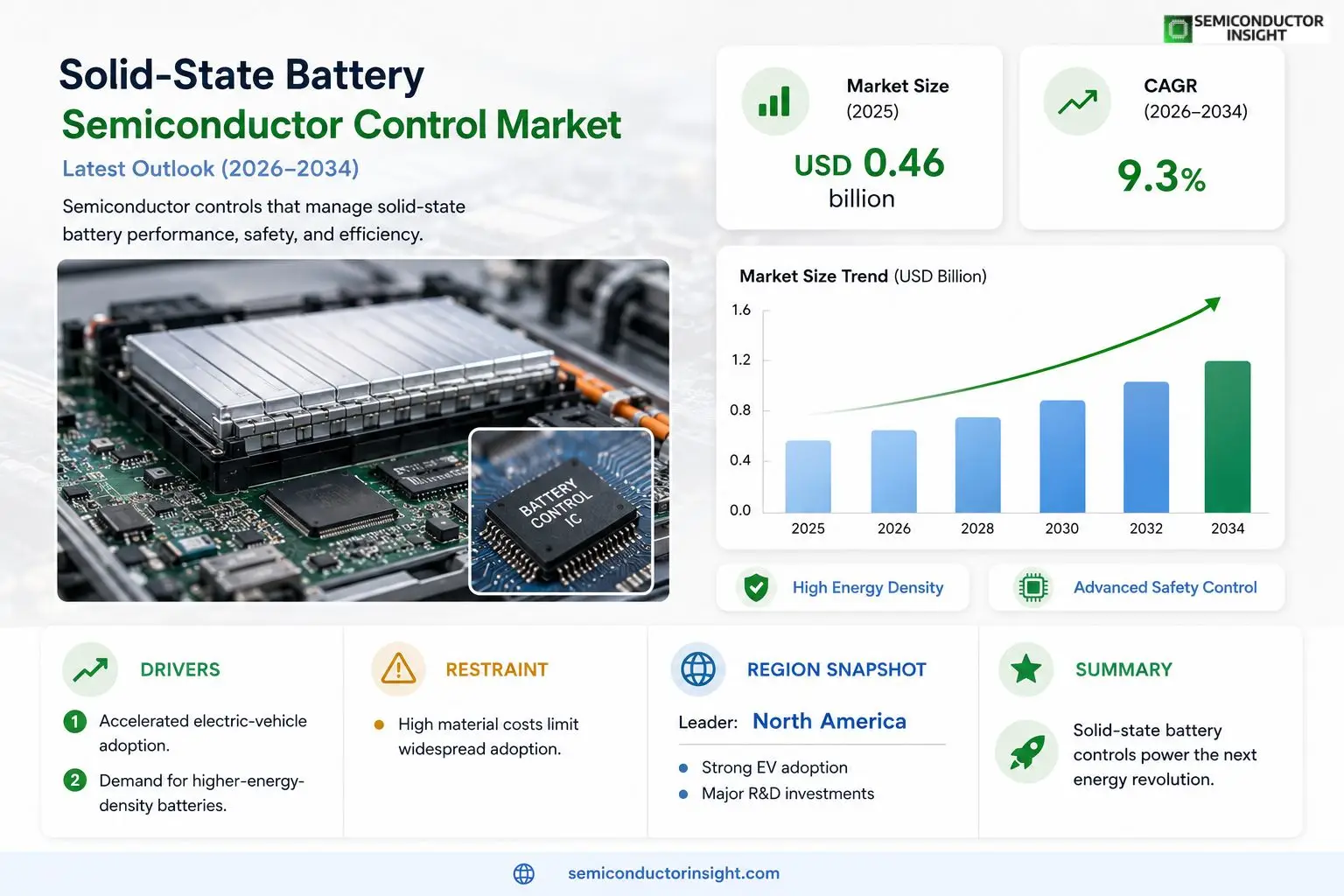
Global solid-state battery semiconductor control market size was valued at USD 0.46 billion in 2025. The market is projected to grow from USD 0.48 billion in 2026 to USD 1.14 billion by 2034, exhibiting a CAGR of 9.3% during the forecast period.
Solid-state battery semiconductor controls are specialized integrated circuits that manage voltage regulation, current monitoring, thermal management and safety functions within solid‑state lithium‑ion cells. These controllers enable precise charge‑discharge cycles, protect against dendrite formation and optimize energy density by coordinating solid electrolyte interfaces and electrode behavior.The market is experiencing rapid expansion because electric‑vehicle adoption accelerates and manufacturers seek higher energy density solutions; however, challenges such as high material costs persist. Furthermore, increased R&D funding from governments and strategic partnershipse.g., a July 2023 alliance between Toyota Motor Corporation and NXP Semiconductors to co‑develop next‑generation control chipsare driving commercialization. Key players including Bosch Sensortec, Infineon Technologies, Renesas Electronics and STMicroelectronics are actively broadening their portfolios.
MARKET DRIVERS
Increasing Adoption of Electric Vehicles
The rapid growth of electric‑vehicle (EV) sales is pushing automakers to seek higher‑energy‑density storage solutions. Solid-State Battery Semiconductor Control Market players are benefiting as manufacturers prioritize safety and fast‑charging capabilities that solid‑state architectures can deliver.
Expansion of Renewable Energy Grids
Utilities are integrating larger shares of intermittent renewables, creating demand for robust grid‑scale storage. Advanced semiconductor control units enable precise charge‑discharge management, making solid‑state batteries attractive for stationary applications.
➤ “Regulatory incentives for low‑emission transport are accelerating investment in next‑generation battery technologies,” says a senior analyst.
In parallel, government policies that subsidize clean‑energy projects are fostering R&D collaborations, further strengthening the Solid‑State Battery Semiconductor Control Market ecosystem.
MARKET CHALLENGES
Manufacturing Yield and Cost Constraints
Producing large‑area solid electrolytes with consistent defect‑free quality remains technically demanding. The high capital expenditure required for specialized equipment translates into elevated unit costs, deterring some OEMs from immediate adoption.
Other Challenges
Supply Chain Vulnerabilities
The reliance on rare‑earth and high‑purity ceramic materials introduces supply‑risk exposures. Fluctuations in raw‑material availability can delay product roll‑outs and increase price volatility.
MARKET RESTRAINTS
Technical Integration Barriers
Integrating solid‑state battery control modules with existing vehicle architectures requires redesign of power‑train software stacks. Legacy systems lack the flexibility to accommodate the precise voltage regulation needed for solid‑state chemistries, slowing market penetration.
Regulatory Certification Delays
Stringent safety standards for new battery technologies extend certification timelines. Until comprehensive test protocols are harmonized globally, many manufacturers adopt a cautious rollout strategy, limiting short‑term volume growth.
MARKET OPPORTUNITIES
High‑Performance Automotive Segments
Premium and performance‑oriented vehicle segments are willing to pay a premium for the increased energy density and safety profile of solid‑state batteries. This creates a niche where semiconductor control solutions can command higher margins.
Strategic Partnerships with AI Chip Makers
Collaborations that embed AI‑driven predictive control into solid‑state battery management can unlock new value propositions, such as adaptive thermal regulation and lifespan optimization, opening fresh revenue streams for the Solid‑State Battery Semiconductor Control Market.
Solid-State Battery Semiconductor Control Market Trends
Rise of High‑Energy EV Platforms
The rapid expansion of electric‑vehicle line‑ups that target longer range and faster charging has created a clear need for solid‑state battery packs with tighter performance tolerances. Semiconductor control ICs are now engineered to deliver sub‑millivolt voltage regulation while monitoring micro‑ampere leakage currents that could indicate early dendrite growth. These functions not only protect cell integrity but also enable manufacturers to extract additional capacity from the same form factor, directly influencing the vehicle’s advertised range. As OEMs integrate these controllers into next‑generation platforms, the Solid‑State Battery Semiconductor Control Market observes heightened procurement activity, especially for chips that support dual‑temperature profiling and over‑charge mitigation. The shift toward modular battery designs further amplifies demand for scalable control solutions that can be replicated across multiple pack configurations without sacrificing safety certifications.
Other Trends
Cost‑Driven Material Innovation
Material costs for solid‑state electrolytes remain a primary barrier to widespread adoption. Recent collaborations between semiconductor firms and electrolyte manufacturers aim to develop lower‑cost thin‑film deposition techniques that retain high ionic conductivity while simplifying the stack‑up process. Early pilot runs suggest a potential reduction of material expense by up to fifteen percent, a figure that encourages mid‑range vehicle manufacturers to consider solid‑state packs as a viable alternative to conventional lithium‑ion cells. In parallel, research into doped sulfide and oxide electrolytes is producing compositions that can be processed at lower temperatures, thereby cutting energy consumption in the manufacturing line. These advances collectively improve the cost‑benefit equation for automotive programs that prioritize safety and energy density.
Strategic Partnerships and Government Support
Government R&D programs across Europe, Asia, and North America have increased funding for next‑generation battery control chips, emphasizing safety certifications, thermal management, and real‑time diagnostics. Strategic alliancessuch as the 2023 partnership between a leading automotive OEM and a major semiconductor supplierare accelerating chip qualification cycles and shortening time‑to‑market for new solid‑state battery controllers. These collaborations frequently include joint test‑bed facilities where hardware and software teams validate control algorithms against real‑world driving cycles. The result is a faster feedback loop that reduces development risk and aligns product roadmaps with regulatory safety standards. As more OEMs announce solid‑state battery targets for the late 2020s, the ecosystem of supported semiconductor solutions expands, reinforcing the upward trajectory of the market.
COMPETITIVE LANDSCAPEKey Industry Players
Solid-State Battery Semiconductor Control Market Competitive Landscape
The solid‑state battery semiconductor control market is currently led by a small group of large integrated‑circuit manufacturers that command the majority of revenue and R&D spend. Bosch Sensortec, Infineon Technologies, NXP Semiconductors, and STMicroelectronics have established dedicated product lines for voltage regulation, current monitoring and thermal management within solid‑state cells. Their extensive automotive and industrial customer bases enable rapid scale‑up of control chips for electric‑vehicle platforms, while strategic alliancessuch as the 2023 Toyota‑NXP partnershipreinforce their market position. These leaders benefit from deep silicon expertise, global supply chains, and the ability to invest in advanced packaging required for high‑energy‑density batteries, creating a tiered market structure where the top tier captures the bulk of high‑volume contracts.Beyond the dominant tier, a diverse set of niche players is expanding functionality and targeting specialty segments. Companies such as Renesas Electronics, Analog Devices, Texas Instruments, Murata Manufacturing, Panasonic, ON Semiconductor, Samsung Electronics, and Toshiba are introducing differentiated sensor integration, power‑gate architectures, and safety‑critical firmware. Their focus on ultra‑low‑power operation, miniaturized form factors, and collaborative research with university labs adds depth to the ecosystem, allowing OEMs to source specialized controllers for premium performance applications. This broader base of innovators sustains competitive pressure, drives incremental efficiency gains, and supports the overall CAGR forecast of 9.3% through 2034.
List of Key Solid-State Battery Semiconductor Control Companies Profiled
- Bosch Sensortec
- Infineon Technologies
- Renesas Electronics
- NXP Semiconductors
- STMicroelectronics
- Analog Devices
- Texas Instruments
- Murata Manufacturing
- Panasonic
- ON Semiconductor
- Samsung Electronics
- Toshiba
Segment Analysis:
| Segment Category | Sub-Segments | Key Insights |
| By Type |
|
Integrated Control ICs dominate the market because they provide compact, high‑precision voltage and thermal regulation, enabling tighter cell packaging and improved safety. They are favored by OEMs seeking seamless integration with battery management systems, and they support advanced algorithms for dendrite suppression and lifespan extension. |
| By Application |
|
Electric Vehicles are the leading application, driven by the need for higher energy density and rapid charge cycles. Controllers in EVs must synchronize solid‑electrolyte interfaces while delivering robust safety functions, making them the focal point of R&D collaborations. Grid storage utilizes the same precision but emphasizes long‑term reliability and thermal stability. |
| By End User |
|
Automotive Manufacturers lead the demand curve, as they embed semiconductor controls directly into vehicle architectures to meet stringent safety standards. Battery pack integrators value modularity and ease of calibration, while semiconductor vendors prioritize differentiation through advanced process technologies and firmware capabilities. |
| By Technology |
|
CMOS‑Based Controls are currently prevalent due to their mature design ecosystem and cost efficiency. However, SiC and GaN technologies are gaining traction for high‑power EV platforms where superior thermal performance and switching speed enable tighter thermal budgets and longer cycle life. |
| By Vehicle Type |
|
Battery‑Electric Cars drive the most sophisticated control solutions, demanding precise thermal management and rapid charge acceptance. Plug‑in hybrids require flexible control strategies that transition between internal combustion and solid‑state battery operation, while commercial trucks prioritize durability and high‑current handling. |
Regional Analysis: North America
United States
The automotive sector is the primary driver of Solid-State Battery Semiconductor Control Market in North America. The pursuit of longer driving ranges and improved safety features is fueling demand for advanced battery management systems. Sophisticated control electronics are essential for optimizing battery performance and ensuring safe operation under various conditions.
Beyond automotive, solid-state batteries are gaining traction in energy storage systems for grid-scale applications and residential energy storage. Precise control of these batteries is crucial for efficient energy management, grid stability, and optimizing power flow. The increasing deployment of renewable energy sources further supports the growth of the energy storage market.
While still in its early stages, the use of solid-state batteries in consumer electronics, such as smartphones and laptops, presents a future opportunity. The benefits of solid-state batteries – smaller size, higher energy density – are highly appealing in this segment. However, cost and scalability remain key challenges.
The growing demand for reliable and long-lasting power sources in industrial IoT (IIoT) devices is creating a niche market for solid-state batteries. These devices often operate in harsh environments, requiring batteries with enhanced performance and durability.
Canada
Canada’s solid-state battery semiconductor control market is closely aligned with the automotive sector in the United States, benefiting from strong government support for clean technology and a growing electric vehicle adoption rate. Several Canadian companies are actively involved in battery research and development, creating a favorable ecosystem for innovation. The focus is on leveraging Canada’s natural resources and skilled workforce to establish a competitive advantage in the battery industry. Strategic partnerships between Canadian and US companies are fostering collaboration and knowledge sharing. While the market is smaller than the US, it exhibits significant growth potential with ongoing investments in battery manufacturing and technological advancements.
Mexico
Mexico’s solid-state battery semiconductor control market is driven by its strong automotive manufacturing base and proximity to the US market. The country serves as a key export hub for vehicles, and the increasing adoption of electric vehicles is boosting demand for advanced battery technologies. Government policies aimed at attracting foreign investment in the automotive and battery industries are further stimulating market growth. The focus is on establishing a robust supply chain for solid-state batteries and control systems to support the region’s automotive production. However, challenges related to infrastructure and regulatory complexities need to be addressed for sustained growth.
Europe
Europe is rapidly emerging as a significant market for solid-state battery semiconductor control, characterized by stringent environmental regulations and strong government initiatives to promote electric mobility. The European Union’s battery strategy aims to achieve battery independence and foster a competitive battery industry. Key countries like Germany, France, and the Netherlands are investing heavily in battery manufacturing and research. The automotive industry in Europe is actively integrating solid-state batteries into its vehicle platforms. Business strategies in Europe are focused on developing sustainable battery supply chains and promoting circular economy principles. The market is expected to see significant growth in the coming years as solid-state battery technology matures and costs decline.
Asia-Pacific
The Asia-Pacific region, particularly China and Japan, is a major player in the global solid-state battery semiconductor control market. China’s ambitious EV goals and substantial investments in battery technology are driving rapid growth. Japan’s strengths in materials science and automotive technology position it as a key innovator. The region is attracting significant investment from both domestic and international players. However, geopolitical tensions and supply chain disruptions pose challenges. The market is characterized by intense competition and a focus on cost optimization and technological advancements. The development of advanced semiconductor control systems is crucial for ensuring the safety and performance of solid-state batteries in the region’s rapidly expanding EV market.
South America
South America represents a nascent market for solid-state battery semiconductor control, with significant potential driven by the growing electric vehicle market in Brazil and Chile. Government incentives and increasing environmental awareness are contributing to EV adoption. However, infrastructural limitations and economic uncertainties pose challenges. The focus is on developing local manufacturing capabilities and establishing robust supply chains. The market is expected to grow steadily in the long term as solid-state battery technology becomes more affordable and accessible.
Middle East & Africa
The Middle East & Africa region presents a long-term growth opportunity for Solid-State Battery Semiconductor Control Market, driven by increasing investments in renewable energy and a growing focus on sustainable transportation. Several countries in the region are developing ambitious EV policies, and the demand for energy storage solutions is rising. However, the market is currently limited by infrastructural constraints and economic factors. The focus is on developing local expertise and attracting foreign investment to support the development of a robust battery industry.
Report Scope
This market research report provides a comprehensive analysis of the Solid-State Battery Semiconductor Control Market , covering the forecast period 2026–2034. It offers detailed insights into market dynamics, technological advancements, competitive landscape, and key trends shaping the industry.
Key focus areas of the report include:
- Market Overview: The report begins with an overview outlining its current market scenario, key growth indicators, and industry transformation drivers. It discusses macroeconomic factors, demand–supply balance, regulatory landscape, and the strategic role of semiconductors in powering advancements across industries such as automotive, telecommunications, consumer electronics, and industrial automation.
- Market Size & Forecast: Historical data and future projections for revenue, unit shipments, and market value across major regions and segments.
- Segmentation Analysis: Detailed breakdown by product type, technology, application, and end-user industry to identify high-growth segments and investment opportunities.
- Regional Insights: Insights into market performance across North America, Europe, Asia-Pacific, Latin America, and the Middle East & Africa, including country-level analysis where relevant.
- Competitive Landscape: Profiles of leading market participants, including their product offerings, R&D focus, manufacturing capacity, pricing strategies, and recent developments such as mergers, acquisitions, and partnerships.
- Technology Trends & Innovation: Assessment of emerging technologies, integration of AI/IoT, semiconductor design trends, fabrication techniques, and evolving industry standards.
- Market Drivers & Restraints: Evaluation of factors driving market growth along with challenges, supply chain constraints, regulatory issues, and market-entry barriers.
- Stakeholder Insights: Insights for component suppliers, OEMs, system integrators, investors, and policymakers regarding the evolving ecosystem and strategic opportunities.
Primary and secondary research methods are employed, including interviews with industry experts, data from verified sources, and real-time market intelligence to ensure the accuracy and reliability of the insights presented.
FREQUENTLY ASKED QUESTIONS:
What is the current market size of Solid-State Battery Semiconductor Control Market?
-> Solid-State Battery Semiconductor Control Market was valued at USD 0.46 billion in 2025 and is expected to reach USD 1.14 billion by 2034, exhibiting a CAGR of 9.3% during the forecast period.
Which key companies operate in Solid-State Battery Semiconductor Control Market?
-> Key players include Bosch Sensortec, Infineon Technologies, Renesas Electronics, and STMicroelectronics, among others.
What are the key growth drivers?
-> Key growth drivers include accelerated electric‑vehicle adoption, demand for higher‑energy‑density solid‑state batteries, and increased government R&D funding for advanced semiconductor solutions.
Which region dominates the market?
-> North America and Asia‑Pacific are currently the leading regions driving market growth, with Europe also maintaining a strong presence.
What are the emerging trends?
-> Emerging trends include strategic partnerships such as the Toyota‑NXP collaboration, integration of AI‑enabled safety features, and advancements in thermal‑management semiconductor designs.
Get Sample Report PDF for Exclusive Insights
Report Sample Includes
- Table of Contents
- List of Tables & Figures
- Charts, Research Methodology, and more...
 Download Sample Report PDF