MARKET INSIGHTS
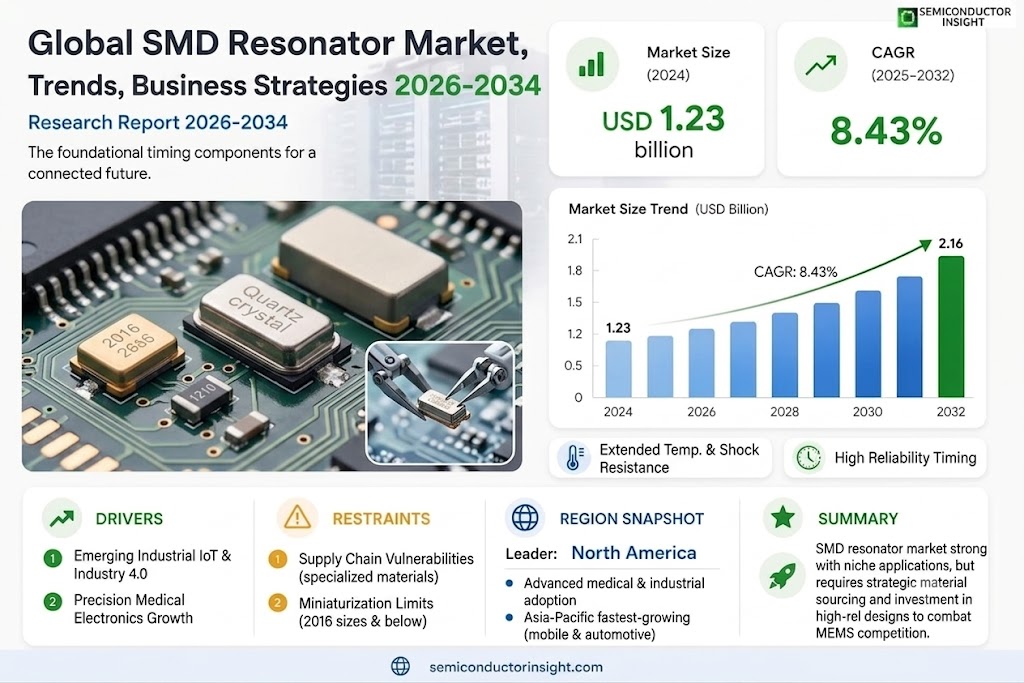
The global SMD Resonator Market size was valued at US$ 1.23 billion in 2024 and is projected to reach US$ 2.16 billion by 2032, at a CAGR of 8.43% during the forecast period 2025–2032.
SMD (Surface Mount Device) resonators are compact electronic components that generate precise frequency signals for timing applications in modern electronics. These passive devices maintain stable oscillations while occupying minimal PCB space, making them ideal for high-density circuit designs. The market offers various types including 2PIN, 3PIN, and 4PIN configurations, with frequency stability ranging from ±10ppm to ±100ppm depending on application requirements.
Market growth is driven by increasing demand from smartphones (accounting for 32% of 2024 consumption), automotive electronics (growing at 8.2% CAGR), and wearable devices. While 5G infrastructure expansion creates new opportunities, supply chain disruptions and material shortages pose challenges. Leading manufacturers like Murata Manufacturing (holding 28% market share) and Kyocera AVX are investing in miniaturization technologies to develop sub-1mm resonators for next-generation IoT devices.
MARKET DYNAMICS
MARKET DRIVERS
Proliferation of 5G and IoT Devices Accelerating SMD Resonator Demand
The rapid deployment of 5G networks and Internet of Things (IoT) technologies is creating unprecedented demand for SMD resonators. These components are essential for frequency control in base stations, smartphones, and IoT edge devices, where stable clock signals are critical. The global 5G infrastructure market is projected to grow significantly, requiring millions of SMD resonators for synchronization and timing applications. With IoT connections expected to exceed 30 billion devices by 2025, the need for compact, high-performance frequency control solutions is driving innovation across the SMD resonator supply chain.
Automotive Electronics Revolution Fueling Market Expansion
Modern vehicles now incorporate hundreds of electronic control units (ECUs) that rely on precise timing components. The automotive SMD resonator market is experiencing robust growth as electric vehicles and advanced driver-assistance systems (ADAS) become mainstream. Luxury vehicles today contain over 100 electronic modules, each potentially requiring multiple resonators for proper operation. As automakers transition to 48V electrical systems and vehicle-to-everything (V2X) communication standards, the specifications for automotive-grade resonators are becoming more stringent, pushing manufacturers to develop enhanced product lines.
MARKET RESTRAINTS
Supply Chain Vulnerabilities Impacting Market Stability
The SMD resonator market faces significant challenges from ongoing global supply chain disruptions. Many manufacturers rely on specialized raw materials that come from limited geographic sources, creating potential bottlenecks. Recent semiconductor shortages have demonstrated how dependent timing component production is on stable material flows. When lead times for certain resonator types exceed six months, designers often seek alternative solutions or redesign circuits, potentially reducing overall market demand.
Other Restraints
Miniaturization Limitations
As electronic devices shrink, resonator manufacturers must develop increasingly smaller form factors while maintaining performance. The transition to 2016 size packages (2.0 × 1.6 mm) and below presents significant technical hurdles in maintaining frequency stability and temperature performance. Some applications are approaching the physical limits of current piezoelectric materials technology.
Price Pressure in Consumer Segments
Intense competition in consumer electronics forces continuous cost reductions. While premium resonator types command higher prices in automotive and industrial applications, the high-volume mobile device market exhibits extreme price sensitivity, often compressing manufacturer margins to single-digit percentages.
MARKET OPPORTUNITIES
Emerging Industrial IoT Applications Opening New Markets
Industry 4.0 initiatives are creating substantial opportunities for SMD resonator manufacturers. Modern factory automation systems require robust timing solutions that can withstand harsh industrial environments while maintaining precision. Predictive maintenance systems alone could drive demand for millions of additional resonators annually as vibration monitoring becomes standard practice. Manufacturers developing specialized industrial-grade resonators with extended temperature ranges and shock resistance are positioned to capture this growing segment.
Medical Electronics Growth Presents Premium Opportunities
The healthcare technology sector represents one of the fastest-growing application areas for high-reliability SMD resonators. From portable diagnostic equipment to implantable devices, medical applications require components with exceptional stability and longevity. With the global medical electronics market expanding rapidly due to aging populations and telemedicine adoption, resonator manufacturers investing in biocompatible materials and specialized packaging can command premium pricing in this high-margin sector.
MARKET CHALLENGES
Technological Transition to MEMS Oscillators Creating Competitive Pressure
The SMD resonator market faces increasing competition from microelectromechanical systems (MEMS) timing solutions. While traditional quartz-based resonators still dominate many applications, MEMS technology offers advantages in shock resistance and miniaturization potential. Some analysts predict MEMS could capture over 20% of the timing component market within five years, particularly in consumer and automotive applications where cost and size are critical factors.
Other Challenges
Frequency Stability in Extreme Environments
Developing resonators that maintain accuracy across extended temperature ranges while resisting mechanical stress remains an engineering challenge. Automotive and aerospace applications often require performance beyond current industry standards, forcing manufacturers to invest heavily in material science research.
Talent Shortage in Specialty Manufacturing
Producing high-quality SMD resonators requires specialized expertise in piezoelectric materials and precision manufacturing. As experienced technicians retire, manufacturers struggle to find and train new personnel capable of maintaining stringent quality standards in resonator production.
SMD RESONATOR MARKET TRENDS
5G Network Expansion and Miniaturization Drive SMD Resonator Adoption
The global rollout of 5G infrastructure has become a primary catalyst for the SMD resonator market, with deployment numbers projected to triple by 2025 compared to 2020 levels. These compact components are essential for maintaining precise frequency stability in 5G base stations and mobile devices operating at millimeter wave frequencies. Device manufacturers increasingly prefer SMD resonators over traditional crystals due to their superior shock resistance and form factor advantages – critical factors as 5G modules shrink to under 10mm thickness. This aligns with the industry’s broader shift toward surface-mount technology, which now accounts for over 65% of electronic component installations globally.
Other Trends
Automotive Electronics Revolution
Modern vehicles now incorporate between 50-150 electronic control units requiring timing components, pushing automotive applications to capture nearly 25% of the SMD resonator market. The transition to electric vehicles and autonomous driving systems has created demand for ultra-stable resonators capable of operating in extreme temperature ranges (-40°C to +125°C). Leading manufacturers have responded with specialized automotive-grade resonators featuring ±0.5% frequency tolerance – a 30% improvement over previous generations. These components now appear in everything from advanced driver assistance systems (ADAS) to battery management controllers.
Consumer Electronics Evolution Fuels Premium Resonator Demand
Smartphones, wearables, and IoT devices are driving innovations in low-power resonator designs. The average flagship smartphone now contains 3-5 SMD resonators for functions ranging from main clock generation to Bluetooth synchronization. With smartwatch shipments expected to surpass 200 million units in 2024, manufacturers are prioritizing resonators with ultra-low current consumption below 1μA. New packaging techniques have enabled resonator sizes to shrink below 1.0×0.8mm while maintaining ±10ppm frequency accuracy – specifications that were unachievable a decade ago. The trend toward module-based designs in consumer electronics has further increased the value density of SMD resonators per device.
COMPETITIVE LANDSCAPE
Key Industry Players
Global Leaders in SMD Resonator Technology Drive Market Innovation
The global SMD resonator market features a competitive landscape where established electronic component manufacturers vie for dominance alongside emerging specialists. Kyocera AVX and Murata Manufacturing currently lead the sector, collectively accounting for approximately 28% of the 2024 market share. Their leadership stems from decades of experience in precision component manufacturing and strong relationships with major electronics OEMs.
ARGO Technology has emerged as a particularly aggressive growth player, leveraging its expertise in high-frequency resonators to capture significant business in 5G infrastructure applications. Meanwhile, PETERMANN-TECHNIK continues to strengthen its position in the automotive electronics segment, where component reliability is paramount. The China-based Zhejiang Jiakang Electronics and Shenzhen Yangxing Technology are rapidly expanding their international presence, capitalizing on competitive pricing and improving technical capabilities.
Several strategic trends are reshaping competition: established players are investing heavily in miniaturization technologies to meet next-generation IoT device requirements, while smaller specialists focus on niche applications like wearable medical devices. The market saw three significant acquisitions in 2023, with Murata’s purchase of a Taiwanese resonator specialist being the most notable.
Looking forward, competition is expected to intensify further as automotive applications drive demand growth. Companies are now focusing on developing high-temperature stable resonators for electric vehicle power systems and advanced driver-assistance systems (ADAS), creating new battlegrounds for technological leadership.
List of Key SMD Resonator Manufacturers Profiled
- Kyocera AVX (Japan)
- Murata Manufacturing (Japan)
- ARGO Technology (U.S.)
- PETERMANN-TECHNIK (Germany)
- Abundance Enterprise Company (Taiwan)
- ALPHA WAVE (U.S.)
- Zhejiang Jiakang Electronics (China)
- Zhejiang Abel Electron (China)
- TKD Science (China)
- Shenzhen Yangxing Technology (China)
- Chip Sun Technology (Taiwan)
- Crystal Power Source (U.S.)
- Shenzhen Jingguanghua Electronics (China)
- Tangshan Guoxin Jingyuan Electronics (China)
- Newxtal (France)
- Chengdu Kingbri Frequency Technology (China)
Segment Analysis:
By Type
2PIN Segment Dominates the Market Due to High Demand in Compact Electronic Devices
The global SMD Resonator market is segmented based on type into:
- 2PIN
- 3PIN
- 4PIN
- Others
By Application
Intelligent Mobile Phone Segment Leads Due to Expanding Smartphone Industry
The market is segmented based on application into:
- Intelligent Mobile Phone
- Tablet PC
- Wearable Devices
- Automobile
- Others
By End User
Consumer Electronics Sector Shows Strong Adoption Due to Miniaturization Trends
The market is segmented based on end user into:
- Consumer Electronics
- Automotive
- Telecommunication
- Industrial
- Others
Regional Analysis: SMD Resonator Market
North America
The North American SMD resonator market is driven by advanced consumer electronics, automotive innovations, and telecommunications growth. The U.S. remains the dominant player, accounting for over 70% of regional demand, fueled by the presence of leading tech companies and semiconductor manufacturers. Stringent quality standards in industries such as aerospace and defense further drive demand for high-precision SMD resonators. Additionally, the increasing integration of IoT devices and 5G infrastructure deployment has accelerated adoption. While established players like Kyocera AVX and Murata Manufacturing lead the market, there’s growing competition from regional suppliers focused on miniaturization and energy efficiency.
Europe
Europe’s SMD resonator industry thrives on strict regulatory compliance and strong demand from automotive and industrial automation sectors. Germany, France, and the UK collectively contribute nearly 60% of regional market share, largely due to their robust automotive electronics manufacturing base. The adoption of SMD resonators in electric vehicles and smart home devices has surged, with EU directives pushing for more reliable and sustainable electronic components. However, high production costs and reliance on imported raw materials pose challenges. European manufacturers are increasingly collaborating with Asian partners to optimize supply chains while maintaining quality.
Asia-Pacific
Asia-Pacific dominates the global SMD resonator market, with China alone representing over 40% of worldwide demand. The region benefits from massive electronics manufacturing hubs in China, Japan, and South Korea, supported by government incentives and a skilled workforce. Rapid smartphone production, wireless communication advancements, and electric vehicle expansion are key drivers. In India, the growing consumer electronics market boosts demand, though local manufacturers struggle with technological gaps compared to established Chinese and Japanese competitors. While cost-effective production remains a strength, the region is gradually shifting toward higher-value resonator components for premium applications.
South America
The SMD resonator market in South America is still emerging, with Brazil and Argentina accounting for the majority of demand. Economic instability and limited semiconductor infrastructure have slowed growth, but increasing investments in telecommunications and automotive supply chains are creating new opportunities. Local assembly of consumer electronics has spurred demand, though most components are still imported. Price sensitivity remains a challenge, pushing manufacturers to focus on mid-range resonator solutions rather than cutting-edge technologies. Partnerships with international suppliers are helping bridge the technology gap, but long-term growth depends on economic recovery and industrial policy reforms.
Middle East & Africa
This region presents a nascent but promising market for SMD resonators, driven by rising electronics consumption and gradual industrial diversification. The UAE, Saudi Arabia, and South Africa are the primary markets, leveraging their telecom expansion and smart city projects. However, reliance on imports, limited manufacturing capabilities, and fluctuating foreign exchange rates hinder market stability. Some regional players are exploring partnerships with Asian manufacturers to establish local assembly units. While the market remains small compared to global counterparts, increasing digital transformation initiatives could unlock future potential.
Report Scope
This market research report provides a comprehensive analysis of the Global SMD Resonator Market, covering the forecast period 2025–2032. It offers detailed insights into market dynamics, technological advancements, competitive landscape, and key trends shaping the industry.
Key focus areas of the report include:
- Market Size & Forecast: Historical data and future projections for revenue, unit shipments, and market value across major regions and segments. The market was valued at US$ 1.23 billion in 2024 and is projected to reach US$ 2.16 billion by 2032.
- Segmentation Analysis: Detailed breakdown by product type (2PIN, 3PIN, 4PIN, Others), application (Intelligent Mobile Phone, Tablet PC, Wearable Devices, Automobile, Others), and end-user industry to identify high-growth segments.
- Regional Outlook: Insights into market performance across North America, Europe, Asia-Pacific, Latin America, and the Middle East & Africa. The U.S. market was estimated at USD million in 2024 while China is projected to reach USD million.
- Competitive Landscape: Profiles of leading players including Kyocera AVX, Murata Manufacturing, ARGO Technology, PETERMANN-TECHNIK, and Zhejiang Jiakang Electronics, covering their market share, R&D focus, and strategic developments.
- Technology Trends & Innovation: Assessment of emerging technologies, miniaturization trends, and evolving industry standards in resonator design and manufacturing.
- Market Drivers & Restraints: Evaluation of factors driving market growth including demand for compact electronics, 5G deployment, and IoT expansion, along with supply chain challenges.
- Stakeholder Analysis: Strategic insights for component suppliers, OEMs, and investors regarding market opportunities in the evolving electronics ecosystem.
Primary and secondary research methods are employed, including interviews with industry experts and data from verified sources, to ensure the accuracy and reliability of the insights presented.
FREQUENTLY ASKED QUESTIONS:
What is the current market size of Global SMD Resonator Market?
-> SMD Resonator Market size was valued at US$ 1.23 billion in 2024 and is projected to reach US$ 2.16 billion by 2032, at a CAGR of 8.43% during the forecast period 2025–2032.
Which key companies operate in Global SMD Resonator Market?
-> Key players include Kyocera AVX, Murata Manufacturing, ARGO Technology, PETERMANN-TECHNIK, and Zhejiang Jiakang Electronics, among others.
What are the key growth drivers?
-> Key growth drivers include increasing demand for compact electronics, 5G network deployment, and expansion of IoT applications.
Which region dominates the market?
-> Asia-Pacific is the fastest-growing region, driven by electronics manufacturing in China and Japan, while North America remains a significant market.
What are the emerging trends?
-> Emerging trends include miniaturization of components, higher frequency stability requirements, and integration with advanced semiconductor packaging.

Get Sample Report PDF for Exclusive Insights
Report Sample Includes
- Table of Contents
- List of Tables & Figures
- Charts, Research Methodology, and more...
 Download Sample Report PDF