
SMD Aluminum Electrolytic Capacitor Market Insights
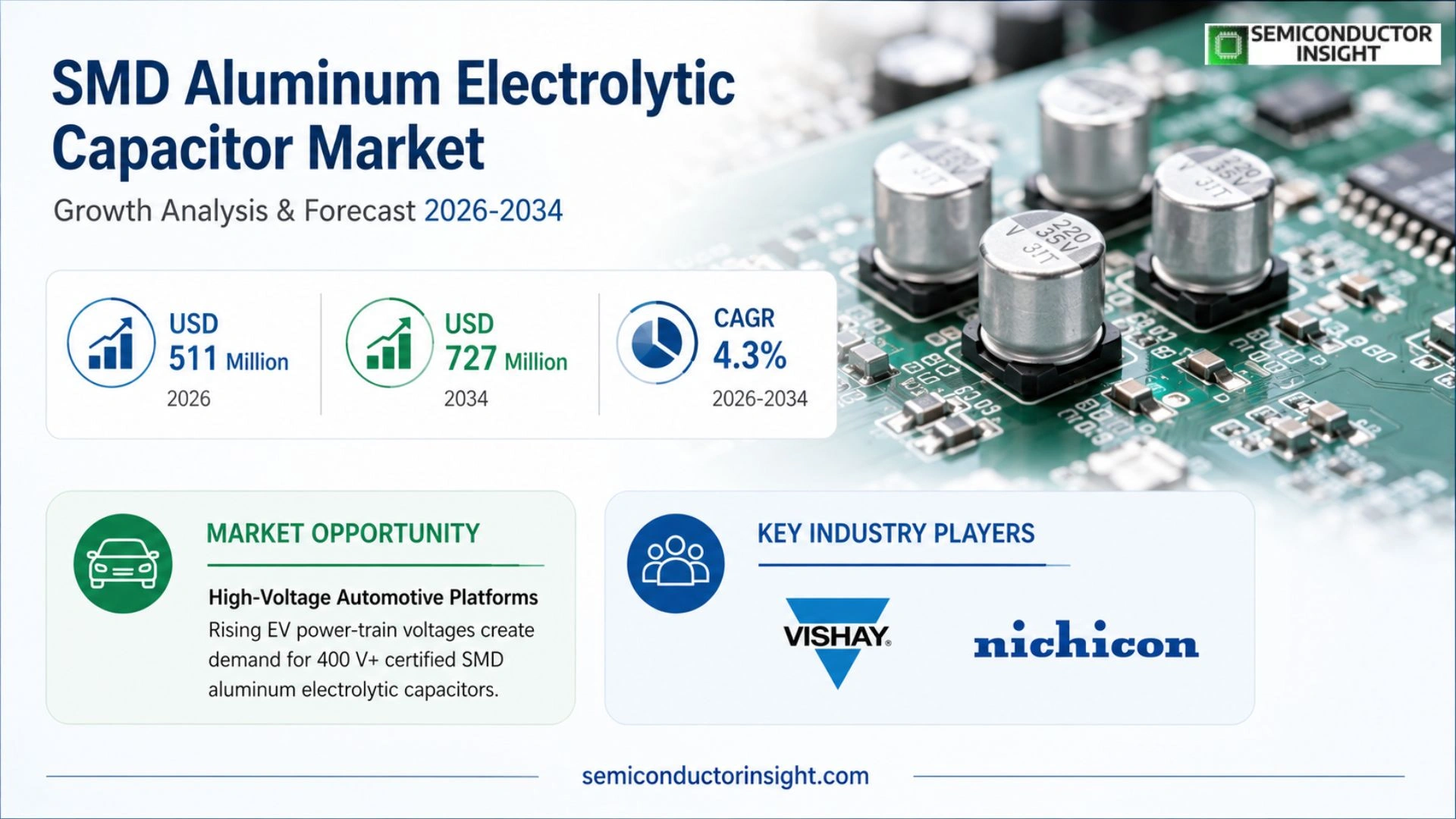
SMD Aluminum Electrolytic Capacitor market size was valued at USD 498 million in 2025. The market is projected to grow from USD 511 million in 2026 to USD 727 million by 2034, exhibiting a CAGR of 4.3% during the forecast period.
SMD Aluminum Electrolytic Capacitors are surface‑mount devices that employ liquid‑type aluminum electrolyte and an anodic oxide dielectric layer formed on high‑purity aluminum foil. Their compact footprint and ability to be mounted directly onto printed circuit boards make them suitable for miniaturized power‑filter, voltage‑regulation and timing applications across consumer electronics, automotive systems and industrial equipment.
The market expansion is fueled by rising demand for high‑density power solutions in smartphones, wearables and electric‑vehicle power modules, while manufacturers such as Vishay, Nichicon, KYOCERA AVX, YAGEO and TDK are investing in advanced foil technologies and solid‑liquid hybrid electrolytes to improve temperature reliability and reduce leakage risk.
MARKET DRIVERS
Rising Demand for Compact Power Solutions
SMD Aluminum Electrolytic Capacitor Market benefits from a steady shift toward miniaturized electronic assemblies. End‑users in consumer electronics, automotive infotainment, and industrial control are consolidating board space, prompting designers to opt for surface‑mount devices that deliver high capacitance in a small footprint.
Expansion of Renewable Energy Systems
Growth in solar‑inverter and wind‑turbine power converters creates a niche for robust electrolytic capacitors that can tolerate temperature excursions while maintaining low ESR. Manufacturers cite improved thermal performance as a decisive factor when specifying SMD components for these applications.
➤ Design engineers increasingly prioritize component reliability over sheer size reduction, making SMD Aluminum Electrolytic Capacitor a strategic choice for high‑stress environments.
Supply‑chain rationalization also fuels adoption; distributors are consolidating SKUs, and a limited series of standardized footprints streamlines inventory management for OEMs seeking cost‑effective procurement.
MARKET CHALLENGES
Stringent Quality and Safety Regulations
Regulatory bodies across Europe and North America impose tight limits on failure rates for safety‑critical equipment. Compliance testing adds cycle time and cost, pressuring manufacturers to validate each batch against stringent IEC and UL standards.
Other Challenges
Material Cost Volatility
Fluctuations in aluminum and electrolyte pricing compress margins, especially for low‑volume producers who lack bargaining power with raw‑material suppliers.
MARKET RESTRAINTS
Competition from Alternative Technologies
Solid‑state alternatives such as polymer and tantalum capacitors deliver lower equivalent series resistance, challenging the traditional niche of aluminum electrolytic devices in high‑frequency circuits. As designers evaluate trade‑offs, SMD Aluminum Electrolytic Capacitor Market faces pressure to justify its value proposition beyond sheer capacitance.
Manufacturing Capacity Constraints
Older production lines limited to through‑hole technology struggle to meet the ramp‑up required for surface‑mount demand. Investment in new equipment is capital‑intensive, deterring smaller players from scaling quickly.
MARKET OPPORTUNITIES
Emergence of High‑Voltage Automotive Platforms
Electric‑vehicle power‑train architectures are integrating higher voltage domains, where the capacitance‑to‑voltage ratio of aluminum electrolytic devices becomes a competitive advantage. Companies that can certify their SMD products for 400 V and above stand to capture a substantial share of this expanding segment.
Smart Manufacturing Integration
Adoption of Industry 4.0 practices,real‑time monitoring of electrolyte quality, predictive maintenance of coating lines, and AI‑driven yield optimization,offers a pathway to reduce waste and improve consistency. Firms leveraging such technologies are positioned to differentiate themselves in a crowded market.
SMD Aluminum Electrolytic Capacitor Market Trends
Consumer Electronics Demand Fuels Volume Growth
The surge in smartphones, wearables and compact IoT devices has forced designers to seek components that combine larger capacitance with a tiny footprint. In 2025, production of SMD type aluminum electrolytic capacitors reached roughly 45 million units, reflecting manufacturers’ response to that pressure. Because the average unit price hovers around US $12, volume uplift directly improves revenue despite modest pricing power. Engineers are now favouring higher specific‑surface‑area foils and refined electrolyte formulations to squeeze more charge into the same board space, a move that lowers bill‑of‑materials for end‑products while preserving performance. This shift not only reinforces the relevance of SMD Aluminum Electrolytic Capacitor Market but also reshapes supply‑chain priorities, as component planners must align capacity with the rapid product cycles of consumer tech firms.
Other Trends
Manufacturing Process Innovations
Modern production begins with precision‑machined high‑purity aluminum foil, followed by electrochemical etching that creates micron‑scale pits, dramatically expanding the effective surface area. A subsequent chemical treatment grows a dense alumina dielectric layer whose integrity dictates both voltage withstand and leakage current. The winding stage stacks anode, cathode and electrolyte‑impregnated paper into a cylindrical core, after which vacuum impregnation saturates the assembly with a tailored electrolyte mix. A final aging step subjects the unit to its rated voltage, healing oxide imperfections and confirming compliance with strict ESR and leakage specifications. These refinements have lowered defect rates and extended operational life, giving manufacturers a competitive edge in markets where reliability is non‑negotiable.
Application‑Driven Shifts
Beyond handhelds, automotive and industrial sectors are reshaping demand patterns. Power modules in new‑energy vehicles operate under wide temperature ranges, prompting a turn toward solid‑state or solid‑liquid hybrid electrolytes that mitigate the drying and leakage issues of traditional liquid chemistries. Such formulations improve high‑temperature endurance and align with the stringent reliability standards of automotive electronics. Meanwhile, Europe, North America and Japan remain the concentration hubs for major players,Vishay, Nichicon, and AISHI Group,because their R&D capabilities can quickly adapt to these reliability challenges. The convergence of tighter thermal specifications and the need for compact, high‑capacity parts is compelling suppliers to invest in next‑generation materials, a strategic move that will dictate market positioning over the next several years.
COMPETITIVE LANDSCAPE
Key Industry Players
Competitive Overview of SMD Aluminum Electrolytic Capacitor Market
Vishay and Nichicon dominate SMD Aluminum Electrolytic segment, each commanding a sizable share of the production capacity that exceeds 40 million units annually. Their advantage stems from mature supply chains in North America and Japan, coupled with the ability to deliver tightly controlled ESR specifications required by high‑frequency power supplies. The scale of their operations enables aggressive pricing and rapid roll‑out of newer high‑density foil technologies, which keeps them at the forefront of contracts with consumer‑electronics OEMs and automotive Tier‑1 suppliers. Both firms invest heavily in automated winding and vacuum‑impregnation lines, reinforcing product reliability and meeting stringent automotive qualification standards.
Beyond the incumbents, a cohort of regional specialists enriches the competitive tapestry. Companies such as KYOCERA AVX, TDK Corporation, and Panasonic Electronic Components exploit strong ties with Japanese and European design houses to capture niche segments that demand ultra‑low profile packages. Emerging Asian manufacturers,AISHI Group, Guangdong Fenghua Advanced Technology, and Yiyang Axboom Electronic,are leveraging cost‑effective production footprints to win business in fast‑growing consumer‑device markets, particularly in South‑East Asia. Meanwhile, niche players like Rubycon, Nippon Chemi‑Con, and Capxon Electronic Technology focus on high‑temperature polymer‑hybrid variants, addressing the reliability concerns of electric‑vehicle power modules and industrial drive applications.
List of Key SMD Aluminum Electrolytic Capacitor Companies Profiled
- Vishay
- Nichicon
- KYOCERA AVX
- TDK Corporation
- Panasonic Electronic Components
- Rubycon
- Nippon Chemi‑Con Corporation
- AIC Tech
- Lelon
- KNSCHA
- Jackcon
- Samyoung
- Unicon
- Toshin Kogyo
- Capxon Electronic Technology
- AISHI Group
- Yiyang Axboom Electronic
- Guangdong Fenghua Advanced Technology
Segment Analysis:
| Segment Category | Sub-Segments | Key Insights |
| By Type |
|
Low Profile SMD is favored for ultra‑compact devices where board height is a critical constraint.
|
| By Application |
|
Consumer Electronics drives the majority of demand for SMD aluminum electrolytic capacitors.
|
| By End User |
|
Smartphones represent the most rapid growth segment for SMD aluminum electrolytic capacitors.
|
| By Manufacturing Process |
|
Foil Etching is a critical differentiator for performance.
|
| By Technology Trend |
|
High Surface Area Foil underpins next‑generation capacity goals.
|
Regional Analysis: SMD Aluminum Electrolytic Capacitor Market
Asia-Pacific
A cluster of fabs in the Pearl River Delta and the Korean peninsula supplies over half of the global volume, leveraging high‑volume wafer processing lines that deliver consistent tolerances. This geographic density reduces logistics overhead and enables quick response to design revisions, reinforcing the region’s cost advantage.
Hybrid and fully electric powertrains require robust decoupling solutions, prompting automakers to specify aluminum electrolytic devices with tighter ripple specifications. Local tier‑1 suppliers are adapting product portfolios to meet these stricter reliability expectations, creating a niche growth segment.
Tightened RoHS compliance and emerging safety standards push manufacturers toward lead‑free formulations and enhanced failure‑mode analysis. Companies that pre‑empt these regulations gain early access to markets where certification cycles are lengthy.
Recent disruptions have motivated firms to diversify raw‑material sources and invest in buffer inventories. Strategic joint ventures with specialty chemical producers are reducing dependency on single‑source electrolytic additives, strengthening overall market stability.
North America
The United States remains a significant consumer of SMD Aluminum Electrolytic Capacitors, driven largely by high‑performance computing and aerospace sectors that demand stringent quality certifications. Domestic makers focus on niche applications, such as mission‑critical avionics, where reliability supersedes cost considerations. Meanwhile, Canadian designers are adopting these components for renewable‑energy inverters, reflecting a broader governmental push toward clean‑technology adoption. The market’s trajectory is shaped by a blend of regulatory scrutiny, which elevates testing standards, and a steady infusion of venture capital into start‑ups targeting advanced power‑management algorithms. As a result, manufacturers are incrementally shifting toward premium‑grade products that align with the continent’s emphasis on safety and performance, rather than competing solely on price.
Europe
European demand for SMD Aluminum Electrolytic Capacitors is anchored by automotive electronics and industrial automation, where the transition to electrified drivetrains accelerates the need for compact energy‑storage solutions. Nations such as Germany and France host design hubs that integrate these capacitors into high‑voltage motor‑control units, emphasizing thermal stability and long‑life cycles. Stringent environmental directives push suppliers toward greener manufacturing practices, encouraging the adoption of low‑emission processes and recyclable packaging. Additionally, the European Union’s focus on digital sovereignty fuels investment in local production capabilities, aiming to reduce reliance on imports. The confluence of regulatory pressure and a premium on technical excellence steers the market toward specialized, high‑reliability offerings across the region.
South America
In Brazil and Argentina, SMD Aluminum Electrolytic Capacitor market is evolving alongside expanding consumer‑electronics consumption and modest growth in renewable‑energy projects. Local manufacturers are scaling up capacity to serve domestic automotive assemblers that are beginning to incorporate hybrid models, though the overall market remains price‑sensitive. Trade policies favoring regional value‑addition incentivize partnerships with Asian producers, enabling technology transfer and boosting design capabilities. While the market size is modest compared with other continents, incremental investments in infrastructure and a gradual shift toward higher‑efficiency devices suggest a steady, if measured, upward trajectory.
Middle East & Africa
The Middle East and Africa region presents a developing landscape for SMD Aluminum Electrolytic Capacitors, primarily linked to burgeoning data‑center construction and renewable‑energy installations in the Gulf states. High ambient temperatures drive demand for capacitors with enhanced thermal performance, prompting suppliers to offer variants with robust electrolyte formulations. In Sub‑Saharan Africa, limited manufacturing capacity means most components are imported, but emerging telecom projects and power‑grid modernization create new entry points for vendors. Strategic collaborations with global distributors are helping to bridge the gap, while regional initiatives aimed at localizing component production are still in early stages, indicating future potential for market expansion.
Report Scope
This market research report provides a comprehensive analysis of the SMD Aluminum Electrolytic Capacitor Market , covering the forecast period 2026–2034. It offers detailed insights into market dynamics, technological advancements, competitive landscape, and key trends shaping the industry.
Key focus areas of the report include:
- Market Overview: The report begins with an overview outlining its current market scenario, key growth indicators, and industry transformation drivers. It discusses macroeconomic factors, demand–supply balance, regulatory landscape, and the strategic role of semiconductors in powering advancements across industries such as automotive, telecommunications, consumer electronics, and industrial automation.
- Market Size & Forecast: Historical data and future projections for revenue, unit shipments, and market value across major regions and segments.
- Segmentation Analysis: Detailed breakdown by product type, technology, application, and end-user industry to identify high-growth segments and investment opportunities.
- Regional Insights: Insights into market performance across North America, Europe, Asia-Pacific, Latin America, and the Middle East & Africa, including country-level analysis where relevant.
- Competitive Landscape: Profiles of leading market participants, including their product offerings, R&D focus, manufacturing capacity, pricing strategies, and recent developments such as mergers, acquisitions, and partnerships.
- Technology Trends & Innovation: Assessment of emerging technologies, integration of AI/IoT, semiconductor design trends, fabrication techniques, and evolving industry standards.
- Market Drivers & Restraints: Evaluation of factors driving market growth along with challenges, supply chain constraints, regulatory issues, and market-entry barriers.
- Stakeholder Insights: Insights for component suppliers, OEMs, system integrators, investors, and policymakers regarding the evolving ecosystem and strategic opportunities.
Primary and secondary research methods are employed, including interviews with industry experts, data from verified sources, and real-time market intelligence to ensure the accuracy and reliability of the insights presented.
FREQUENTLY ASKED QUESTIONS:
What is the current market size of SMD Aluminum Electrolytic Capacitor Market?
-> SMD Aluminum Electrolytic Capacitor market is projected to grow from USD 511 million in 2026 to USD 727 million by 2034, exhibiting a CAGR of 4.3%
Which key companies operate in SMD Aluminum Electrolytic Capacitor Market?
-> Key players include Vishay, Nichicon, KYOCERA AVX, YAGEO, TDK Corporation, Panasonic Electronic Components, Nippon Chemi-Con Corporation, Rubycon, AIC Tech, Lelon, KNSCHA, Jackcon, SAMYOUNG, Unicon, Toshin Kogyo, Capxon Electronic Technology, AISHI, Yiyang Axboom Electronic, Guangdong Fenghua Advanced Technology.
What are the key growth drivers?
-> Key growth drivers include rise of consumer electronics, expansion of automotive electronics, growth in industrial control and communication equipment, and demand for higher capacitance density in compact devices.
Which region dominates the market?
-> Europe and North America hold the largest market share, driven by advanced manufacturing, automotive, and consumer electronics demand.
What are the emerging trends?
-> Emerging trends include development of high specific surface area electrode foils, solid‑state and solid‑liquid hybrid electrolytes, and miniaturization for smartphones and wearable devices.
Get Sample Report PDF for Exclusive Insights
Report Sample Includes
- Table of Contents
- List of Tables & Figures
- Charts, Research Methodology, and more...


