Smartphone Market, Global Business Strategies 2025-2032

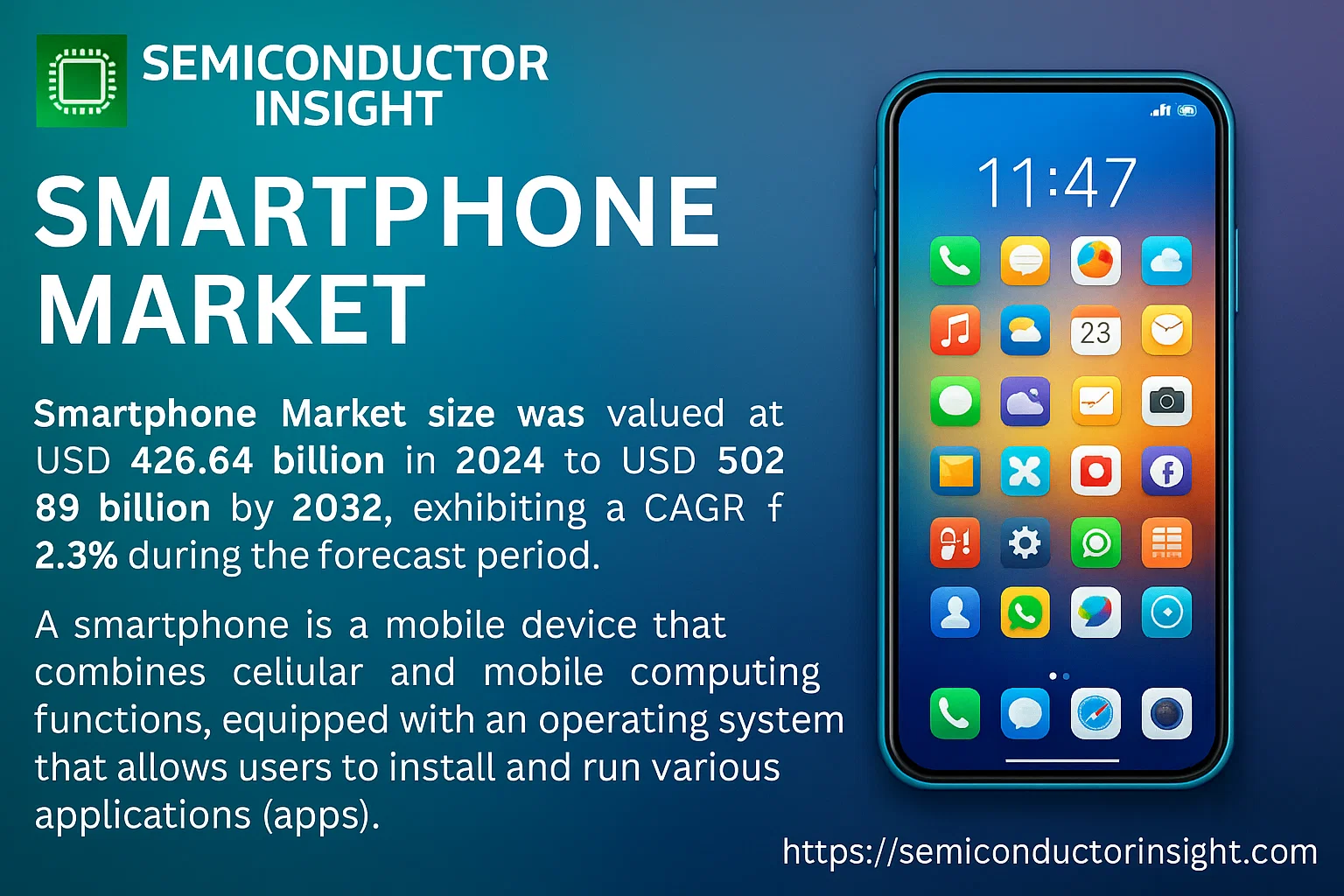
Smartphone Market size was valued at USD 426.64 billion in 2024 to USD 502.89 billion by 2032, exhibiting a CAGR of 2.3% during the forecast period

PDF Icon Download Sample Report PDF
  • Quick Dispatch

    All Orders

  • Secure Payment

    100% Secure Payment

Price range: $1,500.00 through $4,250.00

Clear

MARKET INSIGHTS

Global Smartphone Market size was valued at USD 426.64 billion in 2024 to USD 502.89 billion by 2032, exhibiting a CAGR of 2.3% during the forecast period.

A smartphone is a mobile device that combines cellular and mobile computing functions, equipped with an operating system that allows users to install and run various applications (apps). These devices typically feature advanced capabilities compared to basic mobile phones, including high-speed internet connectivity, multi-touch interfaces, GPS navigation, and high-resolution cameras that support photography and videography.

The market continues to evolve through technological innovation and shifting consumer preferences. Key growth drivers include the global rollout of 5G networks, which promises significantly faster data speeds and lower latency, stimulating upgrade cycles among existing users. Furthermore, the emergence of innovative form factors, particularly foldable displays, has created new premium segments within the market. However, growth is tempered by challenges such as high market penetration in developed regions leading to longer replacement cycles and intense price competition among manufacturers, which pressures profit margins. Leading players like Apple, Samsung, and Xiaomi continue to drive competition through frequent product launches and ecosystem integration with other devices and services.
Smartphone Market Share Smartphone Market Size Smartphone Market Trends

MARKET DRIVERS

Proliferation of 5G Technology

The global rollout of 5G networks is a primary driver for smartphone market growth. The demand for faster data speeds, lower latency, and enhanced connectivity for applications like streaming, gaming, and IoT integration is compelling consumers to upgrade their devices. This technology transition is creating significant replacement cycles, particularly in developed markets.

Increasing Consumer Demand for Premium Features

Consumer appetite for advanced features such as high-refresh-rate displays, sophisticated multi-lens camera systems, and larger storage capacities continues to fuel sales in the mid-range and premium segments. The integration of AI for photography and productivity is becoming a standard expectation, driving purchase decisions.

Emerging markets are experiencing rapid growth due to increasing digitalization and the availability of affordable 4G and 5G-enabled devices.

Furthermore, the smartphone’s role as a central hub for digital identity, payments, and entertainment solidifies its necessity, sustaining a high baseline demand even in saturated markets.

MARKET CHALLENGES

Intense Market Saturation and Price Competition

In many mature markets, smartphone penetration exceeds 90%, making growth increasingly dependent on convincing users to upgrade rather than acquiring new ones. This leads to fierce price competition and compressed profit margins for manufacturers, who must continuously innovate to justify new purchases.

Other Challenges

Global Supply Chain Disruptions
The industry remains vulnerable to component shortages, logistical bottlenecks, and geopolitical tensions that can delay production and increase costs, impacting launch schedules and availability.

Rapid Technological Obsolescence
The fast pace of innovation means that new models can render previous generations obsolete quickly, creating challenges for inventory management and contributing to electronic waste, which is an increasing regulatory and consumer concern.

MARKET RESTRAINTS

Longer Device Replacement Cycles

As smartphone technology matures, the performance gap between generations narrows. Consumers are holding onto their devices for longer periods, with the average replacement cycle now extending beyond three years in many regions. This trend directly restrains market volume growth by reducing the frequency of purchases.

Economic Pressures and Inflation

Global economic uncertainty and rising inflation are causing consumers to prioritize essential spending over discretionary upgrades to premium smartphones. This has led to a noticeable shift in demand toward more affordable and mid-tier models, constraining revenue growth for the overall market.

MARKET OPPORTUNITIES

Expansion in Emerging Economies

Significant growth potential exists in regions like Africa, Southeast Asia, and Latin America, where smartphone penetration is lower. The increasing availability of low-cost 4G and 5G devices is bringing millions of new users online, creating a vast, untapped market for first-time smartphone buyers and affordable upgrades.

Growth of Foldable Devices

The foldable smartphone segment represents a high-growth niche, offering a premium, differentiated form factor that justifies higher price points. As manufacturing costs decrease and durability improves, this category is expected to move from a novelty to a more mainstream option, driving revenue in the premium segment.

Integration with Ecosystem Services

There is a substantial opportunity for manufacturers to increase revenue through integrated ecosystems, including app stores, cloud storage, financial services, and subscription-based content. Locking users into a brand’s ecosystem creates recurring revenue streams and enhances customer loyalty beyond the initial hardware sale.

Smartphone Market Trends
Market Expansion and Growth Trajectory

The global smartphone market, valued at $426,640 million in 2024, is projected to reach $502,890 million by 2032, growing at a compound annual growth rate (CAGR) of 2.3%. This growth is underpinned by the smartphone’s evolution into a multifunctional device central to modern life, featuring internet connectivity, advanced cameras, and powerful operating systems. The market’s expansion is driven by continuous technological innovation and shifting consumer preferences, though it contends with challenges such as market saturation in developed regions.

Other Trends

5G Popularization

The widespread rollout of 5G networks is a primary growth driver, significantly boosting smartphone sales. 5G technology offers substantially faster download speeds, lower latency, and more reliable connections. These improvements are compelling users to upgrade to compatible devices, creating a substantial replacement cycle that energizes the market.

Folding Screens and New Form Factors

The rise of folding screen smartphones has injected new vitality into the market. These devices offer larger screen real estate while maintaining portability, appealing to users seeking versatility. This trend signals a move beyond traditional slab-style phones, with expectations for more innovative form factors to emerge, catering to diverse user needs for productivity and entertainment.

High-Performance and Gaming Phones

Fueled by the booming mobile gaming industry, consumer demand for high-performance smartphones is increasing. Gaming phones are specifically designed with enhanced processing power, superior cooling systems, and high-refresh-rate displays to deliver an optimal gaming experience. This segment continues to attract a significant and growing base of young, tech-savvy users.

Ecosystem Integration and Market Challenges

Smartphones are increasingly becoming the central control hub for broader ecosystems, including smart homes, wearable devices, and automotive connectivity. This integration strengthens the device’s indispensability. However, the market faces headwinds from saturation in mature markets, which slows replacement cycles, and intense price competition that pressures profit margins. Furthermore, the rapid pace of technological advancement can lead to consumer hesitation, delaying upgrade decisions as users await the next significant innovation.

COMPETITIVE LANDSCAPE

Key Industry Players

A Market Dominated by Titans and Driven by Innovation

The global smartphone market is characterized by a highly concentrated competitive structure, where a handful of technology giants command the majority of the market share. Apple Inc. and Samsung Electronics consistently lead the industry, capturing a significant portion of global revenues. Their dominance is built upon strong brand loyalty, comprehensive ecosystem integration, and continuous innovation in flagship devices like the iPhone and Galaxy series. These two players compete intensely in the premium segment, driving trends in camera technology, processing power, and software experiences. The overall market is highly mature, particularly in developed regions, leading to fierce competition not only on product features but also on pricing strategies and channel distribution.

Beyond the top-tier leaders, a dynamic group of mainly Chinese manufacturers holds substantial influence, particularly in volume-driven and value-oriented segments. Companies like Xiaomi, OPPO (including its subsidiaries Realme and OnePlus), and Vivo have achieved significant global reach by offering feature-rich smartphones at competitive price points. Other notable players carve out specialized niches: Huawei retains a strong presence despite geopolitical challenges, Honor operates as an independent entity with a focus on innovation, and Google leverages its software expertise with the Pixel line. Additionally, companies like Transsion Holdings dominate specific regional markets in Africa and other emerging economies, while established brands like LG and HTC have transitioned to focusing on niche segments or other technology sectors.

List of Key Smartphone Companies Profiled

Segment Analysis:

Segment Category Sub-Segments Key Insights
By Type
  • Below $200
  • $200 – $500
  • $500 – $1,000
  • Above $1,000
$200 – $500 is the leading segment, capturing the largest global volume due to intense competition and consumer demand for a balance between advanced features and affordability. This mid-range segment is characterized by manufacturers offering premium capabilities like high-quality cameras and 5G connectivity at accessible price points, which drives its dominance. The segment benefits from aggressive marketing and rapid technology trickle-down from flagship models, making it the primary battleground for most brands seeking to expand their market share in both developed and emerging economies.
By Application
  • Direct Sales Channel
  • E-commerce and Retailer
  • Mobile Network Operator (MNO)
  • Others
E-commerce and Retailer channels lead the market, driven by the convenience of online shopping, frequent discounting, and broad consumer access. This channel’s growth is further accelerated by the proliferation of online marketplaces and the increasing consumer comfort with purchasing high-value electronics digitally. Retailers also offer robust comparison tools, customer reviews, and flexible financing options that enhance the purchasing experience, making this the dominant route to market. The segment’s flexibility in reaching diverse consumer demographics without geographical constraints solidifies its leading position.
By End User
  • Individual Consumers
  • Enterprise/Business Users
  • Institutional/Government Users
Individual Consumers constitute the overwhelmingly dominant end-user segment, as smartphones have become essential personal devices for communication, entertainment, and productivity. The high replacement rate driven by technological advancements, social trends, and the appeal of new form factors like foldable phones underpins this segment’s leadership. Furthermore, the integration of smartphones into daily life for activities ranging from mobile banking to social media ensures consistent demand from individual users, making it the primary driver of market volume and innovation focus for manufacturers.
By Operating System
  • Android
  • iOS
  • Others
Android is the clearly dominant operating system globally, owing to its open-source nature and wide adoption across a vast range of device manufacturers and price points. This ecosystem offers unparalleled choice and customization for consumers, which drives its market leadership. The platform’s strength is particularly evident in emerging markets, where its affordability and diversity of available devices make it the default choice for a majority of users. The extensive app ecosystem and deep integration with Google services further cement its position as the leading operating system segment.
By Technology Focus
  • 5G-Enabled Smartphones
  • Gaming-Optimized Phones
  • Camera-Focused Phones
5G-Enabled Smartphones represent the leading and most dynamic technology focus segment, driven by the global rollout of 5G networks and consumer demand for higher-speed connectivity. This segment is at the forefront of innovation, with manufacturers prioritizing 5G compatibility across all price tiers to future-proof their devices. The promise of enhanced mobile experiences, from ultra-fast downloads to improved cloud gaming and augmented reality applications, makes 5G a key purchasing driver and a critical differentiator in a competitive market, ensuring its continued leadership as a technology segment.

Regional Analysis: Smartphone Market

Asia-Pacific

The Asia-Pacific region is the undisputed leader in the global smartphone market, driven by a combination of immense population, rapid economic development, and sophisticated manufacturing ecosystems. This region is not only the largest consumer base but also the primary production hub, with countries like China, South Korea, and Vietnam housing the world’s leading device manufacturers and component suppliers. Market dynamics are characterized by extreme diversity, ranging from mature, high-end markets in countries like Japan and Australia, where consumers prioritize premium features and brand reputation, to burgeoning, price-sensitive markets in India and Southeast Asia, where affordability and value-for-money are paramount. Local players have perfected strategies to cater to specific regional needs, often offering feature-rich devices at highly competitive price points, which constantly pressures global giants. Furthermore, the region is at the forefront of mobile-first innovation, with trends like 5G adoption, advanced mobile gaming, and super-app ecosystems evolving faster here than anywhere else in the world. This dynamic environment, fueled by intense local competition and a young, tech-savvy population, ensures the Asia-Pacific region remains the primary engine of growth and innovation for the global smartphone industry for the foreseeable future.

Manufacturing and Supply Chain Dominance
The region’s supremacy is anchored by its unparalleled manufacturing capacity. It is home to the global supply chain for key components like displays, semiconductors, and batteries. This integrated ecosystem allows for rapid production cycles, cost efficiencies, and a quick response to shifting global demand, giving regional brands a significant strategic advantage in both scale and speed to market.
Diverse Consumer Landscape
Market dynamics vary drastically across the region. Mature markets demand cutting-edge technology, superior cameras, and strong brand prestige. In contrast, growth markets are driven by affordability, durability, and long battery life. This diversity forces manufacturers to maintain a highly segmented product portfolio, creating a hyper-competitive environment that fosters rapid innovation across all price tiers.
Innovation and 5G Adoption
Asia-Pacific is a global testbed for new mobile technologies. The rollout of 5G networks is occurring at a remarkable pace, particularly in China and South Korea, driving demand for compatible devices. This has accelerated innovation in areas like foldable screens, advanced mobile gaming capabilities, and the integration of artificial intelligence into user experiences, setting trends for the rest of the world.
Intense Local Competition
The market is fiercely contested by a mix of global leaders and powerful local champions. These local brands possess deep understanding of regional consumer preferences and distribution channels, allowing them to effectively compete on features, price, and marketing. This competition keeps prices competitive and continuously pushes the boundaries of what is possible in smartphone design and functionality.

North America
The North American smartphone market is characterized by its maturity, high average selling prices, and strong carrier influence. Consumer demand is heavily skewed towards the premium segment, with brand loyalty to Apple and Samsung being particularly strong. The market is largely replacement-driven, with upgrade cycles influenced by carrier subsidies and the introduction of new network technologies like 5G. Carriers play a pivotal role in distribution and customer acquisition, often bundling devices with service plans. While growth is slower than in emerging markets, there is consistent demand for innovative features such as enhanced camera systems, foldable displays, and deeper ecosystem integration with other smart devices. The market is also seeing a growing emphasis on sustainability and device longevity.

Europe
Europe presents a fragmented yet sophisticated smartphone market, with distinct characteristics across Western and Eastern regions. Western Europe mirrors North America in its preference for high-end devices from established brands, with a strong focus on design, camera quality, and data privacy. In contrast, Eastern European markets are more price-sensitive, creating opportunities for mid-range and value-oriented brands. The region has stringent regulatory standards, particularly regarding data protection and environmental sustainability, which influence product design and marketing strategies. Competition is intense, with a healthy mix of global giants and resilient local competitors. The rollout of 5G infrastructure is a key driver for upgrades, though the pace varies significantly between countries.

South America
The South American smartphone market is defined by its economic volatility and strong price sensitivity. Consumers prioritize value and durability, with mid-range and entry-level devices dominating sales. Economic challenges often lead to longer device replacement cycles and a vibrant market for refurbished phones. Despite these constraints, there is a growing appetite for modern features, with strong demand for capable cameras and long-lasting batteries. Local brands have a notable presence, competing effectively by understanding regional payment preferences and distribution nuances. The market holds significant growth potential as economic conditions stabilize and mobile internet penetration continues to increase across the continent.

Middle East & Africa
This region showcases a tale of two markets. The Gulf Cooperation Council (GCC) countries represent a high-value segment with a strong affinity for luxury and flagship smartphones, where brand prestige is a major purchasing factor. In contrast, the broader African continent is a high-growth, ultra-price-sensitive market where affordability and battery life are critical. Feature phones still hold a significant share, but the transition to smartphones is accelerating. Unique challenges include diverse network coverage and the need for devices that can withstand specific environmental conditions. The market is poised for substantial growth, driven by young demographics and increasing mobile internet adoption, making it a key future battleground for budget and mid-range smartphone brands.

Report Scope

This market research report provides a comprehensive analysis of the Smartphone Market, covering the forecast period 2025–2032. It offers detailed insights into market dynamics, technological advancements, competitive landscape, and key trends shaping the industry.

Key focus areas of the report include:

  • Market Overview: The report begins with an overview outlining the current market scenario, key growth indicators, and industry transformation drivers. It discusses the indispensable role of smartphones in modern life, continuous technological advancement, and changes in consumer demand that drive market evolution across various segments.
  • Market Size & Forecast: Historical data and future projections for revenue, unit shipments, and market value across major regions and segments.
  • Segmentation Analysis: Detailed breakdown by price type (Below $200, $200-$500, $500-$1,000, Above $1,000) and by sales channel (Direct Sales, E-commerce and Retailer, Mobile Network Operator, Others) to identify high-growth segments and investment opportunities.
  • Regional Insights: Insights into market performance across North America, Europe, Asia, South America, and the Middle East & Africa, including country-level analysis of key markets such as the US, China, Japan, South Korea, and Germany.
  • Competitive Landscape: Profiles of leading market participants, including their product offerings, market share, R&D focus, pricing strategies, and recent developments such as mergers, acquisitions, and partnerships.
  • Technology Trends & Innovation: Assessment of emerging technologies, including 5G popularization, folding screens, high-performance gaming phones, and ecosystem integration with smart homes and wearable devices.
  • Market Drivers & Restraints: Evaluation of factors driving market growth, such as 5G adoption, along with challenges like market saturation, price competition, and rapid technology update cycles.
  • Stakeholder Insights: Insights for smartphone manufacturers, suppliers, distributors, investors, and policymakers regarding the evolving ecosystem and strategic opportunities.

Primary and secondary research methods are employed, including interviews with industry experts, data from verified sources, and real-time market intelligence to ensure the accuracy and reliability of the insights presented.

FREQUENTLY ASKED QUESTIONS:

What is the current market size of the Smartphone Market?

-> Global Smartphone Market was valued at USD 426,640 million in 2024 and is projected to reach USD 502,890 million by 2032, at a CAGR of 2.3% during the forecast period.

Which key companies operate in the Smartphone Market?

-> Key players include Apple (iPhone), Samsung, Huawei, Xiaomi, OPPO, Vivo, Honor, LG, HTC, ZTE, Transsion Holdings, and Google (Pixel), among others.

What are the key growth drivers?

-> Key growth drivers include the popularization of 5G networks, innovation in folding screen designs, rising demand for high-performance gaming phones, and deeper integration into broader ecosystems like smart homes and car networking.

Which region dominates the market?

-> Asia is a significant market, with key countries including China, Japan, South Korea, and India, driven by high production and consumption volumes.

What are the emerging trends?

-> Emerging trends include the rise of folding screen phones, advancements in 5G technology, the development of gaming-focused smartphones, and the increasing role of smartphones as control hubs for connected devices.

Smartphone Market, Global Business Strategies 2025-2032

Get Sample Report PDF for Exclusive Insights

Report Sample Includes

  • Table of Contents
  • List of Tables & Figures
  • Charts, Research Methodology, and more...

PDF Icon Download Sample Report PDF

Download Sample Report

Table of Content

1 Introduction to Research & Analysis Reports
1.1 Smartphone Market Definition
1.2 Market Segments
1.2.1 Segment by Type
1.2.2 Segment by Application
1.3 Global Smartphone Market Overview
1.4 Features & Benefits of This Report
1.5 Methodology & Sources of Information
1.5.1 Research Methodology
1.5.2 Research Process
1.5.3 Base Year
1.5.4 Report Assumptions & Caveats
2 Global Smartphone Overall Market Size
2.1 Global Smartphone Market Size: 2024 VS 2032
2.2 Global Smartphone Market Size, Prospects & Forecasts: 2020-2032
2.3 Global Smartphone Sales: 2020-2032
3 Company Landscape
3.1 Top Smartphone Players in Global Market
3.2 Top Global Smartphone Companies Ranked by Revenue
3.3 Global Smartphone Revenue by Companies
3.4 Global Smartphone Sales by Companies
3.5 Global Smartphone Price by Manufacturer (2020-2025)
3.6 Top 3 and Top 5 Smartphone Companies in Global Market, by Revenue in 2024
3.7 Global Manufacturers Smartphone Product Type
3.8 Tier 1, Tier 2, and Tier 3 Smartphone Players in Global Market
3.8.1 List of Global Tier 1 Smartphone Companies
3.8.2 List of Global Tier 2 and Tier 3 Smartphone Companies
4 Sights by Product
4.1 Overview
4.1.1 Segment by Type – Global Smartphone Market Size Markets, 2024 & 2032
4.1.2 Android
4.1.3 iOS
4.1.4 Windows Phone
4.2 Segment by Type – Global Smartphone Revenue & Forecasts
4.2.1 Segment by Type – Global Smartphone Revenue, 2020-2025
4.2.2 Segment by Type – Global Smartphone Revenue, 2026-2032
4.2.3 Segment by Type – Global Smartphone Revenue Market Share, 2020-2032
4.3 Segment by Type – Global Smartphone Sales & Forecasts
4.3.1 Segment by Type – Global Smartphone Sales, 2020-2025
4.3.2 Segment by Type – Global Smartphone Sales, 2026-2032
4.3.3 Segment by Type – Global Smartphone Sales Market Share, 2020-2032
4.4 Segment by Type – Global Smartphone Price (Manufacturers Selling Prices), 2020-2032
5 Sights by Application
5.1 Overview
5.1.1 Segment by Application – Global Smartphone Market Size, 2024 & 2032
5.1.2 Children
5.1.3 Adults
5.1.4 The Old
5.2 Segment by Application – Global Smartphone Revenue & Forecasts
5.2.1 Segment by Application – Global Smartphone Revenue, 2020-2025
5.2.2 Segment by Application – Global Smartphone Revenue, 2026-2032
5.2.3 Segment by Application – Global Smartphone Revenue Market Share, 2020-2032
5.3 Segment by Application – Global Smartphone Sales & Forecasts
5.3.1 Segment by Application – Global Smartphone Sales, 2020-2025
5.3.2 Segment by Application – Global Smartphone Sales, 2026-2032
5.3.3 Segment by Application – Global Smartphone Sales Market Share, 2020-2032
5.4 Segment by Application – Global Smartphone Price (Manufacturers Selling Prices), 2020-2032
6 Sights by Region
6.1 By Region – Global Smartphone Market Size, 2024 & 2032
6.2 By Region – Global Smartphone Revenue & Forecasts
6.2.1 By Region – Global Smartphone Revenue, 2020-2025
6.2.2 By Region – Global Smartphone Revenue, 2026-2032
6.2.3 By Region – Global Smartphone Revenue Market Share, 2020-2032
6.3 By Region – Global Smartphone Sales & Forecasts
6.3.1 By Region – Global Smartphone Sales, 2020-2025
6.3.2 By Region – Global Smartphone Sales, 2026-2032
6.3.3 By Region – Global Smartphone Sales Market Share, 2020-2032
6.4 North America
6.4.1 By Country – North America Smartphone Revenue, 2020-2032
6.4.2 By Country – North America Smartphone Sales, 2020-2032
6.4.3 United States Smartphone Market Size, 2020-2032
6.4.4 Canada Smartphone Market Size, 2020-2032
6.4.5 Mexico Smartphone Market Size, 2020-2032
6.5 Europe
6.5.1 By Country – Europe Smartphone Revenue, 2020-2032
6.5.2 By Country – Europe Smartphone Sales, 2020-2032
6.5.3 Germany Smartphone Market Size, 2020-2032
6.5.4 France Smartphone Market Size, 2020-2032
6.5.5 U.K. Smartphone Market Size, 2020-2032
6.5.6 Italy Smartphone Market Size, 2020-2032
6.5.7 Russia Smartphone Market Size, 2020-2032
6.5.8 Nordic Countries Smartphone Market Size, 2020-2032
6.5.9 Benelux Smartphone Market Size, 2020-2032
6.6 Asia
6.6.1 By Region – Asia Smartphone Revenue, 2020-2032
6.6.2 By Region – Asia Smartphone Sales, 2020-2032
6.6.3 China Smartphone Market Size, 2020-2032
6.6.4 Japan Smartphone Market Size, 2020-2032
6.6.5 South Korea Smartphone Market Size, 2020-2032
6.6.6 Southeast Asia Smartphone Market Size, 2020-2032
6.6.7 India Smartphone Market Size, 2020-2032
6.7 South America
6.7.1 By Country – South America Smartphone Revenue, 2020-2032
6.7.2 By Country – South America Smartphone Sales, 2020-2032
6.7.3 Brazil Smartphone Market Size, 2020-2032
6.7.4 Argentina Smartphone Market Size, 2020-2032
6.8 Middle East & Africa
6.8.1 By Country – Middle East & Africa Smartphone Revenue, 2020-2032
6.8.2 By Country – Middle East & Africa Smartphone Sales, 2020-2032
6.8.3 Turkey Smartphone Market Size, 2020-2032
6.8.4 Israel Smartphone Market Size, 2020-2032
6.8.5 Saudi Arabia Smartphone Market Size, 2020-2032
6.8.6 UAE Smartphone Market Size, 2020-2032
7 Manufacturers & Brands Profiles
7.1 Apple
7.1.1 Apple Company Summary
7.1.2 Apple Business Overview
7.1.3 Apple Smartphone Major Product Offerings
7.1.4 Apple Smartphone Sales and Revenue in Global (2020-2025)
7.1.5 Apple Key News & Latest Developments
7.2 Samsung
7.2.1 Samsung Company Summary
7.2.2 Samsung Business Overview
7.2.3 Samsung Smartphone Major Product Offerings
7.2.4 Samsung Smartphone Sales and Revenue in Global (2020-2025)
7.2.5 Samsung Key News & Latest Developments
7.3 Huawei
7.3.1 Huawei Company Summary
7.3.2 Huawei Business Overview
7.3.3 Huawei Smartphone Major Product Offerings
7.3.4 Huawei Smartphone Sales and Revenue in Global (2020-2025)
7.3.5 Huawei Key News & Latest Developments
7.4 OPPO
7.4.1 OPPO Company Summary
7.4.2 OPPO Business Overview
7.4.3 OPPO Smartphone Major Product Offerings
7.4.4 OPPO Smartphone Sales and Revenue in Global (2020-2025)
7.4.5 OPPO Key News & Latest Developments
7.5 Vivo
7.5.1 Vivo Company Summary
7.5.2 Vivo Business Overview
7.5.3 Vivo Smartphone Major Product Offerings
7.5.4 Vivo Smartphone Sales and Revenue in Global (2020-2025)
7.5.5 Vivo Key News & Latest Developments
7.6 Xiaomi
7.6.1 Xiaomi Company Summary
7.6.2 Xiaomi Business Overview
7.6.3 Xiaomi Smartphone Major Product Offerings
7.6.4 Xiaomi Smartphone Sales and Revenue in Global (2020-2025)
7.6.5 Xiaomi Key News & Latest Developments
7.7 Lenovo
7.7.1 Lenovo Company Summary
7.7.2 Lenovo Business Overview
7.7.3 Lenovo Smartphone Major Product Offerings
7.7.4 Lenovo Smartphone Sales and Revenue in Global (2020-2025)
7.7.5 Lenovo Key News & Latest Developments
7.8 LG Electronics
7.8.1 LG Electronics Company Summary
7.8.2 LG Electronics Business Overview
7.8.3 LG Electronics Smartphone Major Product Offerings
7.8.4 LG Electronics Smartphone Sales and Revenue in Global (2020-2025)
7.8.5 LG Electronics Key News & Latest Developments
7.9 Sony
7.9.1 Sony Company Summary
7.9.2 Sony Business Overview
7.9.3 Sony Smartphone Major Product Offerings
7.9.4 Sony Smartphone Sales and Revenue in Global (2020-2025)
7.9.5 Sony Key News & Latest Developments
7.10 ZTE
7.10.1 ZTE Company Summary
7.10.2 ZTE Business Overview
7.10.3 ZTE Smartphone Major Product Offerings
7.10.4 ZTE Smartphone Sales and Revenue in Global (2020-2025)
7.10.5 ZTE Key News & Latest Developments
7.11 ASUSTeK Computer
7.11.1 ASUSTeK Computer Company Summary
7.11.2 ASUSTeK Computer Business Overview
7.11.3 ASUSTeK Computer Smartphone Major Product Offerings
7.11.4 ASUSTeK Computer Smartphone Sales and Revenue in Global (2020-2025)
7.11.5 ASUSTeK Computer Key News & Latest Developments
7.12 BlackBerry
7.12.1 BlackBerry Company Summary
7.12.2 BlackBerry Business Overview
7.12.3 BlackBerry Smartphone Major Product Offerings
7.12.4 BlackBerry Smartphone Sales and Revenue in Global (2020-2025)
7.12.5 BlackBerry Key News & Latest Developments
7.13 Gionee Communication Equipment
7.13.1 Gionee Communication Equipment Company Summary
7.13.2 Gionee Communication Equipment Business Overview
7.13.3 Gionee Communication Equipment Smartphone Major Product Offerings
7.13.4 Gionee Communication Equipment Smartphone Sales and Revenue in Global (2020-2025)
7.13.5 Gionee Communication Equipment Key News & Latest Developments
7.14 Google
7.14.1 Google Company Summary
7.14.2 Google Business Overview
7.14.3 Google Smartphone Major Product Offerings
7.14.4 Google Smartphone Sales and Revenue in Global (2020-2025)
7.14.5 Google Key News & Latest Developments
7.15 Micromax
7.15.1 Micromax Company Summary
7.15.2 Micromax Business Overview
7.15.3 Micromax Smartphone Major Product Offerings
7.15.4 Micromax Smartphone Sales and Revenue in Global (2020-2025)
7.15.5 Micromax Key News & Latest Developments
7.16 Microsoft
7.16.1 Microsoft Company Summary
7.16.2 Microsoft Business Overview
7.16.3 Microsoft Smartphone Major Product Offerings
7.16.4 Microsoft Smartphone Sales and Revenue in Global (2020-2025)
7.16.5 Microsoft Key News & Latest Developments
7.17 Nokia
7.17.1 Nokia Company Summary
7.17.2 Nokia Business Overview
7.17.3 Nokia Smartphone Major Product Offerings
7.17.4 Nokia Smartphone Sales and Revenue in Global (2020-2025)
7.17.5 Nokia Key News & Latest Developments
7.18 OnePlus
7.18.1 OnePlus Company Summary
7.18.2 OnePlus Business Overview
7.18.3 OnePlus Smartphone Major Product Offerings
7.18.4 OnePlus Smartphone Sales and Revenue in Global (2020-2025)
7.18.5 OnePlus Key News & Latest Developments
7.19 Panasonic
7.19.1 Panasonic Company Summary
7.19.2 Panasonic Business Overview
7.19.3 Panasonic Smartphone Major Product Offerings
7.19.4 Panasonic Smartphone Sales and Revenue in Global (2020-2025)
7.19.5 Panasonic Key News & Latest Developments
8 Global Smartphone Production Capacity, Analysis
8.1 Global Smartphone Production Capacity, 2020-2032
8.2 Smartphone Production Capacity of Key Manufacturers in Global Market
8.3 Global Smartphone Production by Region
9 Key Market Trends, Opportunity, Drivers and Restraints
9.1 Market Opportunities & Trends
9.2 Market Drivers
9.3 Market Restraints
10 Smartphone Supply Chain Analysis
10.1 Smartphone Industry Value Chain
10.2 Smartphone Upstream Market
10.3 Smartphone Downstream and Clients
10.4 Marketing Channels Analysis
10.4.1 Marketing Channels
10.4.2 Smartphone Distributors and Sales Agents in Global
11 Conclusion
12 Appendix
12.1 Note
12.2 Examples of Clients
12.3 DisclaimerList of Tables
Table 1. Key Players of Smartphone in Global Market
Table 2. Top Smartphone Players in Global Market, Ranking by Revenue (2024)
Table 3. Global Smartphone Revenue by Companies, (US$, Mn), 2020-2025
Table 4. Global Smartphone Revenue Share by Companies, 2020-2025
Table 5. Global Smartphone Sales by Companies, (K Units), 2020-2025
Table 6. Global Smartphone Sales Share by Companies, 2020-2025
Table 7. Key Manufacturers Smartphone Price (2020-2025) & (USD/Unit)
Table 8. Global Manufacturers Smartphone Product Type
Table 9. List of Global Tier 1 Smartphone Companies, Revenue (US$, Mn) in 2024 and Market Share
Table 10. List of Global Tier 2 and Tier 3 Smartphone Companies, Revenue (US$, Mn) in 2024 and Market Share
Table 11. Segment by Type – Global Smartphone Revenue, (US$, Mn), 2024 & 2032
Table 12. Segment by Type – Global Smartphone Revenue (US$, Mn), 2020-2025
Table 13. Segment by Type – Global Smartphone Revenue (US$, Mn), 2026-2032
Table 14. Segment by Type – Global Smartphone Sales (K Units), 2020-2025
Table 15. Segment by Type – Global Smartphone Sales (K Units), 2026-2032
Table 16. Segment by Application – Global Smartphone Revenue, (US$, Mn), 2024 & 2032
Table 17. Segment by Application – Global Smartphone Revenue, (US$, Mn), 2020-2025
Table 18. Segment by Application – Global Smartphone Revenue, (US$, Mn), 2026-2032
Table 19. Segment by Application – Global Smartphone Sales, (K Units), 2020-2025
Table 20. Segment by Application – Global Smartphone Sales, (K Units), 2026-2032
Table 21. By Region – Global Smartphone Revenue, (US$, Mn), 2025-2032
Table 22. By Region – Global Smartphone Revenue, (US$, Mn), 2020-2025
Table 23. By Region – Global Smartphone Revenue, (US$, Mn), 2026-2032
Table 24. By Region – Global Smartphone Sales, (K Units), 2020-2025
Table 25. By Region – Global Smartphone Sales, (K Units), 2026-2032
Table 26. By Country – North America Smartphone Revenue, (US$, Mn), 2020-2025
Table 27. By Country – North America Smartphone Revenue, (US$, Mn), 2026-2032
Table 28. By Country – North America Smartphone Sales, (K Units), 2020-2025
Table 29. By Country – North America Smartphone Sales, (K Units), 2026-2032
Table 30. By Country – Europe Smartphone Revenue, (US$, Mn), 2020-2025
Table 31. By Country – Europe Smartphone Revenue, (US$, Mn), 2026-2032
Table 32. By Country – Europe Smartphone Sales, (K Units), 2020-2025
Table 33. By Country – Europe Smartphone Sales, (K Units), 2026-2032
Table 34. By Region – Asia Smartphone Revenue, (US$, Mn), 2020-2025
Table 35. By Region – Asia Smartphone Revenue, (US$, Mn), 2026-2032
Table 36. By Region – Asia Smartphone Sales, (K Units), 2020-2025
Table 37. By Region – Asia Smartphone Sales, (K Units), 2026-2032
Table 38. By Country – South America Smartphone Revenue, (US$, Mn), 2020-2025
Table 39. By Country – South America Smartphone Revenue, (US$, Mn), 2026-2032
Table 40. By Country – South America Smartphone Sales, (K Units), 2020-2025
Table 41. By Country – South America Smartphone Sales, (K Units), 2026-2032
Table 42. By Country – Middle East & Africa Smartphone Revenue, (US$, Mn), 2020-2025
Table 43. By Country – Middle East & Africa Smartphone Revenue, (US$, Mn), 2026-2032
Table 44. By Country – Middle East & Africa Smartphone Sales, (K Units), 2020-2025
Table 45. By Country – Middle East & Africa Smartphone Sales, (K Units), 2026-2032
Table 46. Apple Company Summary
Table 47. Apple Smartphone Product Offerings
Table 48. Apple Smartphone Sales (K Units), Revenue (US$, Mn) and Average Price (USD/Unit) & (2020-2025)
Table 49. Apple Key News & Latest Developments
Table 50. Samsung Company Summary
Table 51. Samsung Smartphone Product Offerings
Table 52. Samsung Smartphone Sales (K Units), Revenue (US$, Mn) and Average Price (USD/Unit) & (2020-2025)
Table 53. Samsung Key News & Latest Developments
Table 54. Huawei Company Summary
Table 55. Huawei Smartphone Product Offerings
Table 56. Huawei Smartphone Sales (K Units), Revenue (US$, Mn) and Average Price (USD/Unit) & (2020-2025)
Table 57. Huawei Key News & Latest Developments
Table 58. OPPO Company Summary
Table 59. OPPO Smartphone Product Offerings
Table 60. OPPO Smartphone Sales (K Units), Revenue (US$, Mn) and Average Price (USD/Unit) & (2020-2025)
Table 61. OPPO Key News & Latest Developments
Table 62. Vivo Company Summary
Table 63. Vivo Smartphone Product Offerings
Table 64. Vivo Smartphone Sales (K Units), Revenue (US$, Mn) and Average Price (USD/Unit) & (2020-2025)
Table 65. Vivo Key News & Latest Developments
Table 66. Xiaomi Company Summary
Table 67. Xiaomi Smartphone Product Offerings
Table 68. Xiaomi Smartphone Sales (K Units), Revenue (US$, Mn) and Average Price (USD/Unit) & (2020-2025)
Table 69. Xiaomi Key News & Latest Developments
Table 70. Lenovo Company Summary
Table 71. Lenovo Smartphone Product Offerings
Table 72. Lenovo Smartphone Sales (K Units), Revenue (US$, Mn) and Average Price (USD/Unit) & (2020-2025)
Table 73. Lenovo Key News & Latest Developments
Table 74. LG Electronics Company Summary
Table 75. LG Electronics Smartphone Product Offerings
Table 76. LG Electronics Smartphone Sales (K Units), Revenue (US$, Mn) and Average Price (USD/Unit) & (2020-2025)
Table 77. LG Electronics Key News & Latest Developments
Table 78. Sony Company Summary
Table 79. Sony Smartphone Product Offerings
Table 80. Sony Smartphone Sales (K Units), Revenue (US$, Mn) and Average Price (USD/Unit) & (2020-2025)
Table 81. Sony Key News & Latest Developments
Table 82. ZTE Company Summary
Table 83. ZTE Smartphone Product Offerings
Table 84. ZTE Smartphone Sales (K Units), Revenue (US$, Mn) and Average Price (USD/Unit) & (2020-2025)
Table 85. ZTE Key News & Latest Developments
Table 86. ASUSTeK Computer Company Summary
Table 87. ASUSTeK Computer Smartphone Product Offerings
Table 88. ASUSTeK Computer Smartphone Sales (K Units), Revenue (US$, Mn) and Average Price (USD/Unit) & (2020-2025)
Table 89. ASUSTeK Computer Key News & Latest Developments
Table 90. BlackBerry Company Summary
Table 91. BlackBerry Smartphone Product Offerings
Table 92. BlackBerry Smartphone Sales (K Units), Revenue (US$, Mn) and Average Price (USD/Unit) & (2020-2025)
Table 93. BlackBerry Key News & Latest Developments
Table 94. Gionee Communication Equipment Company Summary
Table 95. Gionee Communication Equipment Smartphone Product Offerings
Table 96. Gionee Communication Equipment Smartphone Sales (K Units), Revenue (US$, Mn) and Average Price (USD/Unit) & (2020-2025)
Table 97. Gionee Communication Equipment Key News & Latest Developments
Table 98. Google Company Summary
Table 99. Google Smartphone Product Offerings
Table 100. Google Smartphone Sales (K Units), Revenue (US$, Mn) and Average Price (USD/Unit) & (2020-2025)
Table 101. Google Key News & Latest Developments
Table 102. Micromax Company Summary
Table 103. Micromax Smartphone Product Offerings
Table 104. Micromax Smartphone Sales (K Units), Revenue (US$, Mn) and Average Price (USD/Unit) & (2020-2025)
Table 105. Micromax Key News & Latest Developments
Table 106. Microsoft Company Summary
Table 107. Microsoft Smartphone Product Offerings
Table 108. Microsoft Smartphone Sales (K Units), Revenue (US$, Mn) and Average Price (USD/Unit) & (2020-2025)
Table 109. Microsoft Key News & Latest Developments
Table 110. Nokia Company Summary
Table 111. Nokia Smartphone Product Offerings
Table 112. Nokia Smartphone Sales (K Units), Revenue (US$, Mn) and Average Price (USD/Unit) & (2020-2025)
Table 113. Nokia Key News & Latest Developments
Table 114. OnePlus Company Summary
Table 115. OnePlus Smartphone Product Offerings
Table 116. OnePlus Smartphone Sales (K Units), Revenue (US$, Mn) and Average Price (USD/Unit) & (2020-2025)
Table 117. OnePlus Key News & Latest Developments
Table 118. Panasonic Company Summary
Table 119. Panasonic Smartphone Product Offerings
Table 120. Panasonic Smartphone Sales (K Units), Revenue (US$, Mn) and Average Price (USD/Unit) & (2020-2025)
Table 121. Panasonic Key News & Latest Developments
Table 122. Smartphone Capacity of Key Manufacturers in Global Market, 2023-2025 (K Units)
Table 123. Global Smartphone Capacity Market Share of Key Manufacturers, 2023-2025
Table 124. Global Smartphone Production by Region, 2020-2025 (K Units)
Table 125. Global Smartphone Production by Region, 2026-2032 (K Units)
Table 126. Smartphone Market Opportunities & Trends in Global Market
Table 127. Smartphone Market Drivers in Global Market
Table 128. Smartphone Market Restraints in Global Market
Table 129. Smartphone Raw Materials
Table 130. Smartphone Raw Materials Suppliers in Global Market
Table 131. Typical Smartphone Downstream
Table 132. Smartphone Downstream Clients in Global Market
Table 133. Smartphone Distributors and Sales Agents in Global Market

List of Figures
Figure 1. Smartphone Product Picture
Figure 2. Smartphone Segment by Type in 2024
Figure 3. Smartphone Segment by Application in 2024
Figure 4. Global Smartphone Market Overview: 2024
Figure 5. Key Caveats
Figure 6. Global Smartphone Market Size: 2024 VS 2032 (US$, Mn)
Figure 7. Global Smartphone Revenue: 2020-2032 (US$, Mn)
Figure 8. Smartphone Sales in Global Market: 2020-2032 (K Units)
Figure 9. The Top 3 and 5 Players Market Share by Smartphone Revenue in 2024
Figure 10. Segment by Type – Global Smartphone Revenue, (US$, Mn), 2024 & 2032
Figure 11. Segment by Type – Global Smartphone Revenue Market Share, 2020-2032
Figure 12. Segment by Type – Global Smartphone Sales Market Share, 2020-2032
Figure 13. Segment by Type – Global Smartphone Price (USD/Unit), 2020-2032
Figure 14. Segment by Application – Global Smartphone Revenue, (US$, Mn), 2024 & 2032
Figure 15. Segment by Application – Global Smartphone Revenue Market Share, 2020-2032
Figure 16. Segment by Application – Global Smartphone Sales Market Share, 2020-2032
Figure 17. Segment by Application -Global Smartphone Price (USD/Unit), 2020-2032
Figure 18. By Region – Global Smartphone Revenue, (US$, Mn), 2025 & 2032
Figure 19. By Region – Global Smartphone Revenue Market Share, 2020 VS 2024 VS 2032
Figure 20. By Region – Global Smartphone Revenue Market Share, 2020-2032
Figure 21. By Region – Global Smartphone Sales Market Share, 2020-2032
Figure 22. By Country – North America Smartphone Revenue Market Share, 2020-2032
Figure 23. By Country – North America Smartphone Sales Market Share, 2020-2032
Figure 24. United States Smartphone Revenue, (US$, Mn), 2020-2032
Figure 25. Canada Smartphone Revenue, (US$, Mn), 2020-2032
Figure 26. Mexico Smartphone Revenue, (US$, Mn), 2020-2032
Figure 27. By Country – Europe Smartphone Revenue Market Share, 2020-2032
Figure 28. By Country – Europe Smartphone Sales Market Share, 2020-2032
Figure 29. Germany Smartphone Revenue, (US$, Mn), 2020-2032
Figure 30. France Smartphone Revenue, (US$, Mn), 2020-2032
Figure 31. U.K. Smartphone Revenue, (US$, Mn), 2020-2032
Figure 32. Italy Smartphone Revenue, (US$, Mn), 2020-2032
Figure 33. Russia Smartphone Revenue, (US$, Mn), 2020-2032
Figure 34. Nordic Countries Smartphone Revenue, (US$, Mn), 2020-2032
Figure 35. Benelux Smartphone Revenue, (US$, Mn), 2020-2032
Figure 36. By Region – Asia Smartphone Revenue Market Share, 2020-2032
Figure 37. By Region – Asia Smartphone Sales Market Share, 2020-2032
Figure 38. China Smartphone Revenue, (US$, Mn), 2020-2032
Figure 39. Japan Smartphone Revenue, (US$, Mn), 2020-2032
Figure 40. South Korea Smartphone Revenue, (US$, Mn), 2020-2032
Figure 41. Southeast Asia Smartphone Revenue, (US$, Mn), 2020-2032
Figure 42. India Smartphone Revenue, (US$, Mn), 2020-2032
Figure 43. By Country – South America Smartphone Revenue Market Share, 2020-2032
Figure 44. By Country – South America Smartphone Sales, Market Share, 2020-2032
Figure 45. Brazil Smartphone Revenue, (US$, Mn), 2020-2032
Figure 46. Argentina Smartphone Revenue, (US$, Mn), 2020-2032
Figure 47. By Country – Middle East & Africa Smartphone Revenue, Market Share, 2020-2032
Figure 48. By Country – Middle East & Africa Smartphone Sales, Market Share, 2020-2032
Figure 49. Turkey Smartphone Revenue, (US$, Mn), 2020-2032
Figure 50. Israel Smartphone Revenue, (US$, Mn), 2020-2032
Figure 51. Saudi Arabia Smartphone Revenue, (US$, Mn), 2020-2032
Figure 52. UAE Smartphone Revenue, (US$, Mn), 2020-2032
Figure 53. Global Smartphone Production Capacity (K Units), 2020-2032
Figure 54. The Percentage of Production Smartphone by Region, 2024 VS 2032
Figure 55. Smartphone Industry Value Chain
Figure 56. Marketing Channels