SmartNIC Semiconductor Market Insights
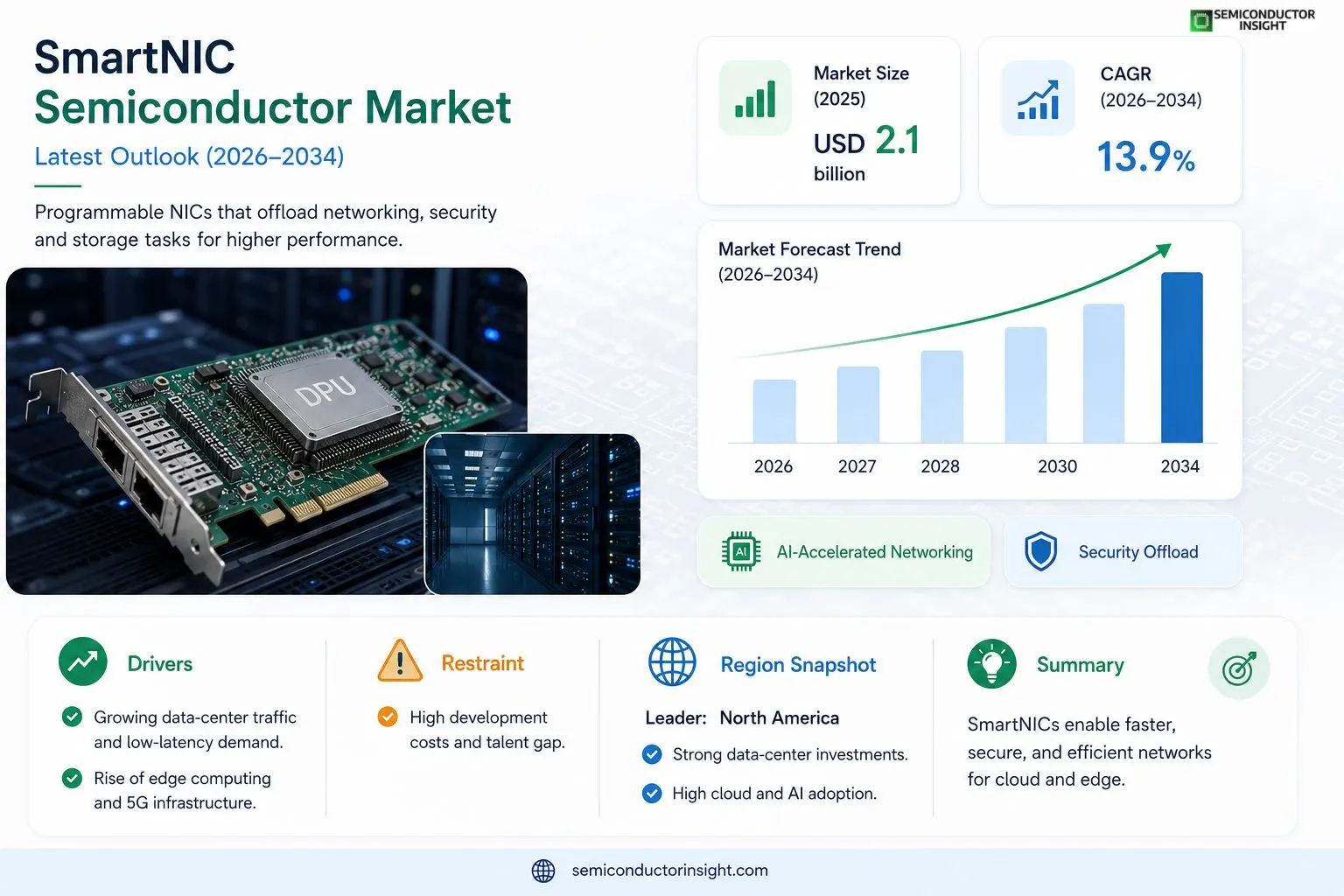
SmartNIC semiconductor market size was valued at USD 2.1 billion in 2025. The market is projected to grow from USD 2.1 billion in 2025 to USD 6.8 billion by 2034, exhibiting a CAGR of 13.9% during the forecast period.
SmartNICs are programmable network interface cards that embed dedicated processors,often referred to as DPUs (Data Processing Units),to offload networking, storage, security and telemetry tasks from host CPUs.
By integrating ASICs, FPGAs or ARM cores with high‑speed Ethernet interfaces, they enable flexible acceleration of cloud workloads, AI inference traffic and edge computing services.The market is experiencing rapid growth due to several factors, including rising demand for low‑latency cloud services, increasing adoption of hyperscale data centers and heightened focus on security offloading.
Furthermore, advancements such as Marvell’s BlueField‑3 DPU launched in March 2024 and NVIDIA’s expanded BlueField portfolio are driving adoption.
Key players,including NVIDIA/Mellanox, Intel Ethernet Group, Broadcom Inc., Marvell Technology Group and Xilinx,continue investing heavily in R&D and strategic partnerships that fuel this expansion.
MARKET DRIVERS
Growing Data‑Center Traffic and Latency Sensitivity
SmartNIC Semiconductor Market is being propelled by the exponential growth of cloud workloads, which require higher bandwidth and lower latency. Modern hyperscale data centers are adopting disaggregated architectures, and SmartNICs offload packet processing from CPUs, enabling up to a 30% reduction in processing latency.
Rise of Edge Computing and 5G Infrastructure
Edge deployments and 5G base stations demand programmable networking interfaces that can handle AI inference and security functions locally. SmartNIC solutions provide the required flexibility, leading to an estimated 18% annual increase in deployments at edge sites.
➤ “SmartNICs are becoming the de‑facto standard for accelerating network functions, especially in environments where power efficiency and real‑time processing are critical.”
Additionally, the convergence of software‑defined networking (SDN) and network function virtualization (NFV) creates a compounding effect, encouraging vendors to integrate advanced ASICs and programmable cores into SmartNICs, thereby expanding the total addressable market.
MARKET CHALLENGES
Complex Integration with Existing Server Architectures
Integrating SmartNICs into legacy server platforms often requires firmware updates and driver compatibility checks, which can extend deployment timelines. Organizations must allocate specialized engineering resources, increasing total cost of ownership.
Other Challenges
Security and Firmware Management
Ensuring that SmartNIC firmware remains secure against emerging threats adds an additional layer of complexity. Frequent patch cycles are necessary to mitigate vulnerabilities in programmable data‑plane code.
MARKET RESTRAINTS
High Development Costs and Limited Talent Pool
Designing high‑performance SmartNIC ASICs involves substantial R&D investment, often exceeding $150 million per generation. The scarcity of engineers skilled in both hardware design and low‑latency networking further constrains rapid market expansion.
MARKET OPPORTUNITIES
AI‑Accelerated Networking Solutions
Embedding AI inference engines directly within SmartNICs opens new revenue streams, particularly for real‑time video analytics and autonomous vehicle data pipelines. Early adopters project a compound annual growth rate of over 20% for AI‑enabled SmartNICs through 2030.
SmartNIC Semiconductor Market Trends
Rising Demand for Low‑Latency Cloud Services
SmartNIC Semiconductor Market is being reshaped by the escalating requirement for low‑latency cloud services and the rapid expansion of hyperscale data centers. Programmable network interface cards that embed dedicated Data Processing Units (DPUs) enable off‑loading of networking, storage, security, and telemetry workloads from host CPUs. By coupling ASICs, FPGAs or ARM cores with high‑speed Ethernet interfaces, these devices provide flexible acceleration for cloud workloads, artificial‑intelligence inference traffic and edge computing services. This functional versatility drives adoption across enterprise and service‑provider environments, where performance efficiency and security isolation are paramount. Recent product launches, such as Marvell’s BlueField‑3 DPU introduced in early 2024, illustrate how integrated designs are accelerating market momentum. Enterprises are also leveraging these SmartNIC solutions to implement zero‑trust networking models, where encryption and inspection functions are moved to the NIC, reducing latency and simplifying policy management.
Other Trends
Technology Integration and Performance
A defining trend within SmartNIC Semiconductor Market is the convergence of heterogeneous processing engines onto a single silicon platform. ASIC‑based DPUs deliver deterministic packet processing, while FPGA fabrics retain reconfigurability for emerging protocols. ARM‑based cores complement these blocks by handling host‑level orchestration and security policy enforcement. This multi‑engine architecture reduces latency footprints and frees general‑purpose CPUs for application workloads, a critical advantage for AI‑driven inference pipelines that demand high throughput. Vendors such as NVIDIA/Mellanox and Intel Ethernet Group have introduced programmable pipelines that support off‑load of TLS termination, storage virtualization, and telemetry aggregation, reinforcing the shift toward fully off‑loaded data‑plane functionality. Additionally, power‑efficiency optimizations through silicon‑level sleep states are enabling deployment in edge nodes where thermal constraints are strict.
Competitive Landscape and Future Outlook
The competitive dynamics of SmartNIC Semiconductor Market are intensifying as leading silicon providers expand R&D spending and forge ecosystem partnerships. Broadcom’s acquisition of specialized DPU IP, Marvell’s continued BlueField roadmap, and Xilinx’s integration of adaptive compute engines illustrate a strategic focus on differentiated performance per watt. Collaboration with cloud service providers accelerates validation of new off‑load models, while open‑source software frameworks lower integration barriers for smaller vendors. Looking ahead, the market is expected to consolidate around a handful of platforms that combine ASIC efficiency with the flexibility of programmable logic, enabling next‑generation workloads such as distributed AI training and real‑time analytics to run with minimal host CPU intervention. Regulatory pressures for data privacy further motivate operators to adopt hardware‑based encryption, positioning SmartNICs as a critical control point for compliance across multi‑cloud environments.
COMPETITIVE LANDSCAPE
Key Industry Players
SmartNIC Semiconductor Market Competitive Landscape Overview
SmartNIC Semiconductor Market is dominated by a handful of large‑scale vendors that combine ASIC design expertise with deep integration of networking IP. NVIDIA (through its Mellanox acquisition) leads with the BlueField‑3 DPU, leveraging a robust ecosystem of cloud providers and hyperscale data centers. Intel’s Ethernet Group competes aggressively with its Ethernet Controllers and Xeon‑based SmartNIC solutions, while Broadcom supplies high‑performance Ethernet ASICs that are widely adopted in carrier‑grade equipment. Marvell Technology Group, benefitting from the Cavium acquisition, offers the ThunderX‑based SmartNIC portfolio that emphasizes programmable pipelines. These incumbents control the majority of revenue, creating an oligopolistic structure in which R&D intensity, foundry partnerships, and strategic software stacks are the primary differentiators.Beyond the core quartet, several niche and emerging players add depth to the ecosystem. Xilinx (now part of AMD) provides FPGA‑based SmartNIC platforms that appeal to customers needing rapid reconfiguration. Pensando Systems delivers ARM‑core DPUs optimized for low‑latency cloud workloads. Netronome focuses on high‑throughput, security‑oriented SmartNICs for telco edge deployments. Achronix and Synopsys supply custom silicon IP that enables boutique semiconductor firms to develop differentiated accelerators. Samsung and Huawei also maintain modest SmartNIC line‑ups targeting regional markets, while Ceva and Cadence contribute critical IP blocks that underpin many of the programmable solutions cited above.
List of Key SmartNIC Semiconductor Companies Profiled
- NVIDIA (Mellanox)
- Intel Ethernet Group
- Broadcom Inc.
- Marvell Technology Group
- Xilinx (AMD)
- Pensando Systems
- Netronome
- Samsung Electronics
- Huawei Technologies
- Ceva Inc.
- Achronix Semiconductor
- Synopsys
Segment Analysis:
| Segment Category | Sub-Segments | Key Insights |
| By Type |
|
ASIC‑centric segment drives the market with deep integration of data‑processing pipelines, offering predictable latency and power efficiency.
|
| By Application |
|
AI/ML acceleration segment is gaining momentum as developers seek to offload tensor‑processing and data movement.
|
| By End User |
|
Hyperscale operators prioritize throughput and security, leveraging SmartNICs to partition workloads across dedicated processing domains.
|
| By Architecture |
|
Modular platforms are emerging as a flexible answer to diverse workload requirements.
|
| By Deployment Model |
|
Edge‑focused deployments highlight the need for low‑latency processing close to the data source.
|
Regional Analysis: North America
United States
The data center segment represents a significant portion of SmartNIC Semiconductor Market in the US. The need for accelerated data transfer and efficient resource management within these facilities is a primary driver. SmartNICs enable data offloading, security enhancements, and improved network virtualization, directly addressing these critical requirements.
The rapid expansion of cloud computing services in the United States is a major catalyst for SmartNIC adoption. Cloud providers are increasingly integrating SmartNICs into their infrastructure to enhance performance, security, and scalability of their offerings. This trend is expected to continue in the coming years, driving further market growth.
The burgeoning artificial intelligence and machine learning sectors in the US are creating high demand for SmartNICs capable of accelerating compute-intensive tasks. These devices offload processing from CPUs, leading to significant performance gains and energy efficiency improvements for AI/ML workloads.
The telecommunications industry in the US is actively deploying SmartNICs to enhance network performance and efficiency. This includes applications in 5G networks and edge computing deployments, where low latency and high bandwidth are paramount.
Europe
The European SmartNIC Semiconductor Market is witnessing steady growth, underpinned by increasing investments in digital infrastructure and a growing focus on data sovereignty. Several key players are establishing a presence in this region, focusing on solutions tailored to the specific needs of European data centers and enterprises. The emphasis on energy efficiency and security regulations is influencing the development and adoption of SmartNIC technologies.
Asia-Pacific
Asia-Pacific represents a high-growth potential market for SmartNIC Semiconductors. Countries like China, Japan, and South Korea are investing heavily in data center infrastructure and digital transformation initiatives. The demand for high-performance networking solutions is rapidly increasing, driven by the expansion of e-commerce, cloud computing, and 5G deployments.
South America
SmartNIC Semiconductor Market in South America is an emerging market with significant growth opportunities. The increasing adoption of cloud services and the expansion of data centers across the region are driving demand for these advanced networking devices. While the market is still relatively nascent, it is expected to witness substantial growth in the coming years.
Middle East & Africa
The Middle East & Africa SmartNIC Semiconductor Market is characterized by increasing investments in digital infrastructure and a growing focus on technological advancements. The expansion of data centers and the adoption of cloud services are creating demand for high-performance networking solutions. The region is expected to witness moderate growth in SmartNIC Semiconductor Market over the next few years.
Report Scope
This market research report provides a comprehensive analysis of the SmartNIC Semiconductor Market , covering the forecast period 2026–2034. It offers detailed insights into market dynamics, technological advancements, competitive landscape, and key trends shaping the industry.
Key focus areas of the report include:
- Market Overview: The report begins with an overview outlining its current market scenario, key growth indicators, and industry transformation drivers. It discusses macroeconomic factors, demand–supply balance, regulatory landscape, and the strategic role of semiconductors in powering advancements across industries such as automotive, telecommunications, consumer electronics, and industrial automation.
- Market Size & Forecast: Historical data and future projections for revenue, unit shipments, and market value across major regions and segments.
- Segmentation Analysis: Detailed breakdown by product type, technology, application, and end-user industry to identify high-growth segments and investment opportunities.
- Regional Insights: Insights into market performance across North America, Europe, Asia-Pacific, Latin America, and the Middle East & Africa, including country-level analysis where relevant.
- Competitive Landscape: Profiles of leading market participants, including their product offerings, R&D focus, manufacturing capacity, pricing strategies, and recent developments such as mergers, acquisitions, and partnerships.
- Technology Trends & Innovation: Assessment of emerging technologies, integration of AI/IoT, semiconductor design trends, fabrication techniques, and evolving industry standards.
- Market Drivers & Restraints: Evaluation of factors driving market growth along with challenges, supply chain constraints, regulatory issues, and market-entry barriers.
- Stakeholder Insights: Insights for component suppliers, OEMs, system integrators, investors, and policymakers regarding the evolving ecosystem and strategic opportunities.
Primary and secondary research methods are employed, including interviews with industry experts, data from verified sources, and real-time market intelligence to ensure the accuracy and reliability of the insights presented.
FREQUENTLY ASKED QUESTIONS:
What is the current market size of SmartNIC Semiconductor Market?
-> SmartNIC Semiconductor Market was valued at USD 2.1 billion in 2025 and is expected to reach USD 6.8 billion by 2034.
Which key companies operate in SmartNIC Semiconductor Market?
-> Key players include NVIDIA/Mellanox, Intel Ethernet Group, Broadcom Inc., Marvell Technology Group, Xilinx.
What are the key growth drivers?
-> Key growth drivers include rising demand for low‑latency cloud services, adoption of hyperscale data centers, heightened security‑offloading requirements, and advancements such as Marvell’s BlueField‑3 DPU and NVIDIA’s expanded BlueField portfolio.
Which region dominates the market?
-> The reference does not specify a single dominant region; growth is observed across major data‑center hubs worldwide.
What are the emerging trends?
-> Emerging trends include integration of ASICs, FPGAs and ARM cores within DPUs, acceleration of AI inference and edge‑computing workloads, and the rollout of next‑generation DPUs such as BlueField‑3.

Get Sample Report PDF for Exclusive Insights
Report Sample Includes
- Table of Contents
- List of Tables & Figures
- Charts, Research Methodology, and more...
 Download Sample Report PDF