Smart Speaker for Industrial (Voice Controlled) ASIC Market Insights
Global Smart Speaker for Industrial (Voice Controlled) ASIC Market size was valued at USD 0.58 billion in 2025. The market is projected to grow from USD 0.68 billion in 2026 to USD 2.34 billion by 2034, exhibiting a CAGR of 14.9% during the forecast period.
Smart Speaker for Industrial (Voice Controlled) ASICs are specialized integrated circuits tailored for voice processing in rugged industrial environments. These chips power smart speakers that enable hands-free operation, featuring advanced capabilities like far-field voice recognition, noise suppression, and real-time command execution for applications in manufacturing, logistics, and warehouses. Key components include wake-word engines, acoustic echo cancellation modules, and edge-based natural language processing units.
The market sees robust expansion driven by Industry 4.0 initiatives, surging demand for automation, and AI integration in factories. While labor shortages push for voice-enabled efficiency, advancements in low-power semiconductors further accelerate adoption. Key players such as Qualcomm Technologies, Inc., NXP Semiconductors N.V., and Texas Instruments Incorporated lead with innovative portfolios. For instance, in March 2024, NXP unveiled its i.MX RT series crossover MCUs optimized for voice AI in industrial IoT devices.
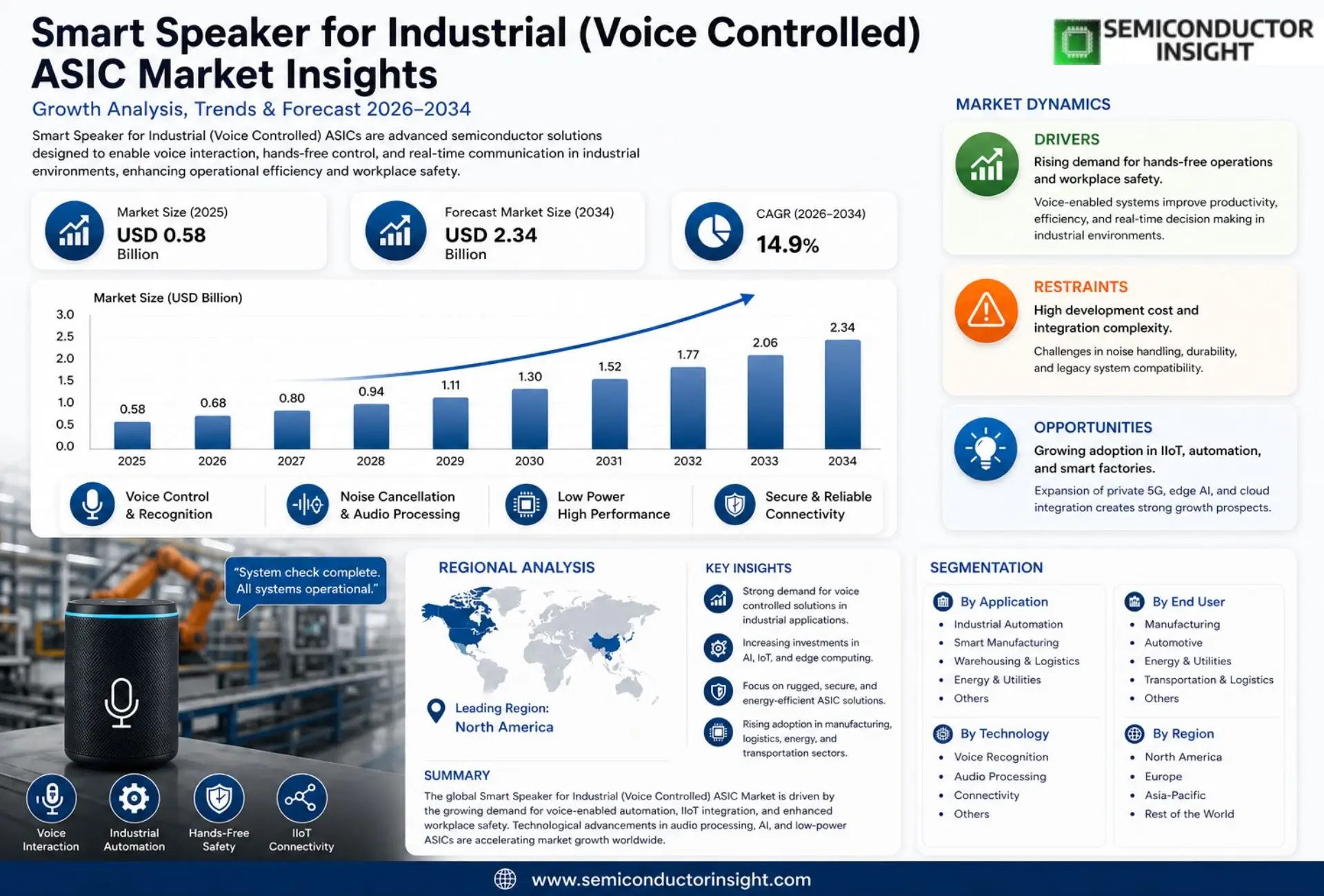
MARKET DRIVERS
Rising Adoption of Voice-Controlled Automation in Industrial Settings
Smart Speaker for Industrial (Voice Controlled) ASIC Market is propelled by the growing integration of voice interfaces into industrial automation systems. Manufacturers are increasingly deploying voice-controlled solutions to enhance operational efficiency, allowing workers to issue commands hands-free while maintaining focus on complex tasks in noisy factory environments.
Advancements in Edge AI and Low-Power ASIC Design
Progress in application-specific integrated circuits optimized for voice processing enables real-time speech recognition with reduced latency and power consumption. These specialized ASICs support on-device processing critical for industrial environments where constant cloud connectivity may be unreliable or introduce security risks.
➤ Custom ASICs deliver superior performance-per-watt for voice AI workloads compared to general-purpose processors, supporting deployment in rugged industrial smart speaker systems.
Integration with Industrial IoT platforms further accelerates demand, as voice-controlled ASICs facilitate seamless interaction with machinery, sensors, and control systems for improved productivity and safety.
MARKET CHALLENGES
Harsh Operating Environments and Noise Interference
Industrial facilities present significant acoustic challenges, including high background noise levels from machinery that can degrade voice recognition accuracy. Developing robust ASICs capable of reliable performance in such conditions requires advanced noise-cancellation algorithms and specialized audio processing capabilities.
Other Challenges
Integration Complexity with Legacy Systems
Many industrial plants rely on older programmable logic controllers and equipment that lack native support for modern voice interfaces, creating compatibility hurdles for voice-controlled ASIC implementations.
High Development Costs and Customization Needs
Designing application-specific chips tailored for industrial voice control involves substantial R&D investment and long development cycles, limiting accessibility for smaller manufacturers.
MARKET RESTRAINTS
Data Security and Privacy Concerns in Industrial Applications
Smart Speaker for Industrial (Voice Controlled) ASIC Market faces restraint from stringent data security requirements. Voice data processed in industrial settings often involves sensitive operational information, raising concerns about potential breaches or unauthorized access when implementing voice-controlled systems.
Regulatory compliance with industrial cybersecurity standards adds complexity and cost to ASIC deployment, particularly for organizations operating across multiple jurisdictions with varying data protection rules.
MARKET OPPORTUNITIES
Expansion into Predictive Maintenance and Worker Safety Applications
Significant growth potential exists for voice-controlled ASICs in enabling predictive maintenance through natural language queries to equipment diagnostics systems. Industrial smart speakers can allow technicians to verbally request status updates or maintenance logs, streamlining workflows and reducing downtime.
Opportunities also arise in enhancing worker safety by integrating voice commands with emergency response and hazard notification systems, providing an intuitive interface in high-risk manufacturing and logistics environments.
Smart Speaker for Industrial (Voice Controlled) ASIC Market Trends
Rising Integration of Voice AI in Industrial Automation
Smart Speaker for Industrial (Voice Controlled) ASIC Market is experiencing steady momentum as manufacturers increasingly prioritize hands-free voice interfaces across production floors, logistics hubs, and warehouse ecosystems. Adoption is accelerating due to the shift toward Industry 4.0 and the push for streamlined workflows that leverage AI-enabled voice processing. These ASICs, designed for rugged and noisy industrial environments, support far-field voice recognition, noise suppression, and real-time command execution. Their ability to function reliably amid heavy machinery and fluctuating acoustics has made them an integral component within modernized industrial systems. Companies are deploying voice-enabled interfaces to reduce workflow interruptions, minimize manual interactions with machinery, and enhance worker safety. This trend is further strengthened by advancements in low-power semiconductor designs that support continuous voice listening without excessive energy consumption.
Other Trends
Advancement of Edge-Based Voice Processing
One of the notable developments withSmart Speaker for Industrial (Voice Controlled) ASIC Market is the increasing use of edge-based natural language processing. This approach enables faster command execution by processing audio inputs locally rather than transmitting them to cloud servers. The capability enhances data privacy and reduces latency, which is critical in time-sensitive industrial operations. Solutions incorporating wake-word engines and acoustic echo cancellation modules have improved responsiveness, allowing operators to execute commands during high-load operational periods without disruptions. Edge-based processing also reduces dependence on network connectivity, a valuable advantage for facilities with limited or variable network coverage.
Growing Adoption Driven by Workforce Challenges
Labor shortages and the need for consistent productivity are prompting industries to incorporate more voice-activated systems powered by specialized ASICs. These chips provide the computational efficiency required for natural, conversational control of machinery. In sectors such as logistics and manufacturing, voice-controlled workflows help reduce training time for new workers and support multilingual environments. Companies benefit from improved task accuracy as operators can focus on physical processes without diverting attention to manual controls. Major semiconductor providers continue to introduce optimized components to support these needs, including innovations like NXP’s i.MX RT series devices designed to enhance voice AI functions in industrial IoT applications.
Expansion of Voice Interfaces in Industrial IoT Platforms
Voice-enabled industrial systems powered by specialized ASIC architectures are becoming increasingly interconnected with broader industrial IoT ecosystems. As manufacturers integrate more sensors, robotics, and automated systems, voice control offers a natural interface layer that enhances operational coordination. The trend is reinforced by improved semiconductor efficiency, enabling continuous wake-word detection and multi-microphone support without compromising device performance. Key industry players are refining ASIC architectures to ensure superior acoustic fidelity and noise resilience, essential for deployment in complex industrial settings. The market’s direction indicates continued growth as industries seek to unify automation, AI, and voice interaction technologies to achieve smoother and safer operational workflows.
COMPETITIVE LANDSCAPEKey Industry Players
Smart Speaker for Industrial (Voice Controlled) ASIC Market Competitive Overview
The competitive landscape of Smart Speaker for Industrial (Voice Controlled) ASIC Market is shaped by a cluster of global semiconductor leaders that specialize in voice-processing, AI-enabled edge computing, and ruggedized industrial-grade integrated circuits. Companies such as Qualcomm Technologies, Inc., NXP Semiconductors N.V., and Texas Instruments Incorporated dominate through extensive IP portfolios and strong capabilities in low‑power, high‑performance ASIC architectures tailored for industrial automation. These players benefit from their established supply chains, long-term OEM partnerships, and ability to integrate far-field voice recognition, noise cancellation, and real-time command processing into resilient industrial systems. As Industry 4.0 accelerates, these firms are strengthening their ASIC platforms with enhanced neural processing engines and more efficient voice wake technologies to support hands-free control in manufacturing and logistics environments.
Beyond the leading providers, several specialized and niche semiconductor companies contribute meaningfully to the market by focusing on voice AI acceleration, acoustic processing, and industrial IoT edge intelligence. Enterprises like Analog Devices, STMicroelectronics, Infineon Technologies, and Renesas Electronics Corporation provide complementary ASICs and SoCs that address industrial reliability, safety, and environmental robustness. Additionally, emerging AI-focused chip companies—including Ambarella, Synaptics, and CEVA, Inc.—supply voice DSPs, low-power NPUs, and software-defined voice engine technologies that enable next-generation industrial smart speakers. These players differentiate through deeper integration of AI inference at the edge, extended temperature-range operation, and optimized power efficiency, supporting the rising need for voice-enabled automation in warehouses, robotics systems, and smart factories.
List of Key Smart Speaker for Industrial (Voice Controlled) ASIC Market Companies Profiled
- Qualcomm Technologies, Inc.
- NXP Semiconductors N.V.
- Texas Instruments Incorporated
- Analog Devices, Inc.
- STMicroelectronics N.V.
- Infineon Technologies AG
- Renesas Electronics Corporation
- Synaptics Incorporated
- Ambarella, Inc.
- CEVA, Inc.
- ON Semiconductor Corporation
- Microchip Technology Inc.
- Samsung Electronics Co., Ltd.
- MediaTek Inc.
- NVIDIA Corporation
Segment Analysis:
| Segment Category | Sub-Segments | Key Insights |
| By Type |
|
Leading Segment Voice Processing ASICs dominate due to their precision in wake‑word detection and acoustic modeling.
|
| By Application |
|
Leading Segment Manufacturing Automation is the primary application driving adoption.
|
| By End User |
|
Leading Segment Manufacturing Enterprises lead due to their strong focus on automation.
|
| By Deployment Model |
|
Leading Segment On‑Device (Edge) processing is preferred across industrial environments.
|
| By Technology Architecture |
|
Leading Segment AI‑Optimized DSP Architecture stands out for advanced voice intelligence capabilities.
|
Regional Analysis: Smart Speaker for Industrial (Voice Controlled) ASIC Market
North America
Industrial automation in North America has evolved toward more intuitive and voice-enabled workflows, increasing demand for specialized ASIC architectures that enhance response accuracy and operational stability. As factories modernize, the reliance on voice-controlled interfaces grows, prompting manufacturers to embed low-energy, high-performance chips optimized for continuous speech processing in dynamic environments.
The region’s robust semiconductor ecosystem encourages continuous experimentation in ASIC design tailored for industrial smart speaker applications. Advanced research hubs and technology-driven partnerships help accelerate next-generation features such as multi-directional sound capture, environmental noise suppression, and efficient edge-level computing for industrial voice systems.
Voice-controlled ASIC-enabled smart speakers are gaining traction across various industries, including logistics, oil and gas, and specialized manufacturing. Companies in these sectors seek solutions that simplify complex processes, improve worker mobility, and reduce operational delays by enabling seamless verbal commands that integrate into broader automation frameworks.
As industrial firms prioritize digital transformation, interest in embedded voice technologies grows. This drives demand for secure and customizable ASIC solutions that can operate reliably in harsh industrial environments while supporting ecosystem integration within cloud, edge, and on-premise automation systems.
Europe
Europe demonstrates steady progress in adopting Smart Speaker for Industrial (Voice Controlled) ASIC Market technologies, driven by strong regulatory frameworks that encourage digital modernization across industrial sectors. Companies in Germany, France, and the Nordic countries are increasingly implementing voice-controlled systems to optimize production efficiency, reduce workforce-related interruptions, and support precision manufacturing. The region’s focus on sustainable automation encourages development of energy-efficient ASIC designs capable of maintaining high-performance audio and processing capabilities with minimal power consumption. European manufacturers also prioritize system interoperability, leading to greater demand for ASIC components that integrate smoothly with existing automation platforms. This environment fosters collaboration between industrial firms and semiconductor specialists, further stimulating innovation in advanced noise-filtering algorithms and robust speech recognition designed for factory environments.
Asia-Pacific
The Asia-Pacific region is experiencing rapid expansion Smart Speaker for Industrial (Voice Controlled) ASIC Market as industrial operations continue to scale across China, Japan, South Korea, and Southeast Asia. High-volume manufacturing sectors are increasingly deploying voice-controlled solutions to improve worker coordination, shorten production cycles, and reduce error rates. This drives significant interest in cost-effective, localized ASIC production that can support large-scale industrial automation initiatives. The region also benefits from strong government-backed digital infrastructure programs, accelerating adoption of voice-enabled interfaces in both large manufacturing plants and emerging industrial hubs. Furthermore, Asia-Pacific’s fast-growing semiconductor industry complements market demand by enabling broader experimentation with advanced chip designs suited for complex acoustic environments and multilingual voice processing needs.
South America
South America is gradually integrating Smart Speaker for Industrial (Voice Controlled) ASIC Market technologies as manufacturers across Brazil, Chile, and Argentina pursue modernization initiatives. Adoption is driven by the need to improve operational safety and streamline workflows in industries such as mining, energy, and transportation. The region’s industrial facilities increasingly seek ruggedized voice-controlled solutions that assist workers in hazardous or remote environments, encouraging demand for ASICs that emphasize durability, stable performance, and real-time processing. Although adoption rates vary across countries, collaborative efforts between technology suppliers and local industrial operators are helping strengthen awareness of voice automation benefits. Incremental investments in digital transformation and industrial connectivity further support the long-term outlook for ASIC-enabled smart speaker integration.
Middle East & Africa
The Middle East & Africa region is at an early yet promising stage in the adoption of Smart Speaker for Industrial (Voice Controlled) ASIC Market solutions. Oil and gas facilities, logistics companies, and infrastructure operators increasingly explore voice-enabled technologies to improve equipment coordination, enhance safety procedures, and support more responsive operational decision-making. Regional demand favors ASIC designs that can maintain high performance in harsh and variable environments, including extreme temperatures and high-noise industrial zones. As companies strengthen their digitalization strategies, interest in secure and adaptable voice interfaces grows. Strategic partnerships between global semiconductor firms and regional integrators are beginning to shape the market landscape, gradually expanding the availability of tailored ASIC solutions for industrial smart speaker applications.
Report Scope
This market research report provides a comprehensive analysis of the Smart Speaker for Industrial (Voice Controlled) ASIC Market , covering the forecast period 2026–2034. It offers detailed insights into market dynamics, technological advancements, competitive landscape, and key trends shaping the industry.
Key focus areas of the report include:
- Market Overview: The report begins with an overview outlining its current market scenario, key growth indicators, and industry transformation drivers. It discusses macroeconomic factors, demand–supply balance, regulatory landscape, and the strategic role of semiconductors in powering advancements across industries such as automotive, telecommunications, consumer electronics, and industrial automation.
- Market Size & Forecast: Historical data and future projections for revenue, unit shipments, and market value across major regions and segments.
- Segmentation Analysis: Detailed breakdown by product type, technology, application, and end-user industry to identify high-growth segments and investment opportunities.
- Regional Insights: Insights into market performance across North America, Europe, Asia-Pacific, Latin America, and the Middle East & Africa, including country-level analysis where relevant.
- Competitive Landscape: Profiles of leading market participants, including their product offerings, R&D focus, manufacturing capacity, pricing strategies, and recent developments such as mergers, acquisitions, and partnerships.
- Technology Trends & Innovation: Assessment of emerging technologies, integration of AI/IoT, semiconductor design trends, fabrication techniques, and evolving industry standards.
- Market Drivers & Restraints: Evaluation of factors driving market growth along with challenges, supply chain constraints, regulatory issues, and market-entry barriers.
- Stakeholder Insights: Insights for component suppliers, OEMs, system integrators, investors, and policymakers regarding the evolving ecosystem and strategic opportunities.
Primary and secondary research methods are employed, including interviews with industry experts, data from verified sources, and real-time market intelligence to ensure the accuracy and reliability of the insights presented.
FREQUENTLY ASKED QUESTIONS:
What is the current market size of Smart Speaker for Industrial (Voice Controlled) ASIC Market?
-> Smart Speaker for Industrial (Voice Controlled) ASIC Market was valued at USD 0.58 billion in 2025 and is expected to reach USD 2.34 billion by 2034, reflecting a CAGR of 14.9%.
Which key companies operate Smart Speaker for Industrial (Voice Controlled) ASIC Market?
-> Key players include Qualcomm Technologies, Inc., NXP Semiconductors N.V., and Texas Instruments Incorporated, among others.
What are the key growth drivers?
-> Key growth drivers include Industry 4.0 initiatives, rising demand for automation, AI integration in factories, and advancements in low-power semiconductors.
Which region dominates the market?
-> The reference content does not specify a dominant region for Smart Speaker for Industrial (Voice Controlled) ASIC Market.
What are the emerging trends?
-> Emerging trends include far-field voice recognition, noise suppression technologies, edge-based natural language processing, and increased adoption of voice-enabled industrial automation.

Get Sample Report PDF for Exclusive Insights
Report Sample Includes
- Table of Contents
- List of Tables & Figures
- Charts, Research Methodology, and more...
 Download Sample Report PDF