Smart Rings Market Insights
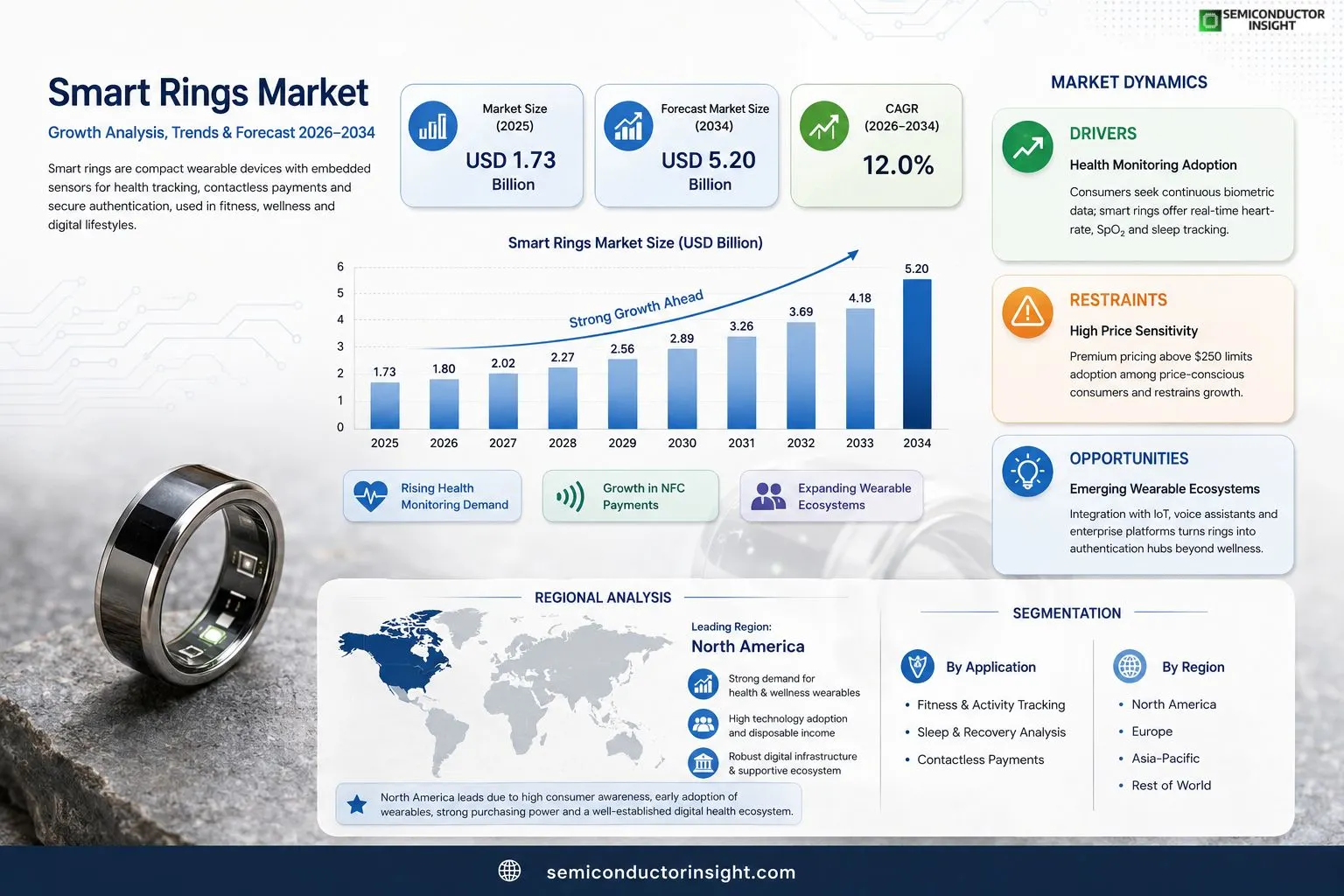
smart rings market size was valued at USD 1.73 billion in 2025. The market is projected to grow from USD 1.80 billion in 2026 to USD 5.20 billion by 2034, exhibiting a CAGR of approximately 12% during the forecast period.
Smart rings are compact wearable devices that combine a traditional ring form factor with embedded sensors such as heart‑rate monitors, accelerometers, temperature probes and NFC chips for contactless payments or secure authentication.The market is experiencing rapid growth because consumer demand for continuous health monitoring is rising, while advancements in low‑power Bluetooth and flexible battery technologies enable longer usage cycles.
Furthermore, the convergence of fashion and function drives adoption among fitness enthusiasts and tech‑savvy professionals alike.
Key playersincluding Oura Health, Motiv Technologies, NFC Ring and McLearare expanding their portfolios with multi‑sensor capabilities and premium designs, further accelerating market expansion.
MARKET DRIVERS
Health Monitoring Adoption
Consumers are increasingly seeking continuous biometric data, and smart rings provide real‑time heart‑rate, blood‑oxygen, and sleep‑quality monitoring in a discreet form factor. The ability to sync this data with mobile health platforms has accelerated Smart Rings Market, especially among fitness‑oriented millennials.
Contactless Payment Integration
Retailers are expanding contactless ecosystems, and rings equipped with NFC chips enable tap‑to‑pay transactions without the need for a phone or card. This convenience drives adoption in urban centers where cashless payments have surpassed 70% of transactions.
➤ “The convergence of health tracking and payment functionality positions smart rings as a pivotal node in the broader wearable network.”
Enterprise pilots in corporate wellness programs are also validating demand, as employers report higher engagement when employees can monitor stress levels via a ring rather than a bulkier smartwatch.
MARKET CHALLENGES
Technical Limitations
Miniaturizing sensors while maintaining accuracy remains a core engineering hurdle. Limited space restricts sensor placement, which can affect the reliability of continuous glucose or temperature measurements compared with larger wearables.
Other Challenges
Battery Life Constraints
Current lithium‑polymer cells provide 2–3 days of operation under continuous monitoring, prompting users to recharge frequently. This reduces the perceived convenience and hampers broader market penetration.
MARKET RESTRAINTS
High Price Sensitivity
Premium pricingoften exceeding $250 for fully featured modelslimits adoption among price‑conscious segments. Without clear cost‑benefit communication, many potential buyers default to more affordable fitness bands, restraining overall market growth.
MARKET OPPORTUNITIES
Emerging Wearable Ecosystems
Integration with voice assistants, smart home devices, and enterprise IoT platforms presents a sizable opportunity. As ecosystems mature, smart rings can act as authentication hubs, unlocking doors, vehicles, and digital services, thereby expanding their functional scope beyond health tracking.Regulatory clarity around medical‑grade data collection is expected to improve, allowing manufacturers to certify health‑monitoring features, which could open new revenue streams in telemedicine and chronic‑disease management.
Smart Rings Market Trends
Rising Health‑Monitoring Demand
Smart Rings Market is being reshaped by a surge in consumer interest for continuous health tracking. Advances in low‑power Bluetooth and flexible battery designs now allow rings to operate for days without charging, making them practical for daily wear. Integrated sensorsincluding heart‑rate monitors, accelerometers, and temperature probesprovide real‑time biometric data that sync seamlessly with mobile health platforms. Fitness enthusiasts appreciate the discreet form factor, while professionals value the blend of health insight and convenience. As awareness of preventive health grows, adoption rates are climbing across age groups, reinforcing the market’s momentum.
Other Trends
Integration of NFC Payments and Secure Authentication
NFC capability has turned smart rings into contactless payment tools and secure authentication devices. Users can complete transactions or unlock devices with a simple tap, reducing reliance on smartphones and cards. This functionality broadens appeal beyond wellness, attracting a tech‑savvy demographic that prioritizes streamlined, secure interactions in both retail and corporate environments. As standards for data encryption improve, confidence in ring‑based payment systems continues to strengthen, prompting manufacturers to expand NFC features across product lines.
Fashion Meets Function
Design aesthetics are becoming a differentiator in Smart Rings Market as brands introduce premium materials such as titanium, ceramic, and responsibly sourced gemstones. The convergence of style and technology encourages adoption among fashion‑forward consumers who view the ring as both an accessory and a functional device. Multi‑sensor platforms are now packaged within elegant designs that align with luxury watch and jewelry trends. Looking ahead, the sector is expected to witness increased collaboration between tech firms and established jewelry houses, driving further integration of customizable looks with advanced health and connectivity features.
COMPETITIVE LANDSCAPEKey Industry Players
Smart Rings Market Competitive Overview
Smart Rings Market is currently led by Oura Health, whose premium multi‑sensor ring dominates the high‑end health‑tracking segment and accounts for a sizable share of the USD 1.73 billion market recorded in 2025. Oura’s strong brand equity, extensive data analytics platform, and continuous hardware upgrades have established a clear hierarchical structure where a handful of well‑capitalized firms set pricing and feature benchmarks, while smaller entrants compete on niche functionality or price sensitivity. Overall, the market presents a moderately concentrated landscape, with the top four playersOura, NFC Ring, McLear, and Motiv Technologiescollectively influencing product roadmaps and driving the projected CAGR of roughly 12 % toward a USD 5.20 billion valuation by 2034.Beyond the dominant tier, a diverse cohort of niche innovators expands the ecosystem. Companies such as Kerv, Circular, Ringly, and Monarq focus on fashion‑forward designs that blend biometric sensors with customizable aesthetics, appealing to lifestyle‑oriented consumers. Emerging entrants like SmartRing.io, Hexos, and Bellabeat’s recent ring line experiment with ultra‑low‑power Bluetooth and integrated NFC for seamless payments, while niche payment specialists such as McLear leverage secure authentication technology to target enterprise and fintech applications. This breadth of specialization fuels incremental adoption across both consumer wellness and professional authentication domains.
List of Key Smart Rings Companies Profiled
- Oura Health
- NFC Ring
- Motiv Technologies
- McLear
- Kerv
- Circular
- Ringly
- Monarq
- Bellabeat (smart ring line)
- Oura
- SmartRing.io
- Hexos
- Xeon Wearables
Segment Analysis:
| Segment Category | Sub-Segments | Key Insights |
| By Type |
|
Health Monitoring Rings are gaining traction as they enable discreet, continuous physiological tracking while preserving the aesthetic of traditional jewelry. • They appeal to users who value privacy and want health data without bulky devices. • Integration with mobile health platforms creates seamless data ecosystems. • The subtle form factor encourages everyday wear, enriching longitudinal health insights. |
| By Application |
|
Fitness & Activity Tracking offers users a minimalist way to monitor movement, calories and workout intensity. • The ring’s proximity to the finger yields reliable motion data even during high‑impact sessions. • Syncing with fitness ecosystems amplifies coaching and motivation. • Its lightweight nature reduces user fatigue compared with wrist‑bound alternatives. |
| By End User |
|
Tech‑savvy Professionals appreciate the ring’s ability to blend productivity with health awareness. • Seamless NFC payments reduce friction in daily transactions. • Real‑time health alerts support well‑being during long work hours. • The premium aesthetic aligns with corporate dress codes, reinforcing brand perception. |
| By Connectivity |
|
Bluetooth Low Energy (BLE) underpins most smart‑ring experiences, delivering reliable data exchange with minimal power draw. • Continuous sensor streaming is possible without frequent charging. • Compatibility with a broad range of smartphones extends market reach. • BLE’s low latency supports immediate notifications for health and security events. |
| By Design & Materials |
|
Premium Metal Alloys convey luxury while housing delicate sensors. • High‑grade titanium and stainless steel provide durability and hypoallergenic comfort. • The tactile feel reinforces user attachment and encourages regular wear. • Aesthetic versatility enables partnerships with fashion houses, expanding appeal beyond pure tech circles. |
Regional Analysis: North America
North America
The continuous development of miniature, highly accurate sensors is a pivotal aspect of the North American smart ring market. Advancements in biosensors, for instance, are enabling more precise monitoring of heart rate variability, body temperature, and blood oxygen saturation. This focus on improved data accuracy enhances the reliability and value proposition of smart rings.
Seamless integration with existing health and fitness platforms is crucial for user adoption. Smart ring manufacturers are increasingly collaborating with popular apps and services to facilitate data sharing and create a more comprehensive health ecosystem. This interoperability enhances the user experience and makes it easier for consumers to track and manage their health data.
The North American market is seeing a trend towards personalized wellness programs powered by smart ring data. Companies are leveraging the insights gathered from smart rings to offer tailored recommendations for fitness, sleep, and stress management. This data-driven approach to wellness is gaining traction among health-conscious consumers.
Growing consumer awareness regarding data privacy and security is a significant factor in the North American market. Smart ring manufacturers are prioritizing robust data encryption and privacy protocols to address these concerns and build trust with consumers. Compliance with stringent data protection regulations is also becoming increasingly important.
North America
The North American smart rings market is benefiting from a strong focus on proactive health management. Consumers are increasingly seeking tools to monitor their well-being and gain deeper insights into their health data. The market’s growth is further propelled by the increasing popularity of fitness tracking and the desire for discreet and stylish wearable technology. The demand for smart rings that offer a comprehensive suite of health monitoring features, including sleep analysis, stress tracking, and activity monitoring, is steadily rising. The region’s robust e-commerce infrastructure facilitates easy access to smart ring products for consumers. Furthermore, the presence of numerous startups and established companies investing in smart ring technology is contributing to innovation and market expansion.
Europe
Europe presents a promising market for smart rings, with a growing emphasis on preventative healthcare and digital well-being. The region’s aging population and increasing healthcare costs are driving demand for solutions that can help individuals proactively manage their health. Smart rings offering features such as fall detection and health monitoring are gaining traction among elderly populations. The European market is characterized by a strong focus on data privacy and security, which is influencing the development of smart ring products. Moreover, government initiatives promoting digital health and wellness are creating a supportive environment for the growth of the smart ring market.
Asia-Pacific
The Asia-Pacific region is emerging as a high-growth market for smart rings, driven by increasing disposable incomes and a rising awareness of health and fitness. The region’s large and tech-savvy population is readily adopting new wearable technologies. Smart rings offering features like sleep tracking and activity analysis are particularly popular among younger consumers. The proliferation of e-commerce platforms and mobile payment systems is facilitating the widespread adoption of smart rings in the region. However, price sensitivity and competition from lower-cost alternatives pose challenges for smart ring manufacturers in Asia-Pacific.
South America
South America represents a nascent market for smart rings, with significant potential for growth. Increasing health consciousness and rising disposable incomes are creating a demand for wearable health monitoring devices. The market is gradually becoming aware of the benefits of smart rings for fitness tracking and health management. However, challenges such as limited awareness, affordability concerns, and logistical hurdles in distribution need to be addressed for the market to fully realize its potential.
Middle East & Africa
The Middle East and Africa region is an emerging market for smart rings, with opportunities for growth driven by increasing health awareness and rising disposable incomes. The region’s young and digitally connected population is receptive to new wearable technologies. Smart rings offering features like fitness tracking and sleep monitoring are gaining traction among health-conscious consumers. However, challenges such as limited infrastructure, affordability constraints, and cultural factors need to be overcome for the market to achieve sustained growth.
Report Scope
This market research report provides a comprehensive analysis of the Smart Rings Market , covering the forecast period 2026–2034. It offers detailed insights into market dynamics, technological advancements, competitive landscape, and key trends shaping the industry.
Key focus areas of the report include:
- Market Overview: The report begins with an overview outlining its current market scenario, key growth indicators, and industry transformation drivers. It discusses macroeconomic factors, demand–supply balance, regulatory landscape, and the strategic role of semiconductors in powering advancements across industries such as automotive, telecommunications, consumer electronics, and industrial automation.
- Market Size & Forecast: Historical data and future projections for revenue, unit shipments, and market value across major regions and segments.
- Segmentation Analysis: Detailed breakdown by product type, technology, application, and end-user industry to identify high-growth segments and investment opportunities.
- Regional Insights: Insights into market performance across North America, Europe, Asia-Pacific, Latin America, and the Middle East & Africa, including country-level analysis where relevant.
- Competitive Landscape: Profiles of leading market participants, including their product offerings, R&D focus, manufacturing capacity, pricing strategies, and recent developments such as mergers, acquisitions, and partnerships.
- Technology Trends & Innovation: Assessment of emerging technologies, integration of AI/IoT, semiconductor design trends, fabrication techniques, and evolving industry standards.
- Market Drivers & Restraints: Evaluation of factors driving market growth along with challenges, supply chain constraints, regulatory issues, and market-entry barriers.
- Stakeholder Insights: Insights for component suppliers, OEMs, system integrators, investors, and policymakers regarding the evolving ecosystem and strategic opportunities.
Primary and secondary research methods are employed, including interviews with industry experts, data from verified sources, and real-time market intelligence to ensure the accuracy and reliability of the insights presented.
FREQUENTLY ASKED QUESTIONS:
What is the current market size of Smart Rings Market?
-> Smart Rings Market was valued at USD 1.73 billion in 2025 and is expected to reach USD 5.20 billion by 2034.
Which key companies operate in Smart Rings Market?
-> Key players include Oura Health, Motiv Technologies, NFC Ring and McLear, among others.
What are the key growth drivers?
-> Key growth drivers include rising consumer demand for continuous health monitoring, advancements in low‑power Bluetooth connectivity, flexible battery technologies, and the convergence of fashion with function.
Which region dominates the market?
-> The reference does not specify a dominant region; regional performance details were not provided.
What are the emerging trends?
-> Emerging trends include multi‑sensor integration, premium design aesthetics, and expanded NFC applications for contactless payments and secure authentication.
Get Sample Report PDF for Exclusive Insights
Report Sample Includes
- Table of Contents
- List of Tables & Figures
- Charts, Research Methodology, and more...