Smart POS Semiconductor Market Insights
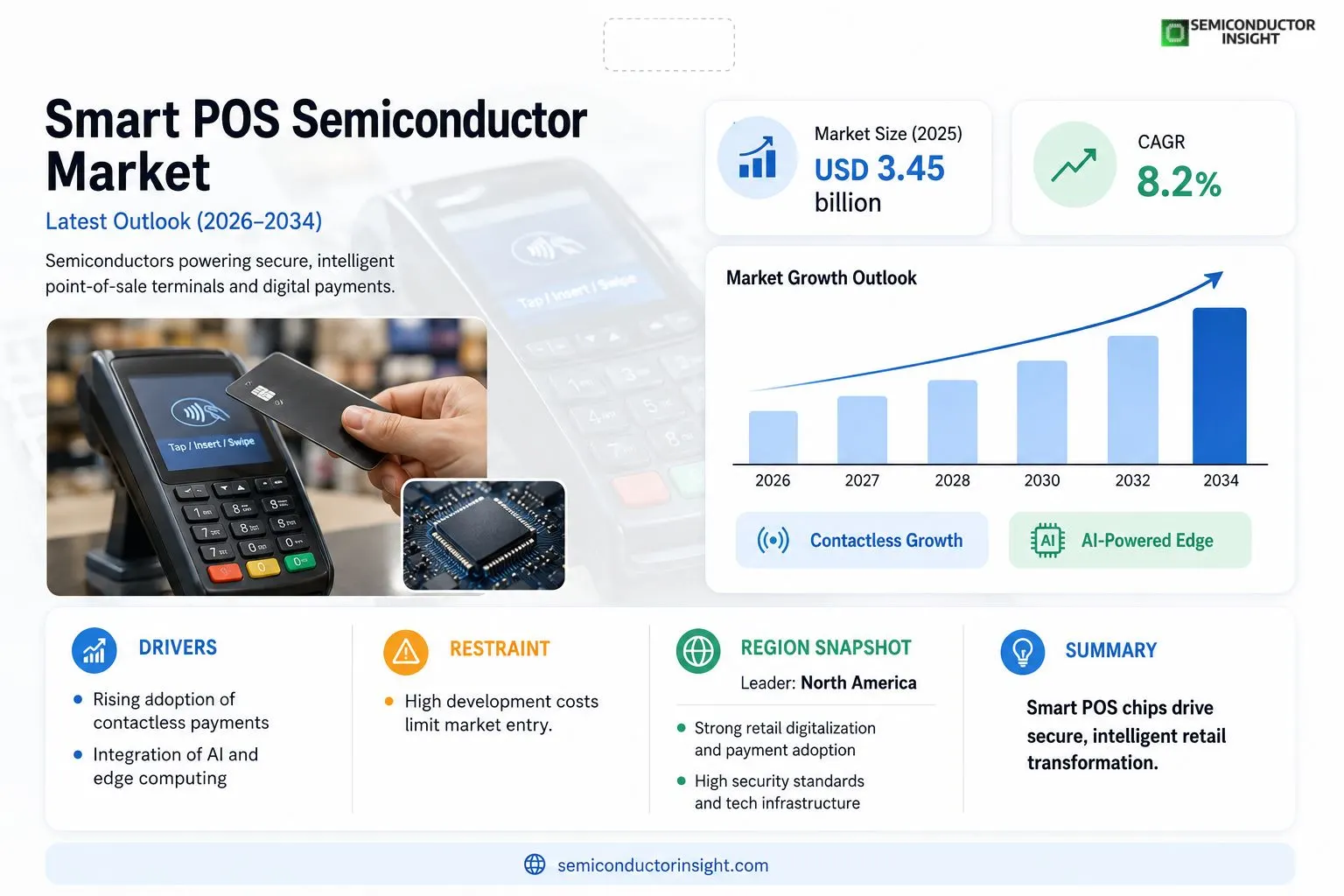
Global Smart POS Semiconductor market is projected to grow from USD 3.60 billion in 2026 to USD 7.12 billion by 2034, exhibiting a CAGR of 8.2% during the forecast period.
Smart POS semiconductors are integrated circuit solutions designed specifically for point‑of‑sale terminals, enabling secure transaction processing, connectivity, and advanced analytics. These chips combine microcontroller units, cryptographic accelerators, NFC/RFID interfaces, and power‑management modules to support contactless payments, inventory tracking, and cloud‑based services.The market is experiencing rapid growth due to expanding retail digitization, rising adoption of contactless payment methods, and increasing demand for low‑latency transaction security. Furthermore, advancements in AI‑enabled edge computing and government mandates for EMV compliance are driving investment. Key players such as NXP Semiconductors,STMicroelectronics,Renesas Electronics,
and Qualcomm are actively launching next‑generation POS solutions.
MARKET DRIVERS
Rising Adoption of Contactless Payments
Smart POS Semiconductor Market is being propelled by accelerating consumer preference for tap‑and‑go transactions. Retailers are upgrading legacy terminals with NFC‑enabled chips that reduce transaction time and enhance hygiene, driving steady demand for advanced semiconductor solutions. Retail digitization initiatives across North America and Europe further reinforce this trend.
Integration of AI and Edge Computing
Embedding AI accelerators and edge‑processing capabilities within POS hardware enables real‑time analytics, fraud detection, and personalized offers. This functional enrichment creates a compelling value proposition for merchants, compelling them to adopt newer semiconductor platforms that support on‑device intelligence. Manufacturers are therefore expanding dedicated AI cores to meet this demand.
➤ Smart POS Semiconductor Market is forecast to surpass several billion dollars by the early 2030s, reflecting a compound annual growth rate above 10%.
Overall, the convergence of contactless payment growth and AI‑driven functionality establishes a robust growth engine, positioning the sector for sustained expansion over the next decade.
MARKET CHALLENGES
Regulatory and Security Concerns
Stringent data‑protection regulations such as PCI‑DSS and regional privacy laws impose rigorous compliance requirements on POS hardware. Semiconductor vendors must incorporate secure elements and hardware‑based encryption, which elevates design complexity and time‑to‑market. Failure to meet these standards can lead to costly recalls and reputational damage.
Other Challenges
Supply Chain Volatility
Global shortages of silicon wafers and packaging materials have intermittently constrained production capacity. Fluctuating lead times increase inventory costs for OEMs, potentially delaying deployments of the latest smart POS solutions.
MARKET RESTRAINTS
High Development Costs
Designing next‑generation POS chips requires substantial R&D investment, especially for integrating multi‑protocol radios, AI cores, and robust security modules. Smaller vendors often lack the capital to fund such projects, limiting market entry and consolidating power among a few established players.
MARKET OPPORTUNITIES
Emerging Markets in Southeast Asia
Rapid urbanization and growing middle‑class consumption in countries such as Indonesia, Vietnam, and the Philippines are spurring demand for modern retail infrastructure. Smart POS Semiconductor Market can capitalize on this by offering cost‑effective, low‑power chips tailored to the region’s connectivity constraints, unlocking sizable growth potential.
Smart POS Semiconductor Market Trends
Retail Digitization and Contactless Payments
Smart POS Semiconductor Market is being reshaped by the accelerating digitization of retail environments. Point‑of‑sale terminals are increasingly required to support contactless payment methods such as NFC and QR‑code transactions, driving demand for semiconductors that integrate secure cryptographic engines, power‑management units, and multi‑protocol connectivity. Vendors are embedding these capabilities into single‑chip solutions that reduce bill of materials while enhancing transaction speed, an essential factor for high‑traffic retail locations. As merchants adopt omnichannel strategies, the need for seamless data flow between in‑store terminals and cloud analytics platforms further pushes semiconductor designers to prioritize low‑latency, high‑bandwidth interfaces.
Other Trends
AI‑Enabled Edge Computing
Edge‑based artificial intelligence is emerging as a differentiator for Smart POS devices. By processing transaction data locally, AI‑enabled chips can detect fraudulent patterns in real time, optimize inventory updates, and personalize promotions without reliance on continuous cloud connectivity. This shift reduces latency and alleviates privacy concerns, especially in regions with strict data‑residency regulations. Leading suppliers are integrating neural‑processing units (NPUs) alongside traditional microcontrollers, enabling on‑device inference for anomaly detection and predictive analytics.
EMV Compliance and Regulatory Influence
Global regulatory mandates for EMV (Europay, Mastercard, Visa) compliance continue to dictate feature sets for Smart POS semiconductors. New standards require robust cryptographic accelerators and tamper‑resistant architectures to protect cardholder data. In response, semiconductor manufacturers are delivering chips with built‑in hardware security modules (HSMs) that meet certification requirements while maintaining cost efficiency. Simultaneously, government initiatives promoting cashless transactions in public sectors are expanding the addressable market for secure POS solutions across a broader range of merchants.
COMPETITIVE LANDSCAPEKey Industry Players
Smart POS Semiconductor Market Competitive Overview
Smart POS Semiconductor Market is dominated by a handful of large integrated‑circuit vendors that combine microcontroller cores, cryptographic accelerators, and NFC/RFID front‑ends into single‑chip solutions. NXP Semiconductors and Qualcomm lead the segment with their highly integrated secure‑element platforms, which are widely adopted by global POS terminal manufacturers for EMV‑co‑certified devices. Their extensive design ecosystems, strong OEM relationships, and aggressive roadmap of AI‑enabled edge processing give them a clear structural advantage, shaping the market’s tiered architecture of flagship, mid‑range, and cost‑optimized product families.Beyond the tier‑one leaders, several niche and emerging players contribute depth and specialization to the ecosystem. STMicroelectronics and Renesas Electronics focus on low‑power microcontroller families tailored for small‑form‑factor terminals. Infineon Technologies and Texas Instruments emphasize robust power‑management and analog front‑end modules that meet stringent security certifications. MediaTek, ON Semiconductor, Broadcom, Microchip Technology, and Samsung Electronics offer differentiated connectivity stacks, system‑in‑package (SiP) options, and regional market coverage that enable smaller vendors to compete in fast‑growing retail corridors across Asia and Europe.
List of Key Smart POS Semiconductor Companies Profiled
- NXP Semiconductors
- Qualcomm
- STMicroelectronics
- Renesas Electronics
- Infineon Technologies
- Texas Instruments
- MediaTek
- ON Semiconductor
- Broadcom
- Microchip Technology
- Samsung Electronics
- Cypress Semiconductor (Infineon)
Segment Analysis:
| Segment Category | Sub-Segments | Key Insights |
| By Type |
|
Microcontroller‑based POS
|
| By Application |
|
Contactless Payments
|
| By End User |
|
Large Retail Chains
|
| By Connectivity |
|
Wi‑Fi
|
| By Security Feature |
|
Cryptographic Accelerators
|
Regional Analysis: North America
North America
The retail sector in North America is undergoing a digital transformation, with Smart POS systems playing a crucial role in omnichannel experiences. The need for secure and fast transaction processing within retail environments fuels demand for specialized semiconductors.
The hospitality and food service industries are increasingly adopting Smart POS solutions for improved operational efficiency and enhanced customer service. The demand for reliable and secure payment processing chips is a primary driver.
Security remains paramount in Smart POS Semiconductor Market. The adoption of advanced encryption technologies and secure element chips is driving innovation in payment security.
The growing trend of embedded systems within POS devices is creating significant opportunities for semiconductor manufacturers. Miniaturization and power efficiency are key considerations in this sector.
Europe
The European market for Smart POS semiconductors is experiencing steady growth, driven by stringent data privacy regulations and a commitment to digital innovation. The focus on secure payment infrastructure and the increasing adoption of mobile POS solutions are major factors influencing market trends. The emphasis on interoperability and compliance with European standards presents both opportunities and challenges for semiconductor vendors. The region’s diverse retail landscape and varying levels of technological adoption create a fragmented market, requiring tailored solutions for specific regional needs.
Asia-Pacific
Asia-Pacific represents the fastest-growing region for Smart POS Semiconductor Market. The rapid expansion of e-commerce and the increasing penetration of digital payment methods are fueling demand for advanced semiconductor solutions. The region’s large and diverse consumer base, coupled with government initiatives promoting digital transformation, are creating significant opportunities for market players. The focus on cost-effective solutions and the growing adoption of IoT devices are key trends shaping the regional landscape.
South America
South America presents a moderately growing market for Smart POS semiconductors, characterized by increasing mobile payment adoption and a growing e-commerce sector. The region’s economic instability and varying levels of infrastructure development pose challenges to market growth. However, the increasing demand for secure and reliable payment solutions is driving demand for advanced semiconductor technologies. The focus on affordability and the growing penetration of smartphones are key trends influencing the regional market.
Middle East & Africa
The Middle East & Africa region represents an emerging market for Smart POS semiconductors, driven by increasing urbanization and a growing retail sector. The region’s focus on digital transformation and the growing adoption of mobile technologies are creating opportunities for market growth. The demand for secure payment solutions and the increasing penetration of e-commerce are key drivers. However, the region’s geopolitical instability and varying levels of technological infrastructure pose challenges to market development.
Report Scope
This market research report provides a comprehensive analysis of the Smart POS Semiconductor Market , covering the forecast period 2026–2034. It offers detailed insights into market dynamics, technological advancements, competitive landscape, and key trends shaping the industry.
Key focus areas of the report include:
- Market Overview: The report begins with an overview outlining its current market scenario, key growth indicators, and industry transformation drivers. It discusses macroeconomic factors, demand–supply balance, regulatory landscape, and the strategic role of semiconductors in powering advancements across industries such as automotive, telecommunications, consumer electronics, and industrial automation.
- Market Size & Forecast: Historical data and future projections for revenue, unit shipments, and market value across major regions and segments.
- Segmentation Analysis: Detailed breakdown by product type, technology, application, and end-user industry to identify high-growth segments and investment opportunities.
- Regional Insights: Insights into market performance across North America, Europe, Asia-Pacific, Latin America, and the Middle East & Africa, including country-level analysis where relevant.
- Competitive Landscape: Profiles of leading market participants, including their product offerings, R&D focus, manufacturing capacity, pricing strategies, and recent developments such as mergers, acquisitions, and partnerships.
- Technology Trends & Innovation: Assessment of emerging technologies, integration of AI/IoT, semiconductor design trends, fabrication techniques, and evolving industry standards.
- Market Drivers & Restraints: Evaluation of factors driving market growth along with challenges, supply chain constraints, regulatory issues, and market-entry barriers.
- Stakeholder Insights: Insights for component suppliers, OEMs, system integrators, investors, and policymakers regarding the evolving ecosystem and strategic opportunities.
Primary and secondary research methods are employed, including interviews with industry experts, data from verified sources, and real-time market intelligence to ensure the accuracy and reliability of the insights presented.
FREQUENTLY ASKED QUESTIONS:
What is the current market size of Smart POS Semiconductor Market?
-> Smart POS Semiconductor Market was valued at USD 3.45 billion in 2025 and is expected to reach USD 7.12 billion by 2034.
Which key companies operate in Smart POS Semiconductor Market?
-> Key players include NXP Semiconductors, STMicroelectronics, Renesas Electronics, Qualcomm, among others.
What are the key growth drivers?
-> Key growth drivers include expanding retail digitization, rising adoption of contactless payment methods, demand for low‑latency transaction security, AI‑enabled edge computing, and government mandates for EMV compliance.
Which region dominates the market?
-> Region‑specific dominance was not disclosed in the provided source data.
What are the emerging trends?
-> Emerging trends include integration of AI/edge computing, advanced cryptographic accelerators, NFC/RFID enhancements, power‑management optimization, and broader cloud‑based service adoption.
Get Sample Report PDF for Exclusive Insights
Report Sample Includes
- Table of Contents
- List of Tables & Figures
- Charts, Research Methodology, and more...
 Download Sample Report PDF