
Market Insights
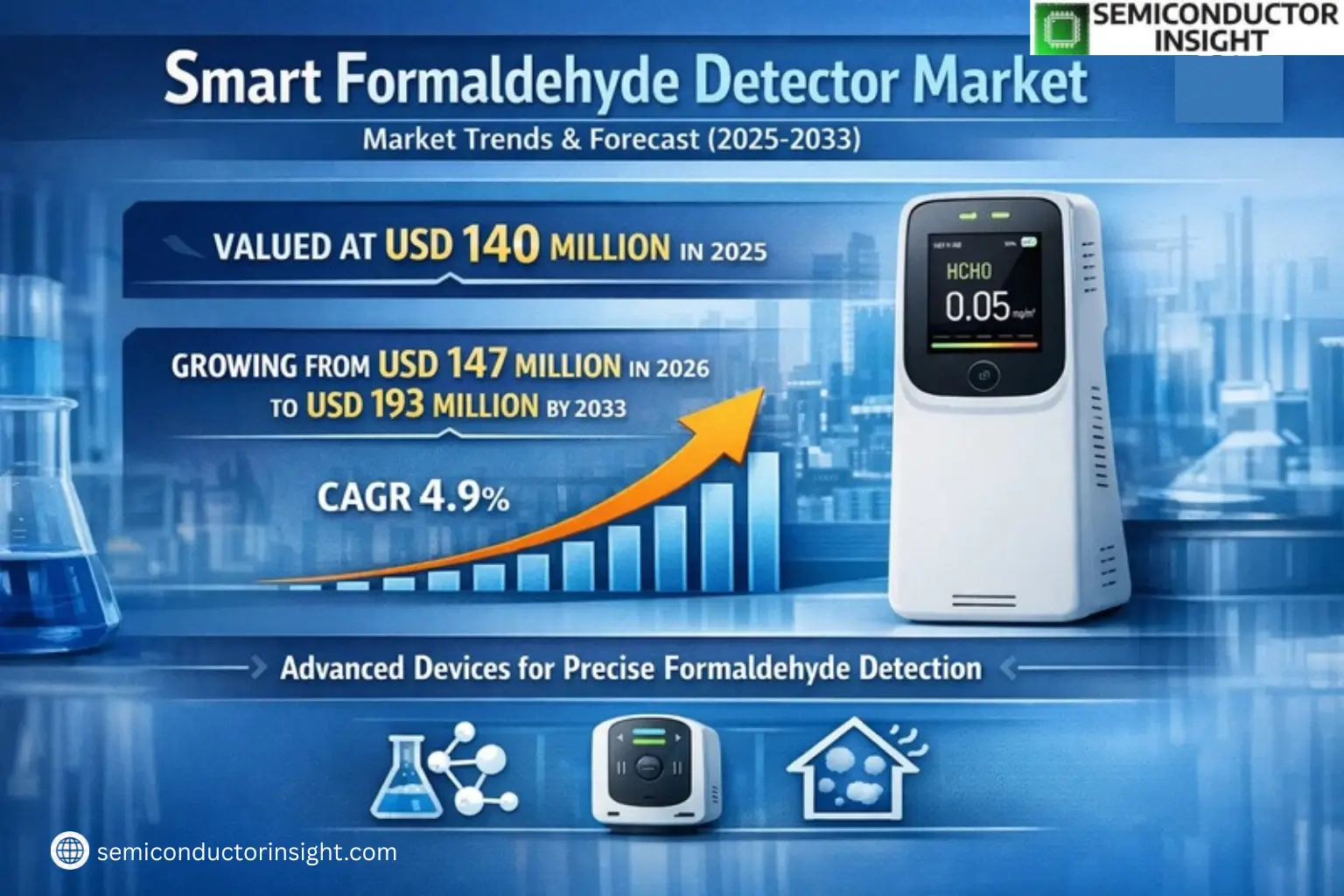
Global Smart Formaldehyde Detector Market was valued at USD 140 million in 2025. The market is projected to grow from USD 147 million in 2026 to USD 193 million by 2033, exhibiting a CAGR of 4.9% during the forecast period.
Smart Formaldehyde Detectors are advanced devices designed to measure formaldehyde levels in the air with high precision. These detectors utilize cutting-edge sensor technology to provide real-time monitoring, ensuring indoor air quality and safety. The product range includes portable and stationary variants, catering to diverse industrial, commercial, and household applications.
The market growth is driven by increasing awareness of indoor air pollution risks and stringent government regulations on workplace safety standards. Portable detectors dominate the segment with nearly 65% market share due to their convenience and affordability. Key players such as New Cosmos-Bie, RIKEN KEIKI, and Begood collectively hold over 70% of the global market share. Asia-Pacific leads regional demand with a 25% share, while Europe and North America together account for approximately 45% of total sales.
MARKET DRIVERS
Increasing Awareness of Indoor Air Quality
The growing awareness about the health risks associated with formaldehyde exposure is a key driver for the Smart Formaldehyde Detector Market. With indoor air pollution being linked to respiratory diseases and allergies, consumers and businesses are investing in advanced detection solutions. Governments are also implementing stricter regulations for indoor air quality monitoring, boosting market demand.
Technological Advancements in Sensor Precision
Recent innovations in IoT-enabled smart formaldehyde detectors have improved accuracy and real-time monitoring capabilities. Manufacturers are integrating AI and cloud-based analytics to provide comprehensive air quality reports, driving adoption across residential and commercial sectors.
Increased construction activities using formaldehyde-emitting materials are further accelerating market growth as builders incorporate air quality monitoring solutions into smart building designs.
MARKET CHALLENGES
High Cost of Advanced Detection Systems
Premium smart formaldehyde detectors with IoT capabilities remain cost-prohibitive for many residential consumers, limiting market penetration in developing economies. The need for regular calibration and maintenance also adds to ownership costs.
Other Challenges
Limited Consumer Awareness in Emerging Markets
Despite health risks, many consumers in developing nations remain unaware of formaldehyde dangers, affecting adoption rates of detection technology.
MARKET RESTRAINTS
Lack of Standardized Global Regulations
Inconsistent formaldehyde exposure regulations across countries create market fragmentation, requiring manufacturers to develop region-specific versions of their smart detectors. This increases production costs and complicates global expansion strategies.
MARKET OPPORTUNITIES
Integration with Smart Home Ecosystems
The rapid growth of smart home technology presents significant opportunities for formaldehyde detector manufacturers. Integrating these devices with platforms like Google Home and Amazon Alexa could drive mainstream adoption, particularly among tech-savvy homeowners concerned about indoor air quality.
Smart Formaldehyde Detector Market Trends
Steady Growth in Smart Formaldehyde Detector Market
Global Smart Formaldehyde Detector Market is projected to grow from USD 140 million in 2025 to USD 193 million by 2033, exhibiting a CAGR of 4.9%. This growth is driven by increasing awareness about indoor air quality and stringent regulations on formaldehyde exposure limits worldwide. Portable detectors currently dominate the market with 65% share due to their convenience and affordability.
Other Trends
Regional Market Dominance
Asia-Pacific leads the Smart Formaldehyde Detector Market with over 25% share, followed closely by North America and Europe which collectively hold about 45% market share. China’s rapid industrialization and growing middle class are key factors in APAC’s strong position, while stringent environmental regulations drive adoption in Western markets.
Key Players and Competitive Landscape
The Smart Formaldehyde Detector Market is consolidated, with the top five manufacturers holding over 70% market share. Companies like New Cosmos-Bie, RIKEN KEIKI, and Begood lead the industry through continuous innovation in detection accuracy and smart connectivity features. Recent developments include IoT integration and mobile app compatibility for real-time monitoring.
Application Segment Growth
Household applications currently represent the largest end-use segment for Smart Formaldehyde Detectors, followed by industrial and commercial sectors. Rising consumer awareness about health risks from formaldehyde emissions in furniture and building materials is accelerating residential adoption.
Technology Advancements
Manufacturers are focusing on developing detectors with higher sensitivity (down to 0.01ppm), faster response times, and longer sensor lifespans. Emerging technologies like electrochemical sensors and photoacoustic spectroscopy are gaining traction for their improved accuracy in formaldehyde detection across various environments.
COMPETITIVE LANDSCAPE
Key Industry Players
Global Leaders Dominate 70% of Smart Formaldehyde Detection Market
Global Smart Formaldehyde Detector Market is highly concentrated, with top five manufacturers holding over 70% market share in 2025. New Cosmos-Bie and RIKEN KEIKI lead the industry with advanced sensor technologies and strong distribution networks across Asia-Pacific, which accounts for 25% of global demand. These established players dominate through continuous R&D investments and strategic partnerships with industrial safety equipment distributors.
Niche players like PPM Technology and GrayWolf are gaining traction by specializing in high-precision detectors for commercial applications. The market sees increasing competition from Chinese manufacturers such as Lanbao and Begood, who offer cost-effective solutions for household applications. Portable detectors remain the dominant product segment (65% share), driving innovation in wireless connectivity and smartphone integration among competitors.
List of Key Smart Formaldehyde Detector Companies Profiled
- New Cosmos-Bie
- RIKEN KEIKI
- PPM Technology
- RAE System
- Sper Scientific
- Hal Technology
- Begood
- E Instruments
- Extech
- Lanbao
- GrayWolf
- Uni-Trend
- RKI Instruments
- Environmental Sensors
- Bacharach
Segment Analysis:
| Segment Category | Sub-Segments | Key Insights |
| By Type |
|
Portable Detectors dominate due to their mobility and ease of use across multiple environments. Key factors include:
|
| By Application |
|
Household Applications show strongest adoption rates due to:
|
| By End User |
|
Homeowners represent the fastest-growing segment because:
|
| By Technology |
|
Electrochemical Sensors are preferred for their:
|
| By Distribution Channel |
|
Online Retail channels show strongest growth momentum due to:
|
Regional Analysis: Smart Formaldehyde Detector Market
Stringent workplace safety regulations in China and Japan mandate formaldehyde monitoring in manufacturing plants and laboratories, creating steady demand for smart detectors. Recent amendments to indoor air quality standards are expanding requirements to commercial buildings.
Integration with building automation systems is gaining traction in developed markets. Japanese manufacturers are leading development of AI-powered predictive detection systems, while Chinese firms focus on cost-effective solutions for mass adoption.
Furniture production accounts for majority demand in Southeast Asia, while electronics manufacturing drives adoption in China and South Korea. Healthcare facilities are emerging as growth segment across the region.
Price sensitivity in emerging markets limits adoption of advanced features. Lack of standardization across countries creates compatibility issues for smart building integrations.
North America
The North American market for smart formaldehyde detectors benefits from strict EPA regulations and growing awareness about indoor air quality issues. The United States leads regional adoption with widespread use in schools, offices and residential applications. Canadian demand is driven by green building certifications and construction industry standards. Integration with smart home systems is significantly higher than other regions, with premium-priced connected devices gaining market share. Medical applications in hospitals and research labs represent a high-value segment.
Europe
European market growth is supported by REACH regulations and workplace safety directives. Germany and Nordic countries show highest adoption rates, benefiting from advanced industrial hygiene practices. Smart formaldehyde detectors are increasingly incorporated into broader environmental monitoring systems. Southern and Eastern European markets remain underpenetrated but show strong growth potential as EU standards expand. The hospitality sector is emerging as key application area in Western Europe.
South America
Market development in South America remains uneven, with Brazil accounting for majority regional demand. Industrial applications in manufacturing and chemical processing dominate, while residential adoption is minimal. Lack of standardized regulations across countries hinders market growth. Price sensitivity favors basic models over smart detectors, though Argentina and Chile show increasing interest in connected solutions.
Middle East & Africa
The Gulf Cooperation Council countries lead regional demand, driven by smart city projects and high-end construction developments. Healthcare sector applications are growing rapidly in UAE and Saudi Arabia. African markets remain largely untapped outside of South Africa, where workplace regulations are driving industrial adoption. The region shows potential for growth as construction activity increases and awareness of indoor air quality issues improves.
Report Scope
This market research report provides a comprehensive analysis of the Smart Formaldehyde Detector Market , covering the forecast period 2025–2033. It offers detailed insights into market dynamics, technological advancements, competitive landscape, and key trends shaping the industry.
Key focus areas of the report include:
- Market Overview: The report begins with an overview outlining its current market scenario, key growth indicators, and industry transformation drivers. It discusses macroeconomic factors, demand–supply balance, regulatory landscape, and the strategic role of Smart Formaldehyde Detectors in measuring air quality across industries such as household, commercial, and industrial sectors.
- Market Size & Forecast: Historical data and future projections for revenue, unit shipments, and market value across major regions and segments.
- Segmentation Analysis: Detailed breakdown by product type (Portable, Stationary), application (Household, Commercial, Industrial), and end-user industry to identify high-growth segments and investment opportunities.
- Regional Insights: Insights into market performance across North America, Europe, Asia-Pacific, Latin America, and the Middle East & Africa, including country-level analysis where relevant.
- Competitive Landscape: Profiles of leading market participants, including their product offerings, R&D focus, manufacturing capacity, pricing strategies, and recent developments such as mergers, acquisitions, and partnerships.
- Technology Trends & Innovation: Assessment of emerging technologies, integration of AI/IoT, and evolving industry standards in formaldehyde detection.
- Market Drivers & Restraints: Evaluation of factors driving market growth along with challenges, supply chain constraints, regulatory issues, and market-entry barriers.
- Stakeholder Insights: Insights for component suppliers, OEMs, system integrators, investors, and policymakers regarding the evolving ecosystem and strategic opportunities.
Primary and secondary research methods are employed, including interviews with industry experts, data from verified sources, and real-time market intelligence to ensure the accuracy and reliability of the insights presented.
FREQUENTLY ASKED QUESTIONS:
What is the current market size of Smart Formaldehyde Detector Market?
-> Smart Formaldehyde Detector Market was valued at USD 140 million in 2025. The market is projected to grow from USD 147 million in 2026 to USD 193 million by 2033, exhibiting a CAGR of 4.9% during the forecast period.
Which key companies operate in Smart Formaldehyde Detector Market?
-> Key players include New Cosmos-Bie, RIKEN KEIKI, Lanbao, Begood, Uni-Trend, PPM Technology, RAE System, among others. Global top five manufacturers hold a share over 70%.
What are the key growth drivers?
-> Key growth drivers include increasing awareness of indoor air quality, stringent government regulations on formaldehyde emissions, and rising demand from residential and commercial sectors.
Which region dominates the market?
-> Asia-Pacific is the largest market with a share over 25%, followed by Europe and North America with a combined share of about 45%.
What are the key market segments by product type?
-> The Portable segment dominates with nearly 65% market share, followed by Stationary detectors.
What are the major application areas?
-> The Household segment is the largest application, followed by Industrial and Commercial sectors.

Get Sample Report PDF for Exclusive Insights
Report Sample Includes
- Table of Contents
- List of Tables & Figures
- Charts, Research Methodology, and more...
 Download Sample Report PDF


