Market Insights
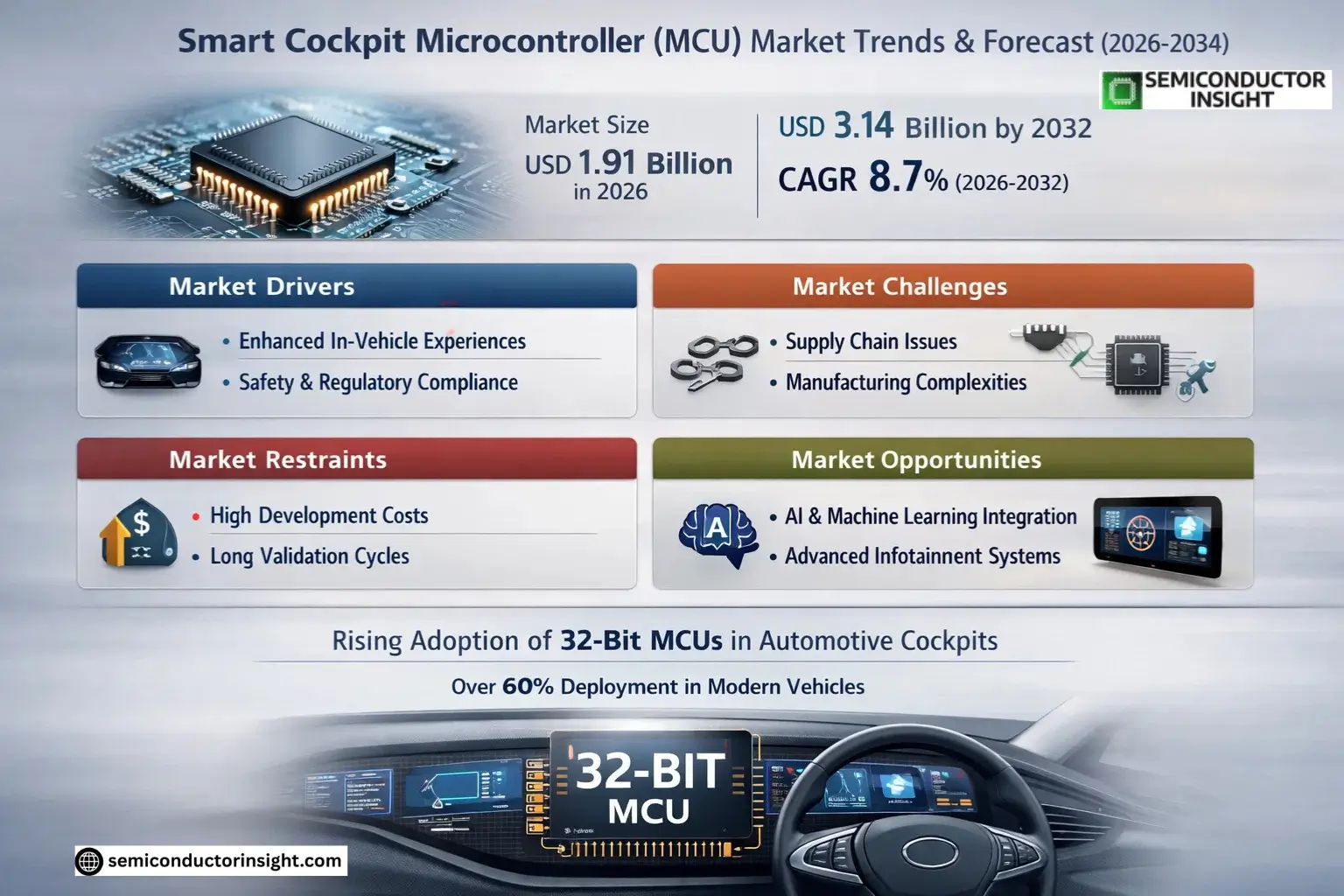
Global Smart Cockpit Microcontroller (MCU) Market was valued at USD 1.76 billion in 2025 and is projected to grow from USD 1.91 billion in 2026 to USD 3.14 billion by 2032, exhibiting a CAGR of 8.7% during the forecast period.
Smart Cockpit Microcontrollers are automotive-grade controllers designed for digital instrumentation, infotainment systems, climate control, and human-machine interaction. These integrated circuits combine processing power with sensing and control capabilities to deliver high reliability and energy efficiency for next-generation vehicle cockpit platforms. The technology enables advanced features such as touchscreen interfaces, voice recognition, and driver assistance systems while meeting stringent automotive safety standards like ISO 26262.
The market growth is driven by increasing vehicle electrification and rising consumer demand for connected car features. With production reaching approximately 3.22 billion units in 2025 at an average price point of USD 0.6 per unit, manufacturers are achieving healthy gross margins around 45%. Key industry players including Microchip Technology, STMicroelectronics, and Texas Instruments are expanding their product portfolios to address the growing need for higher-performance 32-bit MCUs capable of supporting complex automotive applications.
MARKET DRIVERS
Growing Demand for Enhanced In-Vehicle Experiences
Smart Cockpit Microcontroller (MCU) Market is experiencing rapid growth driven by increasing consumer demand for advanced infotainment and connectivity features. Automakers are integrating high-performance MCUs to support touchscreens, voice recognition, and AI-based interfaces, creating immersive driving experiences. The shift toward electric and autonomous vehicles further accelerates adoption, as these platforms require sophisticated cockpit control systems.
Safety and Regulatory Compliance
Stringent automotive safety regulations worldwide are pushing manufacturers to adopt advanced Smart Cockpit MCUs that ensure reliable operation of critical systems. These components enable real-time processing for ADAS integration and driver monitoring, reducing accident risks. By 2026, over 75% of new vehicles are expected to incorporate these safety-enhanced microcontroller solutions.
Additional growth factors include the standardization of Ethernet-based architectures in vehicle networks and the trend toward zone-oriented E/E architectures, both requiring more sophisticated MCU solutions.
MARKET CHALLENGES
Supply Chain and Manufacturing Complexities
Smart Cockpit Microcontroller (MCU) Market faces significant challenges in semiconductor supply chain stability and the high complexity of automotive-grade chip manufacturing. The industry requires specialized fabrication processes to meet automotive temperature and reliability standards, creating production bottlenecks.
Other Challenges
Design Integration Hurdles
Integrating Smart Cockpit MCUs with legacy vehicle architectures while maintaining cybersecurity protections presents technical obstacles. Automakers must balance performance requirements with power efficiency and thermal management constraints.
MARKET RESTRAINTS
High Development Costs and Extended Validation Cycles
The automotive industry’s stringent qualification processes for Smart Cockpit MCUs result in prolonged development timelines and significant R&D investments. Each microcontroller variant requires 12-18 months of validation testing, delaying time-to-market and increasing costs for manufacturers.
MARKET OPPORTUNITIES
Emerging AI and Machine Learning Integration
Next-generation Smart Cockpit MCUs incorporating dedicated AI accelerators present lucrative opportunities. These solutions enable advanced features like natural language processing for voice assistants and predictive user interfaces, creating differentiation opportunities for automakers. The premium vehicle segment is expected to lead adoption of these AI-enhanced MCU solutions.
Smart Cockpit Microcontroller (MCU) Market Trends
Rising Adoption of 32-Bit MCUs in Automotive Cockpits
The automotive industry is witnessing accelerated adoption of 32-bit Smart Cockpit Microcontroller (MCU) units, which now account for over 60% of total deployments. This shift is driven by the need for higher processing power to handle advanced driver-assistance systems (ADAS), augmented reality displays, and voice recognition functionalities in modern vehicle cockpits. Major manufacturers are prioritizing these chips for their superior computing efficiency and automotive-grade reliability.
Other Trends
Increased Focus on Functional Safety Standards
Automakers are demanding Smart Cockpit Microcontroller (MCU) solutions compliant with ISO 26262 ASIL-B and ASIL-A safety standards. This trend reflects the industry’s emphasis on fail-safe operation of critical cockpit functions, with leading suppliers implementing robust hardware-software integration protocols to meet stringent automotive requirements while maintaining optimal power consumption levels.
ARM Cortex Architecture Dominance
Smart Cockpit Microcontroller (MCU) Market shows strong preference for ARM Cortex-based designs, particularly the M and R series, which collectively represent approximately 75% of architectural implementations. These platforms offer the necessary balance between real-time processing capabilities and energy efficiency required for next-generation automotive human-machine interfaces. The trend is reinforced by extensive toolchain support from major semiconductor vendors.
Regional Manufacturing Capacity Expansion
Asia-Pacific has emerged as the dominant production hub for Smart Cockpit Microcontroller (MCU) units, with China increasing its manufacturing capacity by 35% since 2022. This expansion supports growing demand from domestic automakers while enabling global suppliers to optimize their production networks. The region’s advanced semiconductor ecosystem facilitates efficient wafer processing and chip packaging operations.
Integration with Vehicle Electrification
The transition to electric vehicles is creating new opportunities for Smart Cockpit Microcontroller (MCU) applications, particularly in battery management system monitoring and energy-efficient display technologies. Leading EV manufacturers are leveraging these chips to create unified control interfaces that combine traditional cockpit functions with powertrain health data visualization.
COMPETITIVE LANDSCAPE
Key Industry Players
Automotive Semiconductor Leaders Driving Smart Cockpit Innovation
Global Smart Cockpit Microcontroller (MCU) Market is dominated by established semiconductor giants, with Microchip Technology and STMicroelectronics jointly controlling over 35% market share. These leaders specialize in automotive-grade 32-bit ARM Cortex-M series MCUs with ASIL-B certification, offering superior processing power for digital clusters and HMI systems. The industry exhibits an oligopolistic structure where top 5 players account for nearly 60% of 2025’s USD 1.76 billion market.
Niche innovators like Silicon Labs and Cypress Semiconductor (now Infineon) focus on low-power 16-bit solutions for secondary cockpit functions. Emerging Chinese players such as GigaDevice and Chipsea are gaining traction in entry-level vehicle segments through cost-optimized 8-bit MCUs, though with lower ASPs around USD 0.45 per unit compared to industry average of USD 0.60.
List of Key Smart Cockpit MCU Companies Profiled
- Microchip Technology
- STMicroelectronics
- Texas Instruments
- Analog Devices
- Silicon Laboratories
- Toshiba Electronic Devices & Storage
- Infineon Technologies
- Renesas Electronics
- NXP Semiconductors
- ROHM Semiconductor
- GigaDevice Semiconductor
- Chipsea Technologies
- BYD Semiconductor
- AutoChips Inc.
- Holtek Semiconductor
Segment Analysis:
| Segment Category | Sub-Segments | Key Insights |
| By Type |
|
32-Bit Microcontrollers dominate the market due to their superior processing capabilities for complex cockpit functions.
|
| By Application |
|
Infotainment Systems represent the most demanding application segment for smart cockpit MCUs.
|
| By End User |
|
Premium Automakers lead in adoption of advanced smart cockpit MCU solutions.
|
| By Architecture |
|
ARM Cortex-R Series is emerging as the architecture of choice for safety-critical applications.
|
| By Safety Grade |
|
ISO 26262 ASIL-B certified MCUs are becoming the baseline requirement.
|
Regional Analysis: Smart Cockpit Microcontroller (MCU) Market
China’s booming electric vehicle market is driving exceptional demand for Smart Cockpit MCUs, with domestic automakers prioritizing fully digital, AI-powered cockpit experiences. Local MCU manufacturers are developing specialized chips tailored for Chinese infotainment systems and voice recognition interfaces.
Japan maintains leadership in high-reliability automotive MCUs, with tier-1 suppliers integrating sophisticated safety features into cockpit controllers. The market sees growing adoption of multi-display MCU architectures in premium vehicles with advanced driver monitoring systems.
South Korea’s semiconductor giants are developing powerful Smart Cockpit MCUs combining high-performance computing with energy efficiency. Local automakers are pioneering augmented reality HUD systems requiring specialized MCU configurations with low-latency processing.
India’s growing automotive sector presents opportunities for cost-optimized Smart Cockpit MCUs. Local manufacturers seek solutions balancing performance with affordability, driving demand for scalable MCU platforms adaptable across entry-level and premium vehicles.
North America
The North American Smart Cockpit Microcontroller (MCU) Market benefits from strong adoption in premium vehicles and technological partnerships between automakers and Silicon Valley firms. Region-specific requirements for connected vehicle services and advanced driver assistance integration are shaping MCU architectures. Detroit’s Big Three automakers are accelerating digital cockpit deployments, while Tesla’s vertically integrated approach influences regional MCU design philosophies. The market sees growing demand for MCUs supporting over-the-air update capabilities and cybersecurity features.
Europe
Europe’s stringent automotive safety regulations drive innovation in Smart Cockpit MCUs with functional safety certifications. German automakers prioritize high-performance MCUs for luxury vehicle cockpits, while French and Italian manufacturers focus on premium infotainment experiences. The region shows strong adoption of MCUs enabling multi-zone cockpit systems that separate driver-focused and passenger entertainment interfaces. EU mandates for standardized vehicle connectivity influence MCU communication protocol requirements.
Middle East & Africa
Smart Cockpit Microcontroller (MCU) Market evolves through luxury vehicle imports and growing local assembly operations. High-temperature resistant MCU designs gain importance for regional climate conditions. Premium car buyers drive demand for advanced cockpit technologies, while budget-conscious markets create opportunities for entry-level MCU solutions with basic connectivity features.
South America
South America’s Smart Cockpit MCU adoption focuses on cost-efficient solutions for popular compact vehicle segments. Brazilian and Argentine automakers prioritize MCUs supporting multilingual voice recognition and localized infotainment content. The region shows growing interest in connected cockpit technologies, though infrastructure challenges influence MCU feature prioritization.
Report Scope
This market research report provides a comprehensive analysis of the Smart Cockpit Microcontroller (MCU) Market, covering the forecast period 2025–2032. It offers detailed insights into market dynamics, technological advancements, competitive landscape, and key trends shaping the industry.
Key focus areas of the report include:
- Market Overview: The report begins with an overview outlining its current market scenario, key growth indicators, and industry transformation drivers. It discusses macroeconomic factors, demand–supply balance, regulatory landscape, and the strategic role of semiconductors in powering advancements across industries such as automotive, telecommunications, consumer electronics, and industrial automation.
- Market Size & Forecast: Historical data and future projections for revenue, unit shipments, and market value across major regions and segments.
- Segmentation Analysis: Detailed breakdown by product type, technology, application, and end-user industry to identify high-growth segments and investment opportunities.
- Regional Insights: Insights into market performance across North America, Europe, Asia-Pacific, Latin America, and the Middle East & Africa, including country-level analysis where relevant.
- Competitive Landscape: Profiles of leading market participants, including their product offerings, R&D focus, manufacturing capacity, pricing strategies, and recent developments such as mergers, acquisitions, and partnerships.
- Technology Trends & Innovation: Assessment of emerging technologies, integration of AI/IoT, semiconductor design trends, fabrication techniques, and evolving industry standards.
- Market Drivers & Restraints: Evaluation of factors driving market growth along with challenges, supply chain constraints, regulatory issues, and market-entry barriers.
- Stakeholder Insights: Insights for component suppliers, OEMs, system integrators, investors, and policymakers regarding the evolving ecosystem and strategic opportunities.
Primary and secondary research methods are employed, including interviews with industry experts, data from verified sources, and real-time market intelligence to ensure the accuracy and reliability of the insights presented.
FREQUENTLY ASKED QUESTIONS:
What is the current market size of Smart Cockpit Microcontroller (MCU) Market?
-> Smart Cockpit Microcontroller (MCU) Market was valued at USD 1.76 billion in 2025 and is projected to grow from USD 1.91 billion in 2026 to USD 3.14 billion by 2032, exhibiting a CAGR of 8.7% during the forecast period..
What is the growth rate of the Smart Cockpit Microcontroller (MCU) Market?
-> The market is expected to grow at a CAGR of 8.7% during the forecast period 2025-2032.
Which key companies operate in Smart Cockpit Microcontroller (MCU) Market?
-> Key players include Microchip Technology, STMicroelectronics, Texas Instruments, Analog Devices, Silicon Laboratories, and Toshiba.
What are the key applications of Smart Cockpit MCUs?
-> Smart Cockpit MCUs are used in digital instrumentation, infotainment systems, climate control, and human-machine interaction in passenger cars and commercial vehicles.
What was the production volume in 2025?
-> Production was approximately 3.22 billion units in 2025 with an average price of USD 0.6 per unit.

Get Sample Report PDF for Exclusive Insights
Report Sample Includes
- Table of Contents
- List of Tables & Figures
- Charts, Research Methodology, and more...
 Download Sample Report PDF