Smart CMOS Image Sensor with On‑Chip AI Market Insights
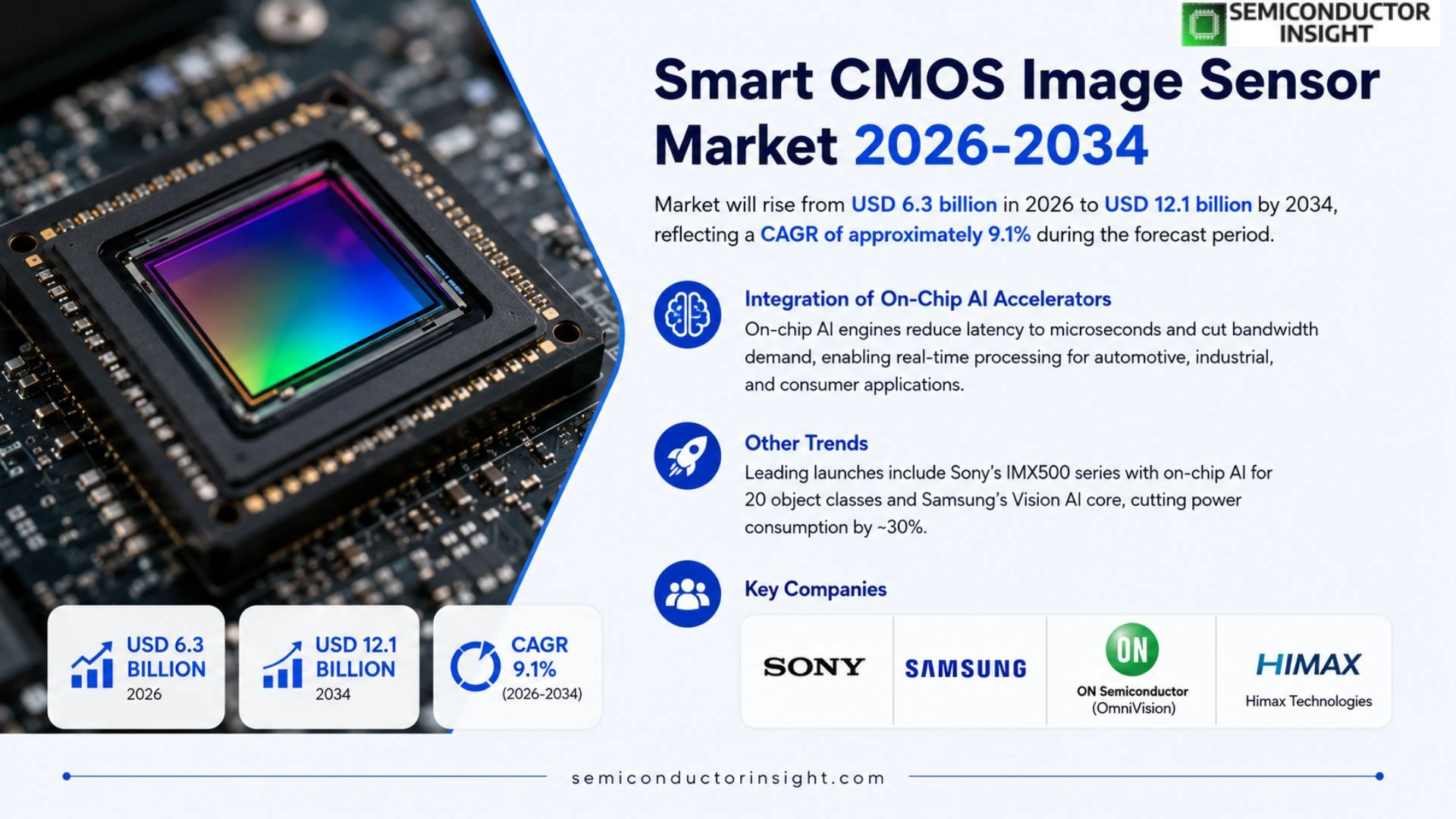
Global Smart CMOS image sensor market incorporating on‑chip artificial intelligence was valued at USD 5.8 billion in 2025. The market will rise from USD 6.3 billion in 2026 to USD 12.1 billion by 2034, reflecting a CAGR of approximately 9.1% during the forecast period.
Smart CMOS image sensors equipped with on‑chip AI merge high‑resolution photodiodes and dedicated neural‑network accelerators, delivering real‑time object detection and classification directly within the sensor array. By processing visual data at the pixel level, these devices cut latency and bandwidth needs for autonomous driving, robotics, smart surveillance and industrial inspection.
The sector gains momentum because automotive OEMs require ultra‑low latency perception while consumer electronics seek power‑efficient vision solutions. Recent product launches,such as Sony’s IMX500 series featuring on‑chip inference announced in early 2024 and Samsung’s integration of Vision AI cores,have accelerated adoption. Leading suppliers including ON Semiconductor (OmniVision), Himax Technologies and STMicroelectronics are expanding their portfolios, strengthening supply confidence across applications.
MARKET DRIVERS
Rising Demand for Real‑Time Vision Analytics
The proliferation of autonomous platforms and advanced driver‑assistance systems forces manufacturers to embed high‑resolution perception capabilities directly at the sensor level. By processing visual data on‑chip, latency drops dramatically, allowing vehicles to react to hazards within milliseconds. This technical advantage converts into a clear competitive edge for OEMs, fuelling investment in Smart CMOS Image Sensor with On‑Chip AI Market.
Convergence of Edge AI and Imaging
Edge‑focused artificial intelligence frameworks have matured to the point where they can be implemented within the limited power envelope of a CMOS die. This convergence eliminates the need for external processors, reduces bill‑of‑materials, and simplifies system architecture. Companies that capitalize on this integration can differentiate their product portfolios and capture premium pricing.
➤ “Embedding AI directly into the pixel array shortens the decision loop, a decisive factor for safety‑critical applications.”
Beyond automotive, industrial robotics and smart retail cameras are adopting on‑chip AI to perform defect detection and shopper behavior analysis locally. The resulting data sovereignty and reduced bandwidth consumption reinforce the strategic relevance of this sensor class across multiple high‑value verticals.
MARKET CHALLENGES
Complexity of Co‑Designing Optics and Algorithms
Designing a sensor that simultaneously meets stringent optical performance and computational efficiency demands close collaboration between photonic engineers and AI specialists. This multidisciplinary effort lengthens development cycles and escalates R&D expenditure, posing a barrier for midsize players lacking deep‑tech resources.
Other Challenges
Supply‑Chain Vulnerabilities
The reliance on advanced silicon‑on‑insulator (SOI) wafers, coupled with limited fab capacity for high‑density AI blocks, creates bottlenecks that can delay product launches. Companies must therefore develop contingency sourcing strategies or risk losing market share to better‑positioned rivals.
MARKET RESTRAINTS
Cost Sensitivity in High‑Volume Segments
While the performance merits of on‑chip AI are clear, the incremental unit cost remains a hurdle for applications such as consumer smartphones and low‑margin IoT devices. Manufacturers that cannot amortize the expense over large production runs may find adoption rates slower than anticipated, limiting overall market penetration.
MARKET OPPORTUNITIES
Emergence of 5G‑Enabled Edge Nodes
The rollout of 5G infrastructure creates a fertile environment for distributed vision systems that process data locally to comply with latency and privacy regulations. Smart CMOS Image Sensor with On‑Chip AI solutions can be positioned as the cornerstone of these edge nodes, opening licensing and OEM partnership opportunities that extend beyond traditional hardware sales.
Smart CMOS Image Sensor with On-Chip AI Market Trends
Integration of On‑Chip AI Accelerators Accelerates Sensor Adoption
The fusion of pixel‑level processing and dedicated neural‑network blocks has reshaped how visual data is handled across automotive, industrial and consumer domains. By embedding inference engines directly within the silicon, latency drops from milliseconds to microseconds, and the demand on upstream bandwidth contracts dramatically. OEMs in the autonomous‑vehicle arena cite the need for sub‑10 ms perception cycles as the catalyst for selecting sensors that can deliver classification results without off‑chip routing. Simultaneously, smart‑home camera manufacturers prioritize power‑efficient pipelines, and on‑chip AI enables continuous monitoring while preserving battery life. The combined effect is a swift shift from legacy image sensors toward integrated AI‑capable devices.
Other Trends
Product‑Launch Momentum from Leading Foundries
Recent introductions, such as Sony’s IMX500 series unveiled in early 2024, showcase a 4‑megapixel array paired with a lightweight inference engine capable of recognizing up to 20 object classes in real time. Samsung’s Vision AI core, embedded in its latest BSI sensors, emphasizes parallel execution of convolutional layers, reducing power draw by roughly 30 % compared with external accelerators. Meanwhile, ON Semiconductor’s OmniVision line has broadened its portfolio to cover low‑light performance while retaining on‑chip classification, strengthening confidence among system integrators that supply continuity will not be a barrier. These releases have collectively lifted market sentiment, prompting design teams to allocate budget toward next‑generation sensor modules rather than traditional image pipelines.
Expanding Application Footprint Fuels Revenue Upside
Beyond automotive and surveillance, the sensor’s ability to filter and label data at the source is unlocking value in robotics and factory automation, where real‑time defect detection translates directly into yield improvements. The sector’s revenue trajectory reflects this diversification: valuation stood at USD 5.8 billion in 2025 and is forecasted to reach USD 12.1 billion by 2034, implying a compound annual increase near 9 percent. This financial lift is not merely a function of price‑per‑unit growth; rather, it stems from higher unit shipments across a broader set of end‑markets, each demanding the latency and power benefits that on‑chip AI delivers.
COMPETITIVE LANDSCAPE
Key Industry Players
Smart CMOS Image Sensors with On‑Chip AI: Competitive Overview
Sony retains a de‑facto leadership position after the launch of its IMX500 series, which fused a high‑resolution photodiode matrix with a dedicated neural‑network accelerator. The company’s deep wafer‑fab capabilities, combined with a long‑standing relationship with automotive OEMs, give it leverage to secure multi‑year supply agreements. Sony’s strategic focus on reducing power draw while preserving pixel‑level inference aligns with the latency constraints of autonomous‑driving platforms, allowing it to command premium pricing and shape the technology roadmap for downstream device makers. The competitive field is therefore anchored by a few large silicon integrators that can sustain R&D spend and shepherd the ecosystem through successive node shrinks.
Beyond the headline player, Samsung has broadened its vision‑AI portfolio by embedding Vision AI cores directly into its ISOCELL line, targeting consumer gadgets that demand on‑device processing to preserve privacy. ON Semiconductor (OmniVision) leverages its legacy in mobile imaging to introduce cost‑effective AI‑enabled sensors for smart‑home cameras. Himax, STMicroelectronics, Ambarella and NXP each contribute differentiated IP blocks,ranging from low‑power edge AI engines to robust automotive‑grade safety functions,that enrich the overall supplier tapestry. Texas Instruments and Qualcomm occupy a hybrid space, offering both sensor front‑ends and downstream compute platforms, thereby fostering tighter integration for robotics and industrial inspection. Smaller but technically agile firms such as LG Innotek, Canon, Panasonic and Toshiba (via Renesas) focus on niche form‑factors or specialty markets, ensuring that the ecosystem remains diversified and resilient.
List of Key Smart CMOS Image Sensor with On‑Chip AI Companies Profiled
- Sony
- Samsung
- ON Semiconductor (OmniVision)
- Himax Technologies
- STMicroelectronics
- Ambarella
- Texas Instruments
- Qualcomm
- NXP Semiconductors
- LG Innotek
- Canon
- Panasonic
- Toshiba (Renesas)
Segment Analysis:
| Segment Category | Sub-Segments | Key Insights |
| By Type |
|
Pixel‑Level AI Sensors
|
| By Application |
|
Autonomous Vehicles
|
| By End User |
|
Automotive OEMs
|
| By Integration Architecture |
|
Edge AI Integrated Sensors
|
| By Competitive Advantage |
|
Low Power Consumption
|
Regional Analysis: Smart CMOS Image Sensor with On‑Chip AI Market
Foundries across Taiwan and Singapore have announced fab upgrades expressly for AI‑integrated sensors, boosting throughput without sacrificing pixel performance. Capacity planning now incorporates AI‑core silicon alongside traditional imaging layers, enabling a single wafer to host multiple product families and shortening lead times for adopters.
Corporate labs in Tokyo and Seoul allocate a growing share of budgets to neuromorphic image processing, leveraging local university talent. Joint patents on on‑chip learning algorithms illustrate a strategic shift from incremental upgrades to co‑designed sensor‑AI architectures.
Smartphone OEMs in the region have begun qualifying AI‑sensor modules for flagship devices, citing power‑efficiency gains. Automotive tier‑one suppliers are also integrating these sensors into vision‑based safety suites, accelerating cross‑industry diffusion.
Strategic alliances between sensor manufacturers and AI‑software firms are proliferating, creating turnkey solutions that bundle firmware, calibration tools, and analytics platforms, thereby lowering barriers for downstream device makers.
North America
North America leverages its deep AI algorithm expertise to position itself as a design hub for Smart CMOS Image Sensor with On‑Chip AI Market. While most wafer production remains offshore, domestic chip designers embed advanced inference engines into sensor prototypes, targeting autonomous‑vehicle pilots and high‑resolution surveillance. Venture capital inflows sustain start‑ups that specialise in low‑latency vision processing, fostering a pipeline of differentiating applications even as manufacturing dependency persists.
Europe
European stakeholders prioritize safety‑critical and privacy‑preserving use cases. Automotive manufacturers integrate on‑chip AI sensors to meet stringent functional‑safety standards, while medical imaging firms explore edge‑processing to keep patient data on device. Regulatory frameworks encourage modular verification, prompting OEMs to source sensors that embed certified AI cores, which in turn drives a niche but sophisticated demand segment.
South America
In South America, market momentum is nascent but accelerating. Mobile‑phone upgrades and expanding retail‑digitisation programmes create a modest appetite for smarter imaging. Regional assemblers favour cost‑effective sensor solutions, prompting global suppliers to offer tiered AI‑sensor portfolios that balance performance with affordability, laying the groundwork for broader adoption in the coming years.
Middle East & Africa
The Middle East & Africa region displays selective uptake, primarily within large‑scale surveillance and smart‑city initiatives. Investment in edge‑analytics platforms encourages procurement of sensors that can preprocess video streams locally, reducing bandwidth costs. Although overall volume remains limited, strategic projects act as proof‑points that could catalyse incremental market penetration as infrastructure spend continues.
Report Scope
This market research report provides a comprehensive analysis of the Smart CMOS Image Sensor with On-Chip AI Market , covering the forecast period 2026–2034. It offers detailed insights into market dynamics, technological advancements, competitive landscape, and key trends shaping the industry.
Key focus areas of the report include:
- Market Overview: The report begins with an overview outlining its current market scenario, key growth indicators, and industry transformation drivers. It discusses macroeconomic factors, demand–supply balance, regulatory landscape, and the strategic role of semiconductors in powering advancements across industries such as automotive, telecommunications, consumer electronics, and industrial automation.
- Market Size & Forecast: Historical data and future projections for revenue, unit shipments, and market value across major regions and segments.
- Segmentation Analysis: Detailed breakdown by product type, technology, application, and end-user industry to identify high-growth segments and investment opportunities.
- Regional Insights: Insights into market performance across North America, Europe, Asia-Pacific, Latin America, and the Middle East & Africa, including country-level analysis where relevant.
- Competitive Landscape: Profiles of leading market participants, including their product offerings, R&D focus, manufacturing capacity, pricing strategies, and recent developments such as mergers, acquisitions, and partnerships.
- Technology Trends & Innovation: Assessment of emerging technologies, integration of AI/IoT, semiconductor design trends, fabrication techniques, and evolving industry standards.
- Market Drivers & Restraints: Evaluation of factors driving market growth along with challenges, supply chain constraints, regulatory issues, and market-entry barriers.
- Stakeholder Insights: Insights for component suppliers, OEMs, system integrators, investors, and policymakers regarding the evolving ecosystem and strategic opportunities.
Primary and secondary research methods are employed, including interviews with industry experts, data from verified sources, and real-time market intelligence to ensure the accuracy and reliability of the insights presented.
FREQUENTLY ASKED QUESTIONS:
What is the current market size of Smart CMOS Image Sensor with On-Chip AI Market?
-> Smart CMOS Image Sensor with On-Chip AI Market was valued at USD 5.8 billion in 2025 and is expected to reach USD 12.1 billion by 2034.
Which key companies operate in Smart CMOS Image Sensor with On-Chip AI Market?
-> Key players include Axalta Coating Systems, AkzoNobel, BASF SE, PPG, Sherwin-Williams, and 3M, among others.
What are the key growth drivers?
-> Key growth drivers include railway infrastructure investments, urbanization, and demand for durable coatings.
Which region dominates the market?
-> Asia-Pacific is the fastest-growing region, while Europe remains a dominant market.
What are the emerging trends?
-> Emerging trends include bio-based coatings, smart coatings, and sustainable rail solutions.

Get Sample Report PDF for Exclusive Insights
Report Sample Includes
- Table of Contents
- List of Tables & Figures
- Charts, Research Methodology, and more...
 Download Sample Report PDF