Smart Camera AI SoC Market Insights
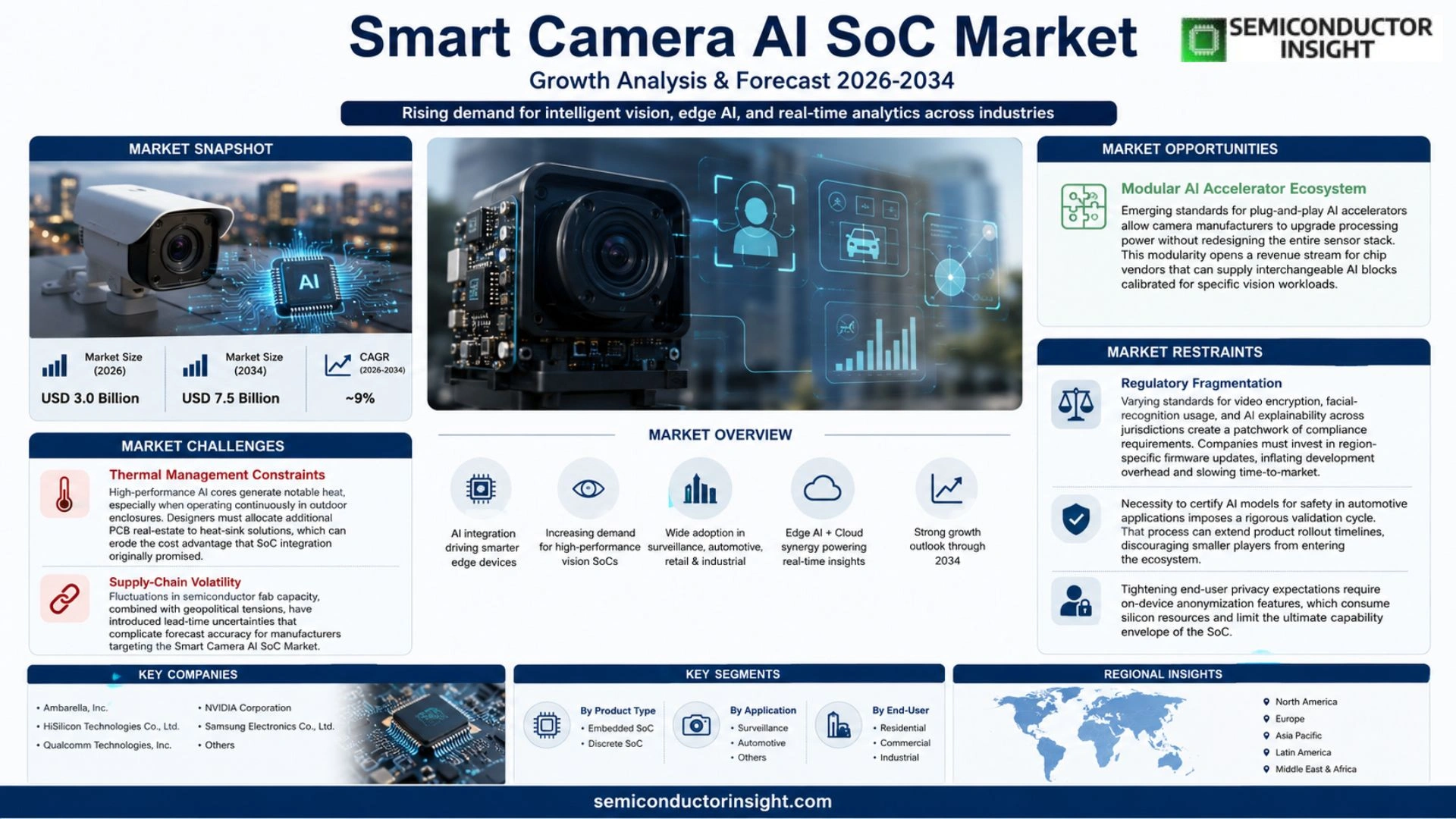
Global Smart Camera AI SoC market size was valued at USD 2.8 billion in 2025. The market will expand from USD 3.0 billion in 2026 to USD 7.5 billion by 2034, reflecting a CAGR of about 9 % during the forecast period.
Smart Camera AI System‑on‑Chip consolidates image sensor processing, neural‑network inference engines and connectivity functions onto a single silicon die, delivering real‑time video analytics, object detection and edge‑AI capabilities within compact camera modules.
The market is gaining momentum because device makers are embedding intelligence directly into cameras for security surveillance, retail footfall analysis and autonomous vehicle perception. At the same time, advances in low‑power semiconductor processes and heightened demand for on‑device privacy preservation are encouraging adoption. Leading vendors such as Ambarella, Himax Semiconductor, Sony Semiconductor Solutions and Qualcomm have introduced multiple generations of AI‑optimized SoCs throughout 2023–2024.
MARKET DRIVERS
Edge‑Computing Adoption Across Consumer Devices
The surge in on‑device processing for video streams has compelled OEMs to embed dedicated AI System‑on‑Chip (SoC) blocks. By eliminating reliance on cloud inference, manufacturers achieve lower latency, reduced bandwidth costs, and stronger data‑privacy guarantees,attributes that directly influence purchasing decisions for smart home cameras and wearables.
Automotive Vision Systems Expansion
Advanced driver‑assistance systems (ADAS) now require centimeter‑level object detection and classification in real time. Integrating Smart Camera AI SoC solutions enables automakers to meet safety‑critical performance thresholds while keeping silicon footprints modest, a combination that accelerates integration into new vehicle platforms.
➤ “Customers prioritize silicon that delivers 4‑K video analytics at under 2 W, because power budgets dictate product form factor and cost structure.”
Enterprise surveillance deployments are also reshaping spend patterns; enterprises favor AI‑enabled cameras that can perform analytics locally, reducing the need for expensive back‑haul infrastructure and simplifying compliance with regional data‑sovereignty regulations.
MARKET CHALLENGES
Thermal Management Constraints
High‑performance AI cores generate notable heat, especially when operating continuously in outdoor enclosures. Designers must allocate additional PCB real‑estate to heat‑sink solutions, which can erode the cost advantage that SoC integration originally promised.
Other Challenges
Supply‑Chain Volatility
Fluctuations in semiconductor fab capacity, combined with geopolitical tensions, have introduced lead‑time uncertainties that complicate forecast accuracy for manufacturers targeting Smart Camera AI SoC Market.
MARKET RESTRAINTS
Regulatory Fragmentation
Varying standards for video encryption, facial‑recognition usage, and AI explainability across jurisdictions create a patchwork of compliance requirements. Companies must invest in region‑specific firmware updates, inflating development overhead and slowing time‑to‑market.
Additionally, the necessity to certify AI models for safety in automotive applications imposes a rigorous validation cycle. That process can extend product rollout timelines, discouraging smaller players from entering the ecosystem.
Finally, end‑user privacy expectations are tightening, prompting manufacturers to embed on‑device anonymization features. While beneficial for consumer trust, these features consume silicon resources that could otherwise be allocated to performance, limiting the ultimate capability envelope of the SoC.
MARKET OPPORTUNITIES
Modular AI Accelerator Ecosystem
Emerging standards for plug‑and‑play AI accelerators allow camera manufacturers to upgrade processing power without redesigning the entire sensor stack. This modularity opens a revenue stream for chip vendors that can supply interchangeable AI blocks calibrated for specific vision workloads.
At the same time, the rise of edge‑AI marketplaces,where developers can purchase pre‑trained models optimized for Smart Camera AI SoC architectures,creates a virtuous cycle: richer model libraries drive hardware sales, and broader hardware adoption incentivizes further model development.
Healthcare imaging devices, particularly portable ultrasound and endoscopic cameras, are beginning to incorporate AI for real‑time anomaly detection. Targeting this niche with SoC solutions that satisfy stringent medical‑device regulations could yield a high‑margin growth segment within the broader market.
Smart Camera AI SoC Market Trends
Edge‑Centric Video Intelligence Consolidation
Smart Camera AI SoC Market is seeing a decisive shift toward single‑chip solutions that merge sensor front‑ends, neural inference engines and wireless interfaces. By collapsing these functions onto one die, manufacturers reduce board space, simplify thermal management and lower bill‑of‑materials costs. This architectural tightening aligns with the demand for real‑time object classification in surveillance hubs, retail traffic counters and vehicle perception units, where latency cannot be tolerated. Customers benefit from deterministic processing pipelines that avoid the jitter introduced by host‑offload architectures, thereby strengthening the business case for on‑camera AI deployment.
Other Trends
Low‑Power Semiconductor Process Evolution
Recent refinements in sub‑10 nm processes have lowered the energy envelope of AI kernels without sacrificing throughput. Chip designers can now run convolutional networks at fractions of a watt, making perpetual operation feasible for battery‑powered installations. The power advantage directly addresses the operating‑expense concerns of large‑scale surveillance networks, where thousands of nodes must remain functional for years with minimal maintenance. Vendors that integrate advanced power‑gating and dynamic voltage scaling into their SoC portfolios are positioning themselves as preferred partners for cost‑sensitive projects.
On‑Device Privacy and Data Sovereignty
Regulatory scrutiny over video analytics has accelerated the move to keep raw footage within the camera enclosure. When inference is performed locally, only abstracted insights,such as counts, alerts or anonymized heat maps,exit the device. This approach reduces exposure to data‑breach risks and satisfies compliance frameworks that restrict cross‑border data flows. Companies that embed secure enclaves and encrypted model storage into their Smart Camera AI SoC offerings can command premium pricing, as end‑users increasingly view privacy preservation as a competitive differentiator rather than a compliance checkbox.
COMPETITIVE LANDSCAPE
Key Industry Players
Smart Camera AI SoC Competitive Overview
Ambarella remains the most visible force in the smart‑camera AI SoC arena, leveraging its deep heritage in video compression and real‑time analytics to launch successive generations of the H series chips. The company’s ability to integrate a high‑efficiency neural‑network engine with advanced ISP pipelines has translated into a preferential position among security‑camera OEMs and automotive vision suppliers. Its pricing discipline and early‑stage ecosystem support,software libraries, reference designs, and a dedicated developer portal,have created a defensible market slice that newer entrants find difficult to erode. The broader competitive environment is marked by a tiered structure: a handful of tier‑one vendors dominate high‑volume, performance‑critical modules, while a broader set of midsize firms target cost‑sensitive or highly integrated applications such as retail foot‑traffic analysis and edge‑AI gateways. This stratification reflects divergent customer priorities around power envelope, latency, and integration depth.
Beyond Ambarella, a constellation of seasoned semiconductor players is reshaping the landscape. Himax Semiconductor and Sony Semiconductor Solutions have capitalised on their sensor expertise to bundle AI acceleration directly onto imaging chips, shortening bill‑of‑materials for compact cameras. Qualcomm’s Snapdragon Vision series and MediaTek’s Dimensity‑AI line are pushing the envelope on heterogeneous compute, appealing to device makers that favour a single‑chip solution for both connectivity and vision. Samsung Electronics and Intel are leveraging their advanced process nodes to deliver ultra‑low‑power cores that meet stringent automotive safety standards. NXP Semiconductors, Texas Instruments, ON Semiconductor, STMicroelectronics and Renesas Electronics each bring niche IP blocks,ranging from dedicated DSPs to secure enclaves,that allow system integrators to tailor functionality without licensing overhead. The varied portfolios illustrate a market that rewards both specialization and breadth, prompting partners to weigh integration convenience against performance optimisation.
List of Key Smart Camera AI SoC Companies Profiled
- Ambarella
- Himax Semiconductor
- Sony Semiconductor Solutions
- Qualcomm
- MediaTek
- Samsung Electronics
- Intel
- NXP Semiconductors
- Texas Instruments
- ON Semiconductor
- STMicroelectronics
- Renesas Electronics
Segment Analysis:
| Segment Category | Sub-Segments | Key Insights |
| By Type |
|
Edge AI SoCs are emerging as the dominant type because they combine high‑performance neural inference engines with ultra‑low power consumption, enabling real‑time analytics directly inside the camera.
|
| By Application |
|
Security Surveillance leads the application landscape as operators seek continuous, intelligent monitoring without reliance on cloud connectivity.
|
| By End User |
|
System Integrators emerge as the primary end‑user because they orchestrate complete smart‑camera solutions for diverse verticals.
|
| By Integration Level |
|
Fully Integrated SoC is gaining traction as manufacturers aim to shrink bill of materials and accelerate time‑to‑market.
|
| By Feature Set |
|
Advanced Neural Acceleration is the most compelling feature set, allowing sophisticated computer‑vision algorithms to execute at the edge without external compute resources.
|
Regional Analysis: Smart Camera AI SoC Market
North America
Chip designers are embedding heterogeneous compute blocks,GPU, DSP, and dedicated AI accelerators,into single SoCs, shortening latency for object detection and facial recognition. This integration supports high‑resolution streams while keeping thermal envelopes modest, a critical factor for indoor surveillance fixtures.
Retail analytics, smart‑city infrastructure, and automotive driver‑monitoring systems dominate procurement lists. Each segment values on‑device inference to reduce bandwidth costs, prompting vendors to tailor SDKs that align with vertical‑specific compliance requirements.
Foundries with advanced 5‑nm and 3‑nm nodes are favored for their ability to deliver high transistor density without compromising yield. Partnerships between fabless innovators and contract manufacturers have intensified, ensuring rapid time‑to‑market for next‑gen AI SoCs.
Privacy legislation such as CCPA shapes firmware design, pushing firms to embed edge‑processing that anonymizes data before transmission. Compliance teams work closely with silicon architects to embed encryption modules directly onto the chip.
Europe
European markets exhibit a nuanced blend of stringent data‑protection statutes and strong industrial automation traditions. Manufacturers in Germany and France prioritize modular SoC architectures that can be re‑programmed to comply with evolving GDPR‑related guidelines. This regulatory pressure fuels a demand for chips that support secure boot and on‑chip key management, prompting local vendors to differentiate through cryptographic robustness. Meanwhile, the region’s focus on smart‑city initiatives,particularly in traffic monitoring and public safety,creates a steady pipeline for AI‑enabled cameras that can process video streams without cloud dependence, thereby preserving citizen privacy while delivering actionable insights to municipal operators. The combined influence of policy and urban‑infrastructure investment sustains a resilient demand environment for sophisticated AI SoCs.
Asia‑Pacific
The Asia‑Pacific corridor is distinguished by rapid consumer‑electronics turnover and aggressive pricing strategies. Companies in China, South Korea, and Taiwan accelerate product cycles, integrating AI SoCs into cost‑sensitive devices such as handheld security cams and low‑budget home assistants. Although price pressure is intense, the region benefits from a deep manufacturing base that can scale volumes efficiently, allowing sophisticated AI features to appear at mass‑market price points. Additionally, governmental smart‑city programs across India and Southeast Asia are unlocking public‑sector procurement, emphasizing low‑power, high‑accuracy vision processors that can operate on constrained energy budgets. This dual thrust of consumer demand and public investment shapes a market that values both affordability and functional depth.
South America
In South America, adoption hinges on incremental upgrades to legacy surveillance infrastructure. Brazilian and Argentine firms are retrofitting existing camera networks with AI‑capable SoCs to introduce analytics such as crowd density estimation and anomaly detection. The emphasis is on plug‑and‑play solutions that minimize installation disruption, prompting vendors to design modular chipsets that can be swapped into older camera housings. Market participants also navigate fluctuating currency environments, favoring flexible licensing models that decouple hardware cost from software royalties. These dynamics encourage a focus on adaptable AI SoCs that deliver measurable security enhancements without imposing prohibitive capital expenditures.
Middle East & Africa
The Middle East & Africa region reflects a growing appetite for high‑security perimeter monitoring amid expanding oil‑and‑gas facilities and critical infrastructure projects. Deployments in the United Arab Emirates and Saudi Arabia highlight a preference for AI SoCs that can operate under harsh environmental conditions,high temperature tolerance and dust resistance are non‑negotiable. Simultaneously, African economies are leveraging AI‑enabled cameras to support smart‑agriculture initiatives, where on‑device inference enables early pest detection and yield forecasting. Vendors responding to these varied use cases emphasize ruggedized chip designs and low‑latency processing, ensuring that Smart Camera AI SoC Market delivers practical value across diverse operational contexts.
Report Scope
This market research report provides a comprehensive analysis of the Smart Camera AI SoC Market , covering the forecast period 2026–2034. It offers detailed insights into market dynamics, technological advancements, competitive landscape, and key trends shaping the industry.
Key focus areas of the report include:
- Market Overview: The report begins with an overview outlining its current market scenario, key growth indicators, and industry transformation drivers. It discusses macroeconomic factors, demand–supply balance, regulatory landscape, and the strategic role of semiconductors in powering advancements across industries such as automotive, telecommunications, consumer electronics, and industrial automation.
- Market Size & Forecast: Historical data and future projections for revenue, unit shipments, and market value across major regions and segments.
- Segmentation Analysis: Detailed breakdown by product type, technology, application, and end-user industry to identify high-growth segments and investment opportunities.
- Regional Insights: Insights into market performance across North America, Europe, Asia-Pacific, Latin America, and the Middle East & Africa, including country-level analysis where relevant.
- Competitive Landscape: Profiles of leading market participants, including their product offerings, R&D focus, manufacturing capacity, pricing strategies, and recent developments such as mergers, acquisitions, and partnerships.
- Technology Trends & Innovation: Assessment of emerging technologies, integration of AI/IoT, semiconductor design trends, fabrication techniques, and evolving industry standards.
- Market Drivers & Restraints: Evaluation of factors driving market growth along with challenges, supply chain constraints, regulatory issues, and market-entry barriers.
- Stakeholder Insights: Insights for component suppliers, OEMs, system integrators, investors, and policymakers regarding the evolving ecosystem and strategic opportunities.
Primary and secondary research methods are employed, including interviews with industry experts, data from verified sources, and real-time market intelligence to ensure the accuracy and reliability of the insights presented.
FREQUENTLY ASKED QUESTIONS:
What is the current market size of Smart Camera AI SoC Market?
-> Smart Camera AI SoC market size will expand from USD 3.0 billion in 2026 to USD 7.5 billion by 2034, reflecting a CAGR of about 9 %
Which key companies operate in Smart Camera AI SoC Market?
-> Key players include Ambarella, Himax Semiconductor, Sony Semiconductor Solutions, Qualcomm, among others.
What are the key growth drivers?
-> Key growth drivers include embedding AI directly into cameras, low‑power semiconductor advancements, demand for on‑device privacy, security surveillance, retail analytics, and autonomous vehicle perception.
Which region dominates the market?
-> Asia-Pacific is the fastest‑growing region, while North America remains a dominant market.
What are the emerging trends?
-> Emerging trends include edge‑AI processing, multi‑modal sensor fusion, and next‑generation low‑power AI‑optimized SoCs.

Get Sample Report PDF for Exclusive Insights
Report Sample Includes
- Table of Contents
- List of Tables & Figures
- Charts, Research Methodology, and more...
 Download Sample Report PDF