Smart Appliance Semiconductor Market Insights
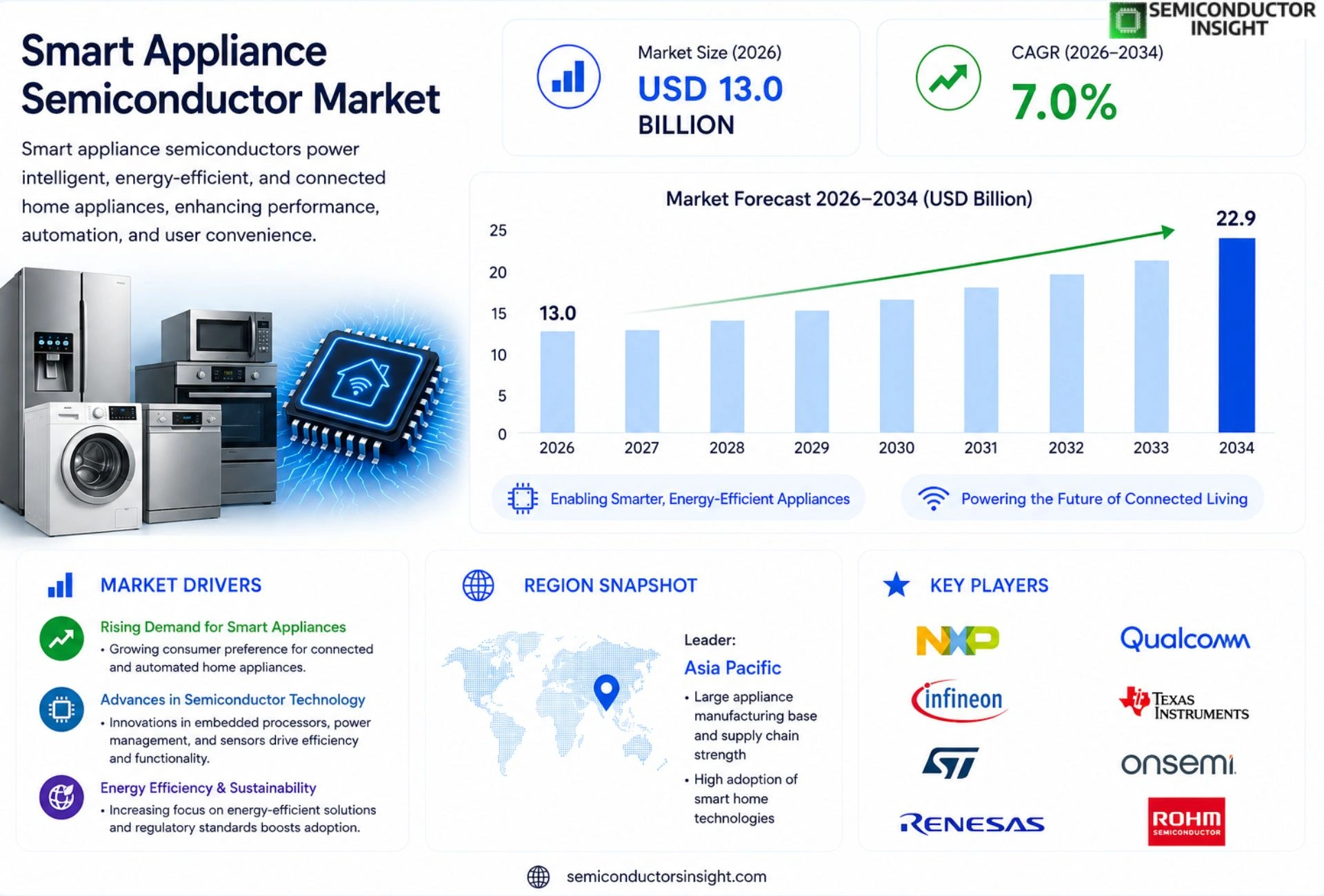
Global Smart Appliance Semiconductor Market size was valued at USD 12.3 billion in 2025. The market is projected to grow from USD 13.0 billion in 2026 to USD 22.9 billion by 2034, exhibiting a CAGR of 7.0% during the forecast period.
Smart appliance semiconductors are specialized integrated circuits that provide connectivity, power‑management, sensor fusion and on‑device artificial‑intelligence capabilities for household appliances such as refrigerators, washing machines, ovens and HVAC systems. These chips enable features like remote monitoring, predictive maintenance and energy‑optimization through Wi‑Fi, Bluetooth Low Energy or Thread communication stacks.
The market is experiencing rapid expansion because consumer demand for connected homes is accelerating, while stringent energy‑efficiency standards push manufacturers toward more intelligent control electronics. Furthermore, advances in edge‑AI processors reduce latency and enhance user experience, prompting OEMs to embed richer functionality directly into appliances. Key players,including NXP Semiconductors, Texas Instruments, STMicroelectronics and Renesas,are investing heavily in R&D and strategic partnerships to broaden their smart appliance semiconductor portfolios.
MARKET DRIVERS
Increasing Connectivity in Home Appliances
The rise of Internet‑of‑Things ecosystems has pushed manufacturers to embed more advanced semiconductor chips that enable real‑time communication, remote monitoring, and over‑the‑air updates. This trend fuels demand for Smart Appliance Semiconductor Market as consumers expect appliances that can be controlled via smartphones and voice assistants.
Energy‑Efficiency Demands
Stricter energy‑consumption standards and rising electricity costs are driving the need for low‑power, high‑performance semiconductor solutions. Designers are focusing on power‑management ICs that reduce standby draw while maintaining performance, directly supporting the growth of smart appliances.
➤ Industry analysts anticipate robust adoption of AI‑enabled semiconductors in smart appliances over the next five years.
Furthermore, the convergence of edge‑computing capabilities with sensor‑rich platforms creates new value propositions, encouraging OEMs to invest heavily in next‑generation chips tailored for Smart Appliance Semiconductor Market.
MARKET CHALLENGES
Complex Integration Requirements
Integrating diverse functionalities,connectivity, AI inference, and power management,into a single silicon package raises design complexity. Companies must balance performance, thermal constraints, and cost, which can extend development cycles.
Other Challenges
Supply Chain Volatility
Global shortages of silicon wafers and critical raw materials increase lead times and price pressure, making it difficult for manufacturers to maintain steady production volumes.
MARKET RESTRAINTS
Regulatory and Safety Standards
Stringent safety certifications for household electronics, along with regional electromagnetic compatibility (EMC) rules, add compliance costs and lengthen time‑to‑market for new semiconductor designs.
In addition, data‑privacy regulations governing the collection of usage patterns can limit the deployment of certain connectivity features, restraining the full potential of smart appliance solutions.
MARKET OPPORTUNITIES
Edge‑AI Integration
Embedding AI inference engines directly on appliance chips enables real‑time decision making without reliance on cloud latency. This creates opportunities for differentiated products that offer predictive maintenance and adaptive energy optimization.
Moreover, emerging form‑factor technologies such as system‑in‑package (SiP) and 3D‑stacked architectures provide pathways to increase functionality while minimizing board space, opening new market segments in compact smart devices.
Smart Appliance Semiconductor Market Trends
Rise of Connected Home Appliances
Smart Appliance Semiconductor Market is being reshaped by a surge in consumer interest for connected living spaces. Manufacturers are embedding communication stacks such as Wi‑Fi, Bluetooth Low Energy, and Thread into refrigerators, washing machines, ovens, and HVAC units to enable remote monitoring, predictive maintenance, and energy‑optimization. This shift is driven by tighter energy‑efficiency regulations that compel OEMs to adopt intelligent control electronics. As a result, the ecosystem is witnessing broader adoption of semiconductors that combine power‑management, sensor fusion, and on‑device intelligence, creating a more responsive and sustainable home environment.
Other Trends
Edge AI Integration
Edge‑AI processors are becoming a cornerstone of Smart Appliance Semiconductor Market, reducing latency and enhancing user experience by handling inference directly on the device. This capability allows appliances to execute real‑time analytics for load prediction, fault detection, and adaptive operation without relying on cloud connectivity. The availability of low‑power AI cores enables manufacturers to introduce richer feature sets while preserving energy budgets, aligning with both consumer expectations for instantaneous feedback and regulatory pressure for lower household energy consumption.
Strategic Partnerships and R&D Focus
Leading semiconductor firms,including NXP Semiconductors, Texas Instruments, STMicroelectronics, and Renesas,are intensifying R&D investments and forming strategic alliances with appliance makers. These collaborations aim to co‑develop reference designs, accelerate time‑to‑market, and ensure compatibility with emerging standards for smart home interoperability. Joint programs also address supply‑chain resilience and cost optimization, allowing OEMs to embed advanced functionality while maintaining competitive pricing structures. The cumulative effect is a more integrated value chain that sustains the upward momentum of Smart Appliance Semiconductor Market.
COMPETITIVE LANDSCAPE
Key Industry Players
Intense R&D Investment, Strategic Partnerships, and Portfolio Diversification Define the Competitive Dynamics of the Global Smart Appliance Semiconductor Market
The global Smart Appliance Semiconductor Market is characterized by the strong presence of established integrated device manufacturers and fabless semiconductor companies competing across connectivity, power management, microcontroller, and edge-AI processor segments. NXP Semiconductors holds a prominent position in this landscape, leveraging its broad portfolio of wireless microcontrollers and secure connectivity solutions tailored for connected home appliances. Texas Instruments reinforces its competitive standing through its extensive range of analog and embedded processing chips optimized for energy-efficient appliance control, while STMicroelectronics capitalizes on its STM32 microcontroller ecosystem to address smart appliance design requirements. Renesas Electronics continues to expand its footprint by integrating AI-capable microcontrollers and power management ICs into its smart home semiconductor offerings. These leading players collectively shape market pricing, technology benchmarks, and customer expectations, investing heavily in research and development as well as forging strategic OEM partnerships to sustain long-term competitive advantage in an environment where consumer demand for intelligent, energy-efficient household appliances is accelerating rapidly.
Beyond the dominant tier-one players, Smart Appliance Semiconductor Market also features a number of highly specialized and regionally significant companies contributing meaningful innovation. Infineon Technologies is recognized for its robust power semiconductors and security-enabled microcontrollers widely adopted in HVAC and white goods applications. Qualcomm advances the edge-AI dimension of smart appliances through its connectivity and on-device machine learning chipsets, while Nordic Semiconductor and Silicon Laboratories focus on ultra-low-power wireless connectivity solutions based on Bluetooth Low Energy, Zigbee, and Thread protocols essential for IoT-enabled home appliances. MediaTek and Espressif Systems have gained notable traction, particularly in cost-sensitive Asian markets, by offering highly integrated Wi-Fi and Bluetooth SoCs for smart appliance manufacturers. Microchip Technology and ON Semiconductor further diversify the competitive field with their microcontroller and power management portfolios, and Nuvoton Technology serves the market with purpose-built microcontrollers for home appliance control boards, collectively ensuring a competitive, innovation-driven ecosystem across the forecast period.
List of Key Smart Appliance Semiconductor Companies Profiled
- NXP Semiconductors
- Texas Instruments
- STMicroelectronics
- Renesas Electronics
- Infineon Technologies
- Qualcomm Incorporated
- Nordic Semiconductor
- Silicon Laboratories
- MediaTek Inc.
- Espressif Systems
- Microchip Technology
- ON Semiconductor (onsemi)
- Nuvoton Technology
- Broadcom Inc.
- Marvell Technology
Segment Analysis:
| Segment Category | Sub-Segments | Key Insights |
| By Type |
|
Connectivity Chips are the primary driver of market expansion.
|
| By Application |
|
Refrigeration leads application‑wise.
|
| By End User |
|
OEM Manufacturers dominate the end‑user landscape.
|
| By Connectivity Technology |
|
Wi‑Fi emerges as the leading connectivity choice.
|
| By Functional Capability |
|
Energy Management is the pivotal functional driver.
|
Regional Analysis: North America
United States
The demand for chips facilitating seamless connectivity – Wi-Fi, Bluetooth, Zigbee – remains a cornerstone of the Smart Appliance Semiconductor Market. This includes chips optimized for low power consumption and reliable communication within the home network.
Efficient power management is crucial for extending battery life in various smart appliance components and optimizing overall energy consumption. The market for power management ICs is experiencing substantial growth, driven by stricter energy efficiency standards.
The integration of a wide array of sensors – temperature, humidity, motion, pressure – is enabling smarter appliances with enhanced functionality and predictive capabilities. The Smart Appliance Semiconductor Market is heavily reliant on specialized sensors and the chips that process their data.
Robust embedded processors are the brains behind smart appliances, enabling sophisticated control logic, user interface management, and data processing. The demand for high-performance, low-power processors continues to be a key driver.
Europe
The European Smart Appliance Semiconductor Market is characterized by stringent environmental regulations and a strong focus on sustainable consumption. Germany, France, and the United Kingdom are key markets, with a growing consumer base embracing energy-efficient and connected home solutions. The region’s well-established industrial base and strong automotive semiconductor sector are contributing to advancements in appliance technology. The emphasis on data privacy and security is also shaping chip design and development within this region. Innovation in areas like predictive maintenance and smart energy management is gaining traction, further fueling the demand for advanced semiconductor solutions for the Smart Appliance Semiconductor Market.
Asia-Pacific
Asia-Pacific, spearheaded by China and Japan, represents the largest and fastest-growing market for Smart Appliance Semiconductor Market components. China’s rapidly expanding middle class and government initiatives promoting smart home adoption are driving significant demand. Japan, with its strong technological foundation and sophisticated manufacturing capabilities, is focused on developing high-end, energy-efficient appliances. The region’s dominance in consumer electronics manufacturing also creates a strong demand for chips used in smart appliances. The increasing adoption of AI and IoT technologies is further accelerating market growth. Competition among local and international players is intense, leading to continuous innovation and cost optimization within the Smart Appliance Semiconductor Market.
South America
The Smart Appliance Semiconductor Market in South America is an emerging market with significant growth potential. Brazil and Mexico are the leading markets, driven by increasing urbanization and rising disposable incomes. While adoption rates are currently lower than in North America and Europe, there is a growing awareness of energy efficiency and connected home benefits. The region presents opportunities for companies offering cost-effective semiconductor solutions tailored to the local market needs. Government policies aimed at promoting technological advancement and infrastructure development are expected to further stimulate growth within the Smart Appliance Semiconductor Market.
Middle East & Africa
The Smart Appliance Semiconductor Market in the Middle East and Africa is in its early stages of development but holds considerable long-term potential. Rapid urbanization, economic diversification, and increasing disposable incomes are driving demand for modern appliances. The region’s focus on smart cities and infrastructure projects is also creating opportunities for connected home solutions. The Smart Appliance Semiconductor Market is expected to witness significant growth as awareness of smart home technologies increases and affordability improves. Opportunities exist for companies providing tailored solutions for the specific needs of this diverse and developing region.
Report Scope
This market research report provides a comprehensive analysis of the Smart Appliance Semiconductor Market , covering the forecast period 2026–2034. It offers detailed insights into market dynamics, technological advancements, competitive landscape, and key trends shaping the industry.
Key focus areas of the report include:
- Market Overview: The report begins with an overview outlining its current market scenario, key growth indicators, and industry transformation drivers. It discusses macroeconomic factors, demand–supply balance, regulatory landscape, and the strategic role of semiconductors in powering advancements across industries such as automotive, telecommunications, consumer electronics, and industrial automation.
- Market Size & Forecast: Historical data and future projections for revenue, unit shipments, and market value across major regions and segments.
- Segmentation Analysis: Detailed breakdown by product type, technology, application, and end-user industry to identify high-growth segments and investment opportunities.
- Regional Insights: Insights into market performance across North America, Europe, Asia-Pacific, Latin America, and the Middle East & Africa, including country-level analysis where relevant.
- Competitive Landscape: Profiles of leading market participants, including their product offerings, R&D focus, manufacturing capacity, pricing strategies, and recent developments such as mergers, acquisitions, and partnerships.
- Technology Trends & Innovation: Assessment of emerging technologies, integration of AI/IoT, semiconductor design trends, fabrication techniques, and evolving industry standards.
- Market Drivers & Restraints: Evaluation of factors driving market growth along with challenges, supply chain constraints, regulatory issues, and market-entry barriers.
- Stakeholder Insights: Insights for component suppliers, OEMs, system integrators, investors, and policymakers regarding the evolving ecosystem and strategic opportunities.
Primary and secondary research methods are employed, including interviews with industry experts, data from verified sources, and real-time market intelligence to ensure the accuracy and reliability of the insights presented.
FREQUENTLY ASKED QUESTIONS:
What is the current market size of Smart Appliance Semiconductor Market?
-> Smart Appliance Semiconductor Market was valued at USD 12.3 billion in 2025 and is expected to reach USD 22.9 billion by 2034, representing a CAGR of 7.0%.
Which key companies operate Smart Appliance Semiconductor Market?
-> Key players include NXP Semiconductors, Texas Instruments, STMicroelectronics, and Renesas, among others.
What are the key growth drivers?
-> Key growth drivers include rising consumer demand for connected homes, stringent energy‑efficiency standards, and advances in edge‑AI processors that enable low‑latency intelligent control.
Which region dominates the market?
-> The market is globally distributed with significant activity in North America, Europe, and Asia‑Pacific, each contributing strongly to overall growth.
What are the emerging trends?
-> Emerging trends include integration of AI/IoT at the edge, adoption of Wi‑Fi, Bluetooth Low Energy and Thread communication stacks, and development of sensor‑fusion and power‑management semiconductors for smarter appliances.

Get Sample Report PDF for Exclusive Insights
Report Sample Includes
- Table of Contents
- List of Tables & Figures
- Charts, Research Methodology, and more...
 Download Sample Report PDF