
Smart Agriculture Semiconductor Market Insights
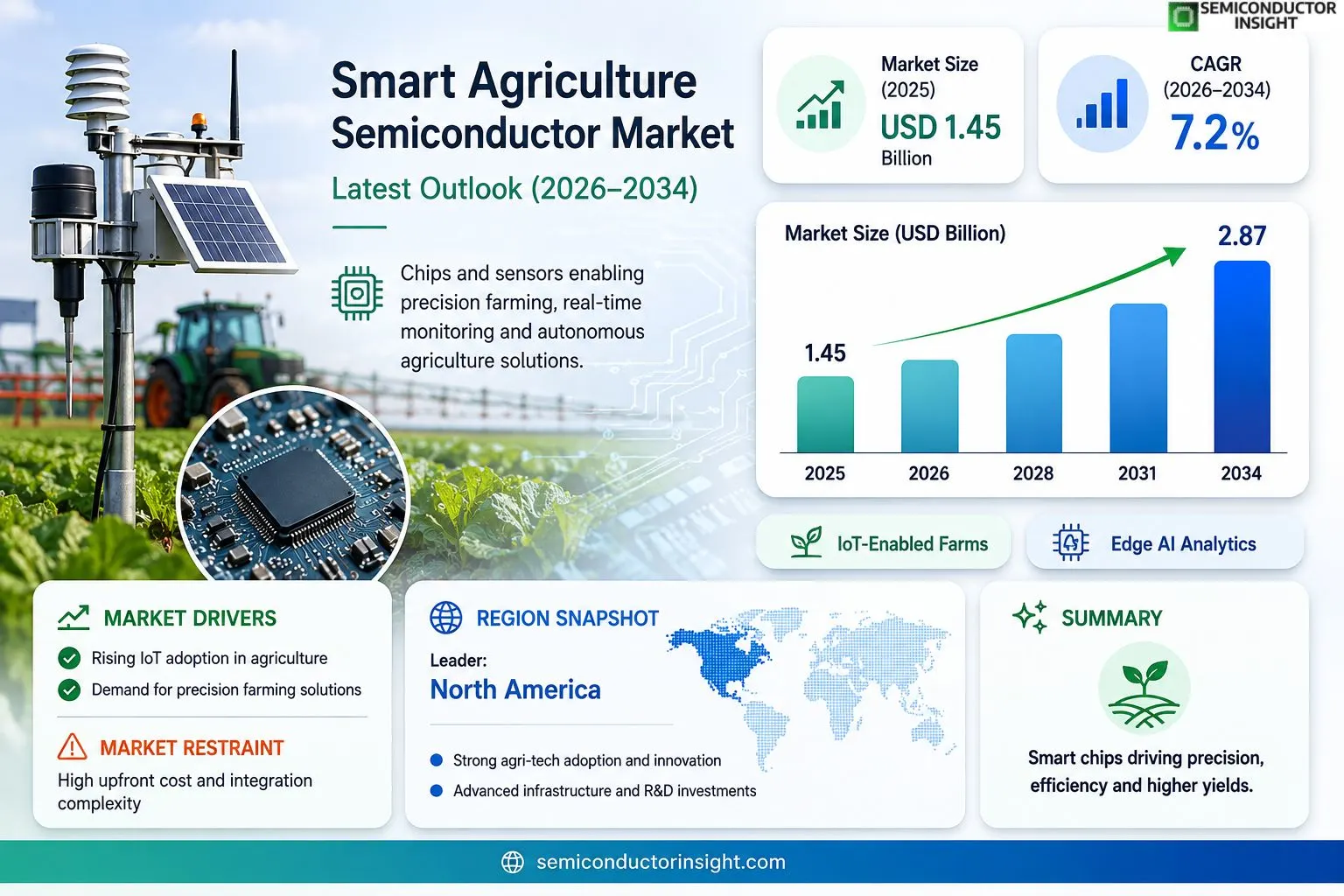
Global Smart Agriculture Semiconductor Market size was valued at USD 1.45 billion in 2025. The market is projected to grow from USD 1.55 billion in 2026 to USD 2.87 billion by 2034, exhibiting a CAGR of 7.2% during the forecast period.
Smart agriculture semiconductors comprise integrated circuits, sensors, micro‑controllers and communication modules that enable precision farming functions such as soil‑moisture detection, nutrient monitoring, autonomous equipment control and real‑time data transmission. These components translate environmental inputs into actionable insights for growers.The market is accelerating because of rising adoption of IoT‑enabled farms, government incentives for sustainable agriculture, and declining costs of sensor fabrication. Furthermore, advances in low‑power AI chips allow edge analytics on field devices, reducing latency and bandwidth needs. Key players,including STMicroelectronics, NXP Semiconductors, Texas Instruments and Bosch,are expanding their portfolios through strategic partnerships and dedicated R&D programs.
MARKET DRIVERS
Precision Farming Demand
Smart Agriculture Semiconductor Market is being propelled by a surge in precision farming practices, where growers rely on high‑resolution sensor data to optimize irrigation, fertilization, and pest control. This shift results in up to 30% higher yields while reducing resource waste, creating strong demand for advanced semiconductor‑based sensing solutions.
IoT and Connectivity Growth
Rapid adoption of IoT platforms in agriculture enables real‑time communication between field devices and cloud analytics. **Low‑power** semiconductor modules that support LoRa, NB‑IoT, and 5G are essential, driving manufacturers to invest heavily in next‑generation chipsets tailored for farm environments.
➤ “Smart sensors that combine AI inference at the edge dramatically reduce latency and improve decision accuracy for growers,” says an industry analyst.
Collectively, these drivers are establishing a robust ecosystem where **data‑driven agriculture** becomes the new norm, ensuring sustained growth for Smart Agriculture Semiconductor Market through 2030.
MARKET CHALLENGES
Integration Complexity
Farmers often operate with legacy equipment, making integration of new semiconductor solutions technically challenging. Compatibility issues between heterogeneous sensor protocols and existing farm management software can delay deployment and increase project timelines.
Other Challenges
High Capital Expenditure
The upfront investment required for deploying dense sensor networks and edge‑computing units remains a significant barrier, especially for small‑to‑medium farms that lack access to financing options.
MARKET RESTRAINTS
Regulatory and Standardization Barriers
Varying regional regulations on wireless spectrum use, data privacy, and agricultural chemical application create uncertainty for semiconductor vendors. The absence of unified standards for sensor interoperability hampers large‑scale adoption and escalates compliance costs.
MARKET OPPORTUNITIES
Emerging Economies Expansion
Rapid modernization of agriculture in regions such as Southeast Asia, Latin America, and Africa offers a sizable growth runway. Governments are incentivizing digital farming initiatives, and the increasing availability of affordable broadband creates fertile ground for semiconductor‑enabled smart farming solutions.
Smart Agriculture Semiconductor Market Trends
Rising Adoption of IoT‑Enabled Farming Solutions
Smart Agriculture Semiconductor Market is being reshaped by the accelerating deployment of IoT‑enabled farms worldwide. Integrated circuits, moisture and nutrient sensors, micro‑controllers, and wireless communication modules now form the backbone of precision agriculture platforms that translate field conditions into actionable data for growers. Declining fabrication costs for silicon‑based sensors, combined with supportive government policies aimed at enhancing food security and reducing environmental impact, have lowered barriers to entry for both large agribusinesses and smaller family farms. As a result, the sector is witnessing a shift from manual, labor‑intensive practices toward automated, data‑driven decision making that optimizes irrigation, fertilization, and pest management while conserving resources.
Other Trends
Edge‑AI Chip Integration
Advances in ultra‑low‑power AI chips are unlocking edge analytics capabilities directly on field‑deployed devices. By embedding neural‑network inference engines within micro‑controllers, sensors can process raw data streams in real time, delivering instant insights on soil moisture gradients, crop health indices, and micro‑climate variations. This on‑device processing reduces reliance on cellular or satellite back‑haul, minimizes latency, and curtails bandwidth consumption,critical advantages for remote or connectivity‑constrained farms. Moreover, the ability to execute predictive algorithms at the edge enables proactive interventions, such as automatically adjusting irrigation schedules or triggering localized nutrient delivery, thereby improving yield consistency and reducing waste.
Strategic Partnerships and Portfolio Expansion
Leading semiconductor manufacturers,including STMicroelectronics, NXP Semiconductors, Texas Instruments, and Bosch,are intensifying collaboration with agritech solution providers, research institutions, and regional technology incubators. These partnerships foster co‑development of custom‑tuned sensor arrays, ruggedized communication modules, and application‑specific integrated circuits that address diverse crop cycles and climatic zones. Simultaneously, manufacturers are expanding their product portfolios to encompass complete smart‑farm ecosystems that integrate sensing, edge processing, and cloud connectivity under unified management platforms. This strategic alignment accelerates time‑to‑market for innovative farming solutions, strengthens competitive positioning, and reinforces the overall trajectory of Smart Agriculture Semiconductor Market toward broader adoption and sustained technological advancement.
COMPETITIVE LANDSCAPEKey Industry Players
Smart Agriculture Semiconductor Market Overview
Smart Agriculture Semiconductor Market is anchored by STMicroelectronics, which leverages a broad portfolio of low‑power MCUs, mixed‑signal sensor ICs, and AI‑enabled edge processors to capture a leading share of precision‑farming deployments. Its strategic acquisitions in AI chip design and deep collaborations with major ag‑equipment OEMs reinforce its market dominance. NXP Semiconductors and Texas Instruments follow closely, each supplying robust IoT connectivity stacks, analog front‑ends, and reliable power‑management solutions that underpin large‑scale field sensor networks. Bosch adds considerable weight through its extensive sensor expertise and long‑standing relationships with agricultural machinery manufacturers, positioning the company as a key integrator of multi‑modal data acquisition systems.Beyond the headline leaders, a constellation of niche innovators widens the competitive landscape. Infineon Technologies concentrates on ruggedized power‑management ICs and high‑precision magnetic sensors for autonomous tractors. Renesas Electronics adapts its automotive‑grade micro‑controllers for harsh field conditions, while Analog Devices delivers ultra‑high‑resolution ADCs critical for soil‑moisture and nutrient analytics. ON Semiconductor supplies imaging sensors that enable drone‑based crop scouting, and Microchip Technology provides affordable, scalable connectivity modules. AMS AG contributes optical sensor platforms for real‑time nutrient detection, Qualcomm fuels remote telemetry with cellular‑IoT chipsets, and ROHM Semiconductor offers precision voltage regulators that ensure reliable operation of edge devices under variable environmental loads.
List of Key Smart Agriculture Semiconductor Companies Profiled
- STMicroelectronics
- NXP Semiconductors
- Texas Instruments
- Bosch
- Infineon Technologies
- Renesas Electronics
- Analog Devices
- ON Semiconductor
- Microchip Technology
- AMS AG
- Qualcomm
- ROHM Semiconductor
Segment Analysis:
| Segment Category | Sub-Segments | Key Insights |
| By Type |
|
Sensors
|
| By Application |
|
Precision Irrigation
|
| By End User |
|
Large‑Scale Farms
|
| By Connectivity |
|
LPWAN
|
| By Power Management |
|
Energy Harvesting Solutions
|
Regional Analysis: North America
United States
The deployment of advanced sensors is central to the growth of Smart Agriculture Semiconductor Market in the US. These sensors collect crucial data on soil conditions, weather patterns, crop health, and livestock behavior, providing farmers with real-time insights. Innovations in sensor design are leading to increased accuracy, durability, and cost-effectiveness.
The ability to analyze the vast amounts of data generated by sensors is paramount. Artificial intelligence (AI) and machine learning (ML) algorithms are being increasingly integrated to extract meaningful insights, predict potential problems, and automate farming tasks, enhancing Smart Agriculture Semiconductor Market.
Robust connectivity solutions, including cellular, satellite, and low-power wide-area networks (LPWAN), are essential for transmitting data from remote farms to central processing units. The Internet of Things (IoT) plays a critical role in connecting various agricultural devices and systems.
Semiconductors are enabling the development of precision irrigation systems that deliver water and nutrients only where and when they are needed. Automation technologies, driven by semiconductor-based controllers and actuators, are streamlining various farming processes.
North America
The North American Smart Agriculture Semiconductor Market is characterized by a mature agricultural infrastructure and a strong adoption rate of advanced technologies. The region benefits from significant government support for agricultural innovation and a well-established ecosystem of agricultural equipment manufacturers and technology providers. The focus is on improving operational efficiency, minimizing environmental impact, and enhancing the sustainability of farming practices.
Europe
Europe presents a dynamic market for Smart Agriculture Semiconductors, with a strong emphasis on sustainable farming and food security. Driven by stringent environmental regulations and a growing consumer demand for sustainably produced food, European farmers are increasingly adopting precision agriculture solutions. The market is witnessing a surge in the development of energy-efficient sensors, smart irrigation systems, and robotic harvesting technologies.
Asia-Pacific
Asia-Pacific is poised for significant growth in Smart Agriculture Semiconductor Market, driven by the region’s vast agricultural land, increasing population, and rising demand for food. The adoption of smart farming technologies is gaining momentum, particularly in countries like China and India. The market is focused on developing affordable and scalable solutions tailored to the needs of smallholder farmers.
South America
South America is experiencing a growing interest in Smart Agriculture Semiconductors, driven by the need to improve crop yields and optimize resource utilization in its expansive agricultural lands. The region is witnessing the adoption of precision irrigation, soil monitoring, and drone-based crop health assessment technologies.
Middle East & Africa
The Middle East & Africa represents an emerging market for Smart Agriculture Semiconductors, with significant potential for growth. The region faces challenges related to water scarcity and climate change, driving the adoption of water-efficient irrigation solutions and drought-resistant crop varieties.
Report Scope
This market research report provides a comprehensive analysis of the Smart Agriculture Semiconductor Market , covering the forecast period 2026–2034. It offers detailed insights into market dynamics, technological advancements, competitive landscape, and key trends shaping the industry.
Key focus areas of the report include:
-
Market Overview: The report begins with an overview outlining its current market scenario, key growth indicators, and industry transformation drivers. It discusses macroeconomic factors, demand–supply balance, regulatory landscape, and the strategic role of semiconductors in powering advancements across industries such as automotive, telecommunications, consumer electronics, and industrial automation.
- Market Size & Forecast: Historical data and future projections for revenue, unit shipments, and market value across major regions and segments.
- Segmentation Analysis: Detailed breakdown by product type, technology, application, and end-user industry to identify high-growth segments and investment opportunities.
- Regional Insights: Insights into market performance across North America, Europe, Asia-Pacific, Latin America, and the Middle East & Africa, including country-level analysis where relevant.
- Competitive Landscape: Profiles of leading market participants, including their product offerings, R&D focus, manufacturing capacity, pricing strategies, and recent developments such as mergers, acquisitions, and partnerships.
- Technology Trends & Innovation: Assessment of emerging technologies, integration of AI/IoT, semiconductor design trends, fabrication techniques, and evolving industry standards.
- Market Drivers & Restraints: Evaluation of factors driving market growth along with challenges, supply chain constraints, regulatory issues, and market-entry barriers.
- Stakeholder Insights: Insights for component suppliers, OEMs, system integrators, investors, and policymakers regarding the evolving ecosystem and strategic opportunities.
Primary and secondary research methods are employed, including interviews with industry experts, data from verified sources, and real-time market intelligence to ensure the accuracy and reliability of the insights presented.
FREQUENTLY ASKED QUESTIONS:
What is the current market size of Smart Agriculture Semiconductor Market?
-> Smart Agriculture Semiconductor Market was valued at USD 1.45 billion in 2025 and is expected to reach USD 2.87 billion by 2034, representing a CAGR of 7.2 % over the forecast period.
Which key companies operate in Smart Agriculture Semiconductor Market?
-> Key players include STMicroelectronics, NXP Semiconductors, Texas Instruments, and Bosch, among others.
What are the key growth drivers?
-> Key growth drivers include rising adoption of IoT‑enabled farms, government incentives for sustainable agriculture, declining costs of sensor fabrication, and advances in low‑power AI chips that enable edge analytics.
Which region dominates the market?
-> The reference material provides a global overview and does not specify a single dominant region.
What are the emerging trends?
-> Emerging trends include integration of low‑power AI chips for edge analytics, expanded IoT connectivity in precision farming, and the development of advanced sensor technologies for real‑time agricultural monitoring.

Get Sample Report PDF for Exclusive Insights
Report Sample Includes
- Table of Contents
- List of Tables & Figures
- Charts, Research Methodology, and more...
 Download Sample Report PDF


