Small Pitch LED Screen Market Insights
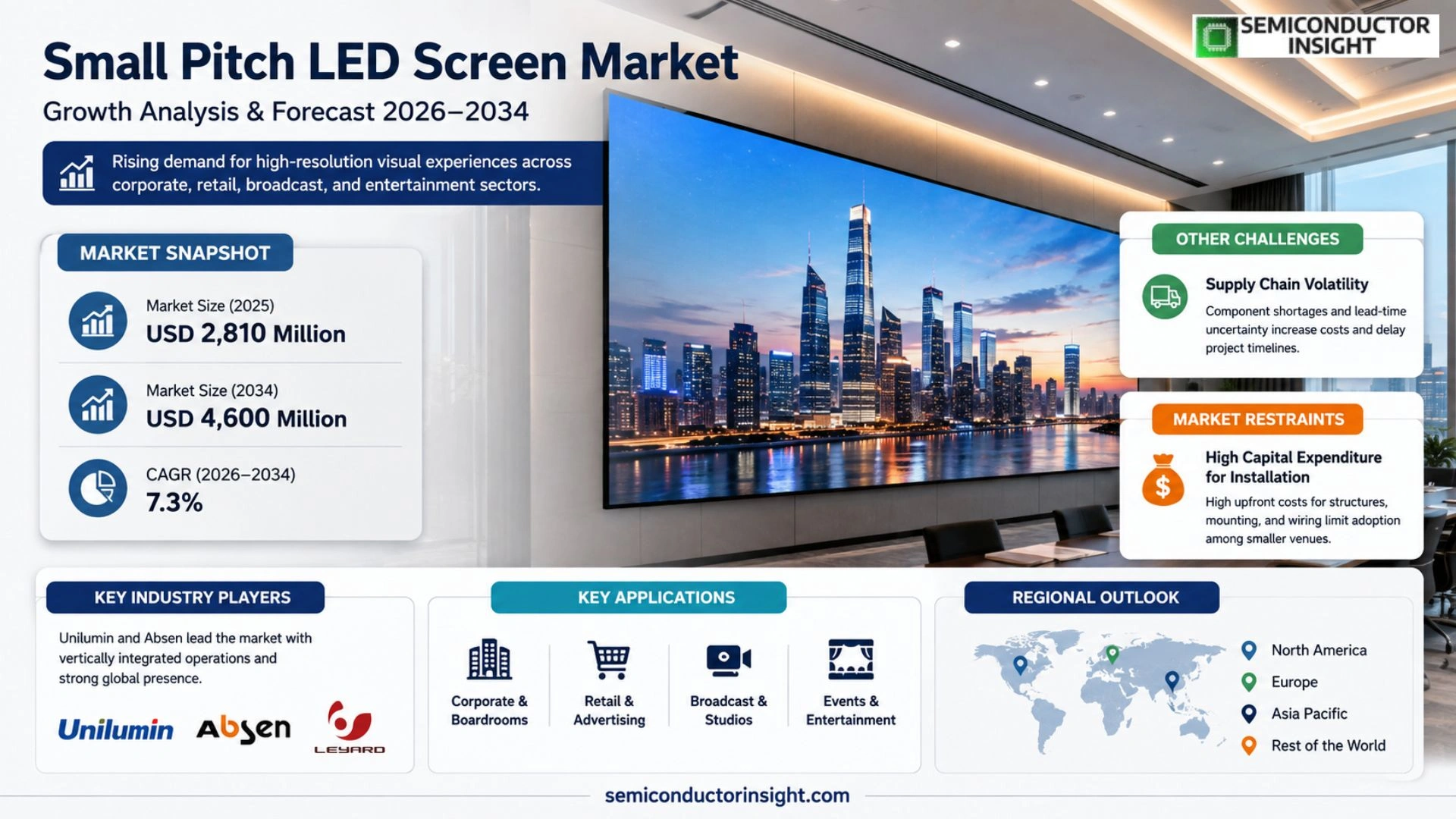
Small Pitch LED Screen market size was valued at USD 2,810 million in 2025 and is projected to reach USD 4,600 million by 2034, exhibiting a CAGR of approximately 7.3 % during the forecast period.
A small‑pitch LED screen is a direct‑view display system typically P2.5 mm pixel pitch or finer,commonly P0.9, P1 2, P1 5 or P1 8,integrating modular cabinets, driver & control electronics, power supplies and mechanical frames for close‑view indoor UHD video walls such as control rooms, corporate meeting spaces and broadcast studios.
The market gains momentum because enterprises demand higher brightness, tighter colour uniformity and seamless scalability that replace LCD walls; meanwhile advances in SMD/IMD/COB chip packaging and low‑latency control platforms lower total cost of ownership while expanding application scope.
MARKET DRIVERS
Rising Demand for Ultra‑High‑Resolution Displays
Small Pitch LED Screen Market benefits from broadcasters and stadium operators seeking pixel‑dense panels that deliver crystal‑clear images at close viewing distances. As audiences increasingly expect cinema‑grade visuals in live venues, owners are upgrading legacy signage with fine‑pitch modules that preserve image fidelity even when spectators sit just a few feet away. This shift translates into larger contract values and quicker adoption cycles across Europe and North America.
Cost Reductions in LED Manufacturing
Advances in chip‑on‑board (COB) technology and the consolidation of wafer suppliers have trimmed per‑unit costs for high‑density LEDs. Manufacturers now achieve yields above 95%, allowing them to price small‑pitch panels competitively against traditional LCD arrays. The resulting margin compression for end‑users is offset by longer service lives and lower power consumption, encouraging capital‑intensive adopters to proceed with confidence.
➤ Industry observers note that projects incorporating sub‑10 mm pitch panels routinely achieve a 12 % reduction in total ownership cost when lifecycle energy savings are accounted for.
Because the technology is maturing, system integrators are able to offer turnkey solutions that bundle hardware, software, and warranty services into a single contract. This bundled approach simplifies procurement for venues and reduces the perceived risk associated with deploying dense LED arrays.
MARKET CHALLENGES
Technical Complexity of Tight Pitch Integration
Designing modules with a pitch below 2 mm demands precise thermal management and meticulous calibration of color balance across thousands of LEDs. Small variations in board layout can produce hotspot formation, which in turn forces installers to adopt more elaborate cooling structures. The technical rigor required raises labor costs and lengthens project timelines.
Other Challenges
Supply Chain Volatility
Fluctuations in semiconductor availability, especially for high‑brightness blue chips, have introduced lead‑time uncertainty for manufacturers. When component scarcity spikes, vendors often pass the premium onto customers, squeezing project budgets and prompting some buyers to postpone upgrades.
The necessity for specialized installation crews further narrows the pool of qualified providers. As a result, many end‑users experience delays in accessing skilled labor, which can erode the competitive advantage of early‑stage adopters.
MARKET RESTRAINTS
High Capital Expenditure for Installation
Deploying fine‑pitch LED systems often requires reinforced mounting structures, custom scaffolding, and extensive wiring runs. The upfront outlay can exceed $1.5 million for a mid‑size arena, a figure that eclipses the budget of many smaller venues. This financial barrier limits adoption to organizations with deep cash reserves or access to favorable financing.
Moreover, the need for periodic calibration and firmware updates adds recurring operational expenses that some operators deem prohibitive, especially when alternative display technologies offer lower entry costs.
MARKET OPPORTUNITIES
Expansion into Interactive Retail Environments
Retail chains are experimenting with immersive windows that combine sub‑5 mm pitch LED panels with touch‑sensing overlays. These installations enable shoppers to interact directly with high‑resolution content, driving dwell time and conversion rates. Early pilots in flagship stores have reported a 20 % uplift in foot traffic during promotional periods.
In parallel, the rise of edge‑computing platforms that process video streams locally creates a pathway for real‑time personalization. By linking small‑pitch screens with customer data feeds, brands can deliver hyper‑targeted advertising that adapts instantly to demographic cues, unlocking a new revenue stream for display owners.
Small Pitch LED Screen Market Trends
Shift Toward Integrated Display Solutions
The indoor display segment is witnessing a decisive move away from isolated panel sales toward full‑system contracts. End users such as control rooms and virtual‑production studios now evaluate proposals based on total uptime, calibration turnaround, and software interoperability rather than pure hardware cost. This shift is fueled by the growing complexity of UHD content pipelines, where pixel‑level uniformity and low‑latency mapping become decisive. Suppliers that bundle LED modules with proprietary control platforms, remote diagnostics, and on‑site service teams are capturing a larger share of project budgets, because clients perceive reduced risk and clearer ROI on the integrated offering.
Other Trends
Supply‑Chain Consolidation and Component Innovation
Upstream manufacturers are converging around a limited set of high‑performance chip architectures, notably IMD and COB formats that deliver deeper blacks and tighter thermal envelopes. The migration from traditional SMD packages reflects a response to two pressures: the need for slimmer panel profiles in premium installations, and the demand for improved durability in mission‑critical environments. As a result, component suppliers are forming strategic alliances with module assemblers, ensuring a steady flow of calibrated, test‑passed units and shaving lead‑times for large‑scale orders. This tighter integration also allows downstream integrators to promise stricter performance guarantees, which is increasingly important for broadcast and XR applications that depend on camera‑friendly displays.
Emerging Service‑Oriented Business Models
While the core technology stabilizes, revenue growth is now being driven by service contracts that extend beyond installation. Leasing arrangements, performance‑based maintenance, and upgrade‑as‑a‑service packages are gaining traction, especially in regions where capital‑expenditure cycles are lengthening. Providers that can combine real‑time monitoring dashboards with predictive failure analytics are differentiating themselves, because they help clients avoid costly downtime in command centers and live‑event venues. This evolution toward a solution‑as‑service paradigm reshapes the competitive landscape: success hinges less on raw manufacturing capacity and more on the ability to deliver end‑to‑end lifecycle value.
COMPETITIVE LANDSCAPE
Key Industry Players
Small Pitch LED Screen Market – Competitive Overview
Among the global producers, a handful of firms dominate the upstream‑to‑downstream value chain. Unilumin and Absen, both headquartered in China, have leveraged vertically integrated operations to secure a commanding share of module and cabinet production. Their ability to co‑source SMD and emerging COB packages, coupled with in‑house thermal‑design expertise, enables rapid rollout of P1.2‑P1.5 panels for control‑room installations. Leyard, with a strong foothold in North America and Europe, differentiates through proprietary calibration software that meets stringent broadcast‑camera requirements, allowing it to command premium pricing in mission‑critical projects. Liantronics and Daktronics round out the top tier by offering end‑to‑end design‑build services, from power‑supply engineering to lifecycle maintenance contracts, which appeals to corporate and venue customers seeking single‑source responsibility. This concentration around a few vertically capable players forces smaller manufacturers to specialize or partner with system integrators to remain viable.
Beyond the marquee names, a vibrant cohort of niche innovators enriches the competitive landscape. InFiLED and LEDMAN focus on ultra‑fine P0.9‑P1.2 modules, targeting premium broadcast studios and virtual‑production studios where colour uniformity and low‑flicker performance are decisive. LightKing and AOTO have built reputations around compact, low‑profile cabinet designs that cater to retail flagship stores demanding seamless wall‑to‑wall aesthetics. Shenzhen Gloshine Technology and Shenzhen Mightary LED concentrate on ruggedised solutions for public‑transport environments, emphasizing dust‑proof encapsulation and extended MTBF ratings. Showtechled and other regional players provide cost‑effective SMD‑based systems for emerging markets, leveraging mature supply chains to keep per‑square‑meter pricing competitive. Their emphasis on modular service kits and rapid on‑site replacement positions them well for contracts where uptime is a contractual metric.
List of Key Small Pitch LED Screen Companies Profiled
- Unilumin
- Absen
- Leyard
- Daktronics
- Liantronics
- InFiLED
- LEDMAN
- LightKing
- AOTO
- Shenzhen Gloshine Technology
- Shenzhen Mightary LED
- Showtechled
Segment Analysis:
| Segment Category | Sub-Segments | Key Insights |
| By Type |
|
P1.2‑P1.5 dominates the market due to its balanced pixel density and cost efficiency.
|
| By Application |
|
Indoor UHD video walls are the leading application, driving ecosystem evolution.
|
| By End User |
|
Broadcast & virtual production leads due to stringent visual performance requirements.
|
| By Integration Level |
|
Full‑system turnkey solutions are gaining traction across high‑value projects.
|
| By Technology Architecture |
|
COB architecture is emerging as the preferred choice for mission‑critical installations.
|
Regional Analysis: Small Pitch LED Screen Market
North America
Large corporations are integrating Small Pitch LED screens into command centers and digital signage networks to convey granular visual data with crisp clarity. The shift from conventional LCD walls reflects a strategic move toward solutions that can scale across varied indoor lighting conditions while maintaining consistent color performance.
Stadiums and arenas are allocating capital to retrofit premium seating zones with ultra‑high‑resolution panels that deliver near‑HD quality at close viewing distances. This approach enhances fan engagement and unlocks new revenue streams through dynamic advertising and interactive experiences.
Flagship stores are deploying Small Pitch LED facades that act as both visual merchandising tools and data collection points. The seamless blend of high‑definition imagery with analytics platforms supports real‑time content personalization based on foot traffic patterns.
A robust network of component manufacturers, software vendors, and specialized integrators in the United States and Canada accelerates the rollout of next‑gen modules, ensuring that product cycles remain short and responsive to emerging design trends.
Europe
European markets exhibit a cautious yet forward‑looking attitude toward Small Pitch LED installations. Regulatory standards around energy efficiency and outdoor brightness levels shape product specifications, encouraging manufacturers to innovate around lower power consumption without compromising pixel density. Cultural venues such as museums and theaters are pioneering the use of ultra‑fine panels to recreate artwork and performances with unprecedented detail, creating a niche that influences broader adoption. At the same time, cross‑border collaborations within the EU foster shared R&D initiatives, reducing time to market for emerging technologies and reinforcing the region’s reputation as a design hub.
Asia‑Pacific
In Asia‑Pacific, rapid urbanization and a surge in mega‑events drive demand for immersive visual solutions. While price sensitivity remains a factor, leading economies are investing in high‑spec installations for public spaces, transportation hubs, and large‑scale concerts. The competitive landscape is marked by aggressive pricing strategies from local manufacturers who simultaneously push the envelope on pixel pitch reductions. Consequently, buyers benefit from a broader choice set, but must navigate varying quality benchmarks, making the role of experienced system integrators increasingly important.
South America
South American adopters are focusing on flagship projects that showcase technological leadership, particularly in capital cities where tourism and entertainment sectors intersect. The market’s growth is tempered by economic volatility, yet public‑private partnerships are emerging to fund premium installations in arenas and cultural centers. These collaborations often emphasize modular designs that allow incremental upgrades, reflecting a pragmatic approach to balancing ambition with fiscal constraints.
Middle East & Africa
The Middle East & Africa region is distinguished by a concentration of high‑visibility projects in luxury hospitality and “smart city” initiatives. Investment decisions are heavily influenced by the desire to project a modern image, prompting developers to opt for Small Pitch LED screens that deliver striking visual impact in both indoor lounges and outdoor promenades. In Africa, selective deployments in major metros serve as proof points for the technology’s versatility, paving the way for future expansions as infrastructure matures.
Report Scope
This market research report provides a comprehensive analysis of the Small Pitch LED Screen Market , covering the forecast period 2026–2034. It offers detailed insights into market dynamics, technological advancements, competitive landscape, and key trends shaping the industry.
Key focus areas of the report include:
- Market Overview: The report begins with an overview outlining its current market scenario, key growth indicators, and industry transformation drivers. It discusses macroeconomic factors, demand–supply balance, regulatory landscape, and the strategic role of semiconductors in powering advancements across industries such as automotive, telecommunications, consumer electronics, and industrial automation.
- Market Size & Forecast: Historical data and future projections for revenue, unit shipments, and market value across major regions and segments.
- Segmentation Analysis: Detailed breakdown by product type, technology, application, and end-user industry to identify high-growth segments and investment opportunities.
- Regional Insights: Insights into market performance across North America, Europe, Asia-Pacific, Latin America, and the Middle East & Africa, including country-level analysis where relevant.
- Competitive Landscape: Profiles of leading market participants, including their product offerings, R&D focus, manufacturing capacity, pricing strategies, and recent developments such as mergers, acquisitions, and partnerships.
- Technology Trends & Innovation: Assessment of emerging technologies, integration of AI/IoT, semiconductor design trends, fabrication techniques, and evolving industry standards.
- Market Drivers & Restraints: Evaluation of factors driving market growth along with challenges, supply chain constraints, regulatory issues, and market-entry barriers.
- Stakeholder Insights: Insights for component suppliers, OEMs, system integrators, investors, and policymakers regarding the evolving ecosystem and strategic opportunities.
Primary and secondary research methods are employed, including interviews with industry experts, data from verified sources, and real-time market intelligence to ensure the accuracy and reliability of the insights presented.
FREQUENTLY ASKED QUESTIONS:
What is the current market size of Small Pitch LED Screen Market?
-> Small Pitch LED Screen market is projected to reach USD 4,600 million by 2034, exhibiting a CAGR of approximately 7.3 % during the forecast period.
Which key companies operate in Small Pitch LED Screen Market?
-> Key players include Unilumin, Absen, DICOLOR GROUP, Shenzhen Gloshine Technology, INFiLED, Leyard, Liantronics, Daktronics, Sansitech, Ledman, LightKing, AOTO, Shenzhen Mightary LED, Showtechled, Shenzhen Eager, YES TECH, LCF-LED, among others.
What are the key growth drivers?
-> Key growth drivers include rising demand for indoor UHD video walls in control rooms, broadcast studios, and corporate collaboration spaces; need for high‑resolution, camera‑friendly displays in virtual production and XR; increasing adoption in premium retail and digital signage; and continued price‑performance improvements of fine‑pitch LED technologies.
Which region dominates the market?
-> Asia‑Pacific leads manufacturing capacity, ecosystem completeness, and downstream integration services, making it the dominant region, while North America and Europe drive high‑end deployment standards.
What are the emerging trends?
-> Emerging trends include transition from conventional SMD to IMD and COB architectures, enhanced surface encapsulation for durability, higher integration of control and driving electronics, and increasing focus on camera‑friendliness, low flicker, and real‑time color consistency for broadcast and virtual production applications.

Get Sample Report PDF for Exclusive Insights
Report Sample Includes
- Table of Contents
- List of Tables & Figures
- Charts, Research Methodology, and more...