MARKET INSIGHTS
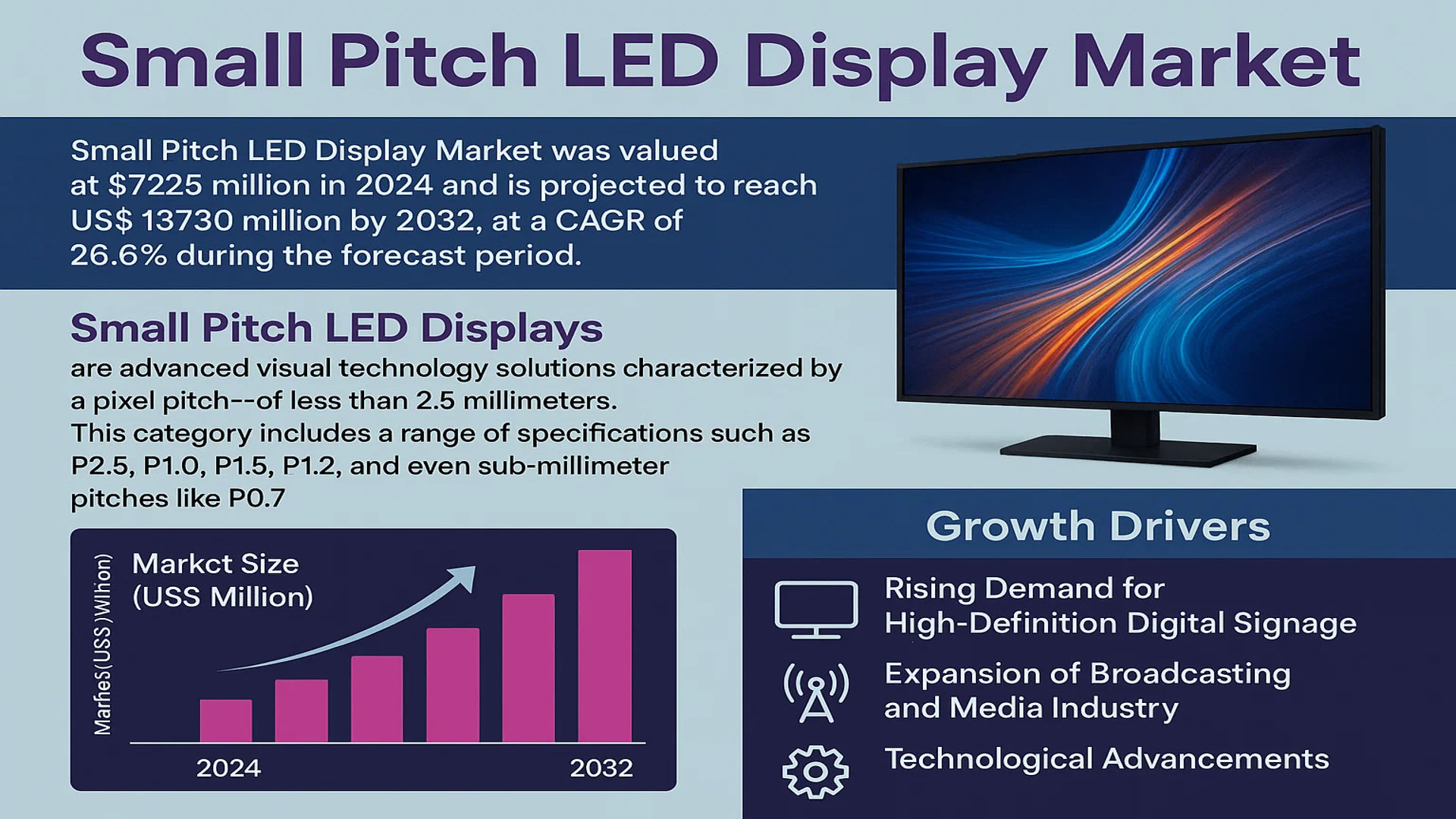
The global Small Pitch LED Display Market was valued at 2725 million in 2024 and is projected to reach US$ 13730 million by 2032, at a CAGR of 26.6% during the forecast period.
Small Pitch LED Displays are advanced visual technology solutions characterized by a pixel pitch—the distance between the centers of two adjacent pixels—of less than 2.5 millimeters. This category includes a range of specifications such as P2.5, P2.0, P1.8, P1.5, P1.2, P1.0, and even sub-millimeter pitches like P0.7. These displays are engineered to deliver exceptionally high-resolution imagery with superior color uniformity and wide viewing angles, making them ideal for applications where image clarity and seamless integration are paramount.
The market is experiencing explosive growth driven by several key factors, including the rising demand for high-definition digital signage in retail and corporate environments, the rapid expansion of the broadcasting and media industry, and significant technological advancements that have improved performance while reducing costs. Furthermore, the increasing adoption in control rooms for critical data visualization and in public spaces like museums and transportation hubs is contributing to market expansion. The competitive landscape is concentrated, with the top 10 players, including Leyard, Unilumin, and Samsung, collectively holding approximately 79% of the market share, indicating a highly competitive yet consolidated industry structure.
MARKET DYNAMICS
MARKET DRIVERS
Growing Demand for High-Resolution Visual Experiences to Drive Market Expansion
The global small pitch LED display market is experiencing robust growth driven by increasing consumer and commercial demand for superior visual experiences. As pixel pitches decrease below 2.5mm, these displays deliver exceptional image quality with higher pixel density, making them ideal for applications requiring close viewing distances. The market has witnessed significant adoption in corporate environments, retail spaces, and broadcast studios where crystal-clear imagery is essential. This trend is further accelerated by the declining cost per square meter of small pitch LED technology, making it more accessible across various sectors. The transition from traditional display solutions to advanced LED technology represents a fundamental shift in visual communication standards worldwide.
Technological Advancements and Product Innovation to Accelerate Market Growth
Continuous technological innovations are significantly propelling the small pitch LED display market forward. Manufacturers are consistently developing displays with finer pixel pitches, improved brightness levels, and enhanced color reproduction capabilities. Recent advancements include the development of micro-LED technology and improved manufacturing processes that enable higher production yields and reduced costs. These innovations allow for seamless integration of LED displays in diverse environments, from control rooms requiring 24/7 operation to luxury retail spaces demanding aesthetic appeal. The industry’s focus on research and development has resulted in products that offer better energy efficiency, longer lifespan, and reduced maintenance requirements, making them increasingly attractive to potential buyers.
Furthermore, the integration of smart technologies and IoT capabilities into small pitch LED displays is creating new application possibilities. These advanced displays can now incorporate sensors, connectivity features, and content management systems that enable dynamic content delivery and real-time monitoring.
➤ For instance, recent product launches feature displays with pixel pitches below 1.0mm, offering 4K and 8K resolution capabilities that rival traditional LCD solutions while providing the seamless appearance and flexibility unique to LED technology.
The convergence of these technological advancements with growing market acceptance is creating a virtuous cycle of innovation and adoption that continues to drive the industry forward.
MARKET CHALLENGES
High Initial Investment and Total Cost of Ownership to Challenge Market Penetration
Despite the growing adoption, the small pitch LED display market faces significant challenges related to cost structures. The initial investment required for small pitch LED installations remains substantially higher than alternative display technologies, particularly for pitches below 1.5mm. This cost barrier is most pronounced in price-sensitive markets and among small to medium-sized enterprises. The total cost of ownership extends beyond the initial purchase to include installation, maintenance, and potential content creation expenses, creating a comprehensive financial consideration for potential adopters.
Other Challenges
Technical Complexity and Installation Requirements
The installation of small pitch LED displays requires specialized expertise and careful planning. Factors such as cooling requirements, power distribution, and structural support necessitate professional installation services. The technical complexity increases with finer pixel pitches, where even minor installation errors can affect display performance and longevity. This requirement for specialized installation teams can limit deployment speed and increase project timelines.
Content Adaptation and System Integration
Effective utilization of small pitch LED displays often requires content specifically designed for high-resolution LED viewing. Many organizations face challenges in adapting existing content or creating new material that maximizes the technology’s potential. Additionally, integrating these displays with existing IT infrastructure and control systems can present compatibility issues that require additional investment in interface solutions and technical support.
MARKET RESTRAINTS
Intense Competition from Alternative Display Technologies to Limit Market Growth
The small pitch LED display market operates in a highly competitive landscape where alternative technologies continue to advance and present compelling alternatives. Liquid crystal display (LCD) technology, particularly with narrow bezel designs and improving performance characteristics, remains a strong competitor in many application segments. The development of OLED technology and its improving cost structure presents another competitive pressure, especially in applications requiring exceptional black levels and contrast ratios. These competing technologies often benefit from established manufacturing scales and widespread market acceptance, creating pricing pressures and adoption barriers for small pitch LED solutions.
Additionally, the rapid pace of technological change itself acts as a restraint, as potential buyers may delay purchasing decisions in anticipation of future product improvements or price reductions. This waiting game mentality can temporarily suppress market growth even as technology continues to advance.
MARKET OPPORTUNITIES
Expanding Applications in Emerging Sectors to Create New Growth Avenues
The small pitch LED display market is poised for significant growth through expansion into new application areas beyond traditional segments. The technology’s flexibility, durability, and visual performance make it suitable for emerging applications in healthcare, education, and smart city infrastructure. In healthcare environments, these displays are finding use in surgical suites and diagnostic centers where high-resolution imaging is critical. Educational institutions are adopting small pitch LED displays for interactive learning environments and digital signage applications.
The integration of small pitch LED technology with augmented and virtual reality systems presents another substantial opportunity. As these immersive technologies gain traction across various industries, the demand for high-quality display solutions that can serve as visualization platforms or complementary display systems is expected to increase significantly.
Furthermore, the growing emphasis on digital transformation across multiple industry verticals creates opportunities for small pitch LED displays to replace traditional presentation and information display systems. The technology’s ability to create seamless, large-scale displays without visible bezels makes it particularly attractive for modern corporate environments, entertainment venues, and public spaces seeking to enhance their digital infrastructure.
SMALL PITCH LED DISPLAY MARKET TRENDS
Advancements in Pixel Density and Resolution to Emerge as a Trend in the Market
Advancements in pixel density and resolution represent a dominant trend driving the small pitch LED display market forward. With pixel pitches now falling below 1.0mm, manufacturers are achieving unprecedented image clarity and seamless viewing experiences, even at extremely close distances. These technological improvements are crucial for applications requiring high-definition content, such as broadcast studios, corporate boardrooms, and high-end retail environments. The market has witnessed a significant shift towards finer pitches, with displays below P1.29mm experiencing the fastest growth, projected to capture an increasing share of the overall market revenue. This evolution is supported by continuous innovation in chip-on-board (COB) and integrated mount technology (IMD) packaging, which enhance reliability, reduce pixel failure rates, and improve overall display performance. Furthermore, the integration of high dynamic range (HDR) capabilities and wider color gamuts is becoming standard, meeting the rising demand for superior visual fidelity in professional and commercial settings.
Other Trends
Expansion into Control Rooms and Mission-Critical Environments
The growing adoption of small pitch LED displays in control rooms and mission-critical environments is significantly accelerating market penetration beyond traditional advertising and entertainment. These sectors demand ultra-reliable, 24/7 operation with flawless performance, a requirement that modern small pitch technology is increasingly able to meet. The bezel-free, seamless nature of these displays provides operators with a unified field of view, essential for monitoring complex data streams in sectors like transportation, energy, and security. This trend is further supported by features like redundant power supplies, advanced thermal management systems, and uniform brightness across the entire screen surface. The ability to display high-resolution maps, live video feeds, and real-time analytics on a single, large canvas is reducing the need for multiple monitors and driving investment in sophisticated video wall solutions.
Rising Demand for Interactive and Creative Commercial Applications
The expansion of interactive and creative commercial applications is a powerful driver for the utilization of small pitch LED displays. The retail sector, in particular, is leveraging this technology to create immersive in-store experiences, interactive product showcases, and dynamic digital signage that blends seamlessly with architectural elements. The thin profile and lightweight nature of newer modules allow for curved installations and unconventional shapes, opening new possibilities for brand storytelling and customer engagement. Corporate environments are also adopting these displays for high-impact presentations, video conferencing, and collaborative workspaces, replacing traditional projection systems. This trend is fueled by the convergence of display hardware with sophisticated software platforms enabling content management, scheduling, and even real-time data integration, transforming static screens into dynamic communication hubs.
COMPETITIVE LANDSCAPE
Key Industry Players
Innovation and Strategic Expansion Drive Market Leadership
The global Small Pitch LED Display market exhibits a semi-consolidated competitive structure, characterized by a mix of established multinational corporations and emerging regional players. Leyard and Unilumin are dominant forces, primarily due to their extensive product portfolios, technological innovation, and robust distribution networks across key regions including North America, Europe, and Asia-Pacific. These companies collectively held a significant portion of the market share in 2024, leveraging their expertise in producing displays with pixel pitches below 2.5mm for diverse applications.
Absen and Liantronics also command considerable market presence, driven by their focus on high-resolution displays and strategic partnerships within the corporate, retail, and entertainment sectors. Their growth is further supported by continuous investments in research and development, enabling advancements in display clarity, energy efficiency, and durability.
Additionally, companies like Samsung and Barco are strengthening their positions through targeted expansions into high-growth segments such as control rooms, broadcast studios, and public infrastructure projects. These players emphasize custom solutions and integration capabilities, aligning with the increasing demand for seamless and immersive visual experiences.
Meanwhile, SiliconCore and Christie are notable for their pioneering work in micro-LED and fine-pitch technologies, which cater to specialized applications requiring ultra-high definition. Their ongoing R&D initiatives and collaborations with technology partners are expected to enhance their competitive edge as the market evolves toward smaller pixel pitches and higher adoption rates.
List of Key Small Pitch LED Display Companies Profiled
- Leyard (China)
- Unilumin (China)
- Liantronics (China)
- Absen (China)
- Qiangli (China)
- SANSI (China)
- AOTO Electronics (China)
- Barco (Belgium)
- Vtron (China)
- Elec-Tech International (Retop) (China)
- Triolion (China)
- Kingsun Optoelectronic (Coleder) (China)
- Chip Optech (China)
- SiliconCore (U.S.)
- Christie (Canada)
- Samsung (South Korea)
Segment Analysis:
By Pixel Pitch
Below P1mm Segment Exhibits Strong Growth Due to Rising Demand for Ultra-High-Definition Visual Experiences
The market is segmented based on pixel pitch into:
- P2.1-P2.5 mm
- P1.7-P2.0 mm
- P1.3-P1.69 mm
- P1.0-P1.29 mm
- Below P1 mm
By Application
Control Room Segment Leads Due to Critical Need for High-Resolution, Real-Time Data Visualization
The market is segmented based on application into:
- Commercial – Retail Store
- Corporate Office / Meeting Room
- TV/Media Industry – Studio etc
- Exhibition / Trade Show / Event
- Control Room
- Public – Museum
- Other
By End User
Corporate Sector Represents a Major Adopter Driven by Digital Transformation and Immersive Meeting Solutions
The market is segmented based on end user into:
- Corporate
- Media & Entertainment
- Government & Defense
- Retail
- Transportation
- Others
By Technology
SMD Technology Dominates Owing to Superior Brightness, Reliability, and Wider Viewing Angles
The market is segmented based on technology into:
- Surface Mounted Device (SMD)
- Integrated Mounted Device (IMD)
- Common Cathode
- Others
Regional Analysis: Small Pitch LED Display Market
Asia-Pacific
Asia-Pacific dominates the global Small Pitch LED Display market, accounting for over 60% of global consumption, primarily driven by China’s manufacturing prowess and extensive adoption across multiple sectors. China, home to leading manufacturers like Leyard, Unilumin, and Absen, benefits from massive domestic demand fueled by rapid urbanization, digital transformation initiatives, and government support for smart city infrastructure. High-volume deployment is evident in commercial applications such as retail advertising, corporate offices, and public information displays in transportation hubs. While cost-competitive P2.1-P2.5 mm displays remain popular for large-scale installations, there is a noticeable shift toward finer pitch displays (P1.7-P2.0 mm and below) in premium applications like control rooms and broadcasting studios. India, Japan, and South Korea also contribute significantly, with growth supported by expanding retail sectors, increasing corporate investments in advanced visualization solutions, and rising disposable incomes. However, the region faces challenges related to price sensitivity and varying quality standards, which sometimes hinder the adoption of ultra-high-resolution displays in price-conscious segments.
North America
North America represents a high-value market characterized by strong demand for cutting-edge technology and premium applications. The United States leads the region, driven by substantial investments in corporate infrastructure, media and entertainment, and control room solutions. The adoption of Small Pitch LED Displays is particularly prominent in sectors like broadcasting, where studios utilize displays with pixel pitches below P1.5 mm for seamless on-air visuals, and in corporate environments for immersive boardroom and collaboration setups. High regulatory standards and a focus on energy efficiency further encourage the use of advanced displays with lower power consumption and enhanced durability. While the market is mature, continuous innovation and the need for superior visual experiences sustain growth. Key players like Samsung and Christie have a strong presence, catering to demand for high-end, reliable display solutions in defense, transportation, and luxury retail segments.
Europe
Europe is a significant market for Small Pitch LED Displays, with growth underpinned by technological adoption in commercial, corporate, and public sectors. Countries like Germany, the UK, and France are at the forefront, leveraging these displays for retail advertising, corporate meeting rooms, and public installations in museums and transportation networks. The region’s stringent regulations on energy efficiency and product quality drive demand for high-performance, environmentally compliant displays. European buyers often prioritize products with longer lifespan, better reliability, and sustainable manufacturing practices. There is also growing interest in fine pitch displays (P1.3-P1.69 mm and below) for applications requiring high resolution, such as control rooms and broadcast studios. However, market growth is tempered by economic fluctuations and high competition from Asian manufacturers, leading to a focus on value-added features and localized customer support to maintain competitiveness.
Middle East & Africa
The Middle East & Africa region is an emerging market for Small Pitch LED Displays, with growth concentrated in Gulf Cooperation Council (GCC) countries like the UAE, Saudi Arabia, and Qatar. These nations are investing heavily in smart city projects, luxury retail, and entertainment venues, driving demand for high-quality visual display solutions. The UAE, for example, has seen significant deployments in shopping malls, airports, and corporate offices, with a preference for reliable and high-resolution displays. However, the broader region faces challenges such as economic volatility, limited technical infrastructure, and budget constraints, which slow the adoption of premium small pitch products. While there is growing interest, the market currently relies more on cost-effective options, with potential for expansion as urbanization and digitalization efforts accelerate.
South America
South America is a developing market for Small Pitch LED Displays, with Brazil and Argentina being the primary contributors. Demand is mainly driven by the commercial sector, including retail advertising and corporate offices, as well as applications in transportation and public information displays. Economic instability and currency fluctuations pose significant challenges, often limiting investments in high-end display technology. While there is awareness and gradual adoption of small pitch products, the market remains price-sensitive, with a preference for displays in the P2.1-P2.5 mm range. Nonetheless, as economic conditions stabilize and digital infrastructure improves, the region holds long-term potential for growth, particularly in urban centers and expanding commercial hubs.
Report Scope
This market research report provides a comprehensive analysis of the global Small Pitch LED Display market, covering the forecast period 2025–2032. It offers detailed insights into market dynamics, technological advancements, competitive landscape, and key trends shaping the industry.
Key focus areas of the report include:
- Market Size & Forecast: Historical data and future projections for revenue, unit shipments, and market value across major regions and segments.
- Segmentation Analysis: Detailed breakdown by pixel pitch, application, and end-user industry to identify high-growth segments and investment opportunities.
- Regional Outlook: Insights into market performance across North America, Europe, Asia-Pacific, Latin America, and the Middle East & Africa, including country-level analysis where relevant.
- Competitive Landscape: Profiles of leading market participants, including their product offerings, R&D focus, manufacturing capacity, pricing strategies, and recent developments such as mergers, acquisitions, and partnerships.
- Technology Trends & Innovation: Assessment of emerging technologies, integration of AI/IoT, semiconductor design trends, fabrication techniques, and evolving industry standards.
- Market Drivers & Restraints: Evaluation of factors driving market growth along with challenges, supply chain constraints, regulatory issues, and market-entry barriers.
- Stakeholder Analysis: Insights for component suppliers, OEMs, system integrators, investors, and policymakers regarding the evolving ecosystem and strategic opportunities.
Primary and secondary research methods are employed, including interviews with industry experts, data from verified sources, and real-time market intelligence to ensure the accuracy and reliability of the insights presented.
FREQUENTLY ASKED QUESTIONS:
What is the current market size of Global Small Pitch LED Display Market?
-> Small Pitch LED Display Market was valued at 2725 million in 2024 and is projected to reach US$ 13730 million by 2032, at a CAGR of 26.6% during the forecast period.
Which key companies operate in Global Small Pitch LED Display Market?
-> Key players include Leyard, Unilumin, Liantronics, Absen, Qiangli, SANSI, SiliconCore, Samsung, Christie, and Elec-Tech International (Retop), among others.
What are the key growth drivers?
-> Key growth drivers include increasing demand for high-resolution displays, adoption in corporate and control room environments, urbanization, and technological advancements in LED manufacturing.
Which region dominates the market?
-> Asia-Pacific is the dominant market, driven by manufacturing hubs in China and growing adoption across commercial and public sectors.
What are the emerging trends?
-> Emerging trends include sub-P1mm pixel pitch displays, integration with AI and IoT for smart displays, and increasing use in virtual production and broadcast studios.

Get Sample Report PDF for Exclusive Insights
Report Sample Includes
- Table of Contents
- List of Tables & Figures
- Charts, Research Methodology, and more...