MARKET INSIGHTS
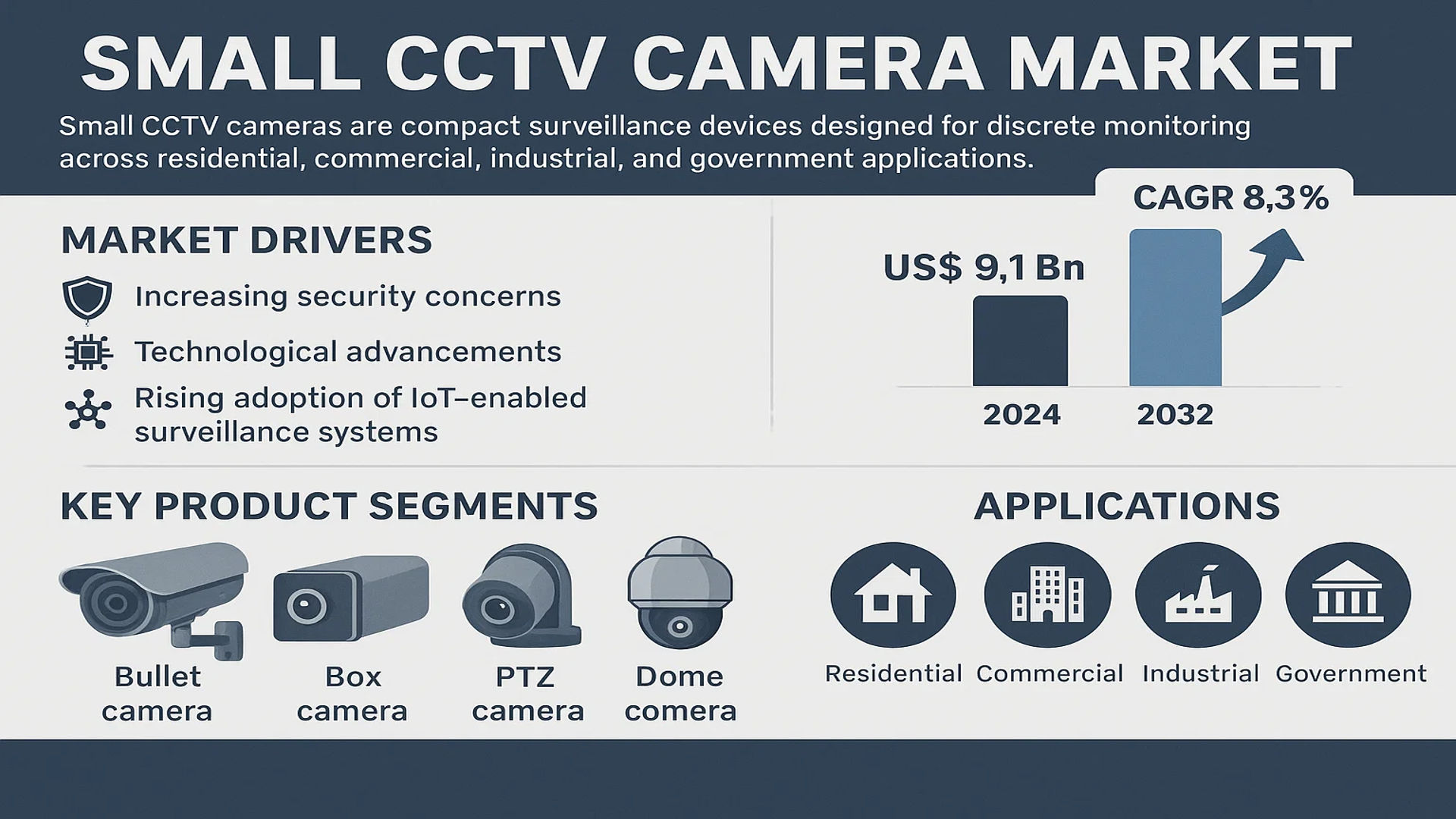
The global Small CCTV Camera Market size was valued at US$ 4.8 billion in 2024 and is projected to reach US$ 9.1 billion by 2032, at a CAGR of 8.3% during the forecast period 2025-2032.
Small CCTV cameras are compact surveillance devices designed for discrete monitoring across residential, commercial, industrial, and government applications. These cameras offer high-definition video capture, motion detection, night vision, and remote access capabilities. Key product segments include bullet cameras, box cameras, PTZ (pan-tilt-zoom) cameras, and dome cameras, each serving specific surveillance needs.
The market growth is driven by increasing security concerns, technological advancements in AI-powered analytics, and the rising adoption of IoT-enabled surveillance systems. While North America currently leads in market share due to strict security regulations, Asia-Pacific is experiencing the fastest growth because of rapid urbanization and infrastructure development. Major players like Hikvision, Dahua Technology, and Axis Communications are expanding their product portfolios with 4K resolution cameras and cloud-based surveillance solutions to capitalize on this demand.
MARKET DYNAMICS
MARKET DRIVERS
Rising Security Concerns and Crime Prevention Efforts Fuel Demand for Small CCTV Cameras
The global small CCTV camera market is experiencing robust growth driven by escalating security concerns across residential, commercial, and public sectors. With urban crime rates increasing in many regions, property owners and businesses are investing heavily in surveillance systems to deter theft and monitor activities. Small CCTV cameras offer discreet monitoring solutions while delivering high-definition video quality, making them particularly appealing for sensitive environments. The commercial segment accounts for over 40% of installations as retail stores, banks, and offices prioritize loss prevention and employee monitoring.
Technological Advancements in Camera Systems Accelerate Market Adoption
Continuous innovations in camera technology are dramatically enhancing the capabilities of small CCTV systems. Modern devices now incorporate features like 4K resolution, night vision, motion detection, and AI-powered analytics while maintaining compact form factors. The integration of wireless connectivity and cloud storage has eliminated traditional installation barriers, enabling flexible deployment scenarios. Recent product launches showcase cameras with facial recognition capabilities and advanced compression algorithms that reduce bandwidth requirements by up to 50%, making them more accessible to budget-conscious consumers.
Smart City Initiatives Worldwide Create Growth Opportunities
Government investments in smart city infrastructure are proving to be a significant growth catalyst for the small CCTV camera market. Municipalities are deploying networked surveillance systems to enhance public safety and traffic management. These initiatives often prioritize compact, high-performance cameras that can be discreetly integrated into urban environments. The Asia-Pacific region leads in smart city implementations, with several countries allocating substantial portions of their infrastructure budgets to surveillance technology upgrades.
MARKET RESTRAINTS
Privacy Regulations and Data Protection Laws Limit Market Expansion
While demand for surveillance grows, stringent privacy regulations present significant challenges for market players. Many jurisdictions have implemented strict data protection laws governing video surveillance, including requirements for data retention periods, access controls, and notification protocols. These regulations vary significantly by region, creating compliance complexities for manufacturers and installers. In some cases, privacy concerns have led to outright bans on certain types of surveillance in public spaces, particularly those employing facial recognition technology.
Cybersecurity Vulnerabilities Hinder Consumer Confidence
The increasing connectivity of CCTV systems exposes them to cybersecurity threats that undermine market growth. Instances of camera hijacking and unauthorized access to live feeds have made headlines, deterring some potential buyers. Consumers remain concerned about vulnerabilities in internet-connected cameras, particularly those installed in private residences. Manufacturers must invest heavily in encryption and authentication protocols to address these concerns, which increases production costs and final product prices.
Price Sensitivity in Developing Markets Constrains Growth
In price-sensitive emerging economies, affordability remains a key barrier to widespread CCTV adoption. While demand exists, many consumers and small businesses cannot justify the investment in premium systems. Local manufacturers offering lower-cost alternatives often compromise on features and quality, creating market segmentation that challenges established brands. This pricing pressure forces global players to develop region-specific product lines with reduced functionality to remain competitive.
MARKET OPPORTUNITIES
AI and Machine Learning Integration Opens New Application Areas
The incorporation of artificial intelligence into small CCTV systems presents significant growth opportunities. Advanced analytics capabilities enable features like behavior recognition, object tracking, and predictive monitoring. These intelligent systems can differentiate between routine activities and potential security threats, reducing false alarms and improving response times. The retail sector shows particular interest in these solutions for customer behavior analysis and inventory management applications beyond traditional security uses.
Expansion of DIY Installation Market Creates New Customer Segments
The growing trend toward self-installed security systems represents a major opportunity for manufacturers. Consumer-friendly small CCTV cameras with simple setup processes and mobile app integration are gaining popularity among residential users. This segment prefers wireless systems that eliminate complex wiring requirements and professional installation costs. Manufacturers responding to this demand with plug-and-play solutions and comprehensive online support can tap into a rapidly expanding market segment.
Emerging Markets Present Untapped Potential
Developing regions with growing middle-class populations and increasing urbanization offer substantial growth potential for small CCTV providers. As disposable incomes rise in these markets, security consciousness increases proportionally. Manufacturers can capitalize on this trend by offering entry-level systems with core functionality at competitive price points. Strategic partnerships with local distributors and customized marketing approaches will be key to success in these diverse markets.
MARKET CHALLENGES
Global Supply Chain Disruptions Impact Manufacturing Stability
The small CCTV camera market faces ongoing challenges from component shortages and supply chain volatility. Many manufacturers rely on specialized chips and sensors that remain in short supply following pandemic-related disruptions. These constraints lead to production delays and inventory inconsistencies, making it difficult to meet fluctuating demand. Companies must develop more resilient supply networks and consider regional manufacturing options to mitigate these challenges.
Intense Competition Leads to Margin Pressures
The market’s rapid growth has attracted numerous competitors, resulting in aggressive price wars that squeeze profit margins. Established brands face competition from both global low-cost providers and regional players offering comparable features at lower price points. This competitive landscape forces companies to continuously innovate while managing costs, creating operational challenges across the industry.
Technological Obsolescence Risks Require Constant Innovation
The rapid pace of technological advancement in surveillance systems presents an ongoing challenge for manufacturers. Products can become obsolete within months as new standards and features emerge. Companies must balance the need for continuous research and development with the practical realities of production cycles and inventory management. Failure to keep pace with technological trends can quickly erode market share in this dynamic industry.
SMALL CCTV CAMERA MARKET TRENDS
Integration of AI and IoT Driving Market Growth
The global Small CCTV Camera market is experiencing rapid expansion due to advancements in artificial intelligence (AI) and the Internet of Things (IoT). AI-powered surveillance systems, equipped with features like facial recognition and motion detection, are revolutionizing security applications in both residential and commercial sectors. The rising need for real-time analytics and automated security solutions has propelled demand, with AI-enhanced cameras accounting for over 30% of the market share in 2024. IoT integration further enhances connectivity, allowing seamless remote monitoring through smartphones and cloud-based platforms. The shift toward smart cities and intelligent infrastructure is accelerating adoption, particularly in urban areas where advanced surveillance is deemed essential.
Other Trends
Growing Demand for Residential Security Solutions
The residential segment is witnessing significant growth as homeowners increasingly prioritize security. Small CCTV cameras, particularly compact and wireless models, are becoming a staple in home surveillance due to their affordability and ease of installation. The demand is further propelled by rising crime rates and the availability of DIY security solutions, eliminating the need for professional setup. In 2024, residential applications contributed nearly 35% of the total market revenue, with projections indicating a steady increase driven by smart home trends. Additionally, integration with voice assistants and smart home ecosystems is simplifying user interaction, making security systems more accessible.
Expansion of Commercial and Industrial Applications
Commercial and industrial sectors are adopting small CCTV cameras at an unprecedented rate, fueled by the need for loss prevention, workforce monitoring, and compliance with stringent safety regulations. Retailers are leveraging AI-driven analytics to optimize store layouts and monitor customer behavior, while warehouses utilize these cameras for inventory tracking and theft reduction. The industrial segment, particularly manufacturing plants, relies on ruggedized small cameras for process monitoring and hazard detection. Market data suggests that the commercial sector will grow at a CAGR of around 9% from 2024 to 2032, driven by increasing investments in automation and security infrastructure. The trend toward high-definition and 360-degree surveillance cameras is also shaping industry preferences, offering broader coverage with minimal hardware footprint.
COMPETITIVE LANDSCAPE
Key Industry Players
Technological Innovation and Strategic Expansion Shape Market Dynamics
The global small CCTV camera market is moderately consolidated, with multinational corporations and regional players competing for market share through product differentiation and strategic partnerships. Hangzhou Hikvision Digital Technology Co. Ltd. and Dahua Technology Co. Ltd. lead the industry, collectively accounting for approximately 30% of the global market revenue in 2024. Their dominance stems from continuous R&D investments—Hikvision alone spent over 10% of its annual revenue on product development last year.
Western manufacturers like Bosch Sicherheitssysteme GmbH and Axis Communications AB maintain strong positions in premium segments, particularly in North America and Europe. These companies focus on high-end surveillance solutions with advanced analytics capabilities, with recent product launches featuring AI-powered object recognition and thermal imaging technologies.
Japanese and South Korean manufacturers are gaining traction through strategic alliances—Panasonic Corporation recently partnered with major cloud service providers to integrate their cameras with enterprise security platforms. Meanwhile, FLIR Systems‘ acquisition of smaller thermal imaging specialists has strengthened its position in industrial monitoring applications.
The competitive landscape is further intensified by emerging Chinese brands offering cost-competitive solutions. These manufacturers are aggressively expanding into Southeast Asia and African markets through localization strategies, challenging established players with 15-20% lower price points for comparable specifications.
List of Key Small CCTV Camera Manufacturers
- Axis Communications AB (Sweden)
- Bosch Sicherheitssysteme GmbH (Germany)
- CP Plus International (India)
- Dahua Technology Co. Ltd. (China)
- Digital Watchdog (U.S.)
- FLIR Systems (U.S.)
- GeoVision Inc. (Taiwan)
- Hangzhou Hikvision Digital Technology Co. Ltd. (China)
- Honeywell International Inc. (U.S.)
- Mitsubishi Electric Corporation (Japan)
- Panasonic Corporation (Japan)
- Pelco Inc. (U.S.)
- Toshiba Corporation (Japan)
Market leaders are responding to competitive pressures through vertical integration—Hikvision now produces its own image sensors, while Axis Communications has developed proprietary compression algorithms. These moves demonstrate how innovation at component level can create durable competitive advantages in this rapidly evolving market.
Segment Analysis:
By Type
Bullet Camera Segment Leads Due to Compact Design and Wide-Angle Surveillance Capabilities
The market is segmented based on type into:
- Bullet Camera
- Box Camera
- PTZ Camera
- Subtypes: Fixed PTZ, Wireless PTZ, and others
- Others
By Application
Commercial Segment Dominates Market Share Owing to Growing Security Needs in Retail and Offices
The market is segmented based on application into:
- Residential
- Commercial
- Subtypes: Retail stores, Banks, Office buildings
- Industrial
- Government
Regional Analysis: Small CCTV Camera Market
Asia-Pacific
Dominating the global small CCTV camera market, Asia-Pacific accounts for the largest market share, driven by rapid urbanization, rising security concerns, and extensive government-led public surveillance projects. Countries like China and India lead demand due to high manufacturing capabilities and increasing adoption of smart city initiatives. The region benefits from strong domestic players such as Hangzhou Hikvision Digital Technology Co., Ltd. and Dahua Technology Co., Ltd., which manufacture competitively priced yet technologically advanced solutions. However, affordability remains a key driver, making bullet and dome cameras the most popular choices for residential and commercial applications.
North America
The second-largest market, North America, is propelled by stringent security regulations and high spending on smart security infrastructure. The U.S. leads with investments in AI-powered surveillance, particularly in sectors like retail and transportation. Innovations from key players such as Honeywell International Inc. and Axis Communications AB focus on high-resolution imaging and cloud storage integration. Demand for wireless and IoT-compatible cameras is surging, driven by smart home adoption and businesses upgrading legacy systems to combat theft and vandalism.
Europe
Governed by strict data privacy laws like GDPR, Europe emphasizes secure and compliant surveillance solutions. Markets such as Germany and the U.K. prioritize high-definition cameras with encryption features for public spaces and critical infrastructure. While growth is steady, resistance to invasive monitoring and higher costs for advanced systems slow adoption in residential sectors. Nonetheless, industrial and government applications remain robust, with Bosch Sicherheitssysteme GmbH playing a pivotal role in supplying compliant, high-performance cameras.
South America
A developing market, South America shows moderate growth due to rising crime rates and increasing commercial security investments. Brazil and Argentina are key adopters, though economic instability restricts large-scale deployments. The market relies on mid-tier cameras, with brands like Intelbras gaining traction. Lack of standardized regulations and budget constraints delay upgrades to AI-based systems, but demand for basic surveillance in retail and residential sectors continues to expand.
Middle East & Africa
Accelerating infrastructure projects and security concerns drive demand in the region, particularly in the UAE and Saudi Arabia. Government initiatives for smart cities and critical infrastructure protection fuel high-end CCTV deployments. However, price sensitivity in Africa and geopolitical instability limit growth. While international brands dominate premium segments, local suppliers are emerging to cater to cost-conscious buyers, focusing on durable, weather-resistant cameras for harsh environments.
Report Scope
This market research report provides a comprehensive analysis of the global Small CCTV Camera market, covering the forecast period 2024–2032. It offers detailed insights into market dynamics, technological advancements, competitive landscape, and key trends shaping the industry.
Key focus areas of the report include:
- Market Size & Forecast: Historical data and future projections for revenue, unit shipments, and market value across major regions and segments. The global Small CCTV Camera market was valued at US$ 4.8 billion in 2024 and is projected to reach US$ 9.1 billion by 2032, growing at a CAGR of 8.3%.
- Segmentation Analysis: Detailed breakdown by product type (Bullet Camera, Box Camera, PTZ Camera, Others), application (Residential, Commercial, Industrial, Government), and end-user industry to identify high-growth segments and investment opportunities. The Bullet Camera segment is projected to reach USD million by 2032.
- Regional Outlook: Insights into market performance across North America (U.S., Canada, Mexico), Europe (Germany, France, U.K., Italy, Russia), Asia-Pacific (China, Japan, India, South Korea), Latin America (Brazil, Argentina), and Middle East & Africa (Saudi Arabia, UAE).
- Competitive Landscape: Profiles of leading market participants including Axis Communication AB, Bosch Sicherheitssysteme GmbH, Hangzhou Hikvision Digital Technology Co.Ltd., Dahua Technology Co.Ltd., and Honeywell International Inc., covering their product offerings, market share, and strategic developments.
- Technology Trends & Innovation: Assessment of emerging technologies including AI-powered surveillance, cloud-based storage solutions, 4K/8K resolution cameras, and IoT integration in security systems.
- Market Drivers & Restraints: Evaluation of factors such as rising security concerns, smart city initiatives, and commercial sector adoption versus challenges like privacy regulations and high installation costs.
- Stakeholder Analysis: Strategic insights for manufacturers, distributors, system integrators, and investors regarding market entry strategies and growth opportunities.
This report employs rigorous primary and secondary research methodologies, including interviews with industry experts and analysis of verified market data to ensure accuracy and reliability.
FREQUENTLY ASKED QUESTIONS:
What is the current market size of Global Small CCTV Camera Market?
-> Small CCTV Camera Market size was valued at US$ 4.8 billion in 2024 and is projected to reach US$ 9.1 billion by 2032, at a CAGR of 8.3% during the forecast period 2025-2032.
Which key companies operate in Global Small CCTV Camera Market?
-> Key players include Axis Communication AB, Bosch Sicherheitssysteme GmbH, Hangzhou Hikvision Digital Technology Co.Ltd., Dahua Technology Co.Ltd., and Honeywell International Inc., among others.
What are the key growth drivers?
-> Key growth drivers include increasing security concerns, smart city development projects, commercial sector adoption, and technological advancements in surveillance systems.
Which region dominates the market?
-> Asia-Pacific currently leads the market, driven by rapid urbanization in China and India, while North America shows significant growth potential.
What are the emerging trends?
-> Emerging trends include AI-powered video analytics, cloud-based surveillance solutions, wireless CCTV systems, and integration with smart home ecosystems.

Get Sample Report PDF for Exclusive Insights
Report Sample Includes
- Table of Contents
- List of Tables & Figures
- Charts, Research Methodology, and more...
 Download Sample Report PDF