
Slim General Purpose Relay Market Insights
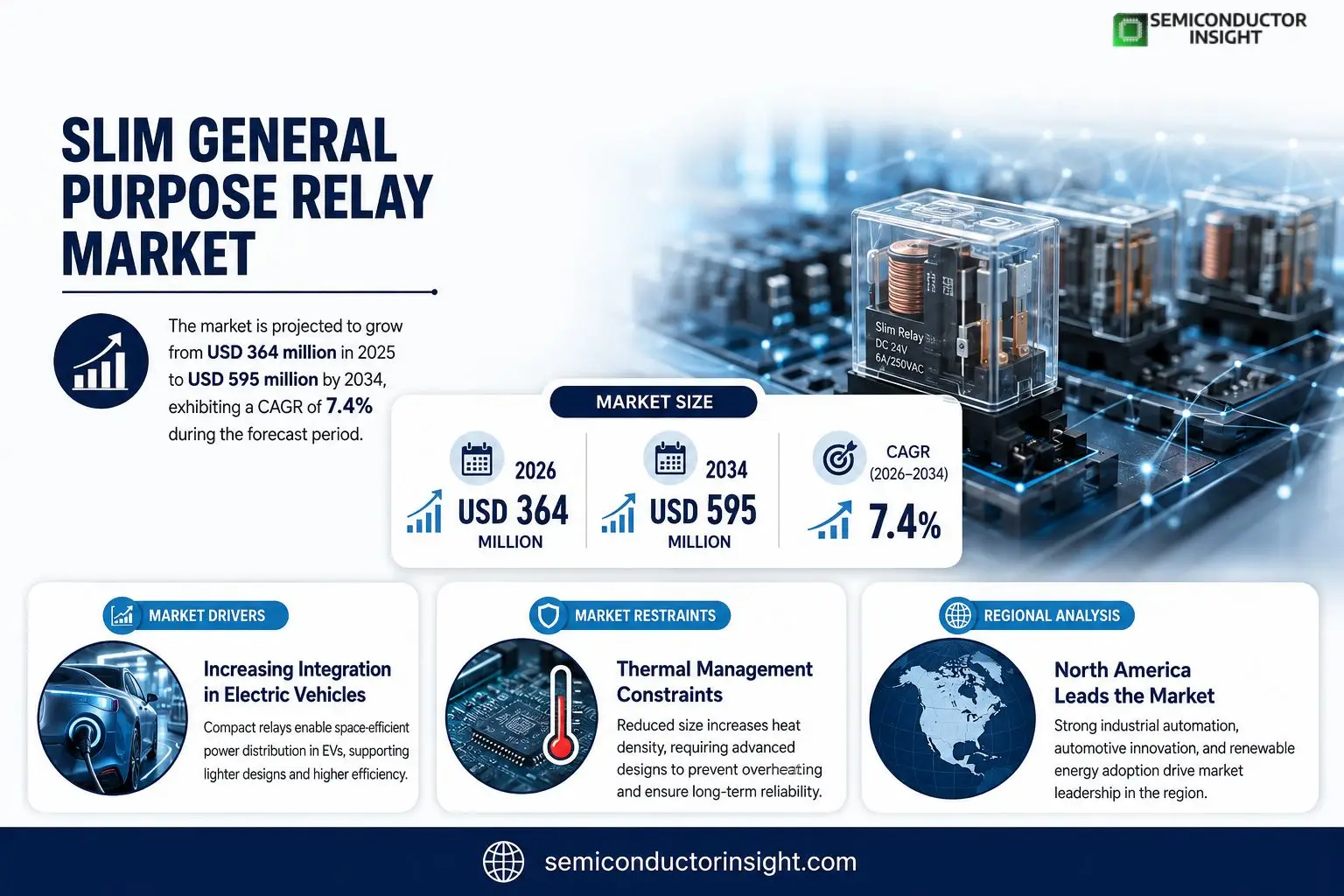
Slim General Purpose Relay market size was valued at USD 364 million in 2025. The market will increase to USD 595 million by 2034, reflecting a compound annual growth rate of 7.4 %.
Slim General Purpose Relays are ultra‑thin DC electromagnetic devices that function as voltage, under‑current, intermediate and time relays within low‑voltage control systems. In 2025, worldwide production reached roughly 50 million units at an average price of USD 8 per unit. Their compact design, easy maintenance and low cost drive adoption across PLCs, building automation and compact frequency converters.
MARKET DRIVERS
Increasing Integration in Electric Vehicles
Automakers are redesigning power distribution architectures to reduce weight and improve packaging efficiency. Slim General Purpose Relay Market benefits from this shift because compact relays allow engineers to free up valuable board space while maintaining the same current‑handling capability as traditional devices. As vehicle electrification accelerates, manufacturers prioritize components that support tighter layouts without compromising reliability.
Demand for Miniaturized Industrial Controllers
Industrial automation is moving toward modular, high‑density control panels. Slim relays fulfill the need for slimmer form factors, enabling tighter cabinet designs and simplifying wiring schemes. OEMs report that a reduction of even a few millimetres per panel translates into measurable cost savings in material and assembly time. This efficiency incentive fuels broader adoption across factory automation and process control equipment.
➤ “The ability to combine high current capacity with a low‑profile footprint is reshaping the component selection criteria for next‑generation equipment.”
Beyond automotive and industrial segments, the rise of smart home appliances creates a parallel demand for slim relays that can be embedded within limited interior volumes. Manufacturers seeking to differentiate products through sleek designs are turning to Slim General Purpose Relay Market as a reliable solution for compact power switching.
MARKET CHALLENGES
Thermal Management Constraints
Compressing the relay envelope inevitably raises surface temperature for a given load. Designers must balance the desire for miniaturization with the need for adequate heat dissipation, especially in high‑current applications. Failure to manage thermal stress can lead to premature failure, prompting some OEMs to hesitate before fully committing to slim form factors.
Other Challenges
Supply Chain Volatility
Component shortages and fluctuating raw‑material costs have introduced uncertainty into production schedules. Since slim relays often rely on specialized coil winding processes, any disruption can delay product launches and affect inventory planning for end‑users.
Regulatory Compliance
Stringent safety standards across automotive and industrial domains require rigorous testing and certification. The additional engineering effort needed to demonstrate compliance for a new, compact relay design adds overhead that may deter smaller manufacturers with limited resources.
MARKET RESTRAINTS
Higher Production Costs
Manufacturing a relay with a reduced footprint often involves tighter tolerances and more advanced tooling. These factors drive unit costs higher than those of conventional relays, which can constrain price‑sensitive segments such as consumer electronics. Companies must weigh the premium against the perceived value of space savings.
Limited Legacy Compatibility
Many existing designs are built around standard‑size relays that have been in production for decades. Retrofitting a system with a slim alternative may necessitate redesign of printed‑circuit boards, connector housings, or mechanical mounts. The engineering effort required to re‑qualify legacy equipment poses a barrier to rapid market penetration.
MARKET OPPORTUNITIES
Emergence of Compact Renewable Energy Inverters
Renewable‑energy inverters are trending toward smaller, lighter enclosures to suit residential installations. Slim relays can replace bulkier switches in these systems, enabling manufacturers to offer more aesthetically pleasing products while preserving performance. This alignment opens a niche where Slim General Purpose Relay Market can capture early adopters.
Growth of Edge‑Computing Devices
Edge computing hardware often operates under strict size and power constraints. Integrating slim relays into power‑routing modules helps device makers meet form‑factor targets without sacrificing current handling. As the edge‑computing ecosystem expands, demand for compact, reliable switching solutions is likely to rise, presenting a strategic entry point for relay suppliers.
Slim General Purpose Relay Market Trends
Shift Toward Intelligent, High‑Density Designs
Slim General Purpose Relay Market is seeing a pronounced migration to compact units that can be packed tightly within modern control panels. Manufacturers such as Omron and Schneider Electric have introduced models whose footprints shrink by up to 30 % compared with legacy relays, enabling equipment designers to realize denser layouts without sacrificing performance. This compression aligns with the broader industry push for space‑efficient installations, especially in PLC‑driven automation and building‑management systems where rack space commands a premium. Companies that can offer reliable operation at reduced dimensions are gaining a decisive edge in contract negotiations for new plant builds.
Other Trends
Manufacturing Precision and Material Choices
Advances in winding technology now allow coil diameters to be reduced while retaining magnetic integrity, resulting in coil power draw around 300 mW for many new models. Contact alloys have been fine‑tuned; the prevalent silver‑tin‑indium mix delivers superior current‑handling, while gold‑plating on micro‑load contacts curtails signal drift. Transparent engineering‑plastic housings give technicians visual access to contact status, cutting troubleshooting time by an estimated 15 %. These engineering nuances translate into lower total‑ownership costs for end users, reinforcing the value proposition of modern Slim General Purpose Relay offerings.
Energy‑Efficient Coils and Modular Connectivity
Energy savings have become a decisive factor in relay selection. Suppliers now embed low‑loss coil designs that keep consumption near 0.3 W, a figure that supports green‑energy certifications for many industrial facilities. In parallel, the adoption of Push‑In Plus plug‑in terminals shortens assembly cycles and dramatically reduces wiring errors, a benefit that resonates with OEMs seeking to accelerate time‑to‑market. The convergence of these attributesminimal power draw and streamlined installationpositions Slim General Purpose Relay Market to satisfy the escalating demand for sustainable, high‑throughput production lines.
COMPETITIVE LANDSCAPE
Key Industry Players
Slim General Purpose Relay Market: Competitive Overview
The segment remains tightly clustered around a handful of multinational manufacturers that dominate volume and pricing power. IDEC Corporation and Omron Automation leverage extensive R&D networks in Japan to deliver ultra‑thin relays with sub‑300 mW coil consumption, positioning them as preferred suppliers for high‑density PLC installations across North America and Europe. Schneider Electric supplements this tier with a broad voltage portfolio and an entrenched distribution footprint in the EU, enabling rapid response to automotive‑grade demand. Their combined market share exceeds half of shipments, a reflection of vertically integrated production lines that minimize lead‑time and allow fine‑tuning of contact alloys for niche load classes. The concentration in Europe, the United States and Japan creates a barrier for newcomers, as scale economies and established standards dominate procurement decisions in industrial automation projects.Beyond the headline players, a diverse set of specialists injects differentiation into the market. Rockwell Automation and Eaton focus on ruggedized units for heavy‑duty process control, often bundling relays with advanced diagnostics in their broader automation suites. TE Connectivity and Panasonic exploit their component‑level expertise to embed LED status indicators and modular plug‑in terminals, catering to OEMs seeking quick‑swap maintenance. European firms such as Finder, Carlo Gavazzi, Turck and EL.CO. concentrate on modular designs for building‑automation and smart‑grid applications, emphasizing transparent housings that simplify field inspection. Smaller but agile companiesWerner Electric, ABB, Lovato Electric, Picker Components, Macromatic, Tele Haase, and the Japanese specialist Lovatotarget region‑specific standards, offering custom voltage options (6 V to 240 V) and PCB‑mount formats that address local regulatory nuances. Their incremental innovations in coil winding precision and contact plating gradually erode the incumbents’ pricing premium, especially as the industrial Internet of Things pushes for integrated status monitoring.
List of Key Slim General Purpose Relay Companies Profiled
- IDEC Corporation
- Omron Automation
- Schneider Electric
- Rockwell Automation
- Eaton
- Macromatic
- TE Connectivity
- Panasonic
- Finder
- Carlo Gavazzi
- Turck
- EL.CO.
- Werner Electric
- ABB
- Lovato Electric
- Picker Components
- Tele Haase
Segment Analysis:
| Segment Category | Sub-Segments | Key Insights |
| By Type |
|
DC Electromagnetic remains the dominant type because of its simple construction and reliable operation. – Engineers prize the straightforward coil‑actuated mechanism for rapid troubleshooting. – The low cost and ease of integration support widespread adoption across compact control panels. |
| By Application |
|
PLC Control Systems drive much of the demand for slim relays. – Their ultra‑thin form factor enables high‑density mounting on DIN rails, essential for modern automation cabinets. – The reliable switching performance aligns with the deterministic timing requirements of programmable logic environments. |
| By End User |
|
Industrial Equipment Manufacturers value the slim relay for its contribution to compact product designs. – The reduced envelope supports lightweight machinery and facilitates modular assembly. – Consistent contact reliability under varied load conditions reassures manufacturers of long‑term durability. |
| By Technology |
|
Intelligent Relays are shaping the future of slim general purpose relays. – Integrated status LEDs and test buttons simplify diagnostics, reducing maintenance cycles. – Communication hooks ready for Industrial IoT enable real‑time condition monitoring, aligning with digital transformation initiatives. |
| By Design Feature |
|
Transparent Housing enhances user confidence and serviceability. – Visual access to contacts allows immediate verification of actuation without disassembly. – Coupled with LED status cues, it shortens troubleshooting time and supports high‑availability applications. |
Regional Analysis: Slim General Purpose Relay Market
North America
Plant operators are redesigning control cabinets to accommodate tighter layouts, and slim relays enable higher channel density without sacrificing safety margins. The shift supports faster system scaling and reduces inventory complexity.
Vehicle electrical architectures now prioritize lightweight assemblies; slim relays replace bulky counterparts in power distribution modules, helping manufacturers meet fuel‑efficiency targets while preserving reliability.
Distributed solar and battery‑storage units benefit from compact relays that fit within limited enclosure spaces, allowing installers to deliver higher power ratings without enlarging rack footprints.
Emerging electromagnetic‑compatibility standards favor designs that minimize loop area; the reduced size of slim relays naturally aligns with these requirements, easing certification processes for OEMs.
Europe
European manufacturers are responding to stringent environmental directives by optimizing product footprints. In sectors such as railway signalling and industrial robotics, designers are substituting traditional relays with slimmer alternatives to meet both space and sustainability targets. The region’s emphasis on modular design standards also encourages the adoption of relays that can be stacked within compact enclosures, thereby shortening time‑to‑market for new equipment. While cost pressures remain, the perceived value of reduced material usage and simplified logistics is driving procurement preferences toward the slim format.
Asia‑Pacific
The Asia‑Pacific market is experiencing rapid expansion of consumer electronics and smart‑home solutions, where board‑level space is at a premium. Manufacturers in China, South Korea, and Japan are increasingly specifying slim relays for compact power modules, viewing them as enablers of product differentiation. Additionally, the region’s aggressive rollout of 5G infrastructure demands dense power distribution networks, prompting telecom equipment makers to integrate these relays to conserve rack space and improve serviceability.
South America
In South America, growing investments in renewable‑energy farms are reshaping power‑distribution architectures. Engineers favor slim relays for their ability to fit within tight inverter housings, a critical factor when retrofitting existing sites with newer, higher‑capacity units. Economic constraints also push local OEMs to seek component solutions that deliver performance without inflating bill‑of‑materials, making the slim profile an attractive compromise between cost and functionality.
Middle East & Africa
The Middle East and Africa region is witnessing a surge in data‑center construction and oil‑field automation projects. Both domains require robust yet compact control solutions capable of withstanding harsh environmental conditions. Slim relays, with their reduced thermal mass and streamlined form factor, are being selected to meet rigorous reliability standards while conserving valuable rack space in high‑density installations. As infrastructure spending accelerates, the market outlook for these relays in the region appears increasingly favorable.
Report Scope
This market research report provides a comprehensive analysis of the Slim General Purpose Relay Market , covering the forecast period 2026–2034. It offers detailed insights into market dynamics, technological advancements, competitive landscape, and key trends shaping the industry.
Key focus areas of the report include:
- Market Overview: The report begins with an overview outlining its current market scenario, key growth indicators, and industry transformation drivers. It discusses macroeconomic factors, demand–supply balance, regulatory landscape, and the strategic role of semiconductors in powering advancements across industries such as automotive, telecommunications, consumer electronics, and industrial automation.
- Market Size & Forecast: Historical data and future projections for revenue, unit shipments, and market value across major regions and segments.
- Segmentation Analysis: Detailed breakdown by product type, technology, application, and end-user industry to identify high-growth segments and investment opportunities.
- Regional Insights: Insights into market performance across North America, Europe, Asia-Pacific, Latin America, and the Middle East & Africa, including country-level analysis where relevant.
- Competitive Landscape: Profiles of leading market participants, including their product offerings, R&D focus, manufacturing capacity, pricing strategies, and recent developments such as mergers, acquisitions, and partnerships.
- Technology Trends & Innovation: Assessment of emerging technologies, integration of AI/IoT, semiconductor design trends, fabrication techniques, and evolving industry standards.
- Market Drivers & Restraints: Evaluation of factors driving market growth along with challenges, supply chain constraints, regulatory issues, and market-entry barriers.
- Stakeholder Insights: Insights for component suppliers, OEMs, system integrators, investors, and policymakers regarding the evolving ecosystem and strategic opportunities.
Primary and secondary research methods are employed, including interviews with industry experts, data from verified sources, and real-time market intelligence to ensure the accuracy and reliability of the insights presented.
FREQUENTLY ASKED QUESTIONS:
What is the current market size of Slim General Purpose Relay Market?
-> Slim General Purpose Relay Market was valued at USD 364 million in 2025 and is expected to reach USD 595 million by 2034, growing at a CAGR of 7.4% during the forecast period.
Which key companies operate in Slim General Purpose Relay Market?
-> Key players include IDEC Corporation, Omron Automation, Rockwell Automation, Eaton, Macromatic, Schneider Electric, Picker Components, Lovato Electric, TE Connectivity, Panasonic, Tele Haase, Finder, Carlo Gavazzi, Turck, EL.CO., Werner Electric, ABB.
What are the key growth drivers?
-> Key growth drivers include high‑density installation requirements, rapid adoption of Industrial IoT, demand for low‑power intelligent relays (≈300 mW), expansion of PLC control systems, building automation, and compact frequency converters.
Which region dominates the market?
-> Europe leads the market with strong concentration of manufacturers and demand, followed closely by North America, while Asia‑Pacific shows fast growth potential.
What are the emerging trends?
-> Emerging trends include intelligent modular relays with integrated LED status indicators, test buttons, mechanical latches, transparent engineering‑plastic housings, Push‑In Plus plug‑in terminals, and IoT‑enabled status monitoring and communication capabilities.

Get Sample Report PDF for Exclusive Insights
Report Sample Includes
- Table of Contents
- List of Tables & Figures
- Charts, Research Methodology, and more...
 Download Sample Report PDF