Six Dimensional Moment Sensors Market Insights
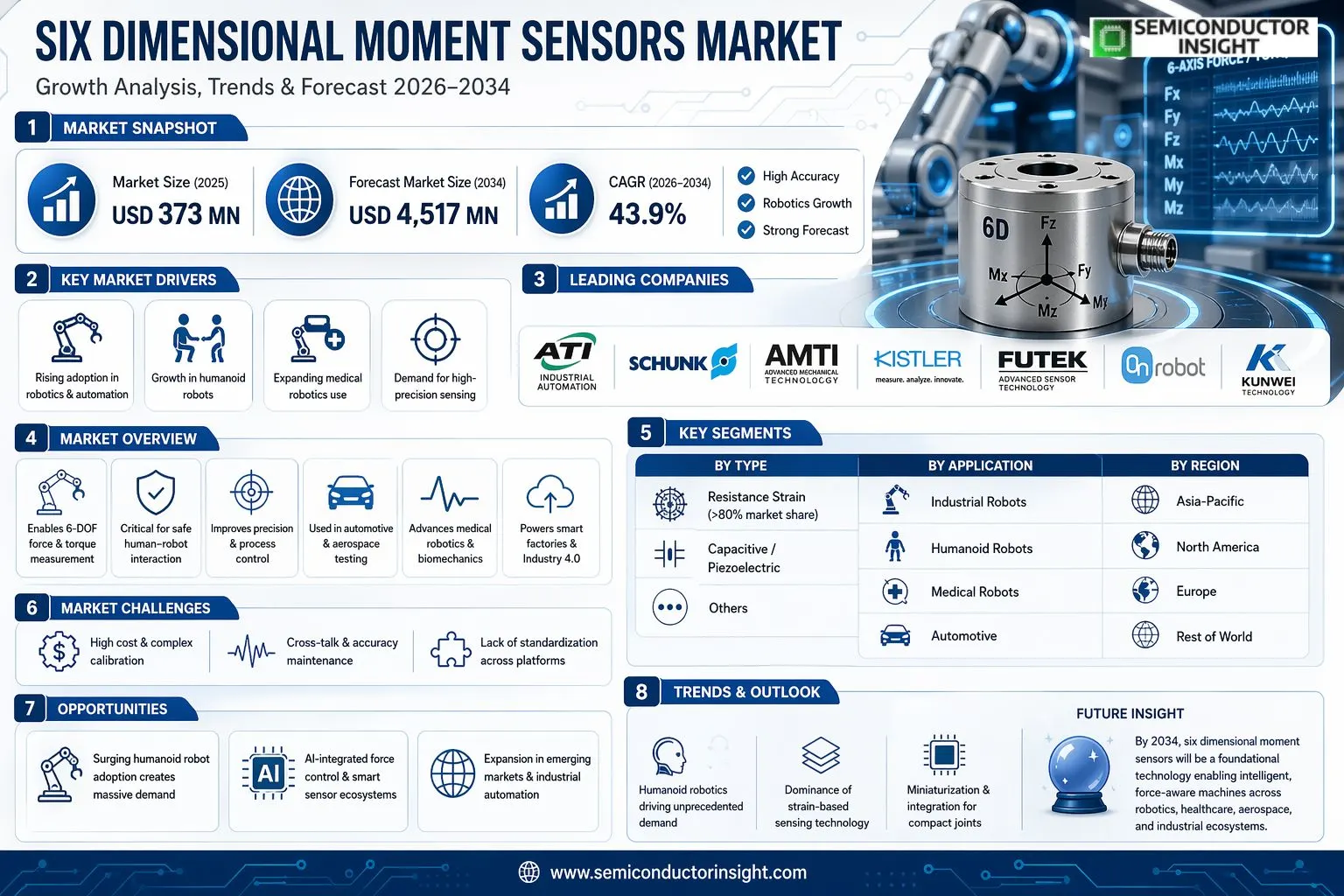
Global Six Dimensional Moment Sensors market size was valued at USD 373 million in 2025. The market is projected to grow from USD 534 million in 2026 to USD 4,517 million by 2034, exhibiting a CAGR of 43.9% during the forecast period.
A Six-Dimensional Moment Sensor measures both forces and moments across six degrees of freedom , three translational forces along the X, Y, and Z axes, and three corresponding rotational moments or torques around those same axes. Engineered to detect multi-axis loads and convert them into precise, actionable data, these sensors are essential for applications requiring high-accuracy force feedback, including robotics, biomechanics, structural testing, and industrial automation. By capturing the full spectrum of mechanical interaction in a single device, six-dimensional force sensors provide the most comprehensive force information available among all sensor categories, distinguished by their high precision, high sensitivity, high bandwidth, and high reliability.
The market is gaining significant momentum driven by the rapid expansion of robotics , particularly humanoid robots , alongside growing adoption in automotive testing, aerospace research, and medical applications. Notably, global sales of six-dimensional force sensors reached nearly 60,000 units in 2024, with China alone accounting for approximately 17,000 units, representing a year-on-year increase of more than 40%. Looking ahead, global market sales are estimated to reach 820,000 units by 2030, with China projected to contribute 300,000 units, reflecting a compound annual sales growth rate of 60% from 2025 to 2030. Among measurement technologies, strain-type force sensors dominate with over 80% market share, deployed by leading players including ATI Industrial Automation, Schunk, and ME-Meßsysteme. The humanoid robot segment, growing at a global CAGR of 104% from 2025 to 2030, is expected to be the most significant long-term growth driver for the six-dimensional force sensor market.
MARKET DRIVERS
Rising Adoption of Robotics and Automation Across Industrial Sectors
The growing integration of collaborative robots (cobots) and industrial automation systems has emerged as a primary catalyst for Six Dimensional Moment Sensors Market. These sensors, capable of simultaneously measuring forces and torques across all six degrees of freedom, are increasingly regarded as essential components in robotic end-effectors, enabling precise force control during assembly, grinding, polishing, and material handling operations. As manufacturers across automotive, electronics, and aerospace industries accelerate their automation investments, demand for high-accuracy multi-axis force-torque sensing solutions continues to expand at a notable pace.
Expansion of Medical Robotics and Minimally Invasive Surgical Applications
The healthcare sector represents one of the fastest-growing end-use verticals driving Six Dimensional Moment Sensors Market. Surgical robotic platforms increasingly incorporate six-axis force-torque sensors to provide haptic feedback, enhance procedural precision, and reduce the risk of tissue damage during minimally invasive procedures. Global rise in robotic-assisted surgeries, rehabilitation exoskeletons, and prosthetic limb development has intensified the requirement for compact, highly sensitive, and biocompatible sensing technologies capable of real-time multi-dimensional force measurement.
➤ The convergence of Industry 4.0 frameworks with advanced sensor fusion technologies is reinforcing the strategic importance of six-dimensional force-torque sensors in smart manufacturing ecosystems, where real-time feedback loops are critical to maintaining product quality and operational efficiency.
Advancements in sensor miniaturization, improved signal-to-noise ratios, and the development of digital output interfaces compatible with modern industrial communication protocols such as EtherCAT and CANopen are further broadening the application scope of Six Dimensional Moment Sensors Market. These technical improvements allow seamless integration into increasingly compact robotic systems without compromising measurement accuracy, thereby attracting investment from both established sensor manufacturers and emerging technology startups focused on next-generation human-machine interaction.
MARKET CHALLENGES
High Manufacturing Complexity and Associated Cost Barriers
One of the most significant challenges confronting Six Dimensional Moment Sensors Market is the inherent complexity involved in fabricating sensors capable of accurately decoupling forces and moments across six independent axes. Achieving low cross-talk between measurement channels, maintaining calibration stability over extended operational periods, and ensuring consistent performance across varying temperature and humidity conditions demands sophisticated manufacturing processes and precision-grade materials. These requirements translate into elevated production costs that can restrict adoption among small and medium-sized enterprises operating under tighter capital expenditure constraints.
Other Challenges
Integration Complexity in Legacy Systems
Incorporating six-dimensional force-torque sensors into existing automation infrastructure or legacy robotic platforms presents considerable engineering challenges. Many end-users lack the in-house expertise required to configure sensor data acquisition pipelines, develop appropriate control algorithms, and validate system-level performance post-integration. This skills gap creates dependency on specialized system integrators and can extend project timelines, adding indirect costs that further dampen adoption rates in price-sensitive markets.
Standardization and Interoperability Limitations
The absence of universally adopted standards for sensor communication protocols, mechanical interfaces, and data formats continues to fragment Six Dimensional Moment Sensors Market. Compatibility issues between sensors from different manufacturers and various robot controller platforms complicate procurement decisions for end-users seeking multi-vendor environments. Without broader industry-wide standardization efforts, interoperability challenges are likely to persist, potentially slowing market penetration in sectors where plug-and-play functionality is a procurement prerequisite.
MARKET RESTRAINTS
Sensitivity to Overload Conditions and Mechanical Durability Concerns
A notable restraint on the broader adoption of six-dimensional force-torque sensors is their relative vulnerability to overload conditions encountered during real-world industrial deployments. In environments where unexpected collisions, sudden load spikes, or vibration-intensive processes are commonplace, sensor elements can sustain damage that compromises measurement integrity or necessitates costly replacements. While overload protection mechanisms have improved, the perceived fragility of precision sensing components compared to conventional position-only feedback systems remains a concern for operations managers evaluating total cost of ownership in demanding production environments.
Limited Awareness and Technical Expertise in Emerging Market Regions
In developing economies across Southeast Asia, Latin America, and parts of Eastern Europe, limited awareness of advanced force-torque sensing technologies and a shortage of application engineering expertise continue to restrain market growth. Many potential end-users in these regions remain reliant on simpler sensing modalities or purely position-based control strategies, partly due to constrained access to technical training resources and limited local distributor networks. Bridging this knowledge gap through targeted education initiatives and localized support infrastructure represents a long-term requirement for meaningful market expansion in these geographies.
MARKET OPPORTUNITIES
Growing Demand from Autonomous Vehicle Testing and Advanced Driver Assistance Development
The rapid development of autonomous vehicle platforms and advanced driver assistance systems (ADAS) is opening new application avenues for Six Dimensional Moment Sensors Market. Steering system validation, suspension dynamics testing, and powertrain force characterization all benefit from the comprehensive measurement capabilities that six-axis force-torque sensors provide. As automotive OEMs and Tier-1 suppliers intensify their investment in vehicle electrification and autonomy programs, the requirement for precise, multi-dimensional load measurement in both laboratory and road-test environments is expected to generate sustained incremental demand for advanced sensing solutions.
Emergence of Human-Robot Collaboration and Tactile Intelligence Research
The accelerating shift toward human-robot collaboration (HRC) in manufacturing and service environments presents a compelling growth opportunity for participants in Six Dimensional Moment Sensors Market. Safe and effective physical interaction between humans and robotic systems fundamentally depends on real-time, high-fidelity force and torque feedback, making six-dimensional sensing a core enabling technology. Concurrently, academic and commercial research into tactile intelligence, soft robotics, and dexterous manipulation is driving demand for novel sensor configurations with enhanced spatial resolution and dynamic response characteristics, creating fertile ground for product innovation and premium market positioning.
Expansion into Aerospace Structural Testing and Space Robotics Applications
Aerospace structural testing programs and the growing commercialization of space robotics represent high-value opportunity segments for Six Dimensional Moment Sensors Market. Ground-based fatigue testing of aircraft components, wind tunnel aerodynamic force measurement, and on-orbit robotic servicing missions all demand sensors with exceptional accuracy, reliability, and resistance to extreme environmental conditions. As both governmental space agencies and private aerospace enterprises scale their development programs, the specification of advanced multi-axis force-torque sensing systems into mission-critical applications is anticipated to create durable, high-margin revenue streams for specialized sensor manufacturers with demonstrated performance credentials in demanding operational contexts.
Six Dimensional Moment Sensors Market Trends
Humanoid Robotics Driving Unprecedented Demand for Six Dimensional Moment Sensors
Six Dimensional Moment Sensors Market is undergoing a structural transformation, largely propelled by the rapid commercialization of humanoid robots. Since the concept of humanoid robots gained significant traction in 2021, demand for six-dimensional force sensors has surged across global manufacturing and technology sectors. Global sales of six-dimensional force sensors reached nearly 60,000 units in 2024, with China alone accounting for approximately 17,000 units , a year-on-year increase of more than 40%. By 2030, global market sales are projected to reach 820,000 units, with China contributing an estimated 300,000 units, reflecting a compound annual sales growth rate of approximately 60% between 2025 and 2030. This trajectory underscores the pivotal role that humanoid robot mass production is expected to play as a primary growth catalyst for Six Dimensional Moment Sensors Market in the long term.
Other Trends
Dominance of Strain-Based Sensing Technology
Among all sensing technologies available in Six Dimensional Moment Sensors Market, resistance strain-based sensors hold the commanding majority, accounting for more than 80% of total force sensor usage globally. Leading manufacturers including ATI Industrial Automation, Schunk, ME-Meßsysteme, and Sintokogio, along with virtually all major Chinese producers, rely on strain force sensor architectures. This widespread adoption is driven by the technology’s proven accuracy, reliability, and cost efficiency across demanding industrial environments. Capacitive and piezoelectric sensor types, while occupying a smaller share, continue to find niche applications where dynamic response and high-frequency measurement are priorities.
Expanding Application Landscape Beyond Traditional Robotics
The application scope of Six Dimensional Moment Sensors Market has evolved well beyond its aerospace origins. While industrial automation , including conventional robotic systems , currently represents the largest application segment, adoption is expanding rapidly across medical robotics, automotive testing, biomechanics, and scientific research. In the automotive industry, six-dimensional force sensors are widely deployed in collision testing and component evaluation for hubs, seats, and structural parts. In humanoid robots specifically, these sensors are installed at critical end-effector locations such as wrists and ankles to enable force control, swing stability, and safety management , functions that have made them a standard component in high-performance humanoid robot architectures.
Competitive Consolidation and Rising Chinese Manufacturer Influence
Global Six Dimensional Moment Sensors market currently exhibits a moderately consolidated competitive structure, with the top five manufacturers collectively accounting for more than 60% of global market share as of 2024. Established players such as ATI Industrial Automation, Schunk, and Advanced Mechanical Technology continue to dominate the core global market. Simultaneously, Chinese manufacturers including Yuli Instruments, Kunwei Technology, and Xinjingcheng are recording explosive growth, narrowing the technology and scale gap with international incumbents. This dual dynamic , of global leader entrenchment alongside aggressive regional challenger expansion , is reshaping supply chain strategies and pricing structures across Six Dimensional Moment Sensors Market, signaling a period of heightened competition and accelerated innovation through the forecast horizon.
COMPETITIVE LANDSCAPE
Key Industry Players
Six Dimensional Moment Sensors Market – Global Competitive Dynamics, Leading Manufacturers, and Strategic Positioning
Global Six Dimensional Moment Sensors market is characterized by a moderately consolidated competitive landscape, with ATI Industrial Automation, Schunk, and Advanced Mechanical Technology collectively commanding a dominant share of Global core market. As of 2025, the world’s top five manufacturers account for more than 60% of total market revenue, reflecting the significant barriers to entry imposed by precision engineering requirements, proprietary calibration technologies, and deep-rooted OEM relationships across robotics, aerospace, and industrial automation sectors. ATI Industrial Automation remains the undisputed global leader, leveraging its extensive portfolio of strain-based six-axis force/torque sensors widely deployed in industrial robot end-effectors, collision testing rigs, and advanced manufacturing systems. Schunk and Advanced Mechanical Technology further reinforce the Western dominance through their high-accuracy, high-bandwidth sensor platforms catering to research institutions, automotive testing laboratories, and collaborative robot integrators. The market’s explosive projected growth , from USD 373 million in 2025 to USD 4,517 million by 2034 at a CAGR of 43.9% , is intensifying competitive rivalry, prompting both established players and emerging entrants to accelerate R&D investment and expand production capacity.
Chinese manufacturers have emerged as a formidable competitive force, fueled by the domestic humanoid robot boom and strong government support for intelligent manufacturing. Companies such as Kunwei Technology, XJCSENSOR, Hypersen, and Guangzhou Haozhi are capturing rapidly growing domestic demand, with China’s six-dimensional force sensor sales reaching approximately 17,000 units in 2024 , a year-on-year increase exceeding 40%. The humanoid robot segment, projected to grow at a global CAGR of 104% from 2025 to 2030, is proving to be the most transformative demand driver, as six-dimensional moment sensors have become standard components at wrist and ankle joints of high-performance humanoid platforms. Niche global players including Kistler, FUTEK, Bota Systems, Robotiq, and ME-Meßsysteme continue to carve out specialized positions in medical robotics, biomechanics research, and precision industrial automation, differentiating through superior signal-to-noise ratios, miniaturized form factors, and application-specific calibration services. With resistance strain sensors accounting for over 80% of total force sensor usage, competition increasingly centers on measurement accuracy, multi-axis crosstalk minimization, overload protection, and seamless integration with robot controller ecosystems.
List of Key Six Dimensional Moment Sensors Companies Profiled
- ATI Industrial Automation
- Schunk
- Advanced Mechanical Technology (AMTI)
- FUTEK Advanced Sensor Technology
- Kistler Group
- Robotiq
- ME-Meßsysteme GmbH
- Bota Systems
- Wacoh-Tech
- Sunrise Instruments
- Epson
- Nordbo Robotics
- OnRobot
- Sintokogio
- FANUC Corporation
- Hypersen Technologies
- Kunwei Technology
- XJCSENSOR
- Robotous
- Guangzhou Haozhi Industrial
- Link-touch (Beijing) Technology
- Changzhou Right Measurement and Control System
- Anhui Zhongkemi Dian Sensor
- Nanjing Shenyuansheng Intelligent Technology
- AidinRobotics
- Anhui Bioforcen Intelligent Technology
- Shenzhen Jia’an Intelligent Technology
- Torque Sensor Technology (Shenzhen)
- Keli Sensing Technology (Ningbo)
- Zhonghang Electronic Measuring Instruments
- Shenzhen Ampron Technology
- Chongqing Luban Robotics Technology Research Institute
Segment Analysis:
| Segment Category | Sub-Segments | Key Insights |
| By Type |
|
Resistance Strain sensors represent the dominant technology type in Six Dimensional Moment Sensors Market, commanding the overwhelming majority of deployments across industrial and research applications globally.
|
| By Application |
|
Industrial Robots currently represent the largest application segment for Six Dimensional Moment Sensors, underpinned by decades of adoption in force-controlled assembly, quality inspection, and collaborative automation workflows.
|
| By End User |
|
Industrial Automation & Manufacturing end users form the foundational demand base for Six Dimensional Moment Sensors, leveraging the sensors’ multi-axis measurement capabilities to enhance process control, reduce downtime, and improve output quality across diverse production environments.
|
| By Measurement Axis Configuration |
|
Standard Six-Axis Configuration sensors dominate procurement across virtually all end markets, as the simultaneous measurement of three translational forces and three rotational moments remains the benchmark requirement for applications demanding full spatial force characterization.
|
| By Installation Point |
|
Wrist/End-Effector Mounted sensors represent the most prevalent installation category, serving as the primary force feedback interface between a robotic manipulator and its task environment across both traditional industrial robots and emerging humanoid platforms.
|
Regional Analysis: Six Dimensional Moment Sensors Market
North America
North America’s extensive deployment of collaborative robots and industrial automation systems has generated sustained demand for six dimensional moment sensors. The automotive and electronics sectors lead adoption, leveraging multi-axis force-torque sensing to enhance precision assembly, quality control, and human-robot interaction safety standards across advanced manufacturing facilities throughout the United States and Canada.
The aerospace and defense industries in North America represent a significant end-use segment for Six Dimensional Moment Sensors Market. Structural testing, flight simulation, and payload monitoring applications demand highly accurate multi-dimensional sensing solutions. Government-backed defense programs and commercial aerospace expansion continue to stimulate procurement of advanced sensor technologies across this strategically vital regional sector.
A dense network of universities, national laboratories, and private R&D centers positions North America as a critical incubator for next-generation six dimensional moment sensor innovations. Collaborative research programs between academia and industry are accelerating sensor miniaturization, wireless integration, and enhanced signal processing, creating a continuous pipeline of commercially viable sensing technologies entering the regional marketplace.
The expanding medical robotics and rehabilitation engineering sectors in North America are emerging as high-growth application areas for six dimensional moment sensors. Surgical robotic platforms, prosthetics development, and assistive device innovation require precise force-torque feedback mechanisms, and North American healthcare institutions and medtech companies are increasingly integrating these advanced sensing solutions into next-generation therapeutic and diagnostic systems.
Europe
Europe holds a prominent and strategically significant position in Six Dimensional Moment Sensors Market, underpinned by the region’s deep-rooted engineering heritage, precision manufacturing culture, and strong commitment to industrial automation. Germany, as the continent’s industrial powerhouse, leads European demand through its world-renowned automotive manufacturing ecosystem, mechanical engineering sector, and advanced robotics industry. Countries such as Switzerland, Sweden, and the Netherlands further contribute through specialized high-precision instrumentation manufacturing and cutting-edge research activity. The European Union’s sustained investment in smart manufacturing initiatives, Industry 4.0 adoption programs, and collaborative robotics deployment is generating consistent and growing demand for advanced multi-axis sensing solutions. Additionally, Europe’s stringent quality and safety standards across automotive, aerospace, and medical device sectors inherently drive the integration of highly accurate six dimensional moment sensors. The region’s well-connected supply chains and strong cross-border industrial collaboration provide European manufacturers and end-users with favorable conditions for adopting and scaling advanced sensing technologies through the forecast horizon.
Asia-Pacific
Asia-Pacific represents the fastest-growing regional market for Six Dimensional Moment Sensors Market, fueled by rapid industrialization, aggressive manufacturing expansion, and accelerating adoption of automation technologies across multiple economies. China, Japan, South Korea, and increasingly India are driving regional demand through large-scale investments in smart factories, automotive production modernization, and electronics manufacturing automation. Japan’s longstanding expertise in precision robotics and sensor engineering positions it as a technology leader within the region, while China’s ambitious manufacturing upgrade agenda is generating substantial procurement activity. South Korea’s advanced semiconductor and electronics industries further amplify regional demand for high-performance force-torque sensing solutions. Government-led industrial policy initiatives across Asia-Pacific, including national robotics development programs and smart city infrastructure projects, are creating favorable long-term conditions for sustained growth in the regional Six Dimensional Moment Sensors Market through 2034.
South America
South America occupies an emerging yet gradually expanding position in Global Six Dimensional Moment Sensors Market. Brazil, as the region’s largest industrial economy, leads adoption through its automotive manufacturing base, agricultural automation initiatives, and growing industrial robotics deployment. Argentina and Chile also contribute modest but steadily increasing demand, particularly from mining automation and food processing industries seeking enhanced precision and operational efficiency. While infrastructure constraints and economic volatility have historically tempered the pace of advanced sensor adoption in the region, rising foreign direct investment, improving industrial competitiveness, and growing awareness of automation benefits are progressively creating market opportunities. South American manufacturers are increasingly recognizing the operational advantages of integrating six dimensional moment sensors into assembly and testing processes, and this awareness is expected to translate into measurable market expansion as regional industrial modernization efforts continue to gain momentum.
Middle East & Africa
The Middle East and Africa region currently represents a nascent but noteworthy segment of Six Dimensional Moment Sensors Market, with growth driven primarily by industrial diversification strategies and infrastructure development programs. Gulf Cooperation Council countries, particularly the United Arab Emirates and Saudi Arabia, are investing significantly in smart manufacturing, oil and gas automation, and advanced logistics infrastructure, creating selective but meaningful demand for precision sensing technologies. South Africa serves as a key entry point for sensor technology adoption across the broader African continent, with mining, automotive assembly, and industrial automation sectors driving procurement activity. While the overall market size in this region remains comparatively modest relative to North America, Europe, and Asia-Pacific, long-term economic diversification initiatives, growing technology transfer activities, and expanding industrial bases in select markets position the Middle East and Africa as a region with measurable growth potential for Six Dimensional Moment Sensors Market through the 2026–2034 forecast period.
Report Scope
This market research report provides a comprehensive analysis of Six Dimensional Moment Sensors Market, covering the forecast period 2026–2034. It offers detailed insights into market dynamics, technological advancements, competitive landscape, and key trends shaping the industry.
Key focus areas of the report include:
- Market Overview: The report begins with an overview outlining its current market scenario, key growth indicators, and industry transformation drivers. It discusses macroeconomic factors, demand–supply balance, regulatory landscape, and the strategic role of six-dimensional moment sensors in powering advancements across industries such as robotics, automotive, aerospace, biomechanics, and industrial automation.
- Market Size & Forecast: Historical data and future projections for revenue, unit shipments, and market value across major regions and segments.
- Segmentation Analysis: Detailed breakdown by product type, technology, application, and end-user industry to identify high-growth segments and investment opportunities.
- Regional Insights: Insights into market performance across North America, Europe, Asia-Pacific, Latin America, and the Middle East & Africa, including country-level analysis where relevant.
- Competitive Landscape: Profiles of leading market participants, including their product offerings, R&D focus, manufacturing capacity, pricing strategies, and recent developments such as mergers, acquisitions, and partnerships.
- Technology Trends & Innovation: Assessment of emerging technologies, integration of AI/IoT, sensor design trends, fabrication techniques, and evolving industry standards.
- Market Drivers & Restraints: Evaluation of factors driving market growth along with challenges, supply chain constraints, regulatory issues, and market-entry barriers.
- Stakeholder Insights: Insights for component suppliers, OEMs, system integrators, investors, and policymakers regarding the evolving ecosystem and strategic opportunities.
Primary and secondary research methods are employed, including interviews with industry experts, data from verified sources, and real-time market intelligence to ensure the accuracy and reliability of the insights presented.
FREQUENTLY ASKED QUESTIONS:
What is the current market size of Six Dimensional Moment Sensors Market?
-> Global Six Dimensional Moment Sensors Market was valued at USD 373 million in 2025 and is expected to reach USD 4,517 million by 2034, growing at a CAGR of 43.9% during the forecast period.
Which key companies operate in Six Dimensional Moment Sensors Market?
-> Key players include ATI Industrial Automation, Schunk, Advanced Mechanical Technology, Kistler, Robotiq, FUTEK, Bota Systems, FANUC, ME-Meßsysteme, and OnRobot, among others. In 2024, the world’s top five manufacturers accounted for more than 60% of Global market.
What are the key growth drivers?
-> Key growth drivers include rapid expansion of humanoid robots, growing adoption of industrial automation, increasing demand for high-precision force feedback in robotics, rising investments in aerospace and automotive testing, and the surge in medical robot applications. Global compound annual growth rate of humanoid robots from 2025 to 2030 is projected to reach 104%, making it a major source of demand for six-dimensional moment sensors.
Which region dominates the market?
-> Asia-Pacific, particularly China, is the fastest-growing region. China’s sales of six-dimensional force sensors reached approximately 17,000 sets in 2024, representing a year-on-year increase of more than 40%, and are projected to reach 300,000 sets by 2030. Global leaders such as ATI Industrial Automation and Schunk continue to dominate the core global market.
What are the emerging trends?
-> Emerging trends include mass adoption of six-dimensional sensors in humanoid robots (installed at wrists and ankles), integration with AI-driven force control systems, rapid growth of strain-type sensors (accounting for over 80% of usage), and expansion into biomechanics, medical robotics, and structural testing applications. Global market sales are estimated to reach 820,000 sets by 2030, with a compound annual sales growth rate of 60% from 2025 to 2030.

Get Sample Report PDF for Exclusive Insights
Report Sample Includes
- Table of Contents
- List of Tables & Figures
- Charts, Research Methodology, and more...
 Download Sample Report PDF