
MARKET INSIGHTS
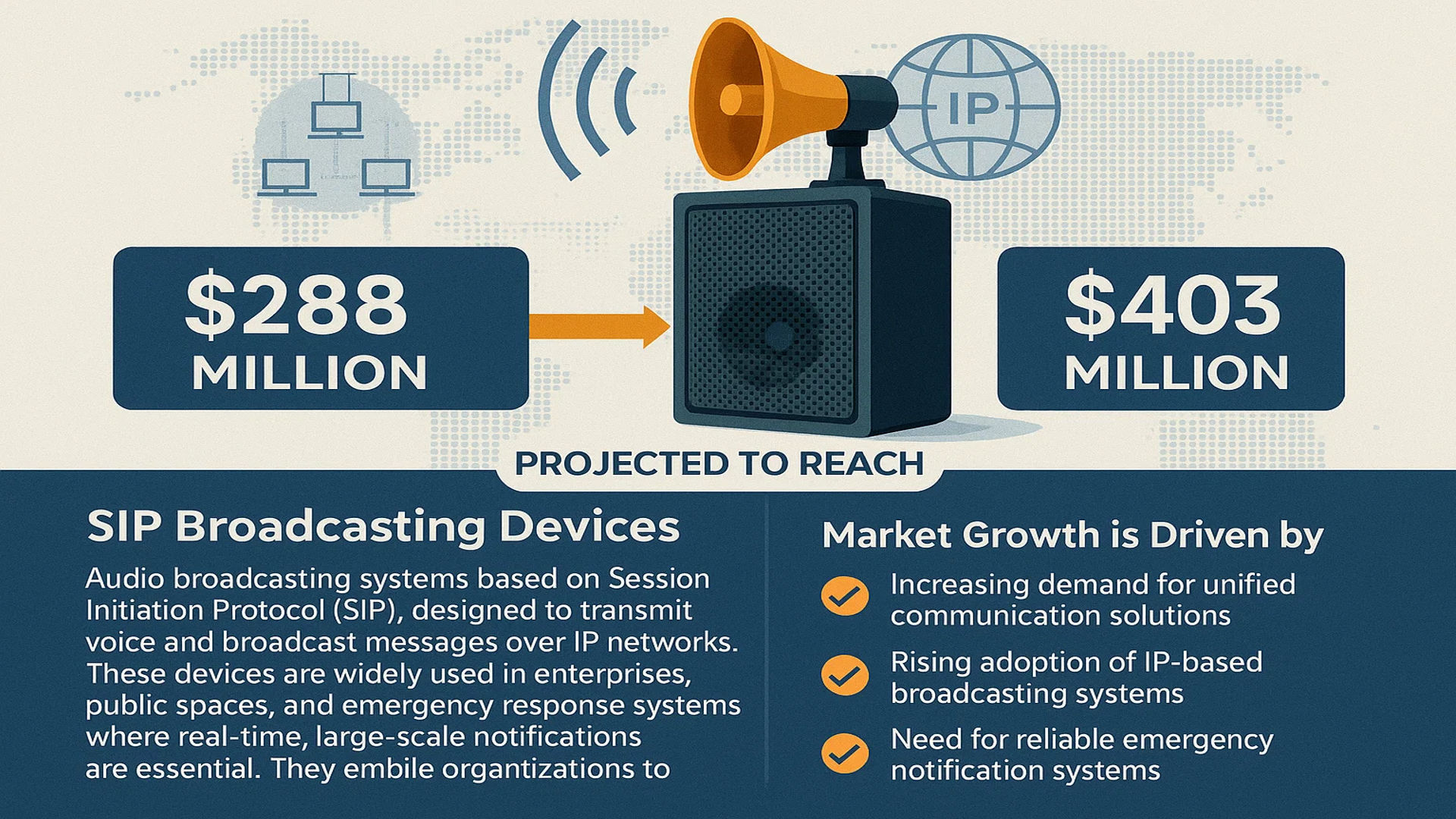
The global SIP Broadcasting Devices Market was valued at 288 million in 2024 and is projected to reach US$ 403 million by 2032, at a CAGR of 4.9% during the forecast period.
SIP Broadcasting Devices are audio broadcasting systems based on the Session Initiation Protocol (SIP), designed to transmit voice and broadcast messages over IP networks. These devices are widely used in enterprises, public spaces, and emergency response systems where real-time, large-scale notifications are essential. They enable organizations to efficiently deliver voice announcements and emergency alerts, improving operational safety and communication effectiveness.
The market growth is driven by increasing demand for unified communication solutions, the rising adoption of IP-based broadcasting systems, and the need for reliable emergency notification systems. While North America dominates the market due to high technological adoption, the Asia-Pacific region is witnessing rapid growth because of expanding infrastructure and digital transformation initiatives. Key players such as KENEUC, Telos Alliance, and Valcom are investing in product innovation to enhance interoperability and scalability, further propelling market expansion.
MARKET DYNAMICS
MARKET DRIVERS
Rising Adoption of IP-Based Communication Infrastructure to Accelerate Market Growth
The global transition from traditional Public Address (PA) systems to IP-based communication networks is significantly driving demand for SIP broadcasting devices. Organizations across sectors are modernizing their communication infrastructure to leverage the scalability, flexibility, and cost-efficiency of VoIP technologies. SIP broadcasting devices integrate seamlessly with existing IP networks, eliminating the need for dedicated wiring and enabling centralized control over multiple locations. This has led to strong adoption in sectors like education, healthcare, and transportation where real-time mass notification is critical. Recent infrastructure upgrades in smart cities have further accelerated deployment, with urban safety projects increasingly incorporating SIP-based emergency notification systems.
Growing Emphasis on Workplace Safety Regulations Fuels Market Expansion
Stringent occupational safety standards worldwide are mandating reliable emergency communication systems in industrial and commercial facilities. SIP broadcasting devices meet these requirements by providing instant voice evacuation alerts during crises, with deployment growing at over 6% annually in hazardous work environments. The technology’s ability to integrate with fire alarms, access control systems, and other safety infrastructure makes it particularly valuable for compliance with modern safety protocols. Manufacturing plants, chemical facilities, and oil refineries represent key growth sectors, where the systems’ rugged designs and fail-safe operation address critical safety needs.
Furthermore, regulatory mandates requiring periodic emergency system testing have created recurring revenue opportunities for maintenance and upgrade services.
➤ For instance, updated building codes in multiple jurisdictions now specify digital notification systems that can deliver targeted evacuation instructions during emergencies.
The convergence of these regulatory requirements with technological advancements in SIP protocols continues to drive robust market growth across multiple industries.
MARKET RESTRAINTS
Network Security Vulnerabilities Pose Significant Adoption Barriers
While SIP broadcasting offers numerous advantages, security concerns surrounding IP-based systems remain a key restraint. These devices are vulnerable to cyber threats including denial-of-service attacks, eavesdropping, and unauthorized access, which could compromise critical communication during emergencies. Organizations with sensitive operations, particularly in defense and government sectors, often prefer isolated analog systems due to these security risks. Implementing robust encryption and authentication protocols adds complexity and cost to SIP deployments, limiting adoption in budget-constrained environments.
Additionally, legacy infrastructure compatibility issues frequently delay migration projects, as many facilities still maintain older analog equipment that cannot interface with modern SIP solutions.
MARKET CHALLENGES
Interoperability and Standardization Issues Complicate Widespread Implementation
The SIP broadcasting market faces persistent challenges regarding interoperability between equipment from different manufacturers. While SIP is an open standard, variations in implementation often result in compatibility problems, particularly when integrating with third-party systems like access control or building automation. This fragmentation increases deployment complexity and total cost of ownership, discouraging some potential adopters. The absence of universal certification standards for emergency notification functionalities further exacerbates these challenges.
Other Challenges
Limited Bandwidth Environments
Deploying high-quality audio broadcasting in bandwidth-constrained locations remains technically challenging, particularly for facilities with legacy network infrastructure.
Latency Sensitivity
Emergency applications demand near-instantaneous message delivery, making network latency optimization crucial yet difficult to achieve consistently across diverse environments.
MARKET OPPORTUNITIES
Integration with AI and IoT Platforms Opens New Growth Avenues
The convergence of SIP broadcasting with artificial intelligence and IoT technologies presents significant growth opportunities. Smart systems combining SIP notification with environmental sensors can automatically trigger customized alerts based on real-time threat detection. This capability is driving adoption in smart city projects, where integrated emergency response systems are becoming standard. The ability to analyze vocal patterns and adjust message delivery for optimal comprehension represents another emerging application of AI in this space.
Manufacturers developing hybrid solutions that bridge SIP and emerging 5G networks are particularly well-positioned to capitalize on next-generation smart infrastructure projects. These technological synergies are expected to elevate SIP broadcasting from standalone notification tools to intelligent components of comprehensive safety ecosystems.
SIP BROADCASTING DEVICES MARKET TRENDS
IP-Based Communication Integration Driving Market Evolution
The SIP Broadcasting Devices market is witnessing robust growth due to the accelerated adoption of IP-based communication systems across industries. With a projected CAGR of 4.9% through 2032, these devices are becoming indispensable for real-time announcements and emergency notifications. SIP broadcasting solutions are increasingly replacing traditional PA systems because of their superior scalability, lower infrastructure costs, and seamless integration with VoIP networks. Enterprises deploying unified communications platforms are particularly driving demand, as these systems require compatibility with SIP protocols for streamlined operations. The ability to broadcast across multiple locations simultaneously through cloud-based solutions has further elevated their adoption rate in sectors like education, healthcare, and transportation.
Other Trends
Smart City Deployments Accelerating
Municipalities worldwide are incorporating SIP broadcasting devices into smart city infrastructures for public safety applications. These systems enable authorities to deliver timely emergency alerts, traffic updates, and public service announcements across urban centers. The integration with IoT sensors allows for automated triggering of broadcasts during emergencies, significantly reducing response times. Transportation hubs are particularly heavy adopters, with over 60% of major airports now using IP-based broadcasting for passenger information systems. This trend is expected to intensify as governments invest in resilient communication networks for disaster management.
Enterprise Digital Transformation Fuels Adoption
The ongoing digital transformation in corporate environments is creating significant opportunities for SIP broadcasting manufacturers. Modern workplaces require flexible communication tools that support hybrid work models, with SIP devices providing the necessary infrastructure for company-wide announcements and facility alerts. Retail chains benefit from zone-specific promotional messaging capabilities, while manufacturing plants utilize them for safety notifications across noisy environments. The industrial sector’s growing emphasis on worker safety protocols has led to a 35% year-over-year increase in demand for ruggedized SIP alarm systems that integrate with facility monitoring equipment. This widespread applicability across verticals continues to expand the technology’s market footprint.
COMPETITIVE LANDSCAPE
Key Industry Players
Market Competition Intensifies as Players Expand Product Offerings and Geographic Reach
The global SIP Broadcasting Devices market features a dynamic competitive landscape characterized by the presence of established manufacturers and emerging innovators. The market is moderately fragmented, with key players competing on factors such as product reliability, integration capabilities, and compliance with emergency communication standards. Valcom and CyberData Corporation currently lead the market, collectively accounting for approximately 28% of the 2024 global revenue share. Their dominance stems from extensive product portfolios covering SIP speakers, alarms, and integrated PA systems for enterprise environments.
Regional players like Guangzhou Unisoft Information Technology are gaining traction in Asian markets through cost-effective solutions tailored for smart city applications. Meanwhile, Telos Alliance maintains strong positioning in North America and Europe by focusing on broadcast-grade audio quality and interoperability with existing IP infrastructure. The company’s recent partnership with major VoIP providers has further strengthened its market position.
Strategic acquisitions and technology integrations are becoming increasingly common as companies seek to expand their capabilities. KENEUC‘s 2023 acquisition of a German audio engineering firm, for instance, enabled the company to enhance its product line with advanced acoustic processing technologies. Similarly, ZYCOO has been investing heavily in AI-powered voice clarity enhancements, positioning its solutions for high-noise industrial environments.
Smaller innovators like TONMIND and Flyingvoice are carving out niches through specialized offerings, particularly in the healthcare and education verticals where customized alert systems are in high demand. However, these companies face pressure from larger players who are rapidly adopting similar features in their mainstream product lines.
List of Leading SIP Broadcasting Device Manufacturers
- Valcom, Inc. (U.S.)
- CyberData Corporation (U.S.)
- KENEUC Electronics Co., Ltd. (China)
- Telos Alliance (U.S.)
- Guangzhou Unisoft Information Technology Co., Ltd. (China)
- RUKOTA Technologies (Germany)
- TONMIND Communication Co. (China)
- Akuvox (China)
- Flyingvoice Technology Co., Ltd. (China)
- ZYCOO Communications (China)
Segment Analysis:
By Type
SIP Speakers Segment Dominates the Market Due to High Adoption in Public Announcements and Emergency Notifications
The market is segmented based on type into:
- SIP Speakers
- Subtypes: Ceiling-mounted, Wall-mounted, and Portable
- SIP Alarms
- Subtypes: Voice alarms, Audio-visual alarms, and others
- Others
By Application
Commercial Use Segment Leads Owing to Widespread Deployment in Retail and Hospitality Sectors
The market is segmented based on application into:
- Commercial Use
- Subtypes: Retail stores, Hotels, Educational institutions
- Industrial Use
- Subtypes: Manufacturing plants, Warehouses, Logistics centers
- Other Applications
By End User
Enterprise Sector Dominates Due to Integration with Unified Communication Systems
The market is segmented based on end user into:
- Enterprise
- Subtypes: Large enterprises, SMEs
- Government & Public Sector
- Healthcare
- Transportation
- Others
Regional Analysis: SIP Broadcasting Devices Market
North America
The North American SIP Broadcasting Devices market is characterized by high adoption rates in enterprise and emergency communication systems. The region benefits from robust IP infrastructure and regulatory mandates for emergency notification systems, particularly in the U.S. where public safety legislation requires reliable mass notification solutions. Growth is further propelled by the integration of SIP broadcasting with unified communications platforms. Major players like CyberData Corporation and Valcom dominate the market, providing solutions for industrial, commercial, and institutional applications. The Canadian market, while smaller, follows similar adoption patterns with a focus on educational institutions and healthcare facilities.
Europe
Europe’s market is driven by strict workplace safety directives and smart city initiatives that incorporate SIP-based public address systems. Germany and the U.K. lead in adoption, with manufacturing facilities and transportation hubs implementing SIP broadcasting for operational alerts. EU-wide standardization of VoIP protocols creates a favorable environment, though market fragmentation persists due to varying national regulations. The increasing shift towards cloud-based SIP solutions is reshaping the competitive landscape, with European telecom providers actively partnering with device manufacturers. However, concerns over GDPR compliance in voice data handling present unique challenges for market players.
Asia-Pacific
The fastest-growing region, Asia-Pacific is experiencing exponential demand fueled by rapid digital transformation across China, Japan, and India. China’s SIP broadcasting market benefits from government-led smart infrastructure projects and expanding enterprise VoIP adoption. Japan’s advanced disaster preparedness systems incorporate SIP alarms extensively, while India’s growing IT sector drives commercial applications. Cost sensitivity leads to strong demand for mid-range SIP speaker solutions, though high-end systems gain traction in financial hubs like Singapore and Hong Kong. Local manufacturers such as Akuvox and ZYCOO compete effectively with international brands through price-competitive offerings.
South America
Market development in South America remains uneven, with Brazil accounting for nearly 60% of regional SIP broadcasting device deployments. Industrial applications in mining and manufacturing drive most demand, though economic instability constrains broader adoption. The lack of standardized emergency communication protocols across countries hampers market potential. Nevertheless, IP infrastructure improvements in major urban centers create opportunities, particularly for integrated security and paging systems. Market education remains critical as many organizations still rely on legacy PA systems.
Middle East & Africa
This emerging market shows strong growth potential in GCC countries, where smart city projects incorporate SIP broadcasting for public spaces. The UAE leads in adopting advanced notification systems for high-rise buildings and transportation hubs. Africa’s market is nascent but expanding in key economic centers including South Africa and Nigeria. While political instability and infrastructure gaps slow adoption, oil & gas facilities and commercial developments represent steady demand drivers. The region also sees increasing use of SIP devices for religious institutions and large-scale event venues.
Report Scope
This market research report provides a comprehensive analysis of the global SIP Broadcasting Devices market, covering the forecast period 2024–2032. It offers detailed insights into market dynamics, technological advancements, competitive landscape, and key trends shaping the industry.
Key focus areas of the report include:
- Market Size & Forecast: Historical data and future projections for revenue, unit shipments, and market value across major regions and segments. The global SIP Broadcasting Devices market was valued at USD 288 million in 2024 and is projected to reach USD 403 million by 2032, growing at a CAGR of 4.9%.
- Segmentation Analysis: Detailed breakdown by product type (SIP Speakers, SIP Alarms, Others) and application (Commercial Use, Industrial Use, Other Applications) to identify high-growth segments.
- Regional Outlook: Insights into market performance across North America, Europe, Asia-Pacific, Latin America, and the Middle East & Africa, with the U.S. and China being key markets.
- Competitive Landscape: Profiles of leading market participants including KENEUC, RUKOTA, Telos Alliance, Valcom, and CyberData Corporation, covering their product offerings and strategic developments.
- Technology Trends & Innovation: Assessment of IP-based broadcasting solutions, integration with VoIP systems, and advancements in emergency communication technologies.
- Market Drivers & Restraints: Evaluation of factors such as growing demand for public address systems, enterprise communication needs, and challenges in interoperability.
- Stakeholder Analysis: Insights for system integrators, IT solution providers, and end-users regarding implementation strategies and ROI considerations.
The research employs both primary and secondary methods, including interviews with industry experts and analysis of verified market data, to ensure accuracy and reliability.
FREQUENTLY ASKED QUESTIONS:
What is the current market size of Global SIP Broadcasting Devices Market?
-> SIP Broadcasting Devices Market was valued at 288 million in 2024 and is projected to reach US$ 403 million by 2032, at a CAGR of 4.9% during the forecast period.
Which key companies operate in Global SIP Broadcasting Devices Market?
-> Key players include KENEUC, RUKOTA, Telos Alliance, Valcom, CyberData Corporation, Guangzhou Unisoft Information Technology, and TONMIND.
What are the key growth drivers?
-> Key growth drivers include increasing adoption of IP-based communication systems, rising demand for emergency broadcast solutions, and growing enterprise security requirements.
Which region dominates the market?
-> North America currently leads in market share, while Asia-Pacific is expected to show the highest growth rate during the forecast period.
What are the emerging trends?
-> Emerging trends include integration with smart building systems, cloud-based SIP broadcasting solutions, and AI-powered voice recognition for targeted messaging.

Get Sample Report PDF for Exclusive Insights
Report Sample Includes
- Table of Contents
- List of Tables & Figures
- Charts, Research Methodology, and more...
 Download Sample Report PDF





