MARKET INSIGHTS
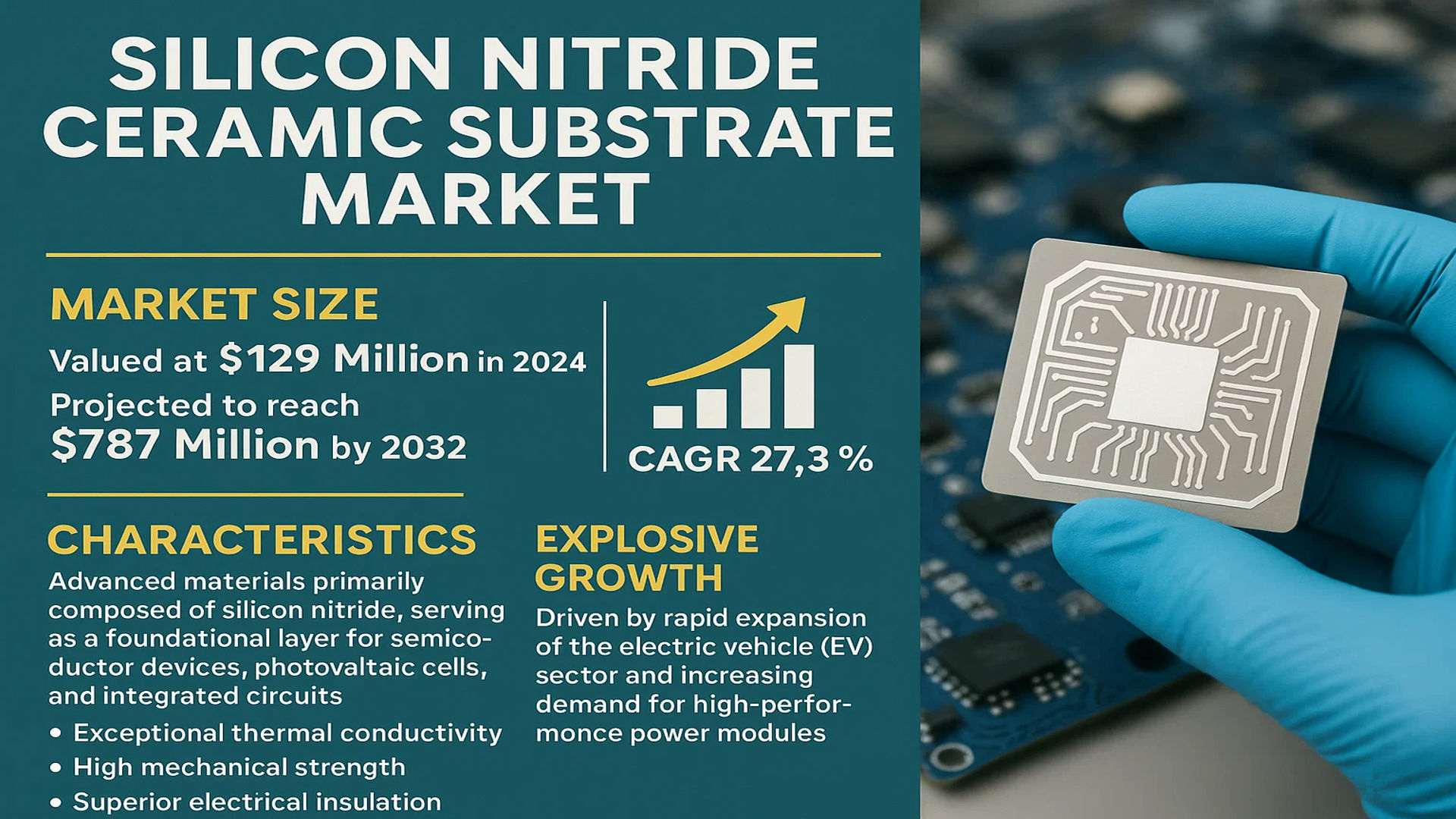
The global Silicon Nitride Ceramic Substrate Market was valued at 129 million in 2024 and is projected to reach US$ 787 million by 2032, at a CAGR of 27.3% during the forecast period.
Silicon nitride ceramic substrates are advanced physical materials composed primarily of silicon nitride, engineered to serve as a foundational layer for semiconductor devices, photovoltaic cells, and integrated circuits. These substrates are characterized by their exceptional thermal conductivity, high mechanical strength, and superior electrical insulation, making them one of the most promising materials for next-generation power electronics and high-temperature applications.
The market is experiencing explosive growth, primarily driven by the rapid expansion of the electric vehicle (EV) sector and the increasing demand for high-performance power modules. Furthermore, advancements in renewable energy infrastructure and the modernization of power grids are significant contributors. The market is highly concentrated, with the top three players—Denka, Toshiba, and Maruwa—collectively holding a dominant 79% market share. Geographically, China is the largest producer, accounting for approximately 96% of global output, while the Asia-Pacific region is the largest consumer market, holding a 66% share of global demand.
MARKET DYNAMICS
MARKET DRIVERS
Accelerated Adoption in Electric Vehicles and Power Electronics to Drive Market Expansion
The global transition toward electric vehicles (EVs) is significantly propelling the silicon nitride ceramic substrate market. These substrates are critical components in power modules for EV inverters and motor drives due to their exceptional thermal conductivity, which exceeds 90 W/mK, and high mechanical strength. With EV sales projected to surpass 17 million units annually by 2024 and continue growing at over 20% CAGR, the demand for reliable, high-performance substrates is surging. Silicon nitride’s ability to withstand extreme thermal cycling and operating temperatures up to 1000°C makes it indispensable for next-generation power devices. Furthermore, the expansion of fast-charging infrastructure, requiring robust power electronics, is driving substantial adoption across automotive and energy sectors.
Growth in Renewable Energy Infrastructure to Boost Market Growth
The rapid expansion of renewable energy systems, particularly solar and wind power installations, is creating strong demand for silicon nitride ceramic substrates. These substrates are essential in power conversion systems for photovoltaic inverters and wind turbine converters, where they enable efficient thermal management and enhance system reliability. Global renewable energy capacity additions reached nearly 510 gigawatts in 2023, representing a 50% increase from 2022 levels. Silicon nitride substrates’ superior performance in high-power, high-temperature applications positions them as enabling technology for grid-scale energy storage systems and smart grid infrastructure. The substrates’ excellent electrical insulation properties and thermal shock resistance make them ideal for power electronic applications in harsh environmental conditions.
Moreover, government initiatives and substantial investments in clean energy infrastructure are accelerating market adoption. National energy security policies and carbon reduction targets are driving increased deployment of power electronics utilizing advanced ceramic substrates.
➤ For instance, major infrastructure investment programs are allocating billions toward modernizing power grids and expanding renewable energy capacity, creating sustained demand for high-performance substrate materials.
Furthermore, technological advancements in substrate manufacturing processes are enhancing product performance while reducing costs, making silicon nitride substrates more accessible across various applications and driving broader market penetration.
MARKET CHALLENGES
High Manufacturing Costs and Complex Production Processes to Challenge Market Growth
The silicon nitride ceramic substrate market faces significant challenges related to manufacturing complexity and associated costs. The production process involves sophisticated techniques including powder preparation, forming, and high-temperature sintering at approximately 1800°C under controlled atmospheres. These processes require specialized equipment and stringent quality control measures, resulting in manufacturing costs that are approximately 40-60% higher than alternative substrate materials. The raw material costs, particularly high-purity silicon nitride powder representing nearly 35% of total production costs, create substantial entry barriers for new market participants. Additionally, achieving consistent quality and performance characteristics across production batches remains technically challenging, affecting yield rates and overall production efficiency.
Other Challenges
Technical Performance Limitations
While silicon nitride offers excellent thermal properties, achieving optimal surface finish and dimensional stability remains challenging. The substrates require precise machining and polishing processes to meet the strict flatness requirements of semiconductor packaging, adding to manufacturing complexity and cost. Variations in thermal expansion coefficient matching with other components can create interface stresses, potentially affecting long-term reliability in certain applications.
Supply Chain Vulnerabilities
The market faces challenges related to raw material availability and supply chain stability. High-purity silicon nitride powder production is concentrated among few global suppliers, creating potential supply bottlenecks. Geopolitical factors and trade policies can disrupt material availability, while quality consistency across different powder batches affects manufacturing consistency and product performance.
MARKET RESTRAINTS
Competition from Alternative Substrate Materials to Deter Market Growth
Silicon nitride ceramic substrates face significant competition from established alternative materials, particularly aluminum nitride and aluminum oxide substrates. Aluminum nitride substrates offer thermal conductivity exceeding 170 W/mK, nearly double that of silicon nitride, while costing approximately 25-30% less in volume production. These materials have well-established manufacturing processes and broader industry acceptance, particularly in consumer electronics and traditional power applications. The existing manufacturing infrastructure and developed supply chains for alternative substrates create adoption barriers for silicon nitride, especially in price-sensitive market segments. Furthermore, the learning curve associated with implementing new materials in manufacturing processes discourages rapid technology transition among established electronics manufacturers.
Additionally, performance limitations in certain application areas restrict market expansion. While excellent for high-power applications, silicon nitride’s higher dielectric constant compared to some alternatives can be disadvantageous in high-frequency applications, limiting its adoption in certain telecommunications and RF power applications.
MARKET OPPORTUNITIES
Expansion in 5G Infrastructure and Aerospace Applications to Provide Profitable Growth Opportunities
The rapid global deployment of 5G network infrastructure presents substantial growth opportunities for silicon nitride ceramic substrates. These substrates are increasingly adopted in 5G base station power amplifiers and RF components due to their excellent high-frequency performance and thermal management capabilities. With over 2 million 5G base stations expected to be deployed globally by 2025 and continued network expansion, the demand for high-reliability substrate materials is accelerating. The substrates’ ability to maintain performance under high power density and extreme environmental conditions makes them ideal for outdoor telecommunications equipment and network infrastructure applications.
Furthermore, the aerospace and defense sectors offer significant growth potential. Silicon nitride substrates are being increasingly adopted in radar systems, satellite communications, and avionics power systems where reliability under extreme conditions is paramount. The materials’ radiation resistance and stability in vacuum environments make them suitable for space applications, while their mechanical strength supports use in vibration-intensive military equipment.
Additionally, emerging applications in medical electronics and high-performance computing are creating new market avenues. The substrates’ biocompatibility and electrical insulation properties support use in medical imaging equipment and implantable medical devices, while their thermal performance benefits next-generation computing systems requiring advanced cooling solutions.
SILICON NITRIDE CERAMIC SUBSTRATE MARKET TRENDS
Electrification of Automotive and Industrial Sectors Drives Unprecedented Demand
The global transition towards electrification, particularly in the automotive and industrial sectors, is the primary catalyst for the silicon nitride ceramic substrate market’s robust growth. The proliferation of electric vehicles (EVs) necessitates advanced power modules that can operate at higher temperatures and voltages, where silicon nitride’s exceptional thermal conductivity—often exceeding 90 W/mK—and high mechanical strength are critical. This is not limited to passenger vehicles; the trend extends to commercial vehicles, railway traction systems, and industrial motor drives. Furthermore, the global push for renewable energy integration into power grids requires more robust and efficient semiconductor packaging. Silicon nitride substrates are becoming the material of choice for insulating metal substrates in these high-power density applications because they significantly enhance thermal management and reliability, directly supporting the market’s projected CAGR of 27.3%.
Other Trends
Miniaturization and Increased Power Density in Electronics
The relentless drive for miniaturization and higher power density in electronics is a significant trend propelling the adoption of silicon nitride substrates. As semiconductor devices shrink, the heat generated per unit area increases dramatically, creating a critical need for substrates that can effectively dissipate this heat to prevent failure. Silicon nitride, with its superior thermal performance compared to traditional materials like aluminum oxide, allows designers to pack more power into smaller form factors. This is especially crucial for next-generation wide-bandgap semiconductors like silicon carbide (SiC) and gallium nitride (GaN), which operate at higher frequencies and temperatures. The ability of silicon nitride to act as a highly effective thermal interface material is therefore indispensable for the continued advancement of compact, high-performance power electronics.
Geographic Production Concentration and Supply Chain Considerations
A defining characteristic of this market is its extreme geographic concentration, which presents both a strength and a potential vulnerability. China’s dominance as a producer, accounting for approximately 96% of global output, is underpinned by significant domestic investment in advanced materials manufacturing and a strong downstream electronics industry. This concentration creates a highly efficient supply hub for the Asia-Pacific region, which consumes about 66% of the global supply. However, this also introduces supply chain risks, as geopolitical tensions or regional disruptions could impact global availability. In response, other regions, particularly in Europe and North America, are increasingly evaluating strategies for onshoring or near-shoring production of these critical components to secure their supply chains for strategic industries like automotive and aerospace, which could lead to a gradual shift in the global production landscape over the long term.
COMPETITIVE LANDSCAPE
Key Industry Players
Market Dominance by Established Material Science Giants Drives Innovation
The global silicon nitride ceramic substrate market exhibits a highly concentrated competitive structure, dominated by a few major players who control a significant portion of the production and technological know-how. This concentration is primarily due to the complex manufacturing processes and substantial capital investment required for high-volume, high-quality production. Denka Company Limited (Japan) stands as the unequivocal market leader, a position solidified through its pioneering work in developing high-thermal-conductivity silicon nitride and its extensive production capacity. The company’s technological edge and established supply agreements with major power semiconductor manufacturers across Asia and Europe make it a cornerstone of the industry.
Following closely, Toshiba Corporation (Japan) and Maruwa Co., Ltd. (Japan) also command significant market shares. Their growth is intrinsically linked to their deep-rooted expertise in advanced ceramics and electronics, allowing them to offer substrates that meet the rigorous reliability and performance standards demanded by the automotive and industrial sectors. These Japanese firms benefit from a strong domestic ecosystem for advanced materials and close collaboration with end-users.
Furthermore, these incumbents are aggressively pursuing capacity expansions and process innovations to maintain their leadership. For instance, recent industry developments indicate strategic investments aimed at scaling production to meet the surging demand from the electric vehicle revolution. This is crucial because the market’s projected growth to $787 million by 2032 is contingent on the ability of these key players to reliably supply the market.
Meanwhile, other significant players are carving out their niches. Kyocera Corporation (Japan) leverages its vast experience in ceramic components to serve diverse applications, while Chinese manufacturers like Weihai Yuanhuan and Sinoma Advanced Nitride Ceramics Co. are strengthening their presence, particularly within the massive Asia-Pacific market. These companies are focusing on competitive pricing and scaling production, which is expected to gradually increase their market influence over the coming years. The competitive strategies thus revolve around technological superiority, strategic capacity growth, and forging strong, long-term partnerships with device manufacturers.
List of Key Silicon Nitride Ceramic Substrate Companies Profiled
- Denka Company Limited (Japan)
- Toshiba Corporation (Japan)
- Maruwa Co., Ltd. (Japan)
- Kyocera Corporation (Japan)
- Weihai Yuanhuan (China)
- Sinoma Advanced Nitride Ceramics Co. (China)
Segment Analysis:
By Type
0.32mm SiN Substrate Segment Dominates the Market Due to Superior Thermal Management in High-Power Applications
The market is segmented based on type into:
- 0.32mm SiN Substrate
- 0.25mm SiN Substrate
By Application
New Energy & Power Grid Segment Leads Due to Critical Role in Renewable Energy Systems and Grid Infrastructure
The market is segmented based on application into:
- Automobile
- Traction & Railway
- New Energy & Power Grid
- Military & Aerospace
- Others
By End-User Industry
Power Electronics Sector Holds Prominence Driven by Demand for Efficient Semiconductor Packaging
The market is segmented based on end-user industry into:
- Power Electronics
- Automotive Electronics
- Renewable Energy
- Aerospace & Defense
- Others
Regional Analysis: Silicon Nitride Ceramic Substrate Market
Asia-Pacific
The Asia-Pacific region is the undisputed global leader in the Silicon Nitride Ceramic Substrate market, commanding approximately 66% of the total market share. This dominance is overwhelmingly driven by China, which alone accounts for an estimated 96% of global production. The region’s supremacy is underpinned by its massive electronics manufacturing ecosystem, substantial government investments in new energy infrastructure, and a robust domestic supply chain. Key applications fueling demand include the rapidly expanding electric vehicle (EV) sector, where these substrates are critical for power modules, and the burgeoning renewable energy industry, particularly in solar and wind power conversion systems. While Japan remains a technological leader with key players like Toshiba and Maruwa, its market share in terms of volume is significantly smaller. The region benefits from strong government support for technological advancement in semiconductors and power electronics, creating a fertile environment for continued growth and innovation in high-performance ceramic substrates.
Europe
Europe represents the second-largest market for Silicon Nitride Ceramic Substrates, holding a significant 32% share of global consumption. The market is primarily driven by the region’s advanced automotive industry, especially the aggressive push towards electrification, and its strong aerospace and industrial sectors. Stringent regulations on vehicle emissions and energy efficiency are compelling automakers to adopt advanced power electronics that rely on high-performance substrates like silicon nitride for their superior thermal management and reliability. Furthermore, significant investments in railway electrification and smart grid technologies across the European Union are creating sustained demand. The market is characterized by a high value-over-volume approach, with a strong emphasis on quality, precision engineering, and compliance with rigorous performance and environmental standards. Leading automotive OEMs and tier-one suppliers are the primary consumers, sourcing substrates for applications in traction inverters, onboard chargers, and DC-DC converters.
North America
The North American market, while currently holding a smaller share of approximately 2%, is poised for notable growth. Demand is concentrated in high-tech industries, including military and aerospace applications, where the exceptional reliability and performance of silicon nitride substrates under extreme conditions are paramount. The region’s growing focus on data centers and 5G infrastructure also presents emerging opportunities, as these substrates can enhance the thermal performance and power density of related electronics. However, the market’s expansion is somewhat tempered by the region’s limited local production capacity, leading to a heavy reliance on imports, primarily from Asia. Recent U.S. government initiatives aimed at reshoring semiconductor and advanced packaging manufacturing could potentially stimulate future domestic demand and investment in the supply chain for advanced ceramic materials.
South America
The market in South America is in a nascent stage of development. Current demand is minimal and is primarily linked to specific industrial and energy projects. The region’s economic volatility and relatively underdeveloped high-tech manufacturing base act as significant barriers to widespread adoption. Growth is sporadic and often tied to foreign direct investment in sectors like mining and energy, which may utilize this technology in specialized power equipment. The lack of a localized production base means all requirements are met through imports, making the market sensitive to global supply chain disruptions and currency exchange fluctuations. Long-term growth will be contingent on broader economic stabilization and increased investment in technological infrastructure.
Middle East & Africa
This region represents an emerging and highly potential market, though its current share is the smallest globally. Development is driven by long-term strategic investments in diversification away from oil, particularly in nations like Saudi Arabia and the UAE under initiatives such as Saudi Vision 2030. Potential applications are emerging in areas like modernized power grids, water desalination plants, and telecommunications infrastructure, all of which require robust power electronics. However, progress is gradual and faces challenges including a lack of local technical expertise, limited regulatory frameworks for advanced electronics, and competition for capital against other infrastructure priorities. The market is expected to evolve slowly, with growth being project-driven rather than based on broad-based industrial demand in the near term.
Report Scope
This market research report provides a comprehensive analysis of the global Silicon Nitride Ceramic Substrate market, covering the forecast period 2025–2032. It offers detailed insights into market dynamics, technological advancements, competitive landscape, and key trends shaping the industry.
Key focus areas of the report include:
- Market Size & Forecast: Historical data and future projections for revenue, unit shipments, and market value across major regions and segments.
- Segmentation Analysis: Detailed breakdown by product type, technology, application, and end-user industry to identify high-growth segments and investment opportunities.
- Regional Outlook: Insights into market performance across North America, Europe, Asia-Pacific, Latin America, and the Middle East & Africa, including country-level analysis where relevant.
- Competitive Landscape: Profiles of leading market participants, including their product offerings, R&D focus, manufacturing capacity, pricing strategies, and recent developments such as mergers, acquisitions, and partnerships.
- Technology Trends & Innovation: Assessment of emerging technologies, integration of AI/IoT, semiconductor design trends, fabrication techniques, and evolving industry standards.
- Market Drivers & Restraints: Evaluation of factors driving market growth along with challenges, supply chain constraints, regulatory issues, and market-entry barriers.
- Stakeholder Analysis: Insights for component suppliers, OEMs, system integrators, investors, and policymakers regarding the evolving ecosystem and strategic opportunities.
Primary and secondary research methods are employed, including interviews with industry experts, data from verified sources, and real-time market intelligence to ensure the accuracy and reliability of the insights presented.
FREQUENTLY ASKED QUESTIONS:
What is the current market size of Global Silicon Nitride Ceramic Substrate Market?
-> Silicon Nitride Ceramic Substrate Market was valued at 129 million in 2024 and is projected to reach US$ 787 million by 2032, at a CAGR of 27.3% during the forecast period.
Which key companies operate in Global Silicon Nitride Ceramic Substrate Market?
-> Key players include Denka, Toshiba, Maruwa, Hitachi, Kyocera, Weihai Yuanhuan, and Sinoma Advanced Nitride Ceramics, among others.
What are the key growth drivers?
-> Key growth drivers include demand for next-generation power devices, expansion of electric vehicles, and growth in renewable energy infrastructure.
Which region dominates the market?
-> Asia-Pacific is the largest market, holding a share of 66%, followed by Europe with 32%.
What are the emerging trends?
-> Emerging trends include advancements in thermal management solutions, increased adoption in military & aerospace applications, and development of thinner substrates.

Get Sample Report PDF for Exclusive Insights
Report Sample Includes
- Table of Contents
- List of Tables & Figures
- Charts, Research Methodology, and more...
 Download Sample Report PDF