Silicon-Based Microdisplay Chips Market Insights
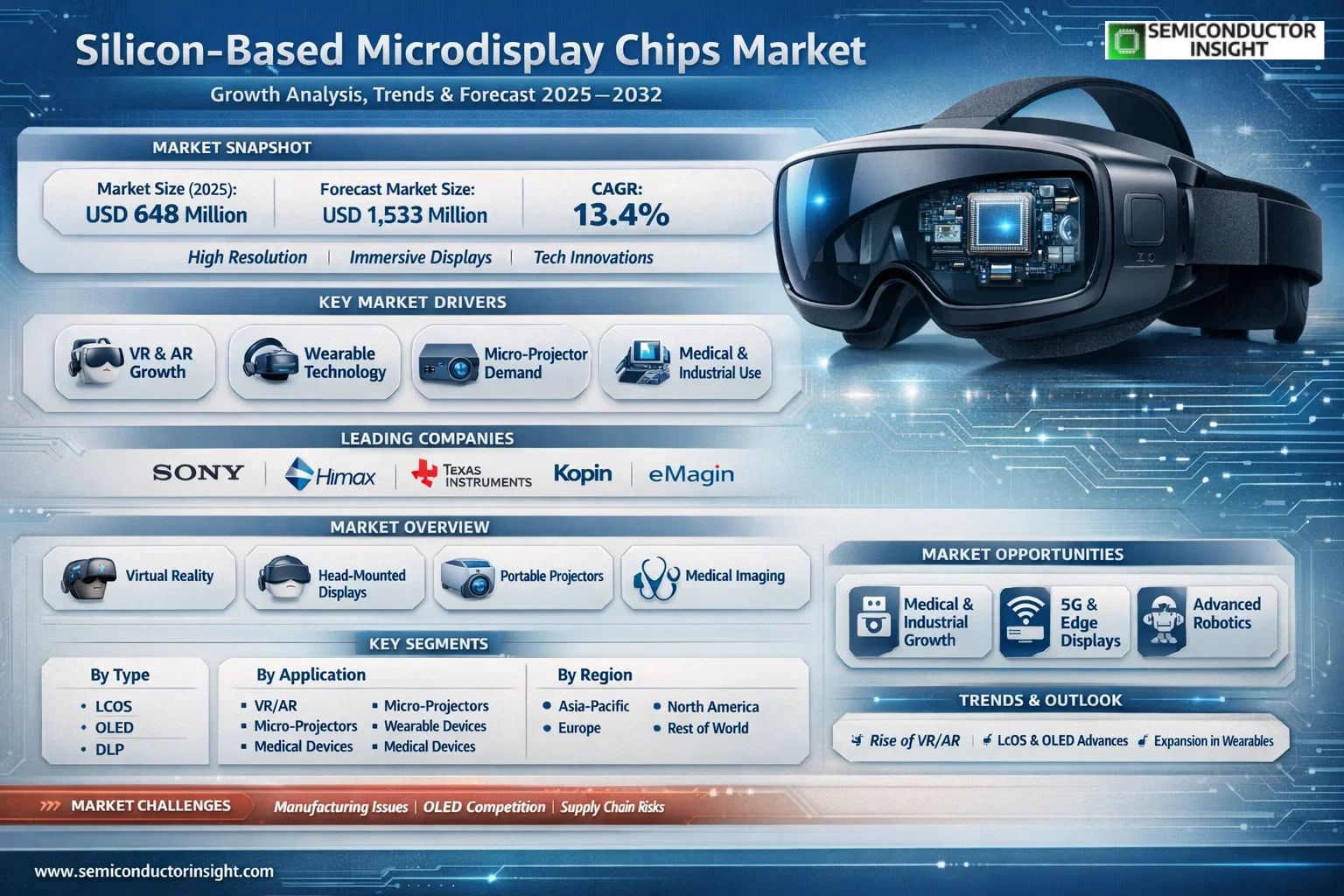
Global Silicon-Based Microdisplay Chips market was valued at USD 648 million in 2025. The market is projected to reach USD 1,533 million by 2032, exhibiting a CAGR of 13.4% during the forecast period.
Silicon-based microdisplay chips are micro-sized display chips made from silicon materials that convert image or video signals into visible display content through miniaturized electronic display units. These chips are typically used in applications that require small, high-definition, and efficient displays, such as virtual reality (VR), augmented reality (AR), micro-projectors, head-mounted displays (HMD), and wearable devices. Compared to traditional display technologies, silicon-based microdisplay chips offer smaller sizes, higher resolutions, and lower power consumption, while providing stable display performance in various environments.
The market is experiencing rapid growth due to several factors, including surging demand for immersive VR/AR experiences, advancements in wearable technology, and expanding applications in micro-projection and medical devices. Furthermore, innovations enhancing resolution and energy efficiency are accelerating adoption across consumer electronics. Initiatives by key players continue to propel this expansion. Sony Semiconductor Solutions, Himax Technologies, Texas Instruments (TI), Kopin, eMagin, OmniVision, HOLOEYE Photonics, and Microoled are some of the key players operating in the market with diverse portfolios.
MARKET DRIVERS
Rising Demand in AR/VR Headsets
Silicon-Based Microdisplay Chips Market is propelled by the surge in augmented reality (AR) and virtual reality (VR) applications, where compact, high-resolution displays are essential. These chips, particularly liquid crystal on silicon (LCoS) technology, offer superior pixel density exceeding 4K resolution in small form factors, enabling immersive experiences in consumer headsets and enterprise training tools. With global AR/VR shipments projected to reach 75 million units by 2025, demand for efficient silicon backplanes has accelerated market growth.
Automotive Head-Up Displays Expansion
Advancements in automotive head-up displays (HUDs) further drive Silicon-Based Microdisplay Chips Market, as manufacturers integrate brighter and wider field-of-view systems into premium vehicles. Silicon-based chips provide the necessary contrast ratios above 1,000,000:1, enhancing driver safety by projecting critical information without diverting attention. The automotive segment alone is expected to contribute 25% of market revenue by 2027, fueled by electrification trends and ADAS adoption.
➤ Silicon-Based Microdisplay Chips Market CAGR of 11.5% through 2030 underscores the pivotal role of high-brightness capabilities in pico projectors and wearable optics.
Innovation in projection technologies, including home theater and portable projectors, reinforces momentum, as silicon chips deliver seamless 8K upscaling with low latency, appealing to gaming and entertainment sectors.
MARKET CHALLENGES
Manufacturing Complexity and Yield Issues
Silicon-Based Microdisplay Chips Market faces hurdles from intricate fabrication processes requiring sub-micron precision for mirror arrays or liquid crystal alignment, leading to yields below 80% in initial production runs. Scaling to higher resolutions amplifies defect rates, straining resources for key players in foundry partnerships. These technical demands slow time-to-market for next-gen devices amid rapid tech evolution.
Other Challenges
Competition from OLED Microdisplays
Emerging organic light-emitting diode (OLED) alternatives challenge silicon-based dominance with self-emissive pixels offering better color gamut over 100% DCI-P3, though at higher costs and lower longevity. Integration complexities in hybrid systems further complicate adoption.
Supply fluctuations for specialized silicon wafers and polarizers add cost volatility, impacting pricing competitiveness in consumer electronics where margins are tight.
MARKET RESTRAINTS
Technical Limitations in Brightness and Power
Power efficiency remains a key restraint in Silicon-Based Microdisplay Chips Market, as reflective architectures demand external illumination sources that consume up to 30% more energy than emissive rivals in battery-powered devices. Achieving luminance levels above 5,000 nits for outdoor visibility proves challenging without thermal throttling, limiting penetration into mobile AR glasses.
Patent thickets and IP disputes among leaders like OmniVision and Sony hinder collaborative R&D, delaying standardization and raising entry barriers for new entrants. Regulatory scrutiny on electronic waste from chip production also pressures sustainability compliance.
Geopolitical tensions disrupt raw material flows, with over 60% of advanced silicon processing concentrated in East Asia, exposing the market to trade vulnerabilities and inflation risks.
MARKET OPPORTUNITIES
Emerging Applications in Medical and Industrial
Silicon-Based Microdisplay Chips Market holds strong potential in medical endoscopes and surgical microscopes, where high-contrast imaging supports minimally invasive procedures with resolutions up to 12MP. Growth in telemedicine, projected at 15% annually, positions these chips for integration into compact diagnostic tools.
Industrial machine vision systems benefit from the durability and precision of silicon-based chips, enabling real-time defect detection in manufacturing lines with sub-millisecond response times. Expansion into smart factories could add $2 billion in market value by 2028.
Strategic alliances for 5G-enabled edge displays in drones and robotics open new avenues, leveraging the chips’ low-latency performance for AI-driven applications in defense and logistics.
Silicon-Based Microdisplay Chips Market Trends
Growing Adoption in VR/AR Applications
Silicon-based microdisplay chips have become essential components in Silicon-Based Microdisplay Chips Market, particularly driving innovations in virtual reality (VR) and augmented reality (AR) devices. These chips excel in delivering high-definition visuals within compact form factors, enabling immersive experiences in head-mounted displays (HMD). Their ability to maintain stable performance across diverse environments, combined with lower power consumption compared to traditional displays, positions them as a preferred choice for next-generation VR/AR hardware. As consumer interest in extended reality technologies surges, manufacturers are increasingly integrating these chips to enhance resolution and responsiveness, fueling market expansion.
Other Trends
Advancements in LCoS and OLED Technologies
Within Silicon-Based Microdisplay Chips Market, liquid crystal on silicon (LCoS) and organic light-emitting diode (OLED) segments are witnessing significant technological progress. LCoS chips provide superior light efficiency and contrast ratios, making them ideal for micro-projectors and precision display applications. Meanwhile, OLED variants offer vibrant colors and faster response times, broadening their appeal in high-end consumer electronics. Key players like Sony Semiconductor Solutions and Himax Technologies are leading developments, focusing on improved pixel densities and manufacturing scalability to meet rising demands.
Expansion into Wearable Devices and Medical Applications
Silicon-Based Microdisplay Chips Market is experiencing robust growth through diversification into wearable devices and medical equipment. In wearables, these chips enable ultra-compact, energy-efficient screens that support always-on functionality without compromising battery life. Medical devices benefit from their reliability in HMDs for surgical visualization and diagnostic tools, where high precision is critical. Regional dynamics show strong momentum in Asia, particularly China and Japan, where companies such as AUO and Visionox are advancing production capabilities. This trend underscores a shift toward multifunctional, miniaturized displays, with digital light processing (DLP) also gaining traction for versatile projection needs. Industry surveys highlight ongoing innovations addressing challenges like thermal management and integration, ensuring sustained competitiveness among suppliers.
COMPETITIVE LANDSCAPE
Key Industry Players
Silicon-Based Microdisplay Chips Market Leaders and Dynamics
Silicon-Based Microdisplay Chips Market exhibits a moderately concentrated structure, led by established semiconductor giants such as Sony Semiconductor Solutions, Himax Technologies, and Texas Instruments (TI). These frontrunners command substantial revenue shares, with the global top five players collectively capturing a significant portion of the market in 2025, amid a sector valued at US$648 million and projected to grow to US$1,533 million by 2032 at a 13.4% CAGR. Dominance stems from their advanced capabilities in LCoS, OLED, and DLP technologies, tailored for high-resolution demands in VR/AR headsets, micro-projectors, and wearables. Sony excels in integrated solutions for consumer electronics, while TI’s DLP expertise drives projector applications, fostering innovation amid rising demand for compact, power-efficient displays.
Beyond the leaders, a cadre of niche players enriches the competitive landscape, including Kopin and eMagin, which specialize in OLED microdisplays for defense and avionics, alongside HOLOEYE Photonics’ LCoS innovations for photonics applications. Emerging Asian contenders like OmniVision, AUO, Visionox, and BOE Technology intensify rivalry through cost-effective scaling for consumer wearables and medical devices, complemented by specialized firms such as Microoled, Hongshi Intelligence Tech, VIEWTRIX Technology, and Nanjing SmartVision Electronics. This mix spurs technological advancements, mergers, and regional expansions, particularly in North America and Asia-Pacific, challenging incumbents while navigating supply chain and R&D hurdles in this high-growth arena.
List of Key Silicon-Based Microdisplay Chips Companies Profiled
- Sony Semiconductor Solutions
- Himax Technologies
- Texas Instruments (TI)
- Kopin
- eMagin
- OmniVision
- HOLOEYE Photonics
- Microoled
- AUO
- Visionox
- BOE Technology
- Hongshi Intelligence Tech
- VIEWTRIX Technology
- Nanjing SmartVision Electronics
Segment Analysis:
| Segment Category | Sub-Segments | Key Insights |
| By Type |
|
LCoS remains the leading segment due to its mature technology and versatility.
|
| By Application |
|
VR/AR leads the application segment, driven by immersive technology demands.
|
| By End User |
|
Consumer Electronics dominates as the primary end user.
|
| By Resolution |
|
Full HD/4K emerges as the leading resolution category for premium applications.
|
| By Display Size |
|
0.5 – 1.0 inch leads in display size segment for balanced performance.
|
Regional Analysis: Silicon-Based Microdisplay Chips Market
North America
North America’s Silicon-Based Microdisplay Chips Market thrives on world-class R&D centers pioneering silicon backplane designs. Universities and labs collaborate with industry to enhance resolution and color gamut, propelling AR/VR integration. This focus yields superior optical performance, attracting global partnerships.
Strong defense sector reliance fuels Silicon-Based Microdisplay Chips Market in North America. Compact chips power helmet-mounted displays and rugged optics, demanding high reliability. Government contracts drive customized developments, enhancing strategic capabilities.
Booming AR/VR and smart eyewear markets accelerate Silicon-Based Microdisplay Chips Market growth. Chipmakers optimize for low latency and eye-tracking features, aligning with consumer trends toward immersive experiences and portable devices.
Abundant venture capital and cross-sector alliances invigorate North America’s Silicon-Based Microdisplay Chips Market. Strategic mergers between fabless designers and integrators streamline commercialization, positioning the region for sustained leadership.
Europe
Europe’s Silicon-Based Microdisplay Chips Market exhibits steady evolution, anchored by precision engineering expertise in Germany and France. Focus on automotive applications drives demand for reflective silicon displays in advanced driver-assistance systems and heads-up displays, emphasizing durability and sunlight readability. Collaborative frameworks like Horizon Europe fund joint ventures, enhancing yield optimization and energy efficiency. Niche strengths in photonics and optics integration support medical endoscopes and industrial projectors. While manufacturing lags behind Asia, Europe’s regulatory emphasis on sustainability spurs eco-friendly silicon processes. Challenges include fragmented supply chains, yet innovation in hybrid silicon-organic displays promises growth. Expanding VR training simulations in enterprises further bolsters market dynamics, positioning Europe as a quality-focused contender.
Asia-Pacific
Asia-Pacific emerges as a powerhouse in Silicon-Based Microdisplay Chips Market, propelled by manufacturing prowess in Japan, South Korea, and China. Massive scale production of silicon-based LCoS and OLED-on-silicon chips caters to consumer electronics and gaming peripherals. Rapid ecosystem development, with foundries scaling high-volume yields, reduces costs and accelerates time-to-market. Consumer-driven demand for affordable AR smart glasses intensifies competition, fostering iterative improvements in brightness and form factors. Government initiatives promote semiconductor self-reliance, attracting foreign investments. Supply chain integration from wafer to module streamlines operations. Despite IP concerns, Asia-Pacific’s agility and volume dominance challenge global leaders, with projections for expanded roles in mobile projection and wearables.
South America
South America’s Silicon-Based Microdisplay Chips Market remains nascent but shows promise through emerging tech adoption in Brazil and Mexico. Focus on cost-effective solutions for education projectors and digital signage leverages imported silicon chips. Local assembly partnerships mitigate import dependencies, building regional capabilities. Rising middle-class demand for consumer displays spurs market entry by international players. Challenges like infrastructure gaps hinder scaling, yet educational VR initiatives and automotive upgrades create opportunities. Policy support for electronics manufacturing encourages technology transfer, gradually elevating South America’s position in the global Silicon-Based Microdisplay Chips Market dynamics.
Middle East & Africa
The Middle East & Africa Silicon-Based Microdisplay Chips Market is developing amid diversification efforts beyond oil. UAE and South Africa’s investments in smart city projects and defense optics drive demand for rugged silicon microdisplays. Harsh environment adaptations prioritize heat-resistant designs for outdoor HUDs and surveillance. Collaborations with Asian suppliers facilitate technology access, while local R&D hubs explore customized applications. Expanding gaming and e-learning sectors in Africa fuel consumer uptake. Infrastructure investments and free trade zones enhance logistics, though skill gaps persist. Strategic focus on high-reliability chips positions the region for incremental growth in specialized niches.
Report Scope
This market research report provides a comprehensive analysis of Silicon-Based Microdisplay Chips Market, covering the forecast period 2025–2032. It offers detailed insights into market dynamics, technological advancements, competitive landscape, and key trends shaping the industry.
Key focus areas of the report include:
- Market Overview: The report begins with an overview outlining its current market scenario, key growth indicators, and industry transformation drivers. It discusses macroeconomic factors, demand–supply balance, regulatory landscape, and the strategic role of semiconductors in powering advancements across industries such as automotive, telecommunications, consumer electronics, and industrial automation.
- Market Size & Forecast: Historical data and future projections for revenue, unit shipments, and market value across major regions and segments.
- Segmentation Analysis: Detailed breakdown by product type, technology, application, and end-user industry to identify high-growth segments and investment opportunities.
- Regional Insights: Insights into market performance across North America, Europe, Asia-Pacific, Latin America, and the Middle East & Africa, including country-level analysis where relevant.
- Competitive Landscape: Profiles of leading market participants, including their product offerings, R&D focus, manufacturing capacity, pricing strategies, and recent developments such as mergers, acquisitions, and partnerships.
- Technology Trends & Innovation: Assessment of emerging technologies, integration of AI/IoT, semiconductor design trends, fabrication techniques, and evolving industry standards.
- Market Drivers & Restraints: Evaluation of factors driving market growth along with challenges, supply chain constraints, regulatory issues, and market-entry barriers.
- Stakeholder Insights: Insights for component suppliers, OEMs, system integrators, investors, and policymakers regarding the evolving ecosystem and strategic opportunities.
Primary and secondary research methods are employed, including interviews with industry experts, data from verified sources, and real-time market intelligence to ensure the accuracy and reliability of the insights presented.
FREQUENTLY ASKED QUESTIONS:
What is the current market size of Silicon-Based Microdisplay Chips Market?
-> Global Silicon-Based Microdisplay Chips market was valued at USD 648 million in 2025 and is projected to reach USD 1533 million by 2032, at a CAGR of 13.4% during the forecast period.
Which key companies operate in Silicon-Based Microdisplay Chips Market?
-> Key players include Sony Semiconductor Solutions, Himax Technologies, Texas Instruments (TI), Kopin, eMagin, OmniVision, among others.
What are the key growth drivers?
-> Key growth drivers include demand for compact, high-resolution displays in VR/AR, head-mounted displays, micro-projectors, and wearable devices.
Which region dominates the market?
-> Asia is the fastest-growing region, while North America remains a dominant market.
What are the emerging trends?
-> Emerging trends include LCoS, OLED, and DLP technologies for efficient microdisplays in VR/AR and wearables.

Get Sample Report PDF for Exclusive Insights
Report Sample Includes
- Table of Contents
- List of Tables & Figures
- Charts, Research Methodology, and more...
 Download Sample Report PDF