MARKET INSIGHTS
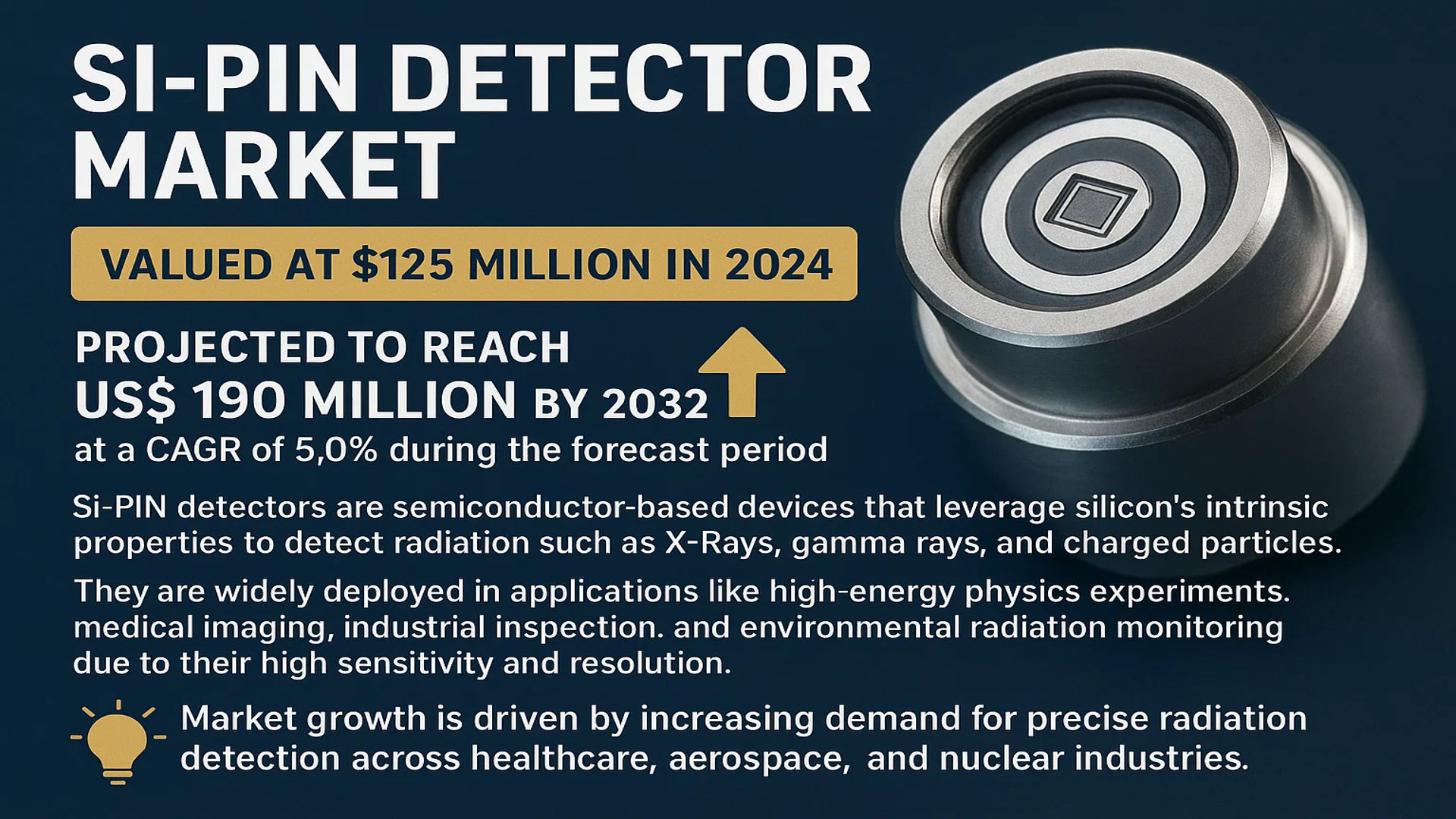
The global Si-PIN Detector Market was valued at 125 million in 2024 and is projected to reach US$ 190 million by 2032, at a CAGR of 5.0% during the forecast period.
Si-PIN detectors are semiconductor-based devices that leverage silicon’s intrinsic properties to detect radiation such as X-rays, gamma rays, and charged particles. These detectors operate by utilizing the electric field generated by a PN junction to separate electron-hole pairs, converting radiation into measurable electrical signals. They are widely deployed in applications like high-energy physics experiments, medical imaging, industrial inspection, and environmental radiation monitoring due to their high sensitivity and resolution.
Market growth is driven by increasing demand for precise radiation detection across healthcare, aerospace, and nuclear industries. While thermoelectric refrigeration dominates current applications, liquid nitrogen-cooled variants are gaining traction for high-precision tasks. However, cost constraints and technical complexities in miniaturization remain challenges. Leading players such as Hamamatsu Photonics, Amptek, and Thorlabs are investing in R&D to enhance detector efficiency, with Asia-Pacific emerging as a key growth region due to expanding industrial and healthcare infrastructure.
MARKET DYNAMICS
MARKET DRIVERS
Growing Demand for Radiation Detection in Medical and Industrial Applications to Fuel Market Growth
The global Si-PIN detector market is experiencing significant growth due to the increasing demand for radiation detection across various sectors. In healthcare, these detectors are critical for diagnostic imaging equipment such as X-ray fluorescence (XRF) analyzers, which are widely used for material composition analysis. The medical imaging market, valued at over $30 billion globally, increasingly relies on high-precision detectors for accurate diagnostics. Furthermore, industrial applications like nuclear power plant monitoring and security screening are driving adoption, with radiation detection equipment sales growing at approximately 7% annually.
Technological Advancements in Semiconductor Detectors to Accelerate Market Expansion
Recent innovations in semiconductor technology have significantly enhanced Si-PIN detector capabilities, making them more sensitive and energy-efficient. Manufacturers are now producing detectors with improved energy resolution below 150 eV at 5.9 keV, enabling more precise radiation measurement. These advancements are particularly valuable in high-energy physics experiments where accuracy is paramount. The development of compact, thermoelectrically cooled detectors has also expanded their use in portable applications, creating new market opportunities in field research and mobile detection systems.
Additionally, the integration of Si-PIN detectors with advanced data processing algorithms has improved their performance in challenging environments. This technological progression is expected to drive adoption across new application areas, particularly in environmental monitoring and space research where reliable radiation detection is essential.
MARKET RESTRAINTS
High Production Costs and Complex Manufacturing Processes to Limit Market Penetration
The Si-PIN detector market faces significant constraints due to the high costs associated with production and quality control. The manufacturing process requires ultra-pure silicon wafers and specialized cleanroom facilities, which account for approximately 40-50% of total production expenses. These costs make Si-PIN detectors significantly more expensive than traditional scintillation detectors, limiting their adoption in cost-sensitive markets.
Moreover, maintaining consistent quality across production batches presents another challenge. The detectors require precise doping and junction formation, with yield rates sometimes below 60% for high-performance units. This manufacturing complexity not only increases costs but also limits production scalability, potentially causing supply constraints as demand grows.
MARKET CHALLENGES
Competition from Alternative Technologies to Pose Significant Market Challenges
Si-PIN detectors face intensifying competition from emerging radiation detection technologies such as cadmium zinc telluride (CZT) and silicon drift detectors (SDD). These alternatives offer superior energy resolution and detection efficiency in certain applications, particularly at higher energy ranges. CZT detectors, for instance, provide room-temperature operation with performance comparable to cooled Si-PIN detectors, making them attractive for portable applications.
The challenge is compounded by the rapid pace of technological advancement in competing detector types. SDD detectors have seen annual performance improvements of 10-15% in recent years, narrowing the performance gap with Si-PIN detectors while offering faster count rate capabilities. This competitive pressure requires continuous innovation from Si-PIN detector manufacturers to maintain market position.
MARKET OPPORTUNITIES
Expanding Applications in Space Exploration to Create New Growth Avenues
The space sector presents significant untapped potential for Si-PIN detector adoption. With global space agency budgets exceeding $80 billion annually and increasing private sector investment, demand for reliable radiation detection systems is growing rapidly. Si-PIN detectors are particularly well-suited for space applications due to their radiation hardness and stability in extreme environments.
Emerging opportunities include planetary exploration missions, where these detectors are used for X-ray fluorescence spectroscopy to analyze planetary surface composition. The development of CubeSat and small satellite technologies has also created new demand for compact, low-power radiation monitoring systems where Si-PIN detectors offer an optimal solution. As space exploration activities expand, this sector is expected to become a major growth driver for the market.
Growing Nuclear Medicine Sector to Drive Future Demand
The nuclear medicine market, projected to exceed $15 billion by 2027, represents another significant opportunity for Si-PIN detector manufacturers. These detectors are increasingly used in positron emission tomography (PET) systems and gamma cameras for high-resolution imaging. As personalized medicine advances, the demand for precise radiation measurement in targeted radiotherapy applications is expected to grow substantially.
Furthermore, the development of new radiopharmaceuticals and the expansion of nuclear medicine facilities in emerging markets are creating additional demand for reliable detection systems. With their ability to provide accurate energy discrimination in compact form factors, Si-PIN detectors are well-positioned to capitalize on this growing market segment.
SI-PIN DETECTOR MARKET TRENDS
Increasing Demand for Radiation Detection in Medical and Industrial Sectors
The Si-PIN detector market is experiencing significant growth due to the rising demand for radiation detection across multiple industries, including healthcare, nuclear power, and security. These detectors play a critical role in medical imaging, particularly in X-ray fluorescence (XRF) spectroscopy and nuclear medicine diagnostics. In 2024, the medical applications segment accounted for nearly 35% of the market share, driven by advancements in non-invasive diagnostic techniques. Furthermore, stringent safety regulations in industrial environments have accelerated the adoption of Si-PIN detectors for radiation monitoring in nuclear facilities and material analysis.
Other Trends
Technological Advancements in Semiconductor Detectors
Continuous innovation in semiconductor detector technology has improved the sensitivity, energy resolution, and efficiency of Si-PIN detectors. Manufacturers are focusing on developing compact, low-power consumption detectors with enhanced operational stability. Recent improvements in thermoelectric cooling systems have also contributed to reduced noise levels in Si-PIN detectors, making them ideal for precise spectral analysis in scientific research. These technological upgrades are expected to propel the market, with liquid nitrogen-cooled detectors alone projected to grow at a 5.6% CAGR from 2024 to 2032.
Expansion of High-Energy Physics Research
The global emphasis on particle physics and nuclear research has significantly boosted the demand for high-precision Si-PIN detectors. Major research institutions and facilities, such as CERN and Fermilab, increasingly rely on these detectors for particle identification and energy measurement. Governments in developed countries are allocating substantial budgets for quantum research, further catalyzing market growth. For instance, the U.S. Department of Energy invested over $3.2 billion in nuclear physics research in 2023, directly benefiting detector manufacturers. Collaborations between academia and private firms are fostering innovation, with new applications emerging in astrophysics and material science.
Growing Security & Defense Applications
With rising global security concerns, Si-PIN detectors are being increasingly deployed in border security, cargo scanning, and military surveillance systems. These detectors provide real-time radiation detection, crucial for identifying nuclear threats and illicit material transport. The defense sector’s investments in radiological detection technologies are anticipated to grow, particularly in regions with elevated geopolitical tensions. Meanwhile, advancements in portable and handheld Si-PIN detectors are enabling field-based spectroscopy, enhancing operational efficiency in hazardous environments.
COMPETITIVE LANDSCAPE
Key Industry Players
Technological Innovation and Strategic Expansion Drive Market Competition
The global Si-PIN Detector market presents a dynamic competitive landscape, characterized by established industry leaders and emerging technology-driven players. Hamamatsu Photonics and Amptek dominate the market with their extensive product portfolios and strong R&D capabilities, securing a combined market share of over 30% in 2024. These companies continue to leverage their expertise in semiconductor technology and radiation detection, driving advancements in high-energy physics applications.
While large corporations maintain leadership through economies of scale, mid-sized players like SiFotonics Technologies are gaining traction through niche specialization and cost-effective solutions. The China-based company has particularly strengthened its position in Asia-Pacific markets through localized production and government partnerships in scientific research infrastructure development.
Recent strategic developments have intensified competition, with Thorlabs acquiring two smaller detection technology firms in 2023 to expand its X-ray spectroscopy capabilities. Meanwhile, Moxtek is enhancing its market position through continuous product innovation, recently launching its third-generation Si-PIN detector with improved energy resolution below 125 eV at 5.9 keV.
The competitive dynamics are further shaped by regional specialists, including Nuchip Photoelectric Technology in China and Guilin Guangyi Intelligent Technology, which collectively account for nearly 15% of the APAC market. These players are increasingly focusing on customizable detector solutions to differentiate themselves in the growing industrial applications segment.
List of Key Si-PIN Detector Companies Profiled
- Hamamatsu Photonics (Japan)
- Amptek (U.S.)
- Thorlabs (U.S.)
- Vishay (U.S.)
- Skyray Instruments (China)
- SiFotonics Technologies (China)
- Moxtek (U.S.)
- Nuchip Photoelectric Technology (Shandong, China)
- Guilin Guangyi Intelligent Technology (China)
- Suzhou Bonphot Optoelectronics (China)
Segment Analysis:
By Type
Thermoelectric Refrigeration Segment Leads Due to Operational Efficiency and Portability Advantages
The market is segmented based on type into:
- Thermoelectric Refrigeration
- Liquid Nitrogen Cooling
By Application
Radiation Measurement Segment Dominates with Growing Demand in Nuclear Safety and Environmental Monitoring
The market is segmented based on application into:
- High-Energy Physics Experiment
- Radiation Measurement
- Imaging Equipment
- Others
Regional Analysis: Si-PIN Detector Market
Asia-Pacific
The Asia-Pacific region dominates the Si-PIN detector market, accounting for the largest revenue share due to strong adoption in industrial and research applications. China leads regional growth, driven by investments in semiconductor manufacturing and expanding physics research infrastructure. Japan’s established presence of key manufacturers like Hamamatsu Photonics further strengthens the regional supply chain. The Thermoelectric Refrigeration segment is growing rapidly across the region due to its operational convenience compared to liquid nitrogen solutions. However, uneven technological adoption persists, with advanced research institutions favoring high-performance models while industrial users prioritize cost efficiency.
North America
North America represents the second-largest Si-PIN detector market, characterized by high specialization in advanced research applications. The U.S. maintains particular strength in high-energy physics experiments through institutions like Fermilab and significant defense sector utilization. Regulatory standards for radiation detection equipment ensure quality benchmarks, creating demand for precision instruments. Regional manufacturers focus on developing compact, low-power detectors for portable applications. While academic and government research budgets drive purchases, commercial adoption grows steadily in industrial quality control and medical imaging sectors.
Europe
Europe’s market benefits from collaborative research initiatives and robust nuclear safety regulations. Germany and France lead regional demand through their established physics research institutions and healthcare sectors. EU funding for particle physics research at CERN and other facilities sustains demand for high-sensitivity detectors. The market shows increasing preference for integrated detector systems that combine Si-PIN technology with advanced signal processing. Environmental testing applications are emerging as a growth area, though adoption varies across countries based on industrial composition and research investment levels.
Middle East & Africa
This region presents emerging opportunities with growing investments in radiation monitoring and industrial quality control. While the market remains relatively small, countries like Israel and Saudi Arabia are driving adoption through healthcare infrastructure development and oil industry applications. The lack of local manufacturing results in dependence on imports from Europe and Asia. However, increasing awareness of radiation safety standards and gradual expansion of research capabilities suggest long-term growth potential, particularly for mid-range detector models suited to industrial applications.
South America
South America’s market is developing, with Brazil and Argentina showing the most activity in research and mining applications. Economic constraints limit widespread adoption, with most demand concentrated at major universities and government facilities. The region faces challenges in technical support infrastructure for advanced detectors, leading some institutions to prefer simpler measurement solutions. Nonetheless, modernization of mining operations and gradual expansion of physics research programs provide avenues for measured market growth over the coming decade.
Report Scope
This market research report provides a comprehensive analysis of the global Si-PIN Detector market, covering the forecast period 2024–2032. It offers detailed insights into market dynamics, technological advancements, competitive landscape, and key trends shaping the industry.
Key focus areas of the report include:
- Market Size & Forecast: Historical data and future projections for revenue, unit shipments, and market value across major regions and segments. The global Si-PIN Detector market was valued at USD 125 million in 2024 and is projected to reach USD 190 million by 2032, growing at a CAGR of 5.0%.
- Segmentation Analysis: Detailed breakdown by product type (Thermoelectric Refrigeration, Liquid Nitrogen Cooling) and application (High-Energy Physics Experiment, Radiation Measurement, Imaging Equipment, Others) to identify high-growth segments.
- Regional Outlook: Insights into market performance across North America, Europe, Asia-Pacific, Latin America, and the Middle East & Africa. The U.S. and China are key markets with significant growth potential.
- Competitive Landscape: Profiles of leading market participants including Thorlabs, Vishay, Hamamatsu Photonics, Amptek, and Moxtek, covering their product portfolios, market share, and strategic developments.
- Technology Trends & Innovation: Assessment of semiconductor detector advancements, fabrication techniques, and integration with radiation detection systems.
- Market Drivers & Restraints: Evaluation of factors such as increasing demand for radiation detection in healthcare and nuclear industries, along with challenges like high production costs.
- Stakeholder Analysis: Strategic insights for detector manufacturers, system integrators, research institutions, and investors regarding market opportunities.
The research employs both primary and secondary methodologies, including interviews with industry experts and analysis of verified market data to ensure accuracy and reliability.
FREQUENTLY ASKED QUESTIONS:
What is the current market size of Global Si-PIN Detector Market?
-> Si-PIN Detector Market was valued at 125 million in 2024 and is projected to reach US$ 190 million by 2032, at a CAGR of 5.0% during the forecast period.
Which key companies operate in Global Si-PIN Detector Market?
-> Key players include Thorlabs, Vishay, Hamamatsu Photonics, Amptek, Moxtek, Skyray Instruments, and SiFotonics Technologies.
What are the key growth drivers?
-> Growth is driven by increasing applications in radiation detection, nuclear safety regulations, and advancements in high-energy physics research.
Which region dominates the market?
-> North America currently leads in market share, while Asia-Pacific is expected to witness the fastest growth during the forecast period.
What are the emerging trends?
-> Emerging trends include miniaturization of detectors, integration with portable devices, and development of high-resolution Si-PIN detectors for specialized applications.

Get Sample Report PDF for Exclusive Insights
Report Sample Includes
- Table of Contents
- List of Tables & Figures
- Charts, Research Methodology, and more...