Session Border Controller (SBC) Market Insights
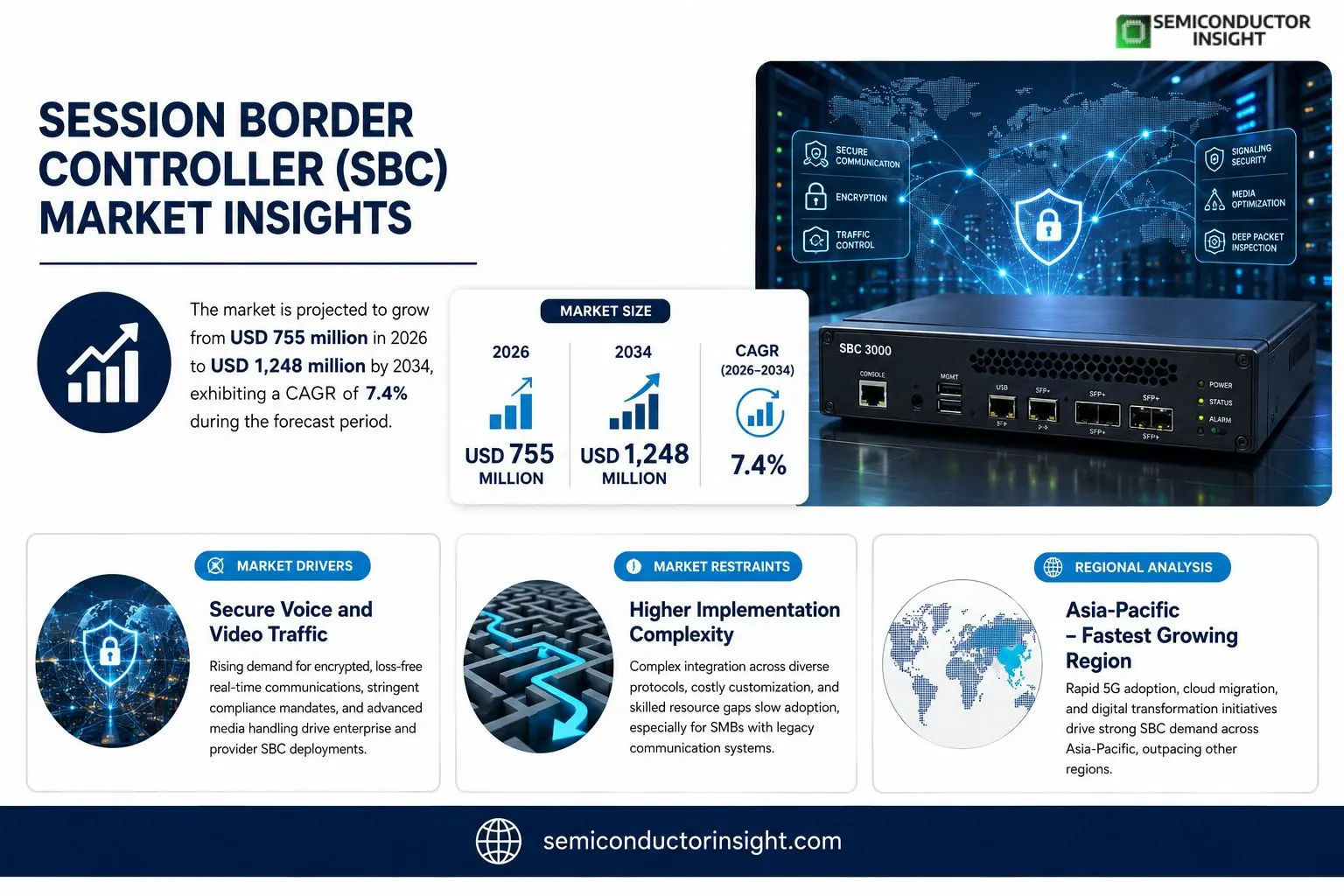
Session Border Controller (SBC) Market was valued at USD 755 million in 2026 and is projected to reach USD 1248 million by 2034 at a CAGR of 7.4% during the forecast period.
A Session Border Controller is a core element within an IP Multimedia Subsystem that safeguards real‑time communications such as VoIP through signalling translation, media stream control, firewall traversal, topology hiding and deep packet inspection.Because network operators face increasing demands for low‑latency voice services across mobile, enterprise and cloud environments, SBC deployments have grown steadily; manufacturers are integrating advanced encryption techniques and edge computing capabilities that align with emerging standards such as MEC and SD‑WAN integration.Global SBC shipments reached approximately half a million units in 2026, averaging USD 1 658 per device – underscoring the premium placed on security features amid rising competition between hardware‑centric vendors and virtualized solutions.Leading suppliers such as Cisco, AudioCodes and Huawei continue to dominate through strategic partnerships while expanding their portfolios toward cloud-native architectures.
MARKET DRIVERS
Secure Voice and Video Traffic
As organizations migrate continuous‑streaming video into hybrid environments, the critical need for encrypted, loss‑free transmission has intensified. Session Border Controller (SBC) Market participants now prioritize layer‑seven inspection, end‑to‑end encryption, and real‑time packet loss compensation. These capabilities reduce the risk of eavesdropping and comply with tightening regulations that demand hardcore audit trails. Controllers that reconcile unified communications with varying network footprints are increasingly prized. Firms that bundle advanced DDoS safeguards with SBCs can command premium pricing, reinforcing the attractiveness of the segment. Moreover, the push to secure emerging mediaAR/VR and holographic conferencingforces vendors to embed multi‑protocol translation layers capable of handling unprecedented bandwidth. Providers who demonstrate low‑latency pickup response and resilient failover within a single chassis gain a competitive edge in high‑stakes sectors such as financial services, healthcare, and broadcast. This convergence of stringent compliance, performance vision, and versatile media handling drives deployments at an accelerated pace across the worldwide SBC map.
Integration with Next‑Gen Cloud Platforms
Cloud‑native SBCs, often rendered as micro‑services, are now integral to the zero‑trust strategy adopted by enterprises. They allow granular control of call signalling, media routing, and policy enforcement directly from the cloud control plane, avoiding legacy on‑prem hardware sprawl. Vendors that supply containers and orchestration‑ready modules reduce deployment time by half, delivering 24/7 uptime without manual configuration. The synergy with SaaS communication solutions is clear: when a SaaS provider upgrades to multi‑region replication, the SBC will automatically redirect traffic, ensuring minimal jitter. Organizations that have already cloud‑lifted collocated SBCs tend to recoup capital expenditures within two years, shortening their return‑on‑investment horizon. Consequently, the SBC market is witnessing a gradual co‑evolution with public cloud ecosystems, creating a new sales avenue for integrations that support “service‑as‑peer‑to‑peer” dialing between cloud instances. The price elasticity for virtual SBCs also eases the entry barrier for mid‑market players, further expanding the customer base.
➤ Developers who comprehend Kubernetes and application‑layer security frameworks often leverage SBC APIs to weave dynamic policy‑based routing into custom call‑flows, a capability that is rapidly becoming a differentiator in service‑level agreements.
The growth in end‑to‑end encrypted sessions, coupled with the rise of cloud‑accelerated deployments, aligns the SBC market’s evolution with broader digital transformation goals. Because the SBC acts as a single point of enforcement across disparate networks, its adoption remains tightly coupled to service‑level quality expectations. Enterprises that deploy highly‑available SBC infrastructures now see measurable improvements in call completion rates, leading to better customer satisfaction indices and lower churn. For vendors, the strategic focus on composite platform integration paves a path to recurring subscription revenues, thereby transforming what was once a primarily capital‑expenditure segment into a lucrative revenue stream for diverse market players.
MARKET CHALLENGES
Higher Implementation Complexity
Commercial SBC adoption frequently hinges on aligning diverse voice and media standards (e.g., SIP, WebRTC, RTP) across legacy and emerging platforms. The process of harmonizing gateway protocols, codec preferences, and inter‑domain signalling can extend installation cycles beyond typical IT service windows. Technical staff must conduct substantial configuration reviews to avoid session renegotiation delays and ensure consistent Quality of Service profiles. In regions with limited skilled resources, this complexity translates into higher onboarding costs and steeper learning curves, dampening the adoption rate across SMB segments. Vendors who offer automation‑driven migration scripts and self‑service configuration portals can mitigate these friction points. Nonetheless, the initial capital outlay remains a deterrent for smaller operators that perceive limited incremental value, especially when their existing PBX or VoIP platforms already meet legacy specifications.
Other Challenges
Regulatory and Interoperability Constraints
The continued evolution of global telecommunication standards, coupled with divergent national policy frameworks, imposes compliance burdens on SBC vendors. Meeting local signaling protocols, adapting to national data residency laws, and navigating cross‑border inter‑connect agreements require coordinated effort across product and legal teams. If a vendor fails to synchronize its SBC firmware with rapidly changing standards, it risks obsolescence overnight, leading to costly patch cycles. Additionally, the fragmentation of the SIP Annex G and emerging security protocols (e.g., SRTP, DTLS) can fragment inter‑operability, compelling carriers to maintain multiple SDN‑aware SBC variants. These regulatory and technical divergences limit market penetration in regulated sectors such as public safety and finance, where strict auditability and interoperability are non‑negotiable.
MARKET RESTRAINTS
Limited Standardization in SIP Extensions
Despite broad adoption of the core SIP standard, many carriers still rely on proprietary extensions to support advanced call control, billing, or media capabilities. These extensions create silos that complicate the integration of centrally managed SBCs across territories. A vendor offering a limited set of SIP profiles may find itself short of critical features required by large carriers, leading to decreased market share. The delay in converging the two ecosystems raises the risk that SBC providers may need to develop custom solutions for each operator, resulting in an elevated cost of ownership that erodes profitability. Consequently, fragmentation in protocol support restricts the speed with which new entrants can secure multinational contracts, dampening overall market dynamism.
Hardware‑Centric Legacy Deployments
Legacy SBC installations are often entrenched within proprietary hardware that lacks modular expansion. As telecom operators gear up for 5G and edge computing, older SBC topologies fail to adapt to requirements for lower latency, higher bandwidth, and modular scaling. The cost of re‑engineering entire voice infrastructures to accommodate these constraints is significant, and many operators opt for incremental upgrades rather than full topology overhauls. This inertia stalls the deployment of newer SBC features that promise operational efficiency, causing the market to stagnate on mid‑range solutions that maintain legacy compatibility at the expense of innovation. Moreover, the scarcity of publicly available firmware and open‑source development tools, coupled with vendor lock‑in, further constrains adoption of advanced SBC offerings.
MARKET OPPORTUNITIES
Opportunities in Healthcare Communications
The healthcare sector’s shift towards patient‑centric digital engagement drives the need for secure, compliant voice and video interactions between clinicians, patients, and support teams. Session Border Controllers that embed HIPAA‑compliant logging, end‑to‑end encryption, and guaranteed uptime become business‑critical infrastructure. With telemedicine enrollment surging, there is an emerging niche that favors SBC vendors who can streamline end‑to‑end call provisioning while offering real‑time media analytics for quality assurance. The projected growth in remote monitoring services creates a perpetual demand for robust signalling integrity, making the health domain a lucrative channel for SBC suppliers to capture subscription‑based revenue models.
Edge‑Enabled SBCs for 5G Networks
5G’s ultra‑low latency promises new use‑cases such as autonomous industrial controls and real‑time health diagnostics. Edge‑deployed SBCs positioned at base‑station sites can reduce signaling round trips by several milliseconds, freeing operators to offer differentiated value‑added services. Vendors that bundle SBC functionality with edge compute nodes, integrating network slicing and real‑time media transformation, can capture a new revenue segment that leverages the 5G ecosystem. Contracts that tie SBC availability to service‑level agreements of connected devices will thus generate a steady revenue stream for providers willing to invest in edge hardware and software integration.
AI‑Driven Voice Quality Prediction
Client‑side artificial‑intelligence models that predict quality of experience (QoE) and pre‑emptively route traffic through optimal SBC paths present a compelling value proposition. By deploying predictive analytics into SBC operations, vendors can drastically reduce call drops and improve user satisfaction across multi‑carrier environments. Enterprises that adopt AI‑enhanced SBCs report faster troubleshooting cycles and lower support costs, positioning insiders that offer these tools as leaders in a data‑centric communication economy. The development of open‑source AI frameworks for SBC monitoring removes barriers to entry for small vendors and encourages collaboration across the ecosystem, amplifying growth potential for the entire market.
Session Border Controller (SBC) Market Trends
Accelerated Migration to Cloud‑Native SBC Deployments
shift toward cloud‑native architectures is reshaping the SBC landscape. With Software‑Defined Networking and Network Function Virtualization gaining maturity, providers are re‑architecting SBCs as modular micro‑services that can be spun up in public or hybrid clouds. Current data indicates that by 2031, cloud‑based SBC solutions will hold roughly forty‑four percent of the deployment market, as finance and enterprise sectors adopt containerized environments for cost efficiency and rapid scaling. This migration is not merely a technology upgrade; it delivers a new revenue stream for vendors who can provide managed services, subscription pricing, and integrated analytics, thereby positioning them to capture recurring income and deepen customer relationships.
Other Trends
Edge‑Integrated SBCs for 5G Manufacturing
Manufacturing plants in the era of Industry 4.0 now require SBCs that can operate with ultra‑low latency and high signal fidelity. A joint solution from Ericsson and Huawei demonstrates latency performance that surpasses traditional SBCs by 61 percent, rendering it fit for real‑time machine‑to‑machine communication in smart factories. The edge focus also reduces backhaul traffic, mitigating congestion on core networks. Manufacturers find the ability to implement MEC‑ready SBCs valuable because it preserves security boundaries while enabling data segmentation across distributed production lines, thereby enhancing operational resilience.
Deepening Security and Compliance with Integrated Zero‑Trust Models
Security remains the linchpin of SBC adoption, especially with the tightening regulatory environment and rising attack sophistication. Modern SBCs now embed intrusion‑prevention engines, national cryptographic algorithms, and zero‑trust frameworks. Chinese vendors, for instance, have introduced chips supporting the SM4 algorithm to comply with domestic encryption mandates, while global suppliers integrate AI‑driven traffic analysis to detect anomalies in real‑time. These capabilities are crucial for service providers and corporate networks that demand end‑to‑end encryption, role‑based access control, and auditability. Consequently, SBC vendors that can deliver a comprehensive security stack alongside traditional performance gains are likely to capture premium segments and retain competitive advantage in a market increasingly focused on compliance and threat intelligence.
COMPETITIVE LANDSCAPE
Key Industry Players
Current Competitive Landscape in the Session Border Controller Market
At the helm of the session border controller tenor stands Cisco, whose portfolio anchors value chain with a mix of hardware, virtualized and cloud‑native offerings. Cisco’s strategic alliances with telecom operators and its recent investment in edge‑based SBCs position the firm to capture the rising demand for ultra‑low latency and network slicing. The company’s enterprises‑centric solutions, combined with deep integration into Cisco Unified Communications, have cemented a market share that dwarfs the competition and created a high barrier to entry for new entrants. In a market projected to grow from US$755 million in 2026 to US$1,248 million by 2034, Cisco’s focus on security, scalability and hybrid deployment models translates into a resilient revenue base that outpaces rivals across all geographic segments.Beyond the dominant player, the competitive matrix widens into a heterogeneous group that serves specific verticals and technology niches. AudioCodes drives the session optimisation space for service providers, leveraging its patented media stream control to deliver superior voice quality. Sonus and Oracle bring legacy strength and robust analytics into contact‑center and enterprise environments, while Avaya continues to serve large‑scale contact‑centre deployments. Edgewater Networks delivers battery‑efficient solutions for the small‑to‑medium enterprise market, and Ingate’s open‑source architecture attracts cost‑conscious integrators. Sangoma occupies the low‑cost segment with compact hardware aimed at small‑network operators. In China, Huawei and ZTE cater to both domestic compliance demands and the broader global OEM market, supported by proprietary chipsets that embed national cryptographic standards. This fragmentation forces newer entrants to either host modular cloud platforms, provide open‑API ecosystems, or target stressed sectors such as government, smart‑city and smart‑factory with specialized security features.
List of Key Session Border Controller Companies Profiled
- Cisco
- Cisco
- AudioCodes
- AudioCodes
- Sonus
- Sonus
- Oracle
- Oracle
- Avaya
- Edgewater Networks
- Ingate
- Sangoma
- Huawei
- ZTE
- Patton Electronics
- InnoMedia
Segment Analysis:
| Segment Category | Sub-Segments | Key Insights |
| By Type |
|
Cloud‑Native SBC anchors the shift toward flexible, software‑defined hosting environments, simplifying scaling and reducing operational costs. 1. Enables rapid deployment across distributed networks, supporting low‑latency demands. 2. Facilitates integration with edge computing and 5G slice architectures, delivering isolated secure channels. 3. Enhances fault tolerance by leveraging container orchestration, providing persistent service continuity. |
| By Application |
|
Telecommunications Service Providers dominate the application landscape, positioning SBCs as critical gatekeepers for unified bandwidth and policy enforcement. 1. They rely on SBCs to negotiate tender compatibility and secure interconnect agreements. 2. The solution must support scalability across massive subscriber bases, ensuring consistent quality of voice and video services. 3. Compliance with national and international regulatory frameworks is central, demanding advanced encryption and auditing features. |
| By End User |
|
Telecom Operators seek SBCs to safeguard inter‑operator connections and regulate shared bandwidth. 1. They prioritize interoperability with diverse network slices and legacy voice infrastructures. 2. Security features are paramount to detect and block emerging attack vectors before escalation. 3. Operators increasingly value SBCs that provide granular policy controls for dynamic traffic steering across global paths. |
| By Deployment Method |
|
Virtualized SBC offers operators a blend of flexibility and cost optimization, easing upgrade cycles and hardware downtime. 1. It facilitates rapid scaling by provisioning instances in response to traffic surges. 2. Virtual platforms integrate seamlessly with NFV orchestration, fostering consistent management across diverse nodes. 3. Virtualization supports multi‑tenant architectures, safeguarding isolated sessions for distinct business units. |
| By Security Feature |
|
Encryption & Cryptography stands as the linchpin of secure session flow, delivering confidential data paths across public and private networks. 1. Adoption of national encryption standards ensures alignment with regulatory mandates, enhancing trust among sovereign entities. 2. Complex key management and forward secrecy protocols mitigate eavesdropping threats. 3. Advanced encryption scales with increasing data volumes, maintaining performance while ensuring compliance with evolving security frameworks. |
Regional Analysis: Session Border Controller (SBC) Market
North America
North American operators routinely upgrade legacy PBX frameworks to SBC‑anchored VoIP systems, a shift driven by cloud services and enterprise mobility. These transitions emphasize low‑latency packet handling and real‑time diagnostics, crucial for mission‑critical applications in finance and healthcare sectors.
Industry guidelines dictate stringent encryption, lawful intercept, and data residency. Compliance with the Communications Security Regulations forces operators to deploy SBCs that can audit traffic, log salient events, and enforce policy controls at layer 3 of the transport stack.
Established vendors such as Avaya, Pexip, and Ribbon dominate the segment, offering integrated platforms that combine SIP‑tracing, policy enforcement, and cloud‑native scaling. Emerging players target niche verticals through open‑source SBCs, but must demonstrate robust security and interoperability to penetrate the U.S. market.
Venture capital flows into SBC incubators focus on AI‑driven call routing, predictive maintenance, and zero‑trust security models, mirroring broader IT transformation agendas across enterprise domains.
Europe
In Europe, Session Border Controller (SBC) Market evolves around stringent data‑protection directives and a fragmented telecom landscape. The GDPR framework demands that SBC solutions enforce strict data minimization, consent logging, and auditability, pushing vendors to embed advanced encryption and real‑time compliance monitoring. Operators across the EUespecially within the UK, Germany, and Franceprioritize inter‑operator interoperability to support roaming across diverse network architectures, facilitated by SBCs that bridge PSTN, Private Networks and emerging 5G back‑haul. The market finds traction in public‑sector deployments, notably within government agencies, where secure voice and video channels are mandated. In industrial settings, the advent of Industry 4.0 and IoT pipelines inflates demand for SBCs that can manage heterogeneous traffic with minimal latency. While incumbents such as Alcatel‑Lucent and Siemens continue to hold a strong presence, the proliferation of open‑source SBC platforms offers cost‑effective alternatives for MSMEs seeking to maintain unified communications without hefty licensing costs. Consolidation remains a strategic theme: larger operators absorb smaller vendors to streamline support and licensing ecosystems, thereby reinforcing their market position. Overall, Europe demonstrates a measured yet steady growth trajectory, largely anchored by regulatory compliance needs and the increasing digitisation of public administration services.
Asia‑Pacific
The Asia‑Pacific region presented the most dynamic growth in Session Border Controller (SBC) Market, driven by rapid urbanisation and the expansion of mobile broadband. Emerging economies such as India and China, along with developed economies like Japan and Australia, are prioritising secure voice over IP to support both consumer and enterprise use cases. Telecom operators in these markets face mounting pressure to decentralise voice traffic through cloud‑based SBC deployments, a trend accelerated by the rollout of 5G infrastructure and the need for low‑latency, real‑time communications. Importantly, local governments are enforcing data‑resident policies; SBCs must archive call data within national borders and offer encryption at rest and in transit. Vendors that can provide modular, scalable SBC platforms, integrated with AI‑driven traffic management, capture significant share of the market. The regional fragmentary vendor landscape ensures that multi‑tenancy, virtualised SBCs that can run across edge data centres are highly valuable. While application‑layer security features such as deep packet inspection remain prevalent, a growing segment demands just‑in‑time encryption and zero‑trust security models. Bullish sentiment with respect to cloud adoption, e‑commerce, and digital services continues to drive SBC deployments across the region. Consequently, Asia‑Pacific will shape trend for SBC technology, representing the largest opportunity for vendors and service providers alike.
South America
South America’s Session Border Controller (SBC) Market is increasingly influenced by the push for digital inclusion and the adoption of VoIP infrastructure across enterprises and telecom operators. As cloud‑based communications mature, political stability and investment incentives in Brazil, Argentina, and Mexico foster an ecosystem for SBC adoption. The region’s tight regulatory environment emphasises lawful intercept and proper record‑keeping; as such, SBC vendors are required to implement robust session‑level logging and encryption. A growing emphasis on cybersecurity, driven by the rise in cyber‑attacks targeting telecommunications, has inflated demand for SBC solutions that embed threat‑detection algorithms and real‑time traffic filtering. Meanwhile, the centralized nature of many local telecom networks favours SBCs capable of achieving seamless inter‑operator integration and efficient resource utilisation. Vendor penetration remains uneven, with domestic providers focusing on on‑premise solutions and multinational vendors targeting large enterprises. The market is expected to grow steadily as telecom operators modernise legacy voice infrastructures and adopt unified communications platforms. The emphasis on digital transformation initiatives and strengthening network security has positioned South America as a rising hub for Session Border Controller innovation.
Middle East & Africa
The Middle East & Africa (MEA) region offers a heterogeneous landscape for Session Border Controller (SBC) Market. Predominantly, the market is shaped by the intersection of burgeoning mobile broadband uptake, high penetration of enterprise‑grade communications, and stricter security standards. Key growth drivers in MEA revolve around implementation of network segmentation, ensuring protection of mission‑critical communications, especially in finance, healthcare and government domains. SBC vendors that deliver compliance functionalitiesin particular lawful intercept and data residencyhave gained traction. Additionally, regional operators continually align with global 5G standards, requiring SBCs that can efficiently route traffic among small cell networks. Emerging economies such as Egypt, Kenya, and Saudi Arabia are scaling up SBC-oriented services to support digitalisation initiatives. However, the market still grapples with fragmented telecom infrastructures and inconsistent investment flows. Regional organisations have adopted standardised SBC frameworks to lower cross‑border digital risk. The future trajectory is likely to favour vendors offering flexible, cloud‑based SBC platforms that integrate artificial intelligence for real‑time traffic optimisation and threat mitigation, maintaining a clear competitive advantage in the space.
Report Scope
This market research report provides a comprehensive analysis of the Session Border Controller (SBC) Market , covering the forecast period 2026–2034. It offers detailed insights into market dynamics, technological advancements, competitive landscape, and key trends shaping the industry.
Key focus areas of the report include:
- Market Overview: The report begins with an overview outlining its current market scenario, key growth indicators, and industry transformation drivers. It discusses macroeconomic factors, demand–supply balance, regulatory landscape, and the strategic role of semiconductors in powering advancements across industries such as automotive, telecommunications, consumer electronics, and industrial automation.
- Market Size & Forecast: Historical data and future projections for revenue, unit shipments, and market value across major regions and segments.
- Segmentation Analysis: Detailed breakdown by product type, technology, application, and end-user industry to identify high-growth segments and investment opportunities.
- Regional Insights: Insights into market performance across North America, Europe, Asia-Pacific, Latin America, and the Middle East & Africa, including country-level analysis where relevant.
- Competitive Landscape: Profiles of leading market participants, including their product offerings, R&D focus, manufacturing capacity, pricing strategies, and recent developments such as mergers, acquisitions, and partnerships.
- Technology Trends & Innovation: Assessment of emerging technologies, integration of AI/IoT, semiconductor design trends, fabrication techniques, and evolving industry standards.
- Market Drivers & Restraints: Evaluation of factors driving market growth along with challenges, supply chain constraints, regulatory issues, and market-entry barriers.
- Stakeholder Insights: Insights for component suppliers, OEMs, system integrators, investors, and policymakers regarding the evolving ecosystem and strategic opportunities.
Primary and secondary research methods are employed, including interviews with industry experts, data from verified sources, and real-time market intelligence to ensure the accuracy and reliability of the insights presented.
FREQUENTLY ASKED QUESTIONS:
What is the current market size of Session Border Controller (SBC) Market?
-> Session Border Controller (SBC) Market was valued at USD 755 million in 2026 and is projected to reach USD 1248 million by 2034 at a CAGR of 7.4% during the forecast period.
Which key companies operate in Session Border Controller (SBC) Market?
-> Key players include Cisco, AudioCodes, Sonus, Oracle, Avaya, Edgewater Networks, PATTON Electronics, Ingate, InnoMedia, Sangoma, HUAWEI, ZTE.
What are the key growth drivers?
-> Key growth drivers include the adoption of 5G and Multi-access Edge Computing, migration to cloud-native and virtualized SBCs, enhanced security with intrusion prevention and national encryption algorithms, integration of AI traffic analysis and zero‑trust architectures, and the convergence of SD‑WAN with SBCs.
Which region dominates the market?
-> Asia‑Pacific has emerged as the fastest‑growing region, while North America remains a dominant market in terms of revenue.
What are the emerging trends?
-> Emerging trends include the integration of 5G and edge computing, cloud‑native virtualization, advanced security capabilities, AI‑driven traffic analysis, zero‑trust architectures, and the synergistic application of SD‑WAN with SBCs.

Get Sample Report PDF for Exclusive Insights
Report Sample Includes
- Table of Contents
- List of Tables & Figures
- Charts, Research Methodology, and more...
 Download Sample Report PDF