
Sensors for Dialysis Machines Market Insights
Global Sensors for Dialysis Machines market was valued at USD 174 million in 2025 and is projected to reach USD 297 million by 2032, exhibiting a CAGR of 8.2% during the forecast period.
Sensors for dialysis machines are critical devices used to monitor various parameters essential for safe and effective treatment. These include blood pressure at multiple points in the extracorporeal circuit, dialysate pressure, temperature, O2 saturation, motor speed, dialyzer membrane pressure gradient, and air bubble detection, ensuring all values remain within proper ranges during dialysis. This report focuses specifically on Sensors for Dialysis Machines Market.
The market is experiencing steady growth driven by the rising global prevalence of chronic kidney disease, which necessitates more dialysis procedures, alongside advancements in precision sensor technologies for better patient outcomes. Furthermore, increasing adoption of home dialysis systems demands reliable, compact sensors. Key manufacturers such as TE Connectivity, Texas Instruments, STMicroelectronics, Analog Devices, Honeywell, and NXP lead the industry, offering innovative solutions tailored to dialysis equipment needs.
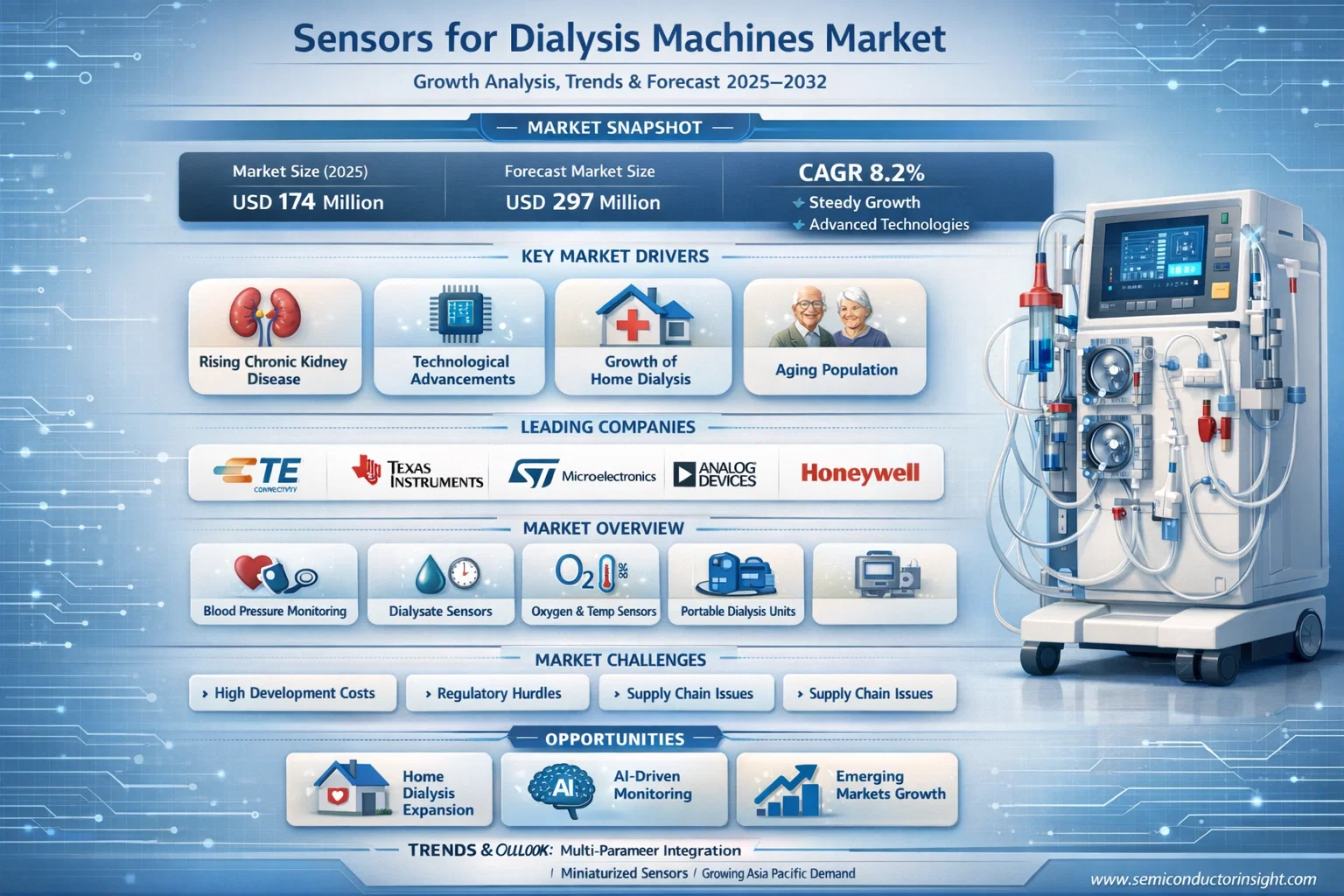
MARKET DRIVERS
Rising Prevalence of Chronic Kidney Disease
Sensors for Dialysis Machines Market is propelled by the growing incidence of chronic kidney disease (CKD), affecting over 500 million people worldwide. As end-stage renal disease (ESRD) cases rise due to diabetes and hypertension, demand for advanced sensors ensuring precise fluid balance, pressure, and blood flow monitoring intensifies, enhancing patient safety during hemodialysis.
Technological Advancements in Sensor Integration
Innovations such as ultrasonic flow sensors and optical hematocrit monitors are transforming dialysis equipment. These sensors provide real-time data accuracy up to 99%, reducing complications like air embolisms. The integration of IoT-enabled sensors supports remote monitoring, aligning with Sensors for Dialysis Machines Market expansion projected at a CAGR of 7-8% through the decade.
➤ Miniaturization and biocompatibility improvements enable compact, reliable sensors for portable dialysis units, driving adoption in home care settings.
Aging populations in North America and Europe further accelerate market growth, with sensor-equipped machines becoming standard to meet heightened safety protocols.
MARKET CHALLENGES
High Development and Calibration Costs
Developing sensors for dialysis machines involves rigorous testing for biocompatibility and precision, leading to elevated costs that strain smaller manufacturers in Sensors for Dialysis Machines Market. Calibration for variables like conductivity and temperature adds complexity, often increasing production expenses by 20-30%.
Other Challenges
Regulatory Compliance Hurdles
Navigating FDA and CE markings demands extensive clinical trials, delaying market entry by up to two years and impacting competitiveness.Supply chain disruptions for rare-earth materials used in pressure sensors exacerbate production delays, particularly in a post-pandemic environment affecting Sensors for Dialysis Machines Market.
MARKET RESTRAINTS
Stringent Regulatory Standards
Sensors for Dialysis Machines Market faces significant restraints from rigorous regulatory frameworks enforced by bodies like the FDA and EMA. These require comprehensive validation of sensor accuracy in blood-contact applications, limiting rapid innovation and increasing time-to-market.High sensor replacement costs, averaging $200-500 per unit, deter widespread adoption in cost-sensitive regions. Additionally, compatibility issues with legacy dialysis systems hinder retrofitting efforts.Intellectual property barriers protect dominant players, creating entry challenges for new entrants in Sensors for Dialysis Machines Market.
MARKET OPPORTUNITIES
Home Dialysis and Wearable Integration
Expansion of home hemodialysis, growing at 10% annually, presents key opportunities for compact sensors in Sensors for Dialysis Machines Market. User-friendly designs with wireless connectivity enable patient-centric care, reducing clinic dependency.AI-enhanced sensors for predictive analytics on ultrafiltration rates offer potential for personalized treatments. Emerging markets in Asia-Pacific, with CKD prevalence rising 15% yearly, drive demand for affordable sensor solutions.Partnerships between sensor firms and dialysis OEMs can accelerate adoption of next-gen technologies like bubble detectors with 100% detection rates.
Sensors for Dialysis Machines Market Trends
Advancements in Multi-Parameter Sensor Integration
Dialysis machines rely on an array of sensors to ensure patient safety and treatment efficacy, monitoring critical parameters such as blood pressure in the extracorporeal circuit, dialysate pressure, temperature, oxygen saturation, motor speed, dialyzer membrane pressure gradient, and air detection. In Sensors for Dialysis Machines Market, a primary trend is the integration of multi-parameter sensors that provide real-time data for precise control, reducing complications during hemodialysis and peritoneal dialysis procedures. Leading manufacturers like TE Connectivity, Texas Instruments, STMicroelectronics, Analog Devices, Honeywell, and NXP are driving this shift through innovative designs that enhance accuracy and reliability.
Other Trends
Growth in Pressure and Temperature Sensor Segments
Pressure sensors and temperature sensors dominate the product type segmentation in Sensors for Dialysis Machines Market, reflecting their essential role in maintaining fluid dynamics and thermal stability during treatments. These segments are expanding due to heightened regulatory standards for patient monitoring, with force sensors and ultrasonic sensors also gaining traction for advanced applications like flow detection and bubble identification. Industry surveys indicate steady demand from manufacturers and suppliers, influenced by evolving dialysis equipment designs.
Application-Driven Expansion in Healthcare Settings
Hospitals and dialysis centers represent the core applications fueling growth in Sensors for Dialysis Machines Market, with specialized sensors tailored for high-volume treatments. The “others” category, including home dialysis setups, is emerging as providers adapt sensors for portable devices. Regionally, North America and Europe lead due to established infrastructure, while Asia, particularly China and Japan, shows potential through increasing dialysis patient populations and local manufacturing. Competitive landscapes reveal top players holding significant revenue shares, supported by recent developments in sensor precision and industry chain optimizations.
COMPETITIVE LANDSCAPE
Key Industry Players
Leading Sensors for Dialysis Machines Manufacturers and Their Market Positions
Sensors for Dialysis Machines Market is characterized by a concentrated structure dominated by a few multinational technology giants specializing in precision sensing technologies. TE Connectivity leads as a primary player, leveraging its expertise in pressure, temperature, and flow sensors critical for monitoring blood pressure, dialysate parameters, and air detection in extracorporeal circuits. Alongside Texas Instruments, STMicroelectronics, Analog Devices, and Honeywell, these top five manufacturers collectively command a substantial revenue share, estimated at over 50% globally in 2025. Their dominance stems from robust R&D investments, integrated sensor solutions tailored for medical devices, and strategic partnerships with dialysis equipment OEMs like Fresenius and Baxter, enabling reliable performance in high-stakes hemodialysis and peritoneal dialysis applications.
Beyond the frontrunners, a cadre of niche players contributes through specialized offerings in ultrasonic, force, and optical sensors, fostering innovation and market diversification. Companies such as NXP Semiconductors and Infineon Technologies excel in semiconductor-based sensors for motor speed and oxygen saturation monitoring, while Sensirion and First Sensor focus on high-accuracy humidity and pressure transducers vital for dialysate quality control. Emerging competitors like Sensata Technologies and Amphenol provide ruggedized solutions for portable dialysis units, addressing growth in home-based therapies. This tier supports market expansion at an 8.2% CAGR through 2032, driven by regulatory compliance, miniaturization trends, and rising chronic kidney disease prevalence, though challenges like supply chain vulnerabilities persist.
List of Key Sensors for Dialysis Machines Companies Profiled
- TE Connectivity
- Texas Instruments
- STMicroelectronics
- Analog Devices
- Honeywell
- NXP Semiconductors
- Infineon Technologies
- Sensirion
- First Sensor
- Amphenol Corporation
- Omron Corporation
- Murata Manufacturing
- Sensata Technologies
- Kulite Semiconductor Products
- BD Sensors
Segment Analysis:
| Segment Category | Sub-Segments | Key Insights |
| By Type |
|
Pressure Sensors
|
| By Application |
|
Hospital
|
| By End User |
|
Dialysis Centers
|
| By Dialysis Modality |
|
Hemodialysis
|
| By Sales Channel |
|
OEM Supply
|
Regional Analysis: Sensors for Dialysis Machines Market
North America
North America leads in sensor innovation for dialysis machines, with developments in optical and electrochemical sensors providing superior accuracy in fluid dynamics monitoring. Research institutions drive miniaturization and biocompatibility, enhancing device portability and patient comfort. This fosters a competitive Sensors for Dialysis Machines Market environment.
Stringent yet supportive regulations ensure high-quality sensors, with FDA approvals accelerating market entry for reliable products. This framework builds trust among healthcare providers, boosting adoption rates in dialysis centers across the region.
Major firms leverage extensive R&D to dominate Sensors for Dialysis Machines Market, partnering with dialysis equipment makers for integrated solutions. Their focus on customization meets diverse clinical needs effectively.
High development costs pose hurdles, yet offset by venture funding and government grants. Supply chain resilience amid global disruptions further strengthens regional market stability.
Europe
Europe exhibits steady growth in Sensors for Dialysis Machines Market, propelled by universal healthcare systems and emphasis on patient-centric innovations. Countries like Germany and France spearhead sensor advancements in hemodialysis and peritoneal dialysis applications, focusing on sensors that detect air bubbles and conductivity with precision. Collaborative EU-funded projects enhance cross-border technology transfer, while stringent CE marking standards ensure product reliability. Rising awareness of end-stage renal disease drives demand, with hospitals prioritizing sensors that support home dialysis setups. Market dynamics favor sustainability, with eco-friendly sensor materials gaining traction. Key challenges include harmonizing diverse national regulations, but strategic alliances among manufacturers mitigate these, positioning Europe as a hub for high-quality, affordable sensor solutions in renal care.
Asia-Pacific
The Asia-Pacific Sensors for Dialysis Machines Market is rapidly expanding due to burgeoning healthcare investments and a large patient pool in nations like China, Japan, and India. Urbanization accelerates dialysis center proliferation, increasing need for cost-effective, durable sensors monitoring vital parameters. Local manufacturers innovate in affordable sensor tech, blending imported precision with indigenous adaptations for tropical climates. Government initiatives promote medical device localization, fostering a vibrant ecosystem. Dynamics include rising medical tourism drawing advanced sensor deployments. While infrastructure gaps persist in rural areas, digital health integration promises equitable access, making Asia-Pacific a high-potential growth engine.
South America
South America’s Sensors for Dialysis Machines Market grows amid improving healthcare access in Brazil and Argentina, where public health programs expand dialysis services. Focus lies on robust sensors resilient to power fluctuations and high humidity, ensuring uninterrupted monitoring. Partnerships with international firms introduce advanced tech, tailored for local needs like portable dialysis units. Economic volatility challenges investments, yet growing middle-class demand and nephrology awareness propel adoption. Regional dynamics emphasize affordability and training for healthcare staff, gradually elevating sensor integration standards.
Middle East & Africa
In the Middle East & Africa, Sensors for Dialysis Machines Market emerges with oil-rich economies funding state-of-the-art facilities in the UAE and Saudi Arabia. Emphasis on expatriate healthcare drives premium sensor imports for precise diagnostics. Across Africa, initiatives combat kidney disease in high-burden areas like South Africa, favoring low-maintenance sensors. Market dynamics revolve around public-private partnerships bridging urban-rural divides. Challenges such as logistics and skill shortages are addressed through training hubs, signaling nascent yet promising regional development.
Report Scope
This market research report provides a comprehensive analysis of Sensors for Dialysis Machines Market, covering the forecast period 2026–2032. It offers detailed insights into market dynamics, technological advancements, competitive landscape, and key trends shaping the industry.
Key focus areas of the report include:
- Market Overview: The report begins with an overview outlining its current market scenario, key growth indicators, and industry transformation drivers. It discusses macroeconomic factors, demand–supply balance, regulatory landscape, and the strategic role of sensors in powering advancements across industries such as hospitals, dialysis centers, and medical device manufacturing.
- Market Size & Forecast: Historical data and future projections for revenue, unit shipments, and market value across major regions and segments.
- Segmentation Analysis: Detailed breakdown by product type, technology, application, and end-user industry to identify high-growth segments and investment opportunities.
- Regional Insights: Insights into market performance across North America, Europe, Asia-Pacific, Latin America, and the Middle East & Africa, including country-level analysis where relevant.
- Competitive Landscape: Profiles of leading market participants, including their product offerings, R&D focus, manufacturing capacity, pricing strategies, and recent developments such as mergers, acquisitions, and partnerships.
- Technology Trends & Innovation: Assessment of emerging technologies, integration of AI/IoT, semiconductor design trends, fabrication techniques, and evolving industry standards.
- Market Drivers & Restraints: Evaluation of factors driving market growth along with challenges, supply chain constraints, regulatory issues, and market-entry barriers.
- Stakeholder Insights: Insights for component suppliers, OEMs, system integrators, investors, and policymakers regarding the evolving ecosystem and strategic opportunities.
Primary and secondary research methods are employed, including interviews with industry experts, data from verified sources, and real-time market intelligence to ensure the accuracy and reliability of the insights presented.
FREQUENTLY ASKED QUESTIONS:
What is the current market size of Sensors for Dialysis Machines Market?
-> Sensors for Dialysis Machines Market was valued at USD 174 million in 2025 and is expected to reach USD 297 million by 2032, at a CAGR of 8.2% during the forecast period.
Which key companies operate in Sensors for Dialysis Machines Market?
-> Key players include TE Connectivity, Texas Instruments, STMicroelectronics, Analog Devices, Honeywell, NXP, among others.
What are the key growth drivers?
-> Key growth drivers include need for monitoring blood pressure, dialysate pressure, temperature, O2 saturation, motor speed, and air detection in dialysis machines.
Which region dominates the market?
-> North America holds significant share with U.S. market estimated in 2025, while Asia including China shows strong growth potential.
What are the emerging trends?
-> Emerging trends include Temperature Sensors, Force Sensors, Pressure Sensors, Ultrasonic Sensors for enhanced dialysis monitoring.

Get Sample Report PDF for Exclusive Insights
Report Sample Includes
- Table of Contents
- List of Tables & Figures
- Charts, Research Methodology, and more...
 Download Sample Report PDF





